Global Hunger Index 2024 - Social Issues | UPSC Learning
Topics
0 topics • 0 completed
🔍
No topics match your search
Global Hunger Index 2024
Medium⏱️ 9 min read
social issues
📖 Introduction
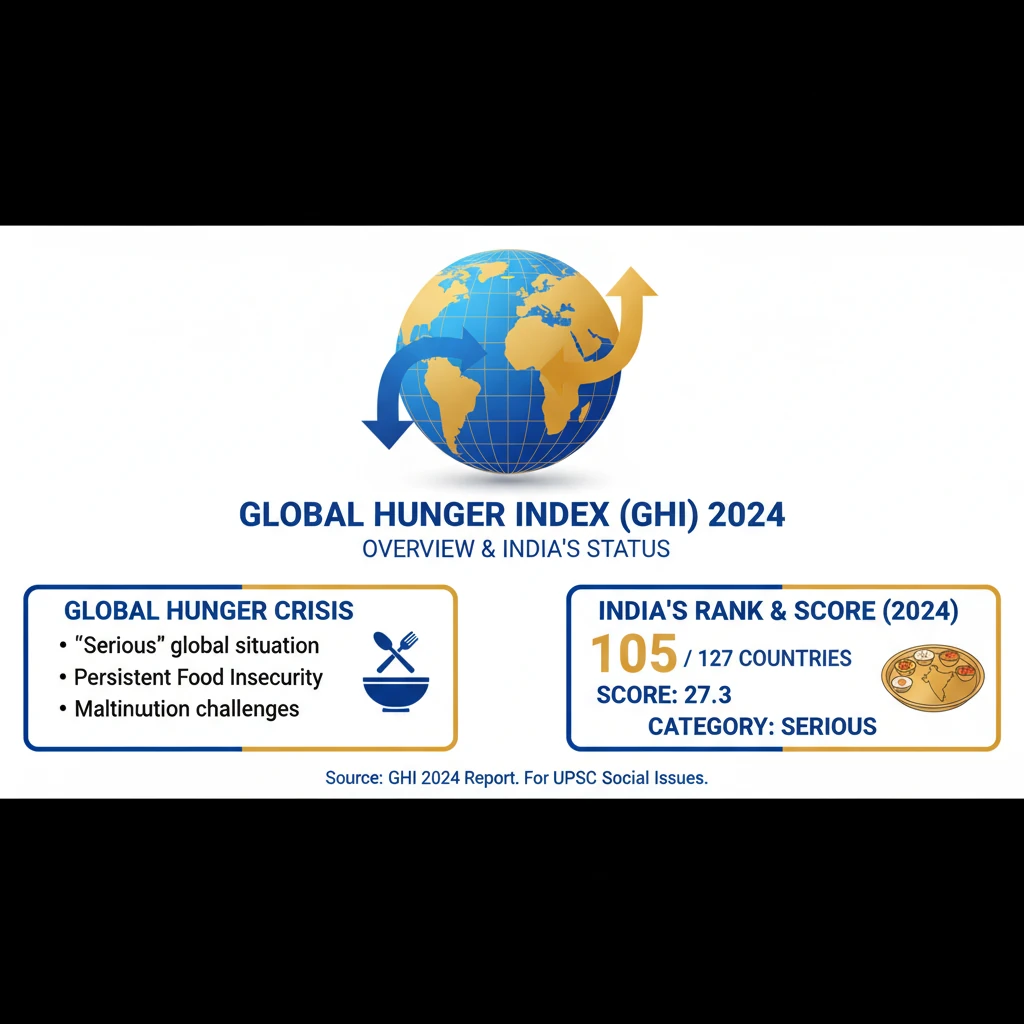
<h4>Overview of Global Hunger Index (GHI) 2024</h4><p>The <strong>Global Hunger Index (GHI) 2024</strong> report highlights a “serious” hunger crisis globally, driven by persistent challenges of <strong>food insecurity</strong> and <strong>malnutrition</strong>.</p><div class="info-box"><p><strong>India's Rank and Score:</strong> India is ranked <strong>105th</strong> out of <strong>127 countries</strong> in the GHI 2024. The country received a score of <strong>27.3</strong>, categorizing its hunger level as “serious.”</p></div><p>This ranking underscores the ongoing need for robust interventions to address nutritional deficiencies and food access across the nation.</p><h4>What is the Global Hunger Index (GHI)?</h4><p>The <strong>Global Hunger Index (GHI)</strong> is an annual, peer-reviewed report that comprehensively measures and tracks hunger at global, regional, and national levels.</p><p>It reflects multiple dimensions of hunger over time, providing a critical tool for policymakers and humanitarian organizations.</p><div class="info-box"><p><strong>Publishing Bodies:</strong> The GHI is jointly published by <strong>Concern Worldwide</strong>, an international humanitarian organization, and <strong>Welthungerhilfe</strong>, a private aid organization based in Germany.</p></div><div class="info-box"><p><strong>Concern Worldwide:</strong> Focuses on addressing poverty and alleviating suffering in the world’s poorest countries.</p><p><strong>Welthungerhilfe:</strong> Founded in <strong>1962</strong> as the German branch of the “Freedom from Hunger Campaign.”</p></div><h4>GHI Score Calculation</h4><p>The <strong>GHI score</strong> is calculated on a <strong>100-point scale</strong>, designed to reflect the severity of hunger in a country.</p><div class="key-point-box"><p><strong>Score Interpretation:</strong> A score of <strong>0</strong> represents the best possible outcome (implying no hunger), while a score of <strong>100</strong> indicates the worst possible scenario (extreme hunger).</p></div><h4>Four Component Indicators of GHI</h4><p>The GHI score is derived from <strong>four equally weighted component indicators</strong> that capture different aspects of hunger and malnutrition:</p><ul><li><strong>Undernourishment:</strong> This indicator measures the <strong>share of the population</strong> whose <strong>calorie intake is insufficient</strong> to sustain a healthy life. It is defined by the <strong>Food and Agriculture Organization of the United Nations (FAO)</strong>.</li><li><strong>Child Stunting:</strong> This refers to the proportion of <strong>children under the age of five</strong> who have <strong>low height for their age</strong>. It is a reflection of <strong>chronic undernutrition</strong>, indicating long-term deprivation.</li><li><strong>Child Wasting:</strong> This measures the share of <strong>children under the age of five</strong> who have <strong>low weight for their height</strong>. It signifies <strong>acute undernutrition</strong>, often resulting from recent and severe food deprivation or disease.</li><li><strong>Child Mortality:</strong> This indicator represents the <strong>share of children who die before their fifth birthday</strong>. It reflects, in part, the fatal combination of inadequate nutrition and unhealthy environments.</li></ul><h4>Key Findings of GHI 2024</h4><p>The <strong>GHI 2024 report</strong> presents specific findings for India and outlines broader global trends in hunger.</p><div class="info-box"><p><strong>India-Specific Findings (2024):</strong></p><ul><li><strong>GHI Score:</strong> <strong>27.3</strong> (categorized as “serious”).</li><li><strong>Improvement:</strong> Slightly improved from <strong>28.7</strong> in <strong>2023</strong> (also “serious”).</li><li><strong>Undernourishment:</strong> <strong>13.7%</strong> of children are undernourished.</li><li><strong>Child Stunting:</strong> <strong>35.5%</strong> of children are stunted.</li><li><strong>Child Wasting:</strong> <strong>18.7%</strong> of children are wasted (notably the <strong>highest globally</strong>).</li><li><strong>Child Mortality Rate:</strong> <strong>2.9%</strong>.</li></ul></div><div class="key-point-box"><p><strong>Global Trends in GHI 2024:</strong> The global GHI score for <strong>2024</strong> is <strong>18.3</strong>, a slight improvement from <strong>18.8</strong> in <strong>2016</strong>. This global score is considered “moderate.”</p></div><p>Notably, India's <strong>South Asian neighbours</strong>, including <strong>Bangladesh</strong>, <strong>Nepal</strong>, and <strong>Sri Lanka</strong>, perform better and are categorized in the “moderate” hunger category.</p><h4>India's Commitment to Eliminate TB</h4><p>While distinct from GHI, the source material mentions India's commitment to eliminating <strong>Tuberculosis (TB)</strong>, which is related to public health and nutrition.</p><div class="info-box"><p><strong>SDG Target 3.3:</strong> India is committed to eliminating <strong>TB by 2025</strong>, five years ahead of the global deadline of <strong>2030</strong>, as part of its <strong>Sustainable Development Goals (SDGs)</strong> commitments.</p></div><p>This ambitious goal reflects a national priority to improve public health outcomes.</p><div class="key-point-box"><p><strong>Key Goals for TB Elimination:</strong></p><ul><li><strong>80% reduction</strong> in <strong>TB incidence</strong> from <strong>2015</strong> levels.</li><li><strong>90% reduction</strong> in <strong>TB mortality</strong> from <strong>2015</strong> levels.</li><li>Elimination of <strong>catastrophic health costs</strong> for <strong>TB-affected households</strong>.</li></ul></div><p>This commitment has been reiterated at various high-level forums and through international declarations.</p><div class="info-box"><p><strong>High-Level Initiatives:</strong></p><ul><li><strong>“End TB Summit” (2018)</strong></li><li><strong>“One World TB Summit” (2023)</strong></li><li>India's signing of the <strong>Gandhinagar Declaration</strong>, adopted at a meeting in <strong>Gandhinagar, Gujarat</strong>, to track progress on TB elimination in the South-East Asia Region.</li></ul></div><h4>India's Initiatives to Eliminate TB</h4><p>To achieve its TB elimination targets, India has launched several comprehensive programs and campaigns:</p><ul><li><strong>National Tuberculosis Elimination Programme (NTEP)</strong></li><li><strong>Pradhan Mantri TB Mukt Bharat Abhiyan</strong></li><li><strong>National Strategic Plan (NSP) for Tuberculosis Elimination (2017-2025)</strong></li><li><strong>TB Harega Desh Jeetega Campaign</strong></li><li><strong>Nikshay Poshan Yojana</strong></li></ul>
💡 Key Takeaways
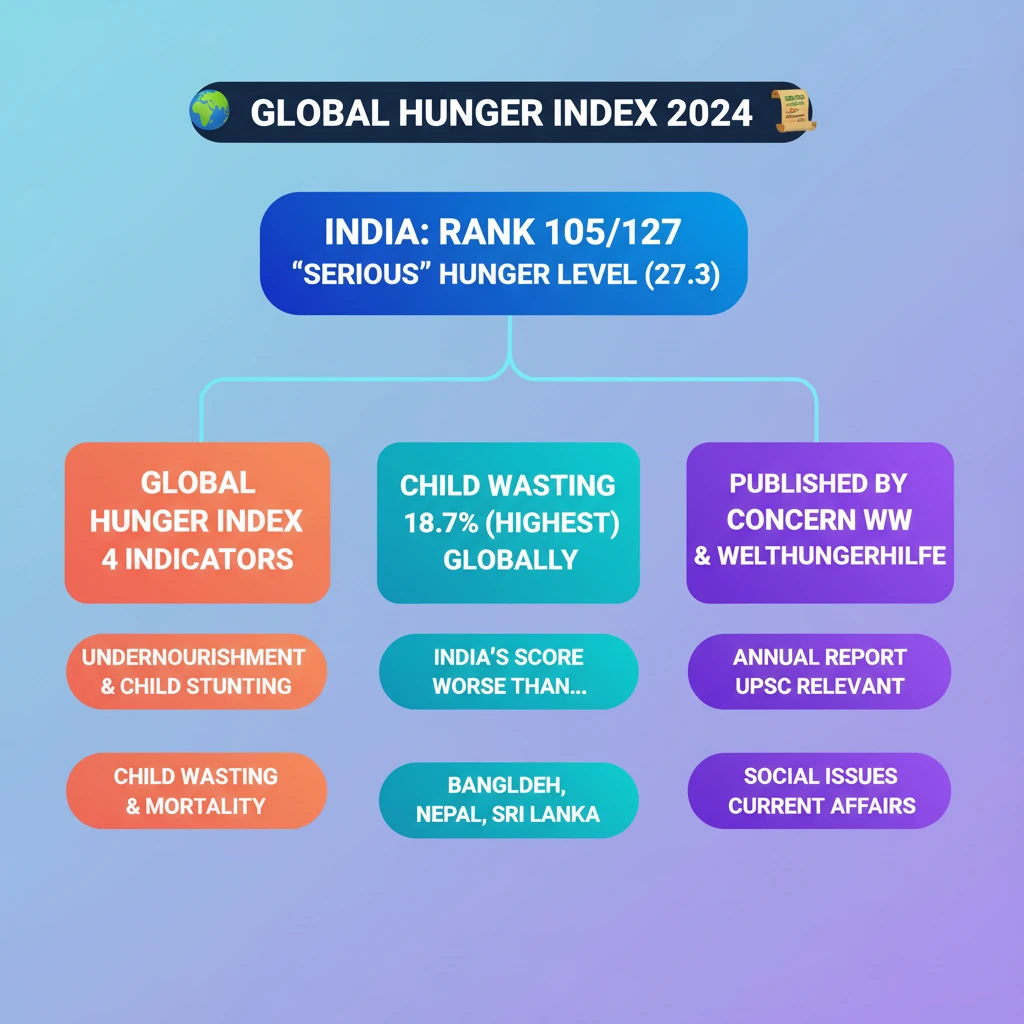
- •India ranks 105th out of 127 countries in GHI 2024 with a "serious" score of 27.3.
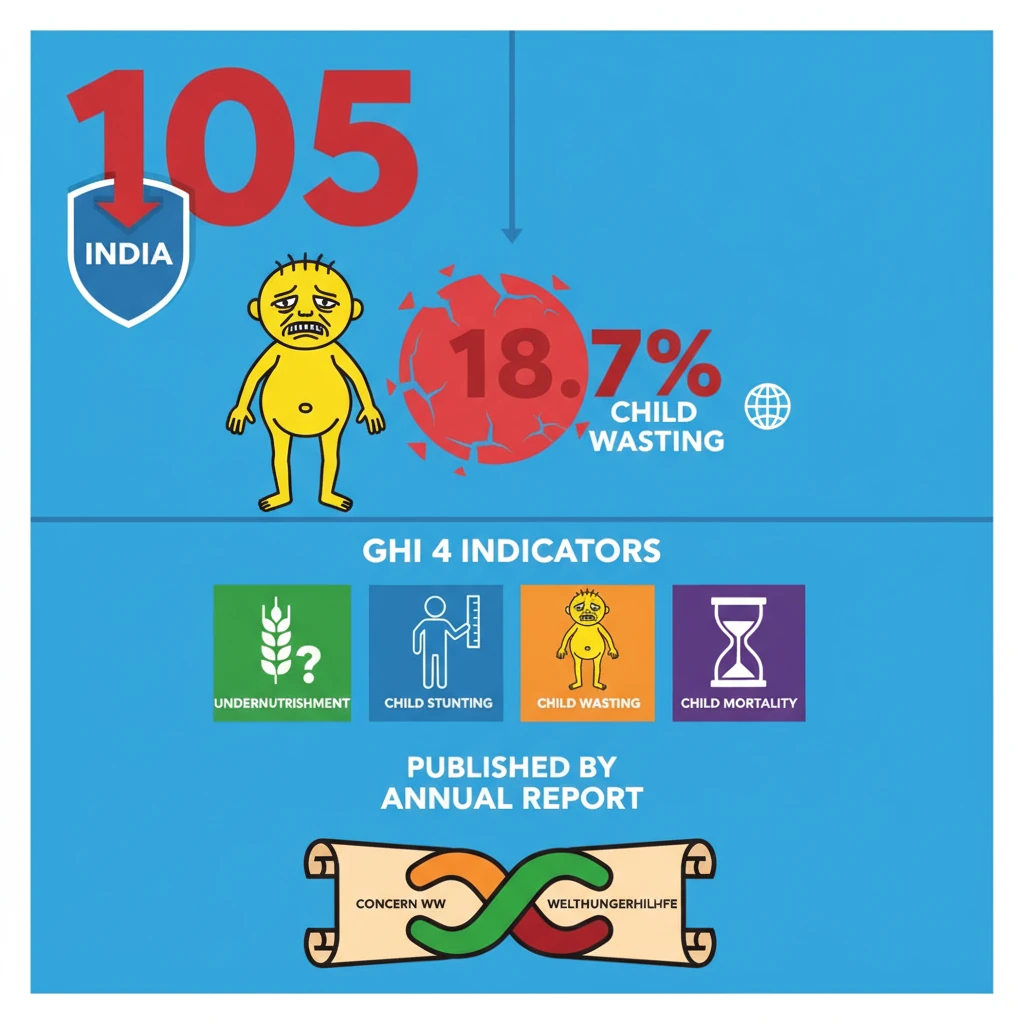
- •Child wasting at 18.7% is the highest globally for India, indicating acute undernutrition.
- •GHI uses four indicators: undernourishment, child stunting, child wasting, and child mortality.
- •The report is published annually by Concern Worldwide and Welthungerhilfe.
- •India's performance is worse than several South Asian neighbours like Bangladesh, Nepal, and Sri Lanka.
- •Addressing hunger is crucial for achieving India's SDG commitments and public health goals, including TB elimination.
🧠 Memory Techniques
95% Verified Content
📚 Reference Sources
•Concern Worldwide (GHI publisher)
•Welthungerhilfe (GHI publisher)
•Food and Agriculture Organization of the United Nations (FAO)