What is the Significance of the Swachh Bharat Mission (SBM)? - Social Issues | UPSC Learning
Topics
0 topics • 0 completed
🔍
No topics match your search
What is the Significance of the Swachh Bharat Mission (SBM)?
Medium⏱️ 7 min read
social issues
📖 Introduction
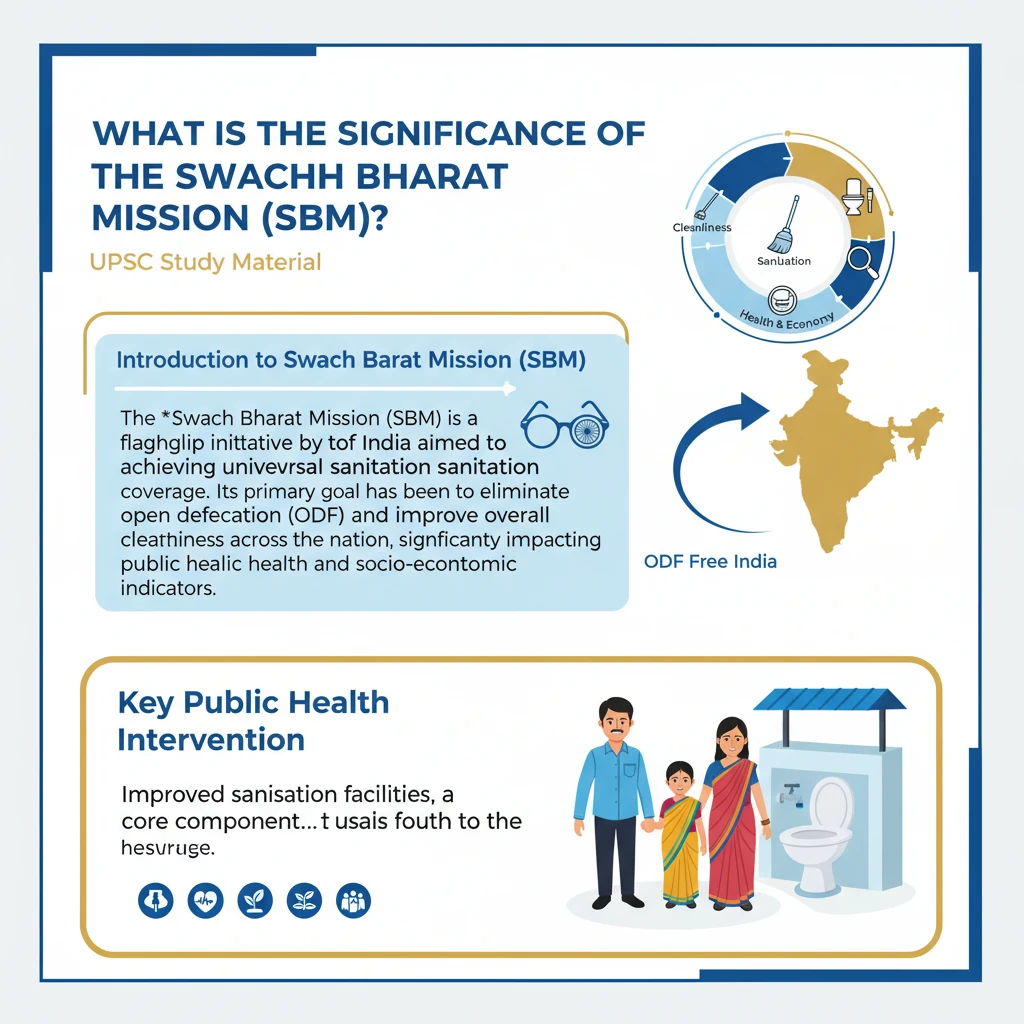
<h4>Introduction to Swachh Bharat Mission (SBM)</h4><p>The <strong>Swachh Bharat Mission (SBM)</strong> is a flagship initiative by the Government of India aimed at achieving universal sanitation coverage.</p><p>Its primary goal has been to eliminate <strong>open defecation (ODF)</strong> and improve overall cleanliness across the nation, significantly impacting public health and socio-economic indicators.</p><h4>Key Public Health Intervention</h4><p>Improved sanitation facilities, a core component of <strong>SBM</strong>, have been directly linked to substantial declines in <strong>Infant Mortality Rate (IMR)</strong> globally.</p><p>Historical trends in Western countries like the <strong>United States</strong> in the early <strong>1900s</strong> show similar positive correlations between sanitation and public health.</p><div class='key-point-box'><p>Research confirms that enhanced sanitation under <strong>SBM</strong> has been a critical factor in reducing both <strong>IMR</strong> and <strong>Under-5 Mortality Rate (U5MR)</strong> in India.</p></div><h4>Addressing the ‘Asian Enigma’</h4><p>The <strong>‘Asian Enigma’</strong> refers to the paradoxical situation where India experienced high rates of <strong>child stunting</strong> despite significant economic progress.</p><p>This enigma was often attributed to widespread <strong>open defecation</strong>, which contributed to poor hygiene and health outcomes among children.</p><div class='key-point-box'><p>The significant reduction in <strong>open defecation</strong> achieved through <strong>SBM</strong> directly addresses this enigma by improving overall sanitation.</p></div><p>This improvement is anticipated to have a profound, long-term impact on effectively reducing <strong>child stunting rates</strong> across the country.</p><h4>Significant Economic Benefits</h4><p>Investments in sanitation initiatives like <strong>SBM</strong> yield substantial economic returns, benefiting the nation on multiple fronts.</p><div class='info-box'><p>According to a <strong>UNICEF</strong> report, every <strong>rupee</strong> invested in <strong>Swachh Bharat Mission</strong> generates an impressive return of <strong>Rs. 4.3</strong>.</p></div><p>These economic gains stem from various factors, including significantly reduced healthcare costs and enhanced productivity among the population.</p><p>If <strong>SBM</strong> fully achieves its objective of eliminating <strong>open defecation</strong> and ensuring improved sanitation, the associated damage costs would drastically decrease.</p><div class='info-box'><p>The total damage costs are projected to be reduced to just <strong>2.7% of GDP</strong>, resulting in an estimated saving of <strong>Rs 8.1 trillion</strong> from the current situation.</p></div>
💡 Key Takeaways
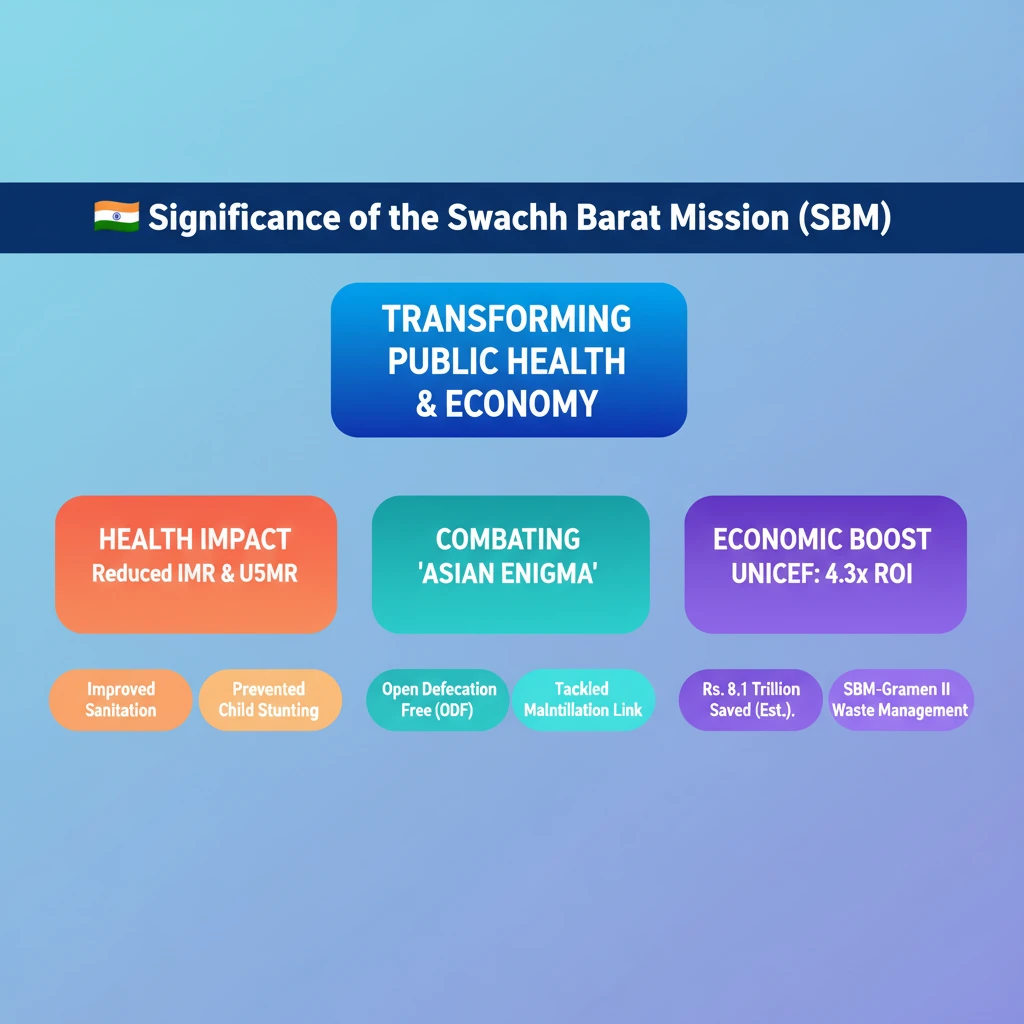
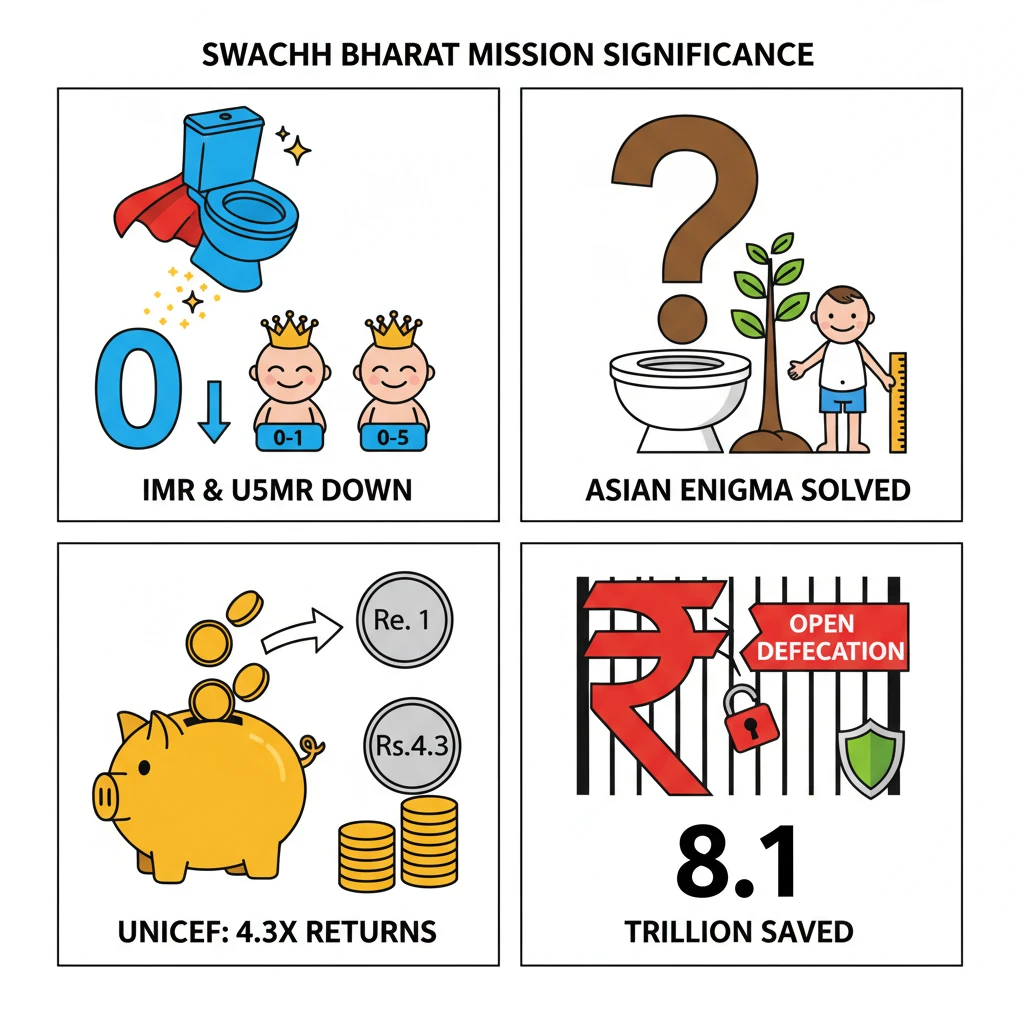
- •SBM significantly reduced Infant Mortality Rate (IMR) and Under-5 Mortality Rate (U5MR) by improving sanitation.
- •It addressed the 'Asian Enigma' by tackling widespread open defecation and its link to child stunting.
- •SBM generated substantial economic returns, with a UNICEF report stating Rs. 4.3 for every Re. 1 invested.
- •The mission aimed to eliminate open defecation, potentially saving Rs 8.1 trillion by reducing damage costs to 2.7% of GDP.
- •SBM continues with SBM-Grameen Phase II, focusing on sustaining ODF status and comprehensive solid and liquid waste management (ODF+).
🧠 Memory Techniques
95% Verified Content
📚 Reference Sources
•UNICEF Report on SBM (as referenced in source material)