Building An Inclusive Society Through SMILE - Social Issues | UPSC Learning
Topics
0 topics • 0 completed
🔍
No topics match your search
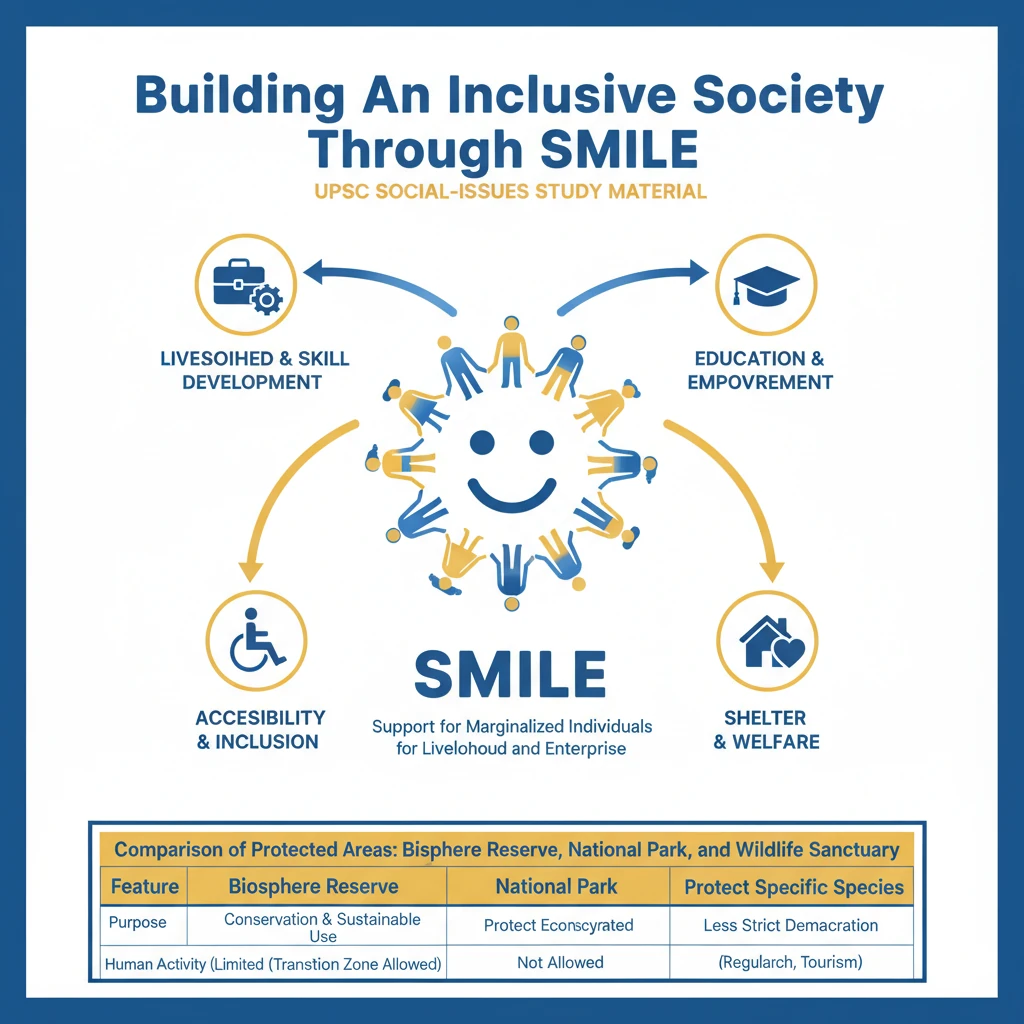
Building An Inclusive Society Through SMILE
Medium⏱️ 8 min read
social issues
📖 Introduction
<h4>Comparison of Protected Areas: Biosphere Reserve, National Park, and Wildlife Sanctuary</h4><p>The provided source material included a comparison of different types of protected areas. While not directly related to the <strong>SMILE Scheme</strong>, this information is retained as per the instruction to include all content.</p><div class='info-box'><table class='info-table'><tr><th>Feature</th><th>Biosphere Reserve</th><th>National Park</th><th>Wildlife Sanctuary</th></tr><tr><td><strong>Purpose</strong></td><td>Promote <strong>sustainable development</strong>, conserve <strong>biodiversity</strong>, <strong>cultural heritage</strong>, and <strong>natural resources</strong>.</td><td>Conserve <strong>natural environment</strong>, protect from <strong>human interference</strong>.</td><td>Protect <strong>habitats of wild animals</strong>, promote <strong>breeding</strong>.</td></tr><tr><td><strong>Management</strong></td><td>Internationally recognized under <strong>UNESCO’s Man and Biosphere (MAB) program</strong> and owned by the <strong>government</strong>.</td><td><strong>Government</strong> has complete power over the <strong>national parks</strong>.</td><td>Can be under the <strong>government</strong> or owned under <strong>private entities</strong>.</td></tr><tr><td><strong>Zones</strong></td><td><strong>Core zone</strong> (strict protection), <strong>Buffer zone</strong> (limited human activities allowed), <strong>Transition zone</strong> (sustainable development encouraged).</td><td>Typically not divided into <strong>zones</strong>.</td><td>Generally not divided into <strong>zones</strong>.</td></tr><tr><td><strong>Human Activities</strong></td><td>Restricted in <strong>core zone</strong>, limited in <strong>buffer zone</strong>, encouraged in <strong>transition zone</strong>.</td><td>Restricted, mainly for <strong>recreational purposes</strong>.</td><td>Restricted to prevent disturbance to <strong>animals</strong>, limited <strong>educational access</strong>.</td></tr><tr><td><strong>Examples</strong></td><td><strong>Nanda Devi</strong> (Uttarakhand), <strong>Nokrek</strong> (Meghalaya).</td><td><strong>Jim Corbett</strong> (Uttarakhand), <strong>Bandhavgarh</strong> (Madhya Pradesh).</td><td><strong>Gir National Park</strong> (Gujarat), <strong>Chilka Lake Bird Sanctuary</strong> (Odisha).</td></tr></table></div><h4>Building An Inclusive Society Through SMILE</h4><p>In <strong>2021</strong>, the <strong>Support for Marginalised Individuals for Livelihood and Enterprise (SMILE) scheme</strong> was launched. This initiative aims to advance the vision of <strong>Viksit Bharat</strong>, focusing on the welfare of marginalized communities.</p><p>A key component of <strong>SMILE</strong> was the introduction of the <strong>Central Sector Scheme for Comprehensive Rehabilitation for the Welfare of Transgender Persons</strong>.</p><h4>Who is a Transgender Person?</h4><p>According to the <strong>Transgender Persons (Protection of Rights) Act, 2019</strong>, a <strong>transgender person</strong> is defined as an individual whose gender does not align with the gender assigned at birth.</p><div class='info-box'><p>This definition is comprehensive, encompassing:</p><ul><li><strong>Trans-persons with intersex variations</strong></li><li><strong>Gender-queer individuals</strong></li><li>Persons with socio-cultural identities such as <strong>kinnar</strong>, <strong>hijra</strong>, <strong>aravani</strong>, and <strong>jogta</strong>.</li></ul></div><p>The <strong>2011 Census of India</strong> was a landmark event, being the first in the nation's history to enumerate the '<strong>trans</strong>' population. It estimated that approximately <strong>4.8 million Indians</strong> identified as <strong>transgender</strong>.</p><h4>What is the SMILE Scheme?</h4><p>The <strong>SMILE scheme</strong> is a new, integrated initiative formed by merging existing welfare schemes for <strong>beggars</strong> and <strong>transgender persons</strong>. It represents a consolidated effort towards social inclusion.</p><div class='key-point-box'><p><strong>SMILE</strong> comprises two primary sub-schemes:</p><ol><li><strong>Central Sector Scheme for Comprehensive Rehabilitation for Welfare of Transgender Persons</strong></li><li><strong>Central Sector Scheme for Comprehensive Rehabilitation of persons engaged in the act of Begging</strong></li></ol><p>These sub-schemes are designed to provide extensive welfare and rehabilitation measures to both the <strong>transgender community</strong> and individuals engaged in <strong>begging</strong>.</p></div><h4>Focus Areas of SMILE</h4><p>The scheme's focus is broad and holistic, addressing multiple facets of rehabilitation and empowerment for marginalized individuals. It aims to provide a life of dignity.</p><ul><li><strong>Rehabilitation</strong> and provision of <strong>medical facilities</strong>.</li><li><strong>Counselling</strong> and assistance with <strong>basic documentation</strong>.</li><li>Support for <strong>education</strong> and <strong>skill development</strong>.</li><li>Facilitation of <strong>economic linkages</strong> for sustainable livelihoods.</li></ul><div class='info-box'><p>It is estimated that approximately <strong>60,000 of the poorest persons</strong> will benefit from the <strong>SMILE scheme</strong>.</p></div><p><strong>SMILE</strong> also includes provisions for <strong>scholarships</strong> for <strong>Transgender Students</strong>. These scholarships are available for students from <strong>Class 9th</strong> onwards, extending up to <strong>post-graduation</strong>, to ensure they can complete their education.</p><p>For <strong>skill development and livelihood</strong>, the scheme leverages the existing <strong>PM-DAKSH scheme</strong>, providing opportunities for vocational training and economic integration.</p><p>A crucial component is <strong>Composite Medical Health</strong>, which offers a comprehensive package in convergence with <strong>Pradhan Mantri Jan Arogya Yojana (PM-JAY)</strong>. This includes support for <strong>Gender-reaffirmation surgeries</strong> through selected hospitals, ensuring access to essential healthcare.</p><p>The scheme also provides <strong>housing facilities</strong> through <strong>‘Garima Greh’</strong>. These homes ensure food, clothing, recreational facilities, skill development opportunities, and medical support for both the <strong>transgender community</strong> and individuals engaged in <strong>begging</strong>.</p><h4>Implementation Strategy</h4><p>The <strong>SMILE scheme</strong> is implemented through a collaborative approach involving various stakeholders. This ensures wider reach and effective service delivery.</p><ul><li><strong>State/UT Governments</strong> and <strong>Local Urban Bodies</strong>.</li><li><strong>Voluntary Organizations</strong> and <strong>Community Based Organizations (CBOs)</strong>.</li><li>Other relevant <strong>Institutions</strong>.</li></ul><p>A dedicated <strong>Transgender Protection Cell</strong> will be established in each state. This cell will monitor cases of offenses against transgender persons, ensuring timely registration, investigation, and prosecution.</p><p>A <strong>National Portal & Helpline</strong> is also part of the scheme. It provides necessary information and solutions to the <strong>transgender community</strong> and individuals engaged in <strong>begging</strong>, offering crucial support when needed.</p><h4>Pilot Implementation and Funding</h4><p>The sub-scheme for <strong>Comprehensive Rehabilitation of Transgenders</strong> has been implemented on a pilot basis in selected cities. These cities were chosen due to their large concentrations of the <strong>beggar</strong> and <strong>Transgender community</strong>.</p><div class='info-box'><p>In the financial year <strong>2019-20</strong>, the Ministry released:</p><ul><li><strong>Rs. 1 crore</strong> to the <strong>National Institute of Social Defence (NISD)</strong>.</li><li><strong>Rs. 70 Lakh</strong> to the <strong>National Backward Classes Finance & Development Corporation (NBCFDC)</strong>.</li></ul><p>These funds were specifically allocated for <strong>skill development programmes for beggars</strong>, demonstrating early efforts towards their rehabilitation.</p></div>
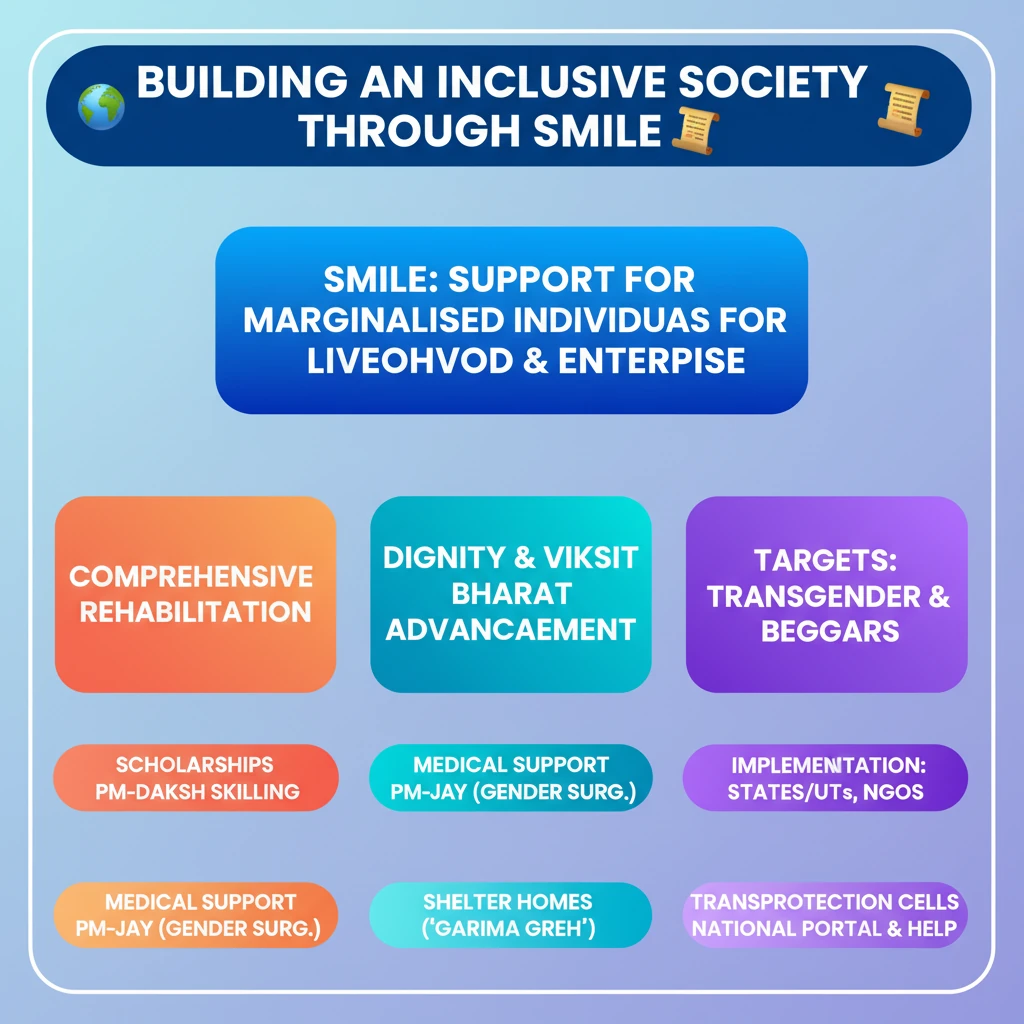
💡 Key Takeaways
- •SMILE (Support for Marginalised Individuals for Livelihood and Enterprise) scheme was launched in 2021 for transgender persons and beggars.
- •It aims for comprehensive rehabilitation, promoting dignity and advancing Viksit Bharat.
- •The scheme merges existing welfare programs and has two sub-schemes for transgender persons and those engaged in begging.
- •Key provisions include scholarships, skill development (via PM-DAKSH), medical support (via PM-JAY, including gender-reaffirmation surgeries), and shelter homes ('Garima Greh').
- •Implementation involves State/UTs, NGOs, and includes Transgender Protection Cells and a National Portal & Helpline.
- •The 2011 Census first enumerated transgender population; the Transgender Persons Act, 2019, provides legal framework.
🧠 Memory Techniques
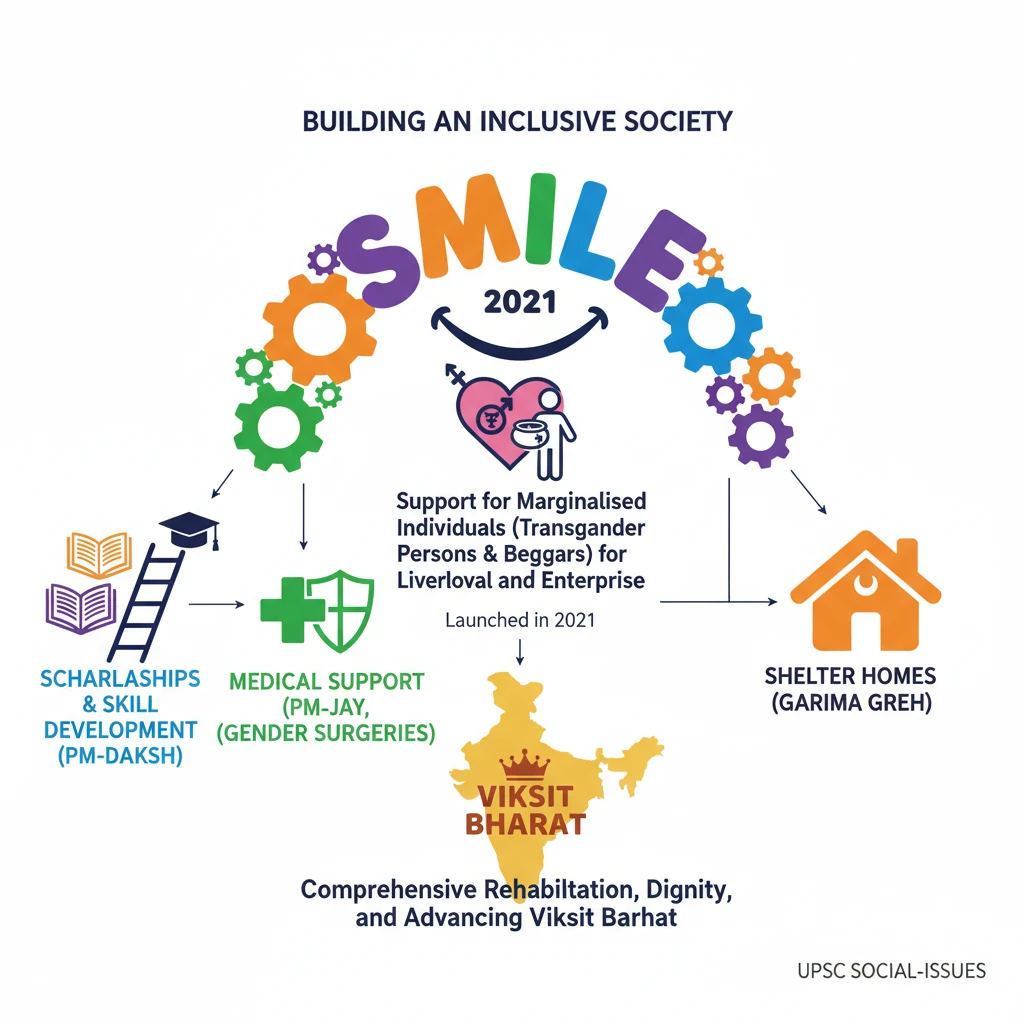
98% Verified Content
📚 Reference Sources
•Ministry of Social Justice and Empowerment (MSJE) official documents on SMILE Scheme
•The Transgender Persons (Protection of Rights) Act, 2019
•Press Information Bureau (PIB) releases on SMILE Scheme
•UNESCO Man and the Biosphere (MAB) Programme for protected area definitions