Health, Nutrition & Education - Social Issues | UPSC Learning
Topics
0 topics • 0 completed
🔍
No topics match your search
Health, Nutrition & Education
Medium⏱️ 15 min read
social issues
📖 Introduction
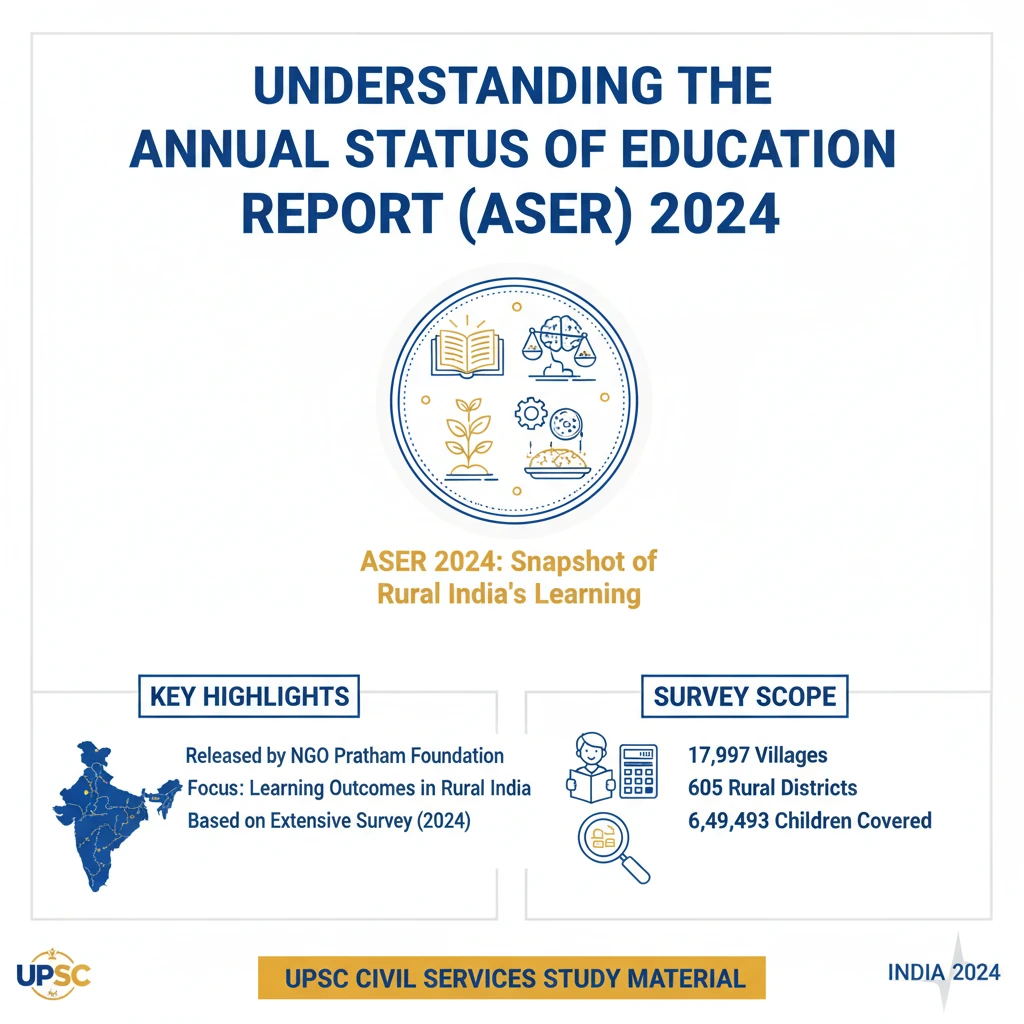
<h4>Understanding the Annual Status of Education Report (ASER) 2024</h4><p>The <strong>Annual Status of Education Report (ASER) 2024</strong>, released by the NGO <strong>Pratham Foundation</strong>, provides a crucial snapshot of learning outcomes among school students in <strong>rural India</strong>.</p><p>This report is based on an extensive survey conducted in <strong>17,997 villages</strong> across <strong>605 rural districts</strong> in <strong>2024</strong>. It covered <strong>6,49,493 children</strong> aged <strong>3-16 years</strong> and assessed the basic reading and arithmetic skills of over <strong>500,000 children</strong> aged <strong>5-16 years</strong>.</p><div class='info-box'><h5>What is ASER?</h5><ul><li><strong>About:</strong> ASER is a <strong>nationwide, citizen-led household survey</strong> that offers an insightful snapshot of children’s schooling and learning in rural India.</li><li><strong>Launch:</strong> It was launched in <strong>2005</strong> and has since tracked educational trends and challenges, evolving in its coverage, focus, and frequency.</li></ul></div><h4>Key Focus Areas of ASER</h4><ul><li><strong>Enrollment:</strong> ASER meticulously tracks <strong>school and preschool enrollment trends</strong>, highlighting improvements and challenges across different states and age groups.</li><li><strong>Learning Outcomes:</strong> It assesses fundamental <strong>reading and arithmetic skills</strong>, demonstrating children's progress at both primary and secondary levels.</li><li><strong>Digital Literacy:</strong> The <strong>ASER 2024</strong> report specifically evaluates older children’s <strong>smartphone skills</strong>, including practical tasks like creating albums, browsing, and messaging.</li></ul><h4>Key Findings of ASER 2024 Report</h4><p><strong>Pre-primary (Age Group 3-5 Years):</strong> Enrollment in pre-primary institutions (<strong>Anganwadi</strong>, government pre-primary classes, or private LKG/UKG) has shown a consistent increase since <strong>2018</strong>.</p><div class='info-box'><ul><li><strong>Enrollment Rise:</strong> For instance, the enrollment of <strong>3-year-olds</strong> rose significantly from <strong>68.1%</strong> in <strong>2018</strong> to <strong>77.4%</strong> in <strong>2024</strong>.</li><li><strong>Main Provider:</strong> <strong>Anganwadi centres</strong> remain the primary provider of pre-primary education, enrolling over half of <strong>3-4-year-olds</strong>.</li><li><strong>Private Sector:</strong> Approximately one-third of <strong>5-year-olds</strong> attend private schools or preschools.</li></ul></div><p><strong>Elementary (Age Group 6-14 Years):</strong> While overall enrollment saw a slight dip, there were notable shifts in learning outcomes.</p><div class='info-box'><ul><li><strong>Overall Enrollment:</strong> Slightly decreased from <strong>98.4%</strong> in <strong>2022</strong> to <strong>98.1%</strong> in <strong>2024</strong>.</li><li><strong>Government School Enrollment:</strong> Declined from <strong>72.9%</strong> to <strong>66.8%</strong>.</li></ul></div><p>In terms of skills, <strong>arithmetic abilities</strong> showed more improvement than reading skills, with government schools making faster progress.</p><div class='key-point-box'><ul><li><strong>Reading Skills (Std III):</strong> <strong>23.4%</strong> of <strong>Standard III</strong> children in government schools could read <strong>Std II-level text</strong> in <strong>2024</strong>, an increase from <strong>16.3%</strong> in <strong>2022</strong>.</li><li><strong>Arithmetic Skills (Std VIII):</strong> <strong>45.6%</strong> of <strong>Std VIII</strong> students could solve basic arithmetic problems in <strong>2024</strong>, indicating a slight improvement.</li></ul></div><p><strong>Older Children (Age Group 15-16 Years):</strong> The report highlights positive trends in enrollment and increasing smartphone access.</p><div class='info-box'><ul><li><strong>Dropout Rate Decrease:</strong> The dropout rate for <strong>15-16-year-olds</strong> decreased from <strong>13.1%</strong> in <strong>2018</strong> to <strong>7.9%</strong> in <strong>2024</strong>.</li><li><strong>Gender Disparity:</strong> Girls still showed a slightly higher dropout rate at <strong>8.1%</strong>.</li></ul></div><p><strong>Smartphone Access and Usage (Digital Literacy):</strong> Digital literacy is becoming increasingly prevalent among older children.</p><div class='info-box'><ul><li><strong>Access:</strong> Nearly <strong>90%</strong> of <strong>14-16-year-olds</strong> have smartphone access, with boys (<strong>85.5%</strong>) using them more than girls (<strong>79.4%</strong>).</li><li><strong>Ownership:</strong> <strong>27%</strong> of <strong>14-year-olds</strong> and <strong>37.8%</strong> of <strong>16-year-olds</strong> own smartphones.</li><li><strong>Usage:</strong> <strong>82.2%</strong> of children use smartphones, with <strong>57%</strong> for education and <strong>76%</strong> for social media.</li><li><strong>Digital Safety:</strong> <strong>62%</strong> of children know how to block/report profiles, and <strong>55.2%</strong> know how to make profiles private.</li></ul></div><p><strong>School Observations:</strong> Improvements were noted in various aspects of school functioning and facilities.</p><ul><li><strong>Foundational Literacy and Numeracy (FLN):</strong> Over <strong>80%</strong> of schools implemented <strong>FLN activities</strong>, and <strong>75%</strong> of these schools had at least one teacher who received <strong>FLN training</strong>.</li><li><strong>Attendance:</strong> Student attendance increased from <strong>72.1%</strong> in <strong>2018</strong> to <strong>75.8%</strong> in <strong>2024</strong>, while teacher attendance rose from <strong>85.1%</strong> to <strong>87.5%</strong>.</li><li><strong>School Facilities:</strong> There were slight improvements in basic school facilities:<ul><li>Usable girls’ toilets increased from <strong>66.4%</strong> in <strong>2018</strong> to <strong>72%</strong> in <strong>2024</strong>.</li><li>Drinking water availability rose from <strong>74.8%</strong> to <strong>77.7%</strong>.</li><li>The use of <strong>non-textbook books</strong> (e.g., novels, short stories) by students increased from <strong>36.9%</strong> to <strong>51.3%</strong>.</li><li>The percentage of schools with <strong>playgrounds</strong> remained stable at around <strong>66%</strong>.</li></ul></li></ul><p><strong>State-Level Differences in Outcomes:</strong> The report highlighted significant variations in learning outcomes and improvement across states, particularly in the post-<strong>Covid-19 pandemic</strong> period.</p><div class='key-point-box'><ul><li>In <strong>Std III</strong>, reading ability lagged behind <strong>2018 levels</strong> in over half the states, although arithmetic improved in all but six.</li><li>In <strong>Std V</strong> and <strong>Std VIII</strong>, many states did not reach pre-pandemic levels, even in arithmetic.</li></ul></div><h4>Understanding Elementary Education</h4><p><strong>Elementary Education</strong> forms the fundamental bedrock of the entire educational system, typically commencing around the age of <strong>six</strong>.</p><div class='info-box'><p><strong>Definition:</strong> It marks the beginning of <strong>formal education</strong> and is crucial for a child’s holistic development, encompassing their <strong>physical, mental, emotional, intellectual, and social growth</strong>.</p></div><h5>Significance of Elementary Education</h5><ul><li><strong>Foundation for Future Learning:</strong> It imparts core skills such as <strong>reading, writing, mathematics, and problem-solving</strong>, which are essential for higher education and future careers.</li><li><strong>Development of Social Skills:</strong> Children learn <strong>teamwork, communication, and empathy</strong> through interactions with peers and teachers.</li><li><strong>Personal and Emotional Growth:</strong> It helps build <strong>self-confidence and motivation</strong>, enabling children to explore their potential and creativity.</li><li><strong>Promotion of Motor Skills:</strong> Activities like <strong>sports and creative expression</strong> aid in the development of both fine and gross motor skills.</li><li><strong>Building Social Awareness:</strong> Children are introduced to concepts of <strong>hygiene, social responsibilities, and civic duties</strong>, fostering informed future citizens.</li><li><strong>Long-Term Economic Impact:</strong> Robust investment in elementary education is a key driver of <strong>economic growth, innovation, and productivity</strong>.</li></ul><h5>Challenges in Elementary Education</h5><p>Despite progress, several significant challenges persist in the elementary education sector.</p><ul><li><strong>Poor School Infrastructure:</strong><ul><li>Of over <strong>14.71 lakh schools</strong> in India, <strong>1.52 lakh</strong> lack functional electricity, impeding the use of technology.</li><li><strong>62,000 schools</strong>, including <strong>46,000 government-run</strong>, lack functional toilets.</li><li>Only <strong>3.37 lakh government schools (33.2%)</strong> have disabled-friendly toilets, with less than a third being functional.</li></ul></li><li><strong>Limited Access to Technology:</strong> Only <strong>43.5%</strong> of government schools have computers for teaching, significantly lower than <strong>70.9%</strong> in privately aided schools.</li><li><strong>Poor Teacher-Student Ratio:</strong> India has nearly <strong>1 lakh schools</strong> with just one teacher each, impacting quality of instruction.</li><li><strong>Social Divides:</strong> Disparities based on <strong>caste-class, rural-urban, religious, and gender</strong> continue to affect educational quality.</li><li><strong>Language Barriers:</strong> A lack of textbooks and materials in <strong>regional languages</strong> limits education access for non-Hindi/English speakers.</li></ul><div class='exam-tip-box'><h4>UPSC Insight: Connecting ASER to Policy</h4><p>The findings of <strong>ASER reports</strong> are critical for UPSC aspirants. They provide empirical data to support arguments on the state of education, challenges, and the effectiveness of government schemes. When discussing <strong>GS-II Social Justice (Education)</strong>, referencing ASER data can significantly enhance your answer's credibility and analytical depth. Be prepared to cite specific statistics for mains answers.</p></div><h4>Government Initiatives Related to Education</h4><p>India has launched several flagship programs to address educational challenges and promote learning outcomes.</p><ul><li><strong>National Programme on Technology Enhanced Learning (NPTEL)</strong></li><li><strong>Sarva Shiksha Abhiyan (SSA)</strong></li><li><strong>PRAGYATA Guidelines</strong></li><li><strong>Mid Day Meal Scheme (PM-POSHAN)</strong></li><li><strong>Beti Bachao Beti Padhao</strong></li><li><strong>PM SHRI Schools</strong></li><li><strong>National Education Policy (NEP) 2020</strong></li></ul><h4>Global Nutrition Targets (GNTs) and India's Progress</h4><p>A recent <strong>Lancet study</strong> evaluated global progress on <strong>Global Nutrition Targets (GNTs)</strong> from <strong>2012 to 2021</strong>, revealing slow progress in tackling maternal and child malnutrition.</p><p>This study highlighted persistent issues of <strong>undernutrition</strong>, <strong>overweight</strong>, and other forms of malnutrition worldwide.</p><div class='info-box'><h5>What are Global Nutrition Targets?</h5><p>The <strong>World Health Assembly (WHA) Resolution</strong> in <strong>2012</strong> endorsed a Comprehensive Implementation Plan on maternal, infant, and young child nutrition. This plan established <strong>six global nutrition targets</strong> to be achieved by <strong>2025</strong>.</p></div><h4>The Six Global Nutrition Targets (GNTs)</h4><ol><li>Achieve a <strong>40% reduction</strong> in the number of children under-5 who are <strong>stunted</strong>.</li><li>Achieve a <strong>50% reduction</strong> in <strong>anaemia</strong> in women of reproductive age.</li><li>Achieve a <strong>30% reduction</strong> in <strong>low birth weight</strong>.</li><li>Ensure that there is <strong>no increase</strong> in <strong>childhood overweight</strong>.</li><li>Increase the rate of <strong>exclusive breastfeeding</strong> in the first 6 months to at least <strong>50%</strong>.</li><li>Reduce and maintain <strong>childhood wasting</strong> to less than <strong>5%</strong>.</li></ol><h4>Key Terms in Nutrition</h4><div class='info-box'><ul><li><strong>Malnutrition:</strong> An imbalance between the nutrients the body needs and the nutrients it receives. It encompasses both <strong>undernutrition</strong> (stunting, wasting, underweight) and <strong>overnutrition</strong> (overweight and obesity), creating a dual burden on public health.</li><li><strong>Anaemia:</strong> A condition characterized by low red blood cells or haemoglobin, which reduces oxygen supply to tissues. It predominantly affects women and children.</li></ul></div><h4>Key Findings of the Lancet Study on GNTs</h4><p><strong>Slow and Insufficient Progress:</strong> The study found that across <strong>204 countries</strong>, progress in meeting GNTs from <strong>2012 to 2021</strong> has been slow and insufficient. Projections up to <strong>2050</strong> show limited success.</p><div class='key-point-box'><ul><li>Few countries are expected to meet the targets for <strong>stunting</strong> in children under 5.</li><li>None of the countries are projected to meet targets for <strong>low birth weight, anaemia, and childhood overweight</strong> by <strong>2030</strong>.</li></ul></div><p><strong>Anaemia and India:</strong> India's fight against anaemia has seen minimal progress over two decades, with complex underlying causes.</p><ul><li><strong>Static Prevalence:</strong> Anaemia in India has remained largely static for <strong>two decades</strong>.</li><li><strong>Beyond Iron Deficiency:</strong> While <strong>iron deficiency</strong> is often assumed to be the sole cause, it accounts for only about <strong>one-third</strong> of anaemia cases. A significant portion (another third) is due to unknown causes.</li><li><strong>Impact of COVID-19:</strong> Anaemia prevalence increased during the <strong>Covid-19 lockdown</strong>, partly due to the cessation of school meals (<strong>Midday Meal Scheme</strong>), highlighting the need for a broader nutrition approach.</li><li><strong>Measurement Discrepancies:</strong> The study found discrepancies in anaemia measurements. In India, <strong>venous blood-based</strong> anaemia prevalence (WHO recommended) was half that of <strong>capillary blood-based</strong> prevalence in national surveys.</li></ul><p><strong>Stunting:</strong> Stunting is a critical issue that develops early in a child's life.</p><ul><li><strong>Early Onset:</strong> Stunting often develops within the <strong>first two years of life</strong>, increasing from <strong>7–8% at birth</strong> to <strong>40% by age two</strong> in India.</li><li><strong>Overfeeding Misconception:</strong> Overfeeding children after age 2 years may lead to them becoming overweight rather than correcting stunting.</li><li><strong>Fat Intake Deficiency:</strong> Indian children consume only <strong>17 grams of fat per day</strong>, significantly below the required <strong>30–40 grams</strong>.</li></ul><p><strong>Childhood Overweight:</strong> Childhood overweight is a growing global concern, including in India, leading to long-term health issues.</p><ul><li><strong>Global Increase:</strong> Overweight among children is increasing globally.</li><li><strong>Metabolic Overnutrition:</strong> A significant portion of Indian children (<strong>50%</strong>) face <strong>metabolic overnutrition</strong>, which contributes to chronic health problems like <strong>non-communicable diseases (NCDs)</strong>.</li></ul><h4>Recommendations for Addressing Malnutrition</h4><p>The Lancet study provided key recommendations for more effective interventions.</p><ul><li><strong>Diversify Diets:</strong> To address anaemia, diets need to be diversified, as it is not solely caused by iron deficiency.</li><li><strong>Early Stunting Prevention:</strong> Focus on preventing stunting specifically in the <strong>first two years of life</strong>.</li><li><strong>Improve Energy Intake:</strong> Enhance energy intake, particularly <strong>fat intake</strong>, for children under 3 years of age.</li><li><strong>Accurate Measurement:</strong> Adopt more accurate and context-specific methods for measuring <strong>anaemia and stunting</strong>.</li><li><strong>Holistic Policy:</strong> Address both <strong>undernutrition and overnutrition</strong> in policy frameworks to prevent non-communicable diseases.</li></ul><div class='exam-tip-box'><h4>UPSC Insight: Dual Burden of Malnutrition</h4><p>The concept of the <strong>"dual burden of malnutrition"</strong> (undernutrition and overnutrition coexisting) is a frequently tested topic in <strong>GS-II Social Justice (Health)</strong>. Understanding the nuances, such as discrepancies in anaemia measurement and the fat intake deficiency alongside rising childhood overweight, provides a comprehensive view for your answers. Always suggest multi-sectoral approaches in your solutions.</p></div><h4>India’s Initiatives Related to Nutrition</h4><p>The Indian government has implemented several schemes to combat malnutrition across various age groups.</p><ul><li><strong>Mission Poshan 2.0</strong></li><li><strong>Integrated Child Development Services (ICDS) Scheme</strong></li><li><strong>Pradhan Mantri Matru Vandana Yojana (PMMVY)</strong></li><li><strong>Mid-Day Meal Scheme (now PM-POSHAN)</strong></li><li><strong>Scheme for Adolescent Girls (SAG)</strong></li><li><strong>Mother’s Absolute Affection (MAA)</strong></li><li><strong>Poshan Vatikas</strong></li></ul>
💡 Key Takeaways
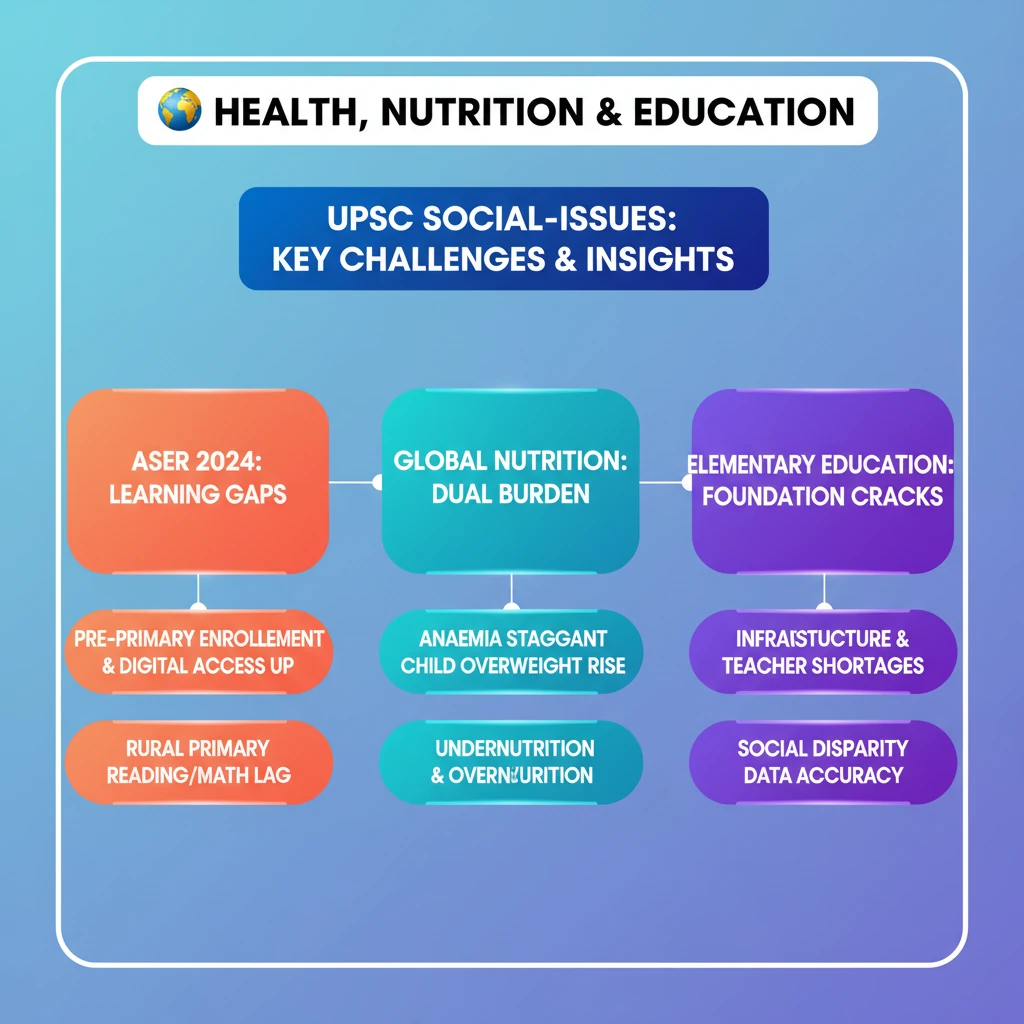
- •ASER 2024 highlights improving pre-primary enrollment and digital access but persistent learning gaps in rural elementary education.
- •Global Nutrition Targets (GNTs) show slow worldwide progress, with India facing static anaemia rates and rising childhood overweight.
- •Elementary education is foundational for holistic development but suffers from infrastructure, teacher, and social disparity challenges.
- •Malnutrition presents a dual burden: undernutrition (stunting, wasting) alongside overnutrition (obesity, metabolic overnutrition).
- •Accurate data (e.g., venous vs. capillary blood for anaemia) is crucial for effective policy formulation and intervention.
- •Government initiatives like NEP 2020, Mission Poshan 2.0, and PM SHRI schools are key to addressing these intertwined issues.
🧠 Memory Techniques
95% Verified Content
📚 Reference Sources
•Pratham Foundation - Annual Status of Education Report (ASER) 2024
•World Health Organization (WHO) - Global Nutrition Targets