What is the State of HIV Infection in India? - Social Issues | UPSC Learning
Topics
0 topics • 0 completed
🔍
No topics match your search
What is the State of HIV Infection in India?
Medium⏱️ 7 min read
social issues
📖 Introduction
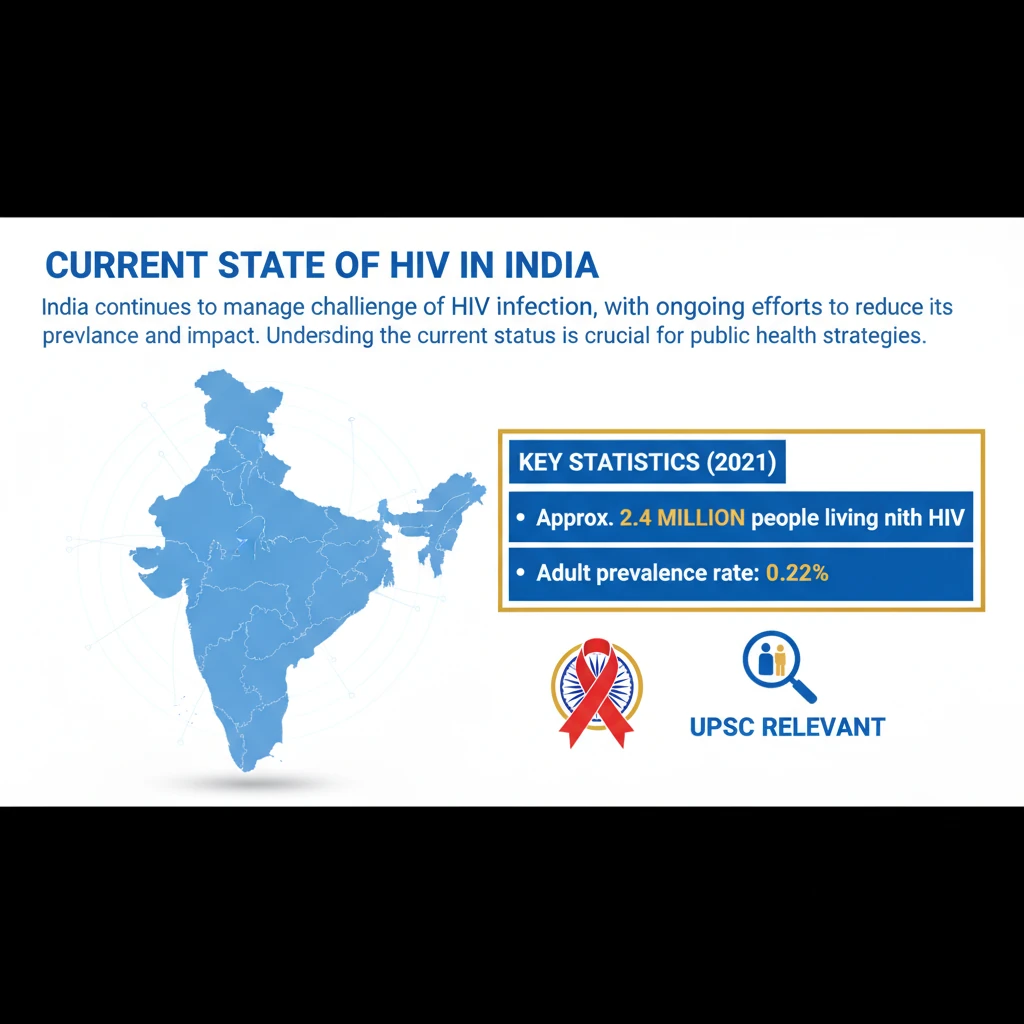
<h4>Current State of HIV in India</h4><p>India continues to manage the challenge of <strong>HIV infection</strong>, with ongoing efforts to reduce its prevalence and impact. Understanding the current status is crucial for public health strategies.</p><div class='info-box'><ul><li>As of <strong>2021</strong>, approximately <strong>2.4 million people</strong> are living with <strong>HIV</strong> in India.</li><li>The <strong>adult prevalence rate</strong> stands at <strong>0.22%</strong>.</li><li>The <strong>India HIV Estimates 2021 report</strong> indicated about <strong>2.3 million PLHIV</strong>, showing a positive <strong>downward trend</strong> in new infections.</li></ul></div><h4>Demographic Distribution of HIV Infection</h4><p>The <strong>HIV epidemic</strong> in India is not uniformly distributed but is largely concentrated within specific <strong>high-risk populations</strong> and demographic groups.</p><div class='key-point-box'><p>Key demographic segments with higher prevalence rates include:</p><ul><li><strong>Female sex workers</strong>: Prevalence rate of <strong>1.13%</strong>.</li><li><strong>Injecting drug users</strong>: Significantly higher prevalence at <strong>5.33%</strong>.</li></ul></div><p>Certain age groups and genders also show distinct patterns in the overall HIV-positive population.</p><div class='info-box'><ul><li><strong>Children under 15 years</strong> account for about <strong>2.5%</strong> of all infections.</li><li><strong>Women</strong> represent approximately <strong>39%</strong> of the total <strong>HIV-positive population</strong> in India.</li></ul></div><h4>Geographical Concentration: High-Prevalence States</h4><p>Geographically, the <strong>HIV epidemic</strong> shows significant variations across different states, with certain regions reporting higher adult prevalence rates.</p><div class='key-point-box'><p>The <strong>Northeast region States</strong> exhibit the highest adult HIV prevalence:</p><ul><li><strong>Mizoram</strong>: <strong>2.70%</strong></li><li><strong>Nagaland</strong>: <strong>1.36%</strong></li><li><strong>Manipur</strong>: <strong>1.05%</strong></li></ul></div><p>Following the Northeast, the <strong>Southern States</strong> also report notable prevalence rates, indicating a regional concentration of the epidemic.</p><div class='info-box'><p>Adult HIV prevalence in Southern States:</p><ul><li><strong>Andhra Pradesh</strong>: <strong>0.67%</strong></li><li><strong>Telangana</strong>: <strong>0.47%</strong></li><li><strong>Karnataka</strong>: <strong>0.46%</strong></li></ul></div><p>When considering the absolute number of <strong>People Living with HIV (PLHIV)</strong>, the Southern States account for the largest share.</p><div class='highlight-box'><p>The total number of <strong>PLHIV</strong> is estimated at around <strong>24 lakhs</strong> (2.4 million).</p><p>The top three states with the largest number of <strong>PLHIV</strong> are:</p><ol><li><strong>Maharashtra</strong></li><li><strong>Andhra Pradesh</strong></li><li><strong>Karnataka</strong></li></ol></div>
💡 Key Takeaways
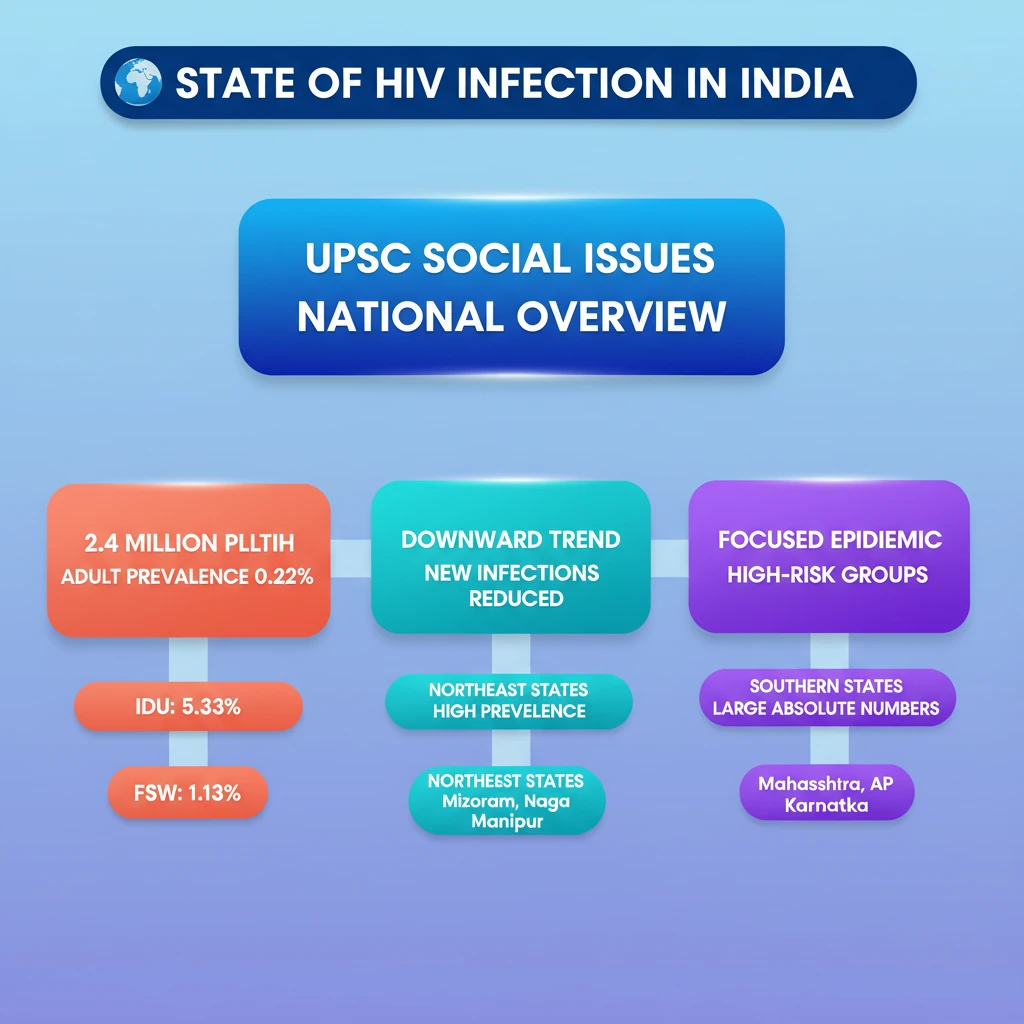
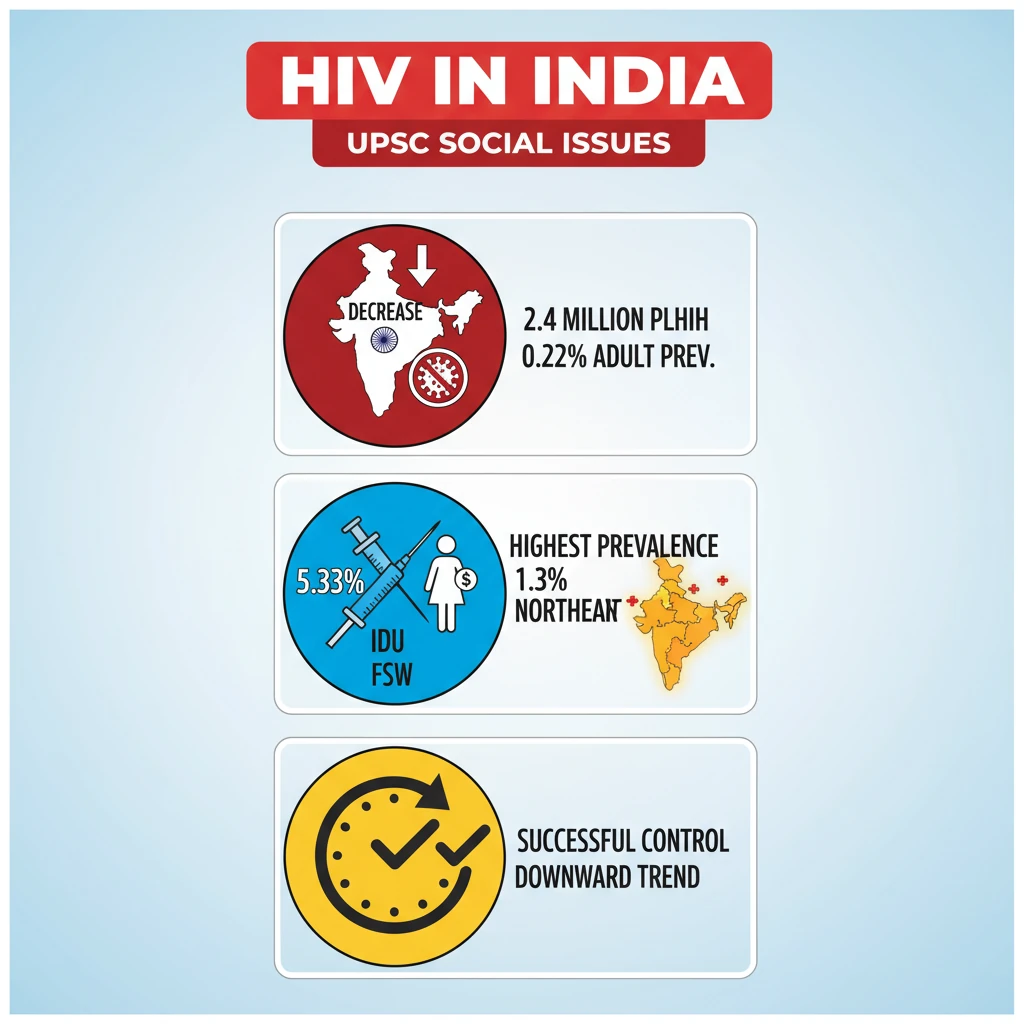
- •India has approximately 2.4 million people living with HIV (PLHIV) as of 2021, with an adult prevalence rate of 0.22%.
- •The country is witnessing a downward trend in new HIV infections, indicating successful control efforts.
- •The epidemic is concentrated among high-risk populations like injecting drug users (5.33%) and female sex workers (1.13%).
- •Northeast states (Mizoram, Nagaland, Manipur) have the highest adult HIV prevalence rates.
- •Southern states (Maharashtra, Andhra Pradesh, Karnataka) account for the largest absolute numbers of PLHIV.
- •Women constitute a significant portion (39%) of the total HIV-positive population.
🧠 Memory Techniques
95% Verified Content
📚 Reference Sources
•India HIV Estimates 2021 report
•Drishti IAS Summary