Sickle Cell Disease - Social Issues | UPSC Learning
Topics
0 topics • 0 completed
🔍
No topics match your search
Sickle Cell Disease
Easy⏱️ 5 min read
social issues
📖 Introduction
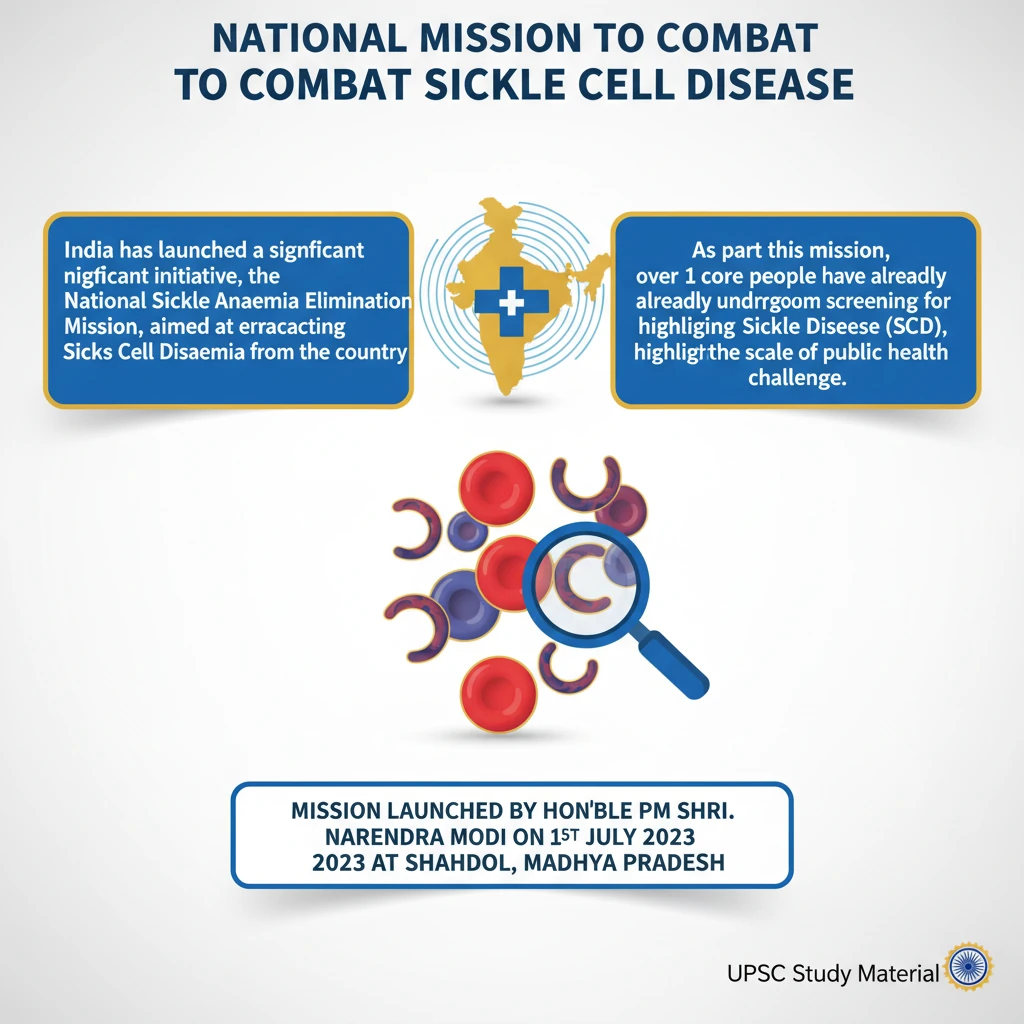
<h4>National Mission to Combat Sickle Cell Disease</h4><p>India has launched a significant initiative, the <strong>National Sickle Cell Anaemia Elimination Mission</strong>, aimed at eradicating <strong>Sickle Cell Anaemia</strong> from the country.</p><p>As part of this mission, over <strong>1 crore people</strong> have already undergone screening for <strong>Sickle Cell Disease (SCD)</strong>, highlighting the scale of the public health challenge.</p><div class='info-box'><p><strong>Mission Launch:</strong> <strong>2023</strong></p><p><strong>Elimination Target:</strong> By <strong>2047</strong></p></div><h4>Understanding Sickle Cell Disease (SCD)</h4><p><strong>Sickle Cell Disease (SCD)</strong> is a collective term for a group of <strong>inherited red blood cell (RBC) disorders</strong>. These conditions are genetic, meaning they are passed down from parents to their children.</p><div class='key-point-box'><p><strong>Healthy RBCs:</strong> Typically <strong>round</strong> and flexible, enabling them to move easily through blood vessels.</p><p><strong>Hemoglobin:</strong> A crucial <strong>protein</strong> within RBCs responsible for carrying <strong>oxygen</strong> throughout the body.</p></div><p>In individuals with <strong>SCD</strong>, the <strong>hemoglobin</strong> is abnormal. This abnormality causes the <strong>red blood cells</strong> to become rigid and sticky.</p><p>Crucially, these affected <strong>RBCs</strong> also change their shape, resembling a <strong>C-shaped farm tool</strong> known as a <strong>“sickle.”</strong> This characteristic shape is where the disease gets its name.</p><h4>Common Symptoms of SCD</h4><p>The symptoms of <strong>Sickle Cell Disease</strong> can vary significantly among individuals, but several common manifestations are observed.</p><ul><li><strong>Chronic Anemia:</strong> This is a persistent lack of healthy red blood cells, leading to symptoms such as severe <strong>fatigue</strong>, general <strong>weakness</strong>, and noticeable <strong>paleness</strong> of the skin.</li><li><strong>Painful Episodes (Sickle Cell Crisis):</strong> These are hallmark symptoms, characterized by sudden and intense pain. The pain can affect various parts of the body, including the <strong>bones</strong>, <strong>chest</strong>, <strong>back</strong>, <strong>arms</strong>, and <strong>legs</strong>.</li><li><strong>Delayed Growth and Puberty:</strong> Children and adolescents with <strong>SCD</strong> may experience delays in their physical development, including slower growth rates and a postponed onset of puberty.</li></ul><h4>Treatment Approaches for SCD</h4><p>While there is no universal cure for <strong>Sickle Cell Disease</strong>, several treatments are available to manage symptoms, prevent complications, and improve quality of life.</p><ul><li><strong>Blood Transfusions:</strong> This treatment involves receiving healthy blood from a donor. It helps to alleviate <strong>anemia</strong> and significantly reduces the frequency and severity of <strong>pain crises</strong>.</li><li><strong>Hydroxyurea:</strong> This is a specific medication prescribed to patients with <strong>SCD</strong>. It works by reducing the occurrence of painful episodes and preventing some of the long-term complications associated with the disease.</li><li><strong>Bone Marrow or Stem Cell Transplantation:</strong> For some patients, particularly children, <strong>bone marrow</strong> or <strong>stem cell transplantation</strong> can offer a curative option. This procedure replaces diseased bone marrow with healthy cells.</li></ul><h4>Government Initiatives Against SCD</h4><p>The Indian government has undertaken specific measures to address the burden of <strong>Sickle Cell Disease</strong> within the country.</p><p>In <strong>2016</strong>, the government released comprehensive <strong>technical operational guidelines</strong>. These guidelines are designed for the effective <strong>prevention and control</strong> of <strong>sickle cell anaemia</strong> across the nation.</p><div class='exam-tip-box'><p>The <strong>National Sickle Cell Anaemia Elimination Mission</strong> (launched <strong>2023</strong>, target <strong>2047</strong>) is a critical current affairs topic for <strong>UPSC Prelims</strong> and <strong>Mains (GS-II: Social Justice, Health)</strong>. Remember the key dates and the mission's ambitious goal.</p></div>
💡 Key Takeaways
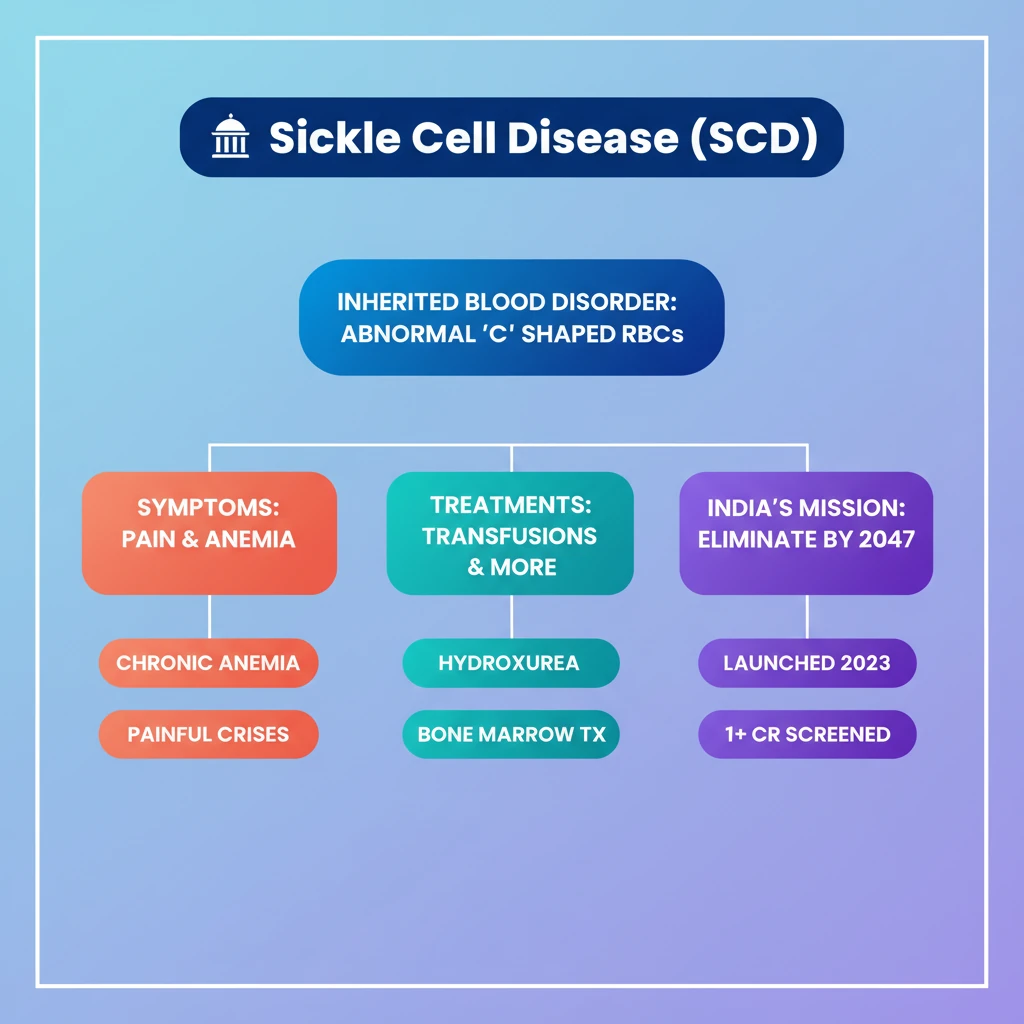
- •Sickle Cell Disease (SCD) is an inherited red blood cell disorder, causing abnormal, C-shaped RBCs.
- •Symptoms include chronic anemia, painful crises, and delayed growth.
- •Treatments involve blood transfusions, Hydroxyurea, and bone marrow transplantation.
- •National Sickle Cell Anaemia Elimination Mission launched in 2023 aims to eliminate SCD by 2047.
- •Over 1 crore people have been screened, highlighting the mission's scale and focus on early detection.
🧠 Memory Techniques

95% Verified Content