Successful Launch of Ariane 6 Rocket - Science And Technology | UPSC Learning
Topics
0 topics • 0 completed
🔍
No topics match your search
Successful Launch of Ariane 6 Rocket
Medium⏱️ 7 min read
science and technology
📖 Introduction
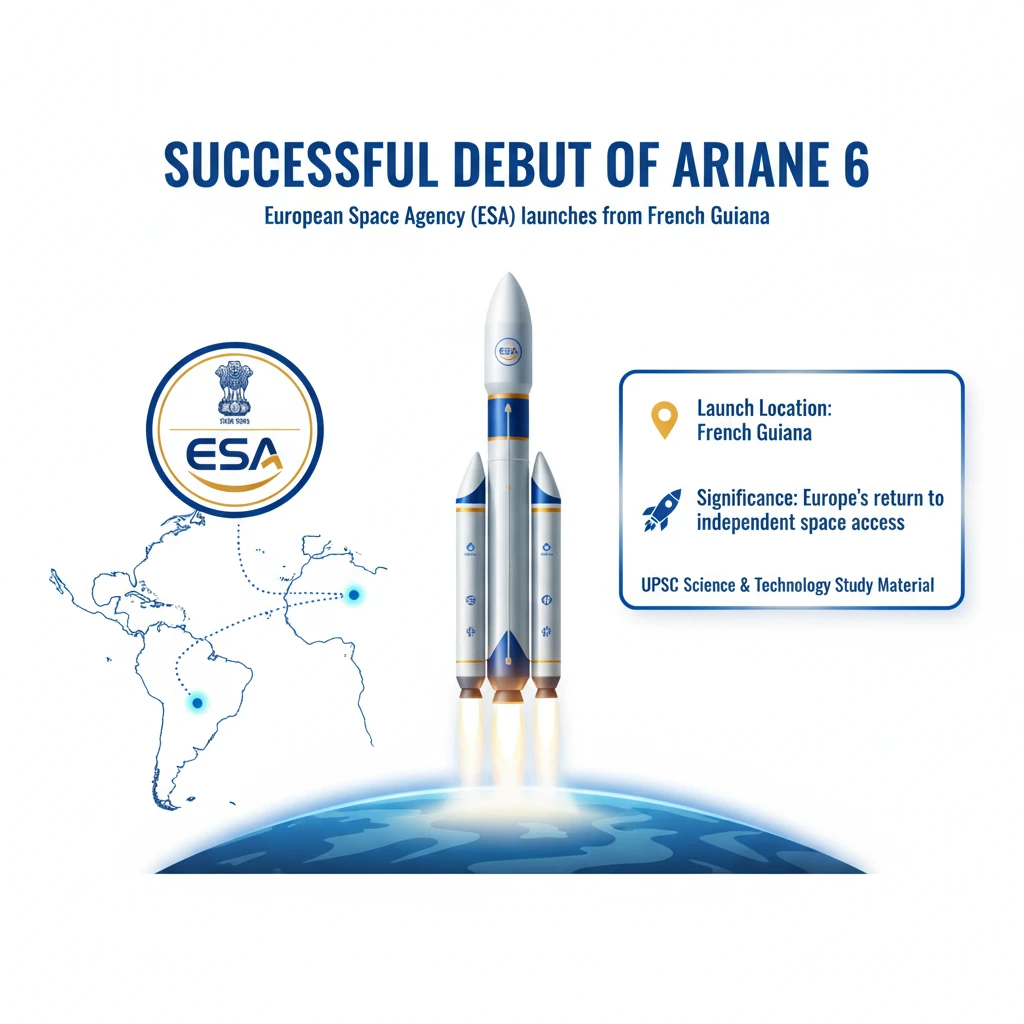
<h4>Successful Debut of Ariane 6</h4><p>The <strong>European Space Agency (ESA)</strong> has successfully launched the <strong>Ariane 6 rocket</strong> for the first time. This landmark event took place from <strong>French Guiana</strong>, signaling <strong>Europe’s return to independent space access</strong> after facing various delays and setbacks.</p><div class='info-box'><p>📍 <strong>Launch Location:</strong> French Guiana</p><p>🚀 <strong>Significance:</strong> Europe's return to independent space access</p></div><h4>Ariane Rocket Series: A New Era</h4><p>The <strong>Ariane 6</strong> is the latest and most advanced rocket in Europe’s distinguished <strong>Ariane rocket series</strong>. It is designed to take over from its highly successful predecessor, the <strong>Ariane 5</strong>.</p><div class='key-point-box'><p>The <strong>Ariane 6</strong> possesses versatile capabilities, enabling it to launch missions from <strong>low-Earth orbit</strong> and extend its reach further into <strong>deep space</strong>.</p></div><h4>Legacy of Ariane 5</h4><p>The <strong>Ariane 5 rocket</strong> has a remarkable track record, having been instrumental in launching numerous critical missions for various international space agencies.</p><ul><li>It launched <strong>NASA’s communication satellites</strong> such as <strong>GSAT-30</strong> and <strong>GSAT-31</strong>.</li><li>It was also used for <strong>ESA’s Juice mission</strong>, a significant deep-space probe.</li><li>Crucially, <strong>Ariane 5</strong> deployed <strong>NASA’s James Webb Space Telescope (JWST)</strong>, one of the most advanced space observatories.</li></ul><h4>Inaugural Flight Payloads</h4><p>The debut flight of <strong>Ariane 6</strong> successfully carried a diverse set of payloads into orbit, demonstrating its immediate operational capability.</p><div class='info-box'><p>The flight deployed <strong>nine cubesats</strong>, including:</p><ul><li><strong>NASA’s Subsolar Radiometer Interferometry Experiment (SUNRISE)</strong></li><li>Other satellites dedicated to studying <strong>Earth’s climate and weather</strong>.</li></ul></div><h4>Advanced Propulsion: The Vinci Engine</h4><p>A significant technological advancement integrated into the <strong>Ariane 6</strong> is its innovative upper stage engine.</p><div class='key-point-box'><p>The <strong>Vinci engine</strong>, utilized in the upper stage, is specifically designed to <strong>restart repeatedly</strong>. This crucial feature allows the operating agency to precisely place multiple payloads into <strong>several different orbits</strong> during a single mission, enhancing mission flexibility and efficiency.</p></div><h4>Future Outlook and Mission Goals</h4><p><strong>Ariane 6</strong> has an ambitious mission manifest planned for the coming years, solidifying Europe's long-term commitment to space exploration and commercial launches.</p><div class='info-box'><p>Over the next several years, <strong>29 missions</strong> are scheduled to be launched by <strong>Ariane 6</strong>. The program aims for a high operational tempo, targeting up to <strong>12 flights a year</strong>.</p></div><div class='exam-tip-box'><p>For <strong>UPSC Prelims</strong>, focus on the rocket's name, launch location, and key technical features like the <strong>Vinci engine's restart capability</strong>. For <strong>Mains GS-III</strong>, understand the strategic importance of <strong>independent space access</strong> and Europe's competitive position in the global space market.</p></div>
💡 Key Takeaways
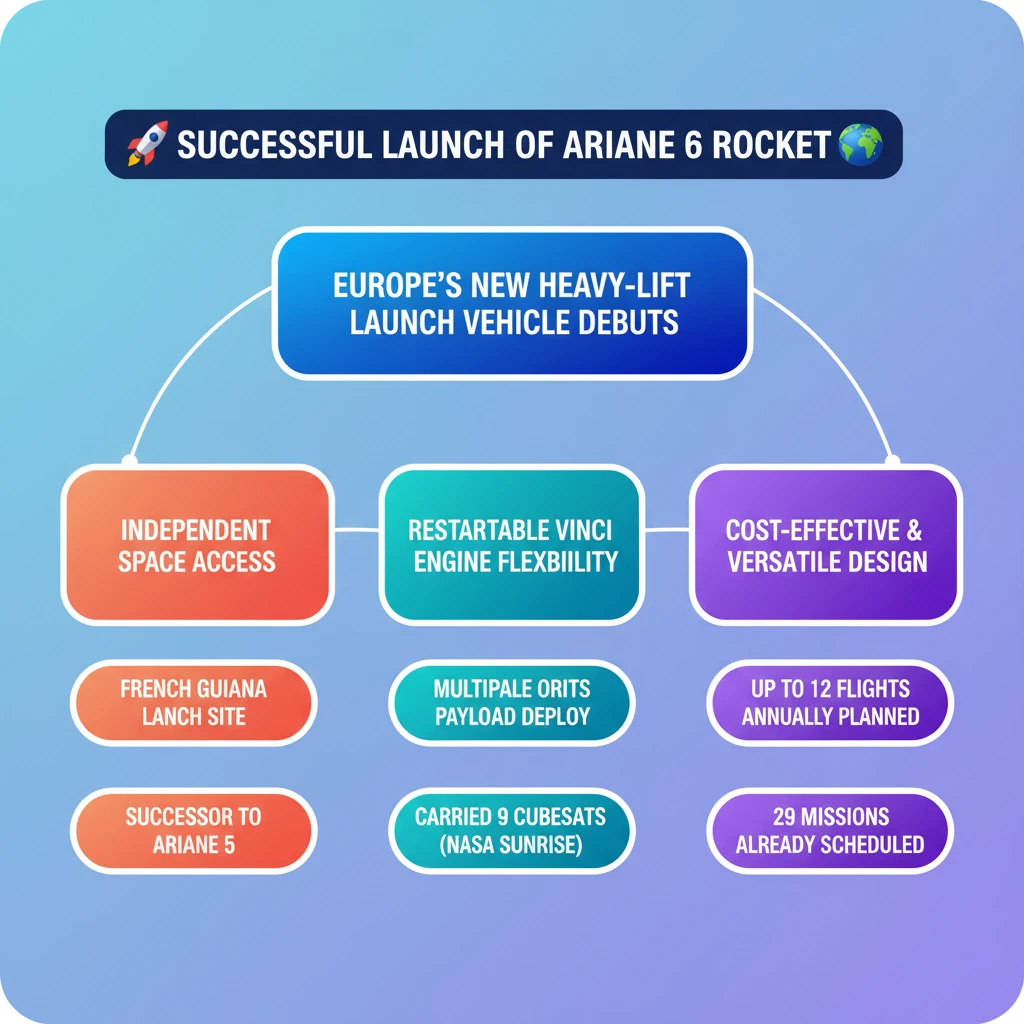
- •Ariane 6 is Europe's new heavy-lift launch vehicle, succeeding Ariane 5.
- •Its successful debut from French Guiana marks Europe's return to independent space access.
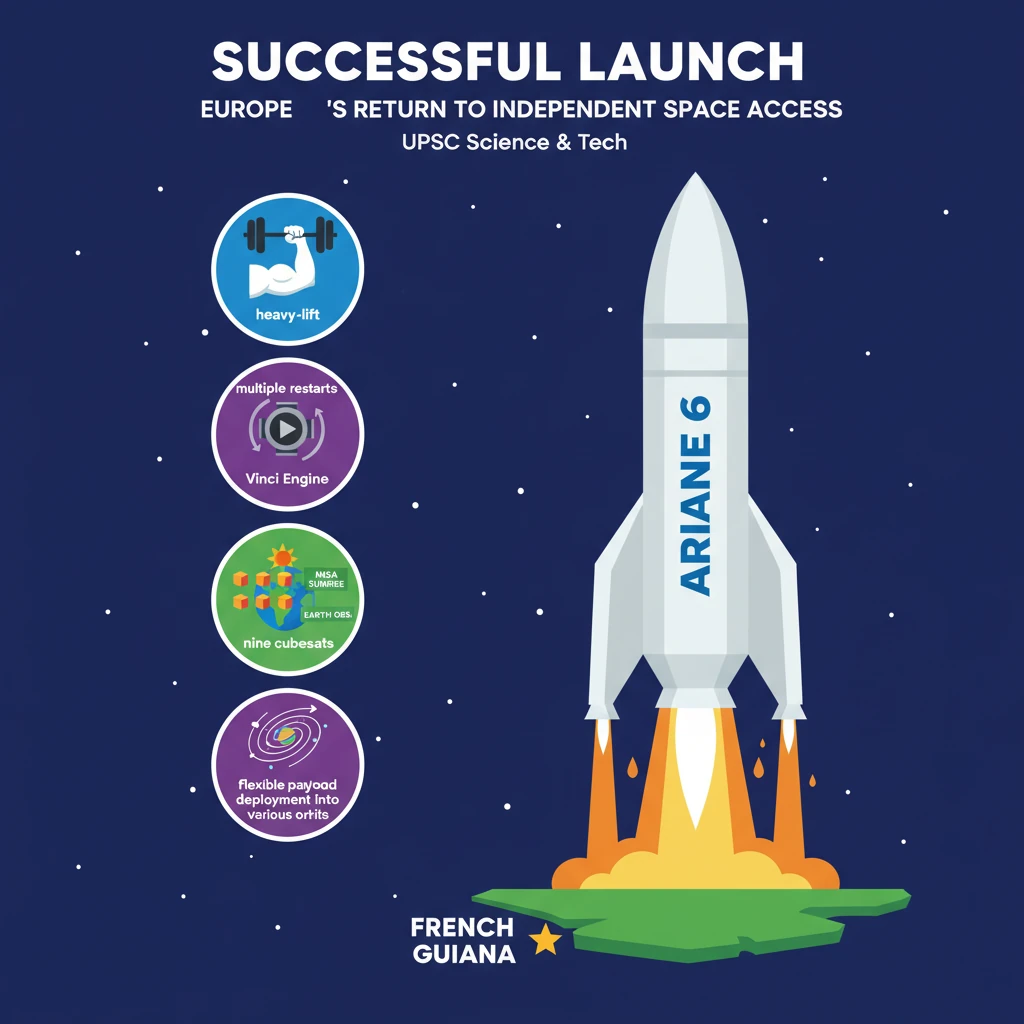
- •The Vinci engine in its upper stage allows for multiple restarts, enabling flexible payload deployment into various orbits.
- •The inaugural flight carried nine cubesats, including NASA's SUNRISE and Earth observation satellites.
- •Ariane 6 is designed for cost-effectiveness and versatility, with plans for up to 12 flights annually and 29 missions scheduled.
- •It is crucial for Europe's strategic autonomy and competitiveness in the global space market.
🧠 Memory Techniques
95% Verified Content
📚 Reference Sources
•European Space Agency (ESA) official website
•NASA official website (for JWST, SUNRISE details)
•Arianespace official website