What are the Biofortified Seed Varieties Developed by ICAR? - Science And Technology | UPSC Learning
Topics
0 topics • 0 completed
🔍
No topics match your search
What are the Biofortified Seed Varieties Developed by ICAR?
Medium⏱️ 7 min read
science and technology
📖 Introduction
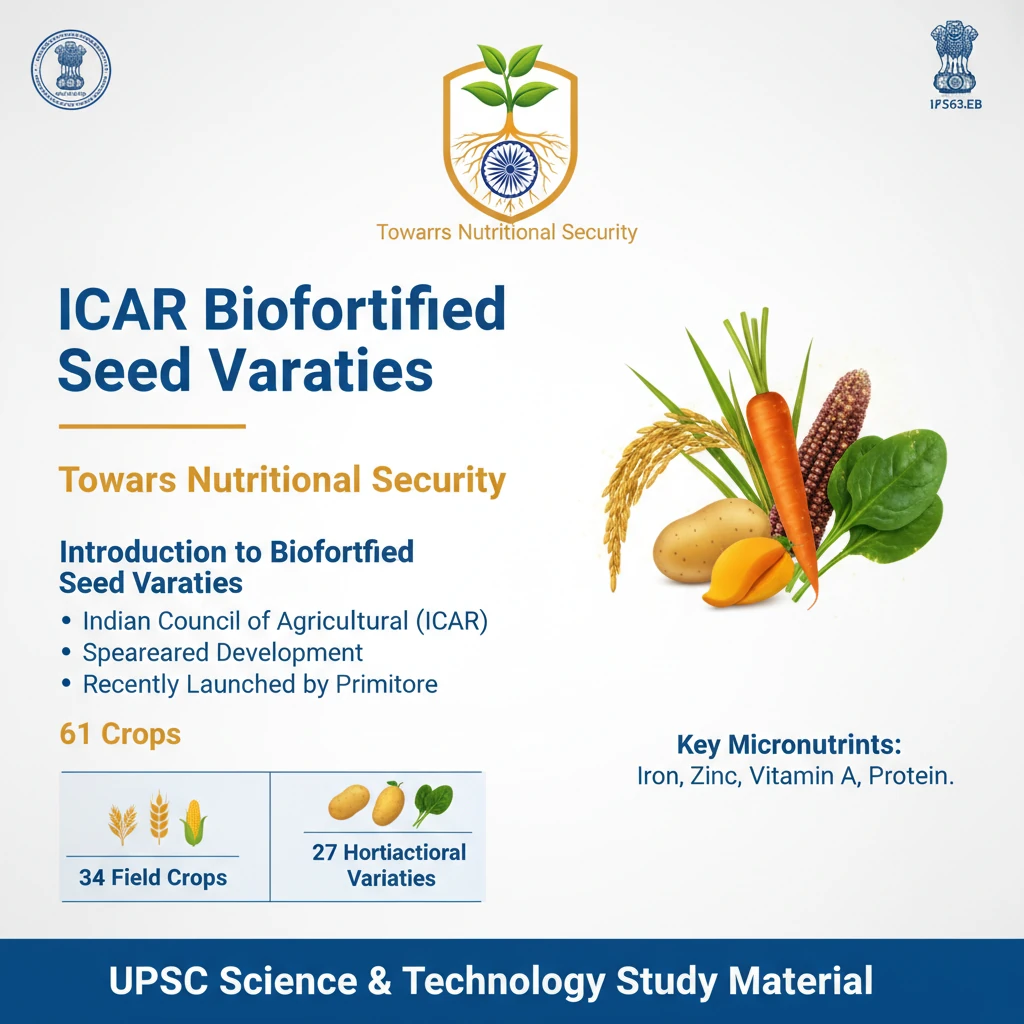
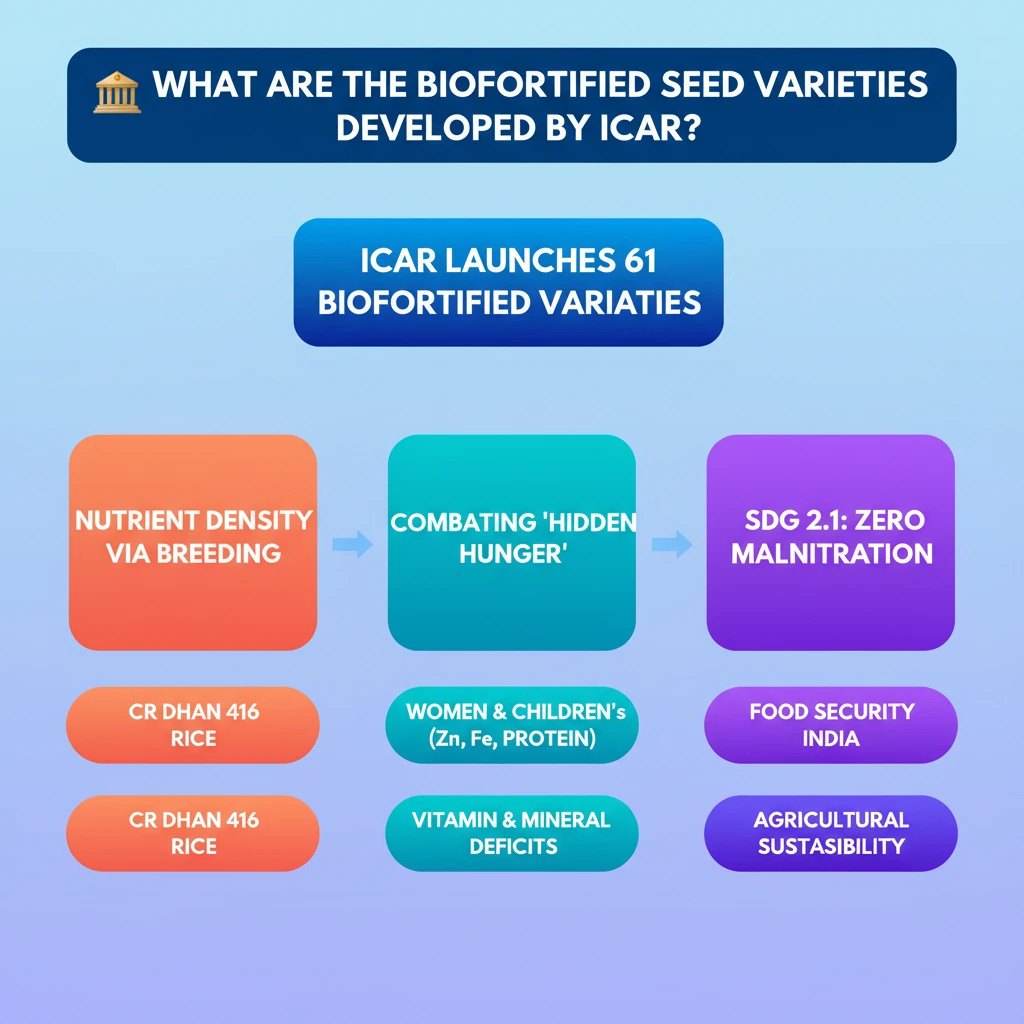
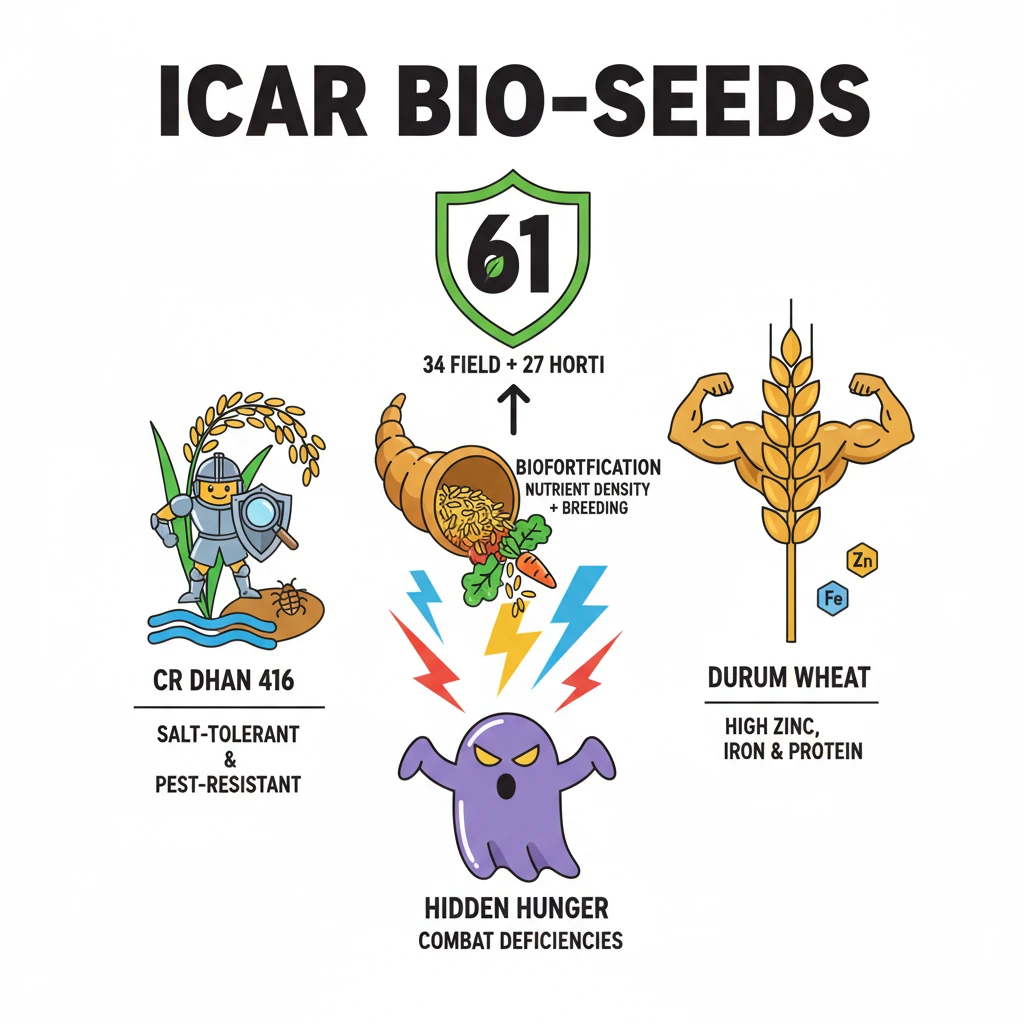
<h4>Introduction to Biofortified Seed Varieties</h4><p>The Indian Council of Agricultural Research (<strong>ICAR</strong>) has spearheaded the development of numerous <strong>biofortified seed varieties</strong>. These varieties were recently launched by the Prime Minister, marking a significant step towards nutritional security in India.</p><p>The initiative covers a total of <strong>61 crops</strong>. This includes <strong>34 field crops</strong> and <strong>27 horticultural varieties</strong>, showcasing a broad approach to addressing malnutrition.</p><div class='info-box'><p><strong>Scope of Biofortified Crops:</strong></p><ul><li><strong>Field Crops:</strong> Cereals, Millets, Forage Crops, Oilseeds, Pulses, Sugarcane, Cotton, Fibre Crops.</li><li><strong>Horticultural Varieties:</strong> Fruits, Vegetables, Plantation Crops, Tubers, Spices, Flowers, Medicinal Plants.</li></ul></div><h4>Spotlight on Key Biofortified Varieties</h4><h5>CR Dhan 416: A Resilient Rice Variety</h5><p><strong>CR Dhan 416</strong> is a specific rice variety developed by ICAR. It is particularly well-suited for cultivation in <strong>coastal saline areas</strong>, which are often challenging for conventional rice cultivation.</p><p>This variety exhibits moderate resistance to several common diseases. These include <strong>brown spot</strong>, <strong>blast</strong>, <strong>sheath rot</strong>, <strong>rice tungro disease</strong>, and <strong>glume discoloration</strong>. This resilience reduces crop losses and enhances farmer income.</p><div class='info-box'><p><strong>Pest Resistance of CR Dhan 416:</strong></p><ul><li><strong>Full resistance</strong> to <strong>brown plant hopper</strong>.</li><li><strong>Full resistance</strong> to <strong>grasshopper</strong>.</li><li><strong>Full resistance</strong> to <strong>stem borer</strong>.</li></ul></div><h5>Durum Wheat Variety: High Zinc & Iron Content</h5><p>A notable <strong>Durum Wheat Variety</strong> has been developed, adapted for <strong>irrigated conditions</strong>. It is particularly suitable for cultivation in states like <strong>Maharashtra</strong>, <strong>Karnataka</strong>, and certain parts of <strong>Tamil Nadu</strong>.</p><p>This wheat variety demonstrates tolerance to <strong>terminal heat</strong>, a critical factor in many wheat-growing regions. It is also resistant to both <strong>stem rust</strong> and <strong>leaf rusts</strong>, ensuring healthier crops and better yields.</p><div class='info-box'><p><strong>Nutrient Profile of Durum Wheat Variety:</strong></p><ul><li><strong>Zinc:</strong> 41.1 ppm (parts per million)</li><li><strong>Iron:</strong> 38.5 ppm</li><li><strong>Protein:</strong> 12%</li></ul><p>This high nutrient density makes it a powerful tool against micronutrient deficiencies.</p></div><h4>Understanding Biofortification</h4><p><strong>Biofortification</strong> is a transformative process aimed at enhancing the nutritional value of food crops. It focuses on increasing the <strong>nutrient density</strong> of staple foods consumed by large populations.</p><div class='info-box'><p><strong>Definition of Biofortification:</strong></p><p>Biofortification is the process by which the <strong>nutrient density</strong> of food crops is increased through <strong>conventional plant breeding</strong>, <strong>improved agronomic practices</strong>, and <strong>modern biotechnology</strong>, without sacrificing any characteristic preferred by consumers.</p></div><p>This approach is widely recognized as a <strong>nutrition-sensitive agriculture intervention</strong>. Its primary goal is to effectively reduce <strong>vitamin and mineral deficiencies</strong>, also known as 'hidden hunger', in vulnerable populations.</p><div class='key-point-box'><p><strong>Examples of Biofortification Projects:</strong></p><ul><li><strong>Iron-biofortification:</strong> Rice, Beans, Sweet Potato, Cassava, Legumes.</li><li><strong>Zinc-biofortification:</strong> Wheat, Rice, Beans, Sweet Potato, Maize.</li><li><strong>Provitamin A carotenoid-biofortification:</strong> Sweet Potato, Maize, Cassava.</li><li><strong>Amino acid and protein-biofortification:</strong> Sorghum, Cassava.</li></ul></div><h4>The Imperative for Biofortification</h4><p>India faces significant challenges related to <strong>malnutrition</strong>, particularly among women and children. High levels of deficiencies in essential vitamins and minerals persist across various demographics.</p><p>Biofortification offers a sustainable and cost-effective strategy to combat this widespread issue. By integrating higher nutrient content directly into staple crops, it reaches a broad segment of the population without requiring significant dietary changes.</p><div class='exam-tip-box'><p><strong>UPSC Insight:</strong> The 'Need for Biofortification' is a crucial topic for <strong>GS-II (Health & Nutrition)</strong> and <strong>GS-III (Agriculture & Food Security)</strong>. Focus on linking it to India's malnutrition statistics and sustainable development goals.</p></div>
💡 Key Takeaways
- •ICAR has launched 61 biofortified seed varieties, including 34 field and 27 horticultural crops.
- •Biofortification increases nutrient density in food crops via breeding, agronomy, or biotechnology.
- •Key examples include CR Dhan 416 (salt-tolerant, pest-resistant rice) and Durum Wheat (high zinc, iron, protein).
- •Biofortification aims to reduce vitamin and mineral deficiencies, combating 'hidden hunger'.
- •It is a critical intervention for India to tackle malnutrition among women and children and achieve SDGs.
🧠 Memory Techniques
95% Verified Content
📚 Reference Sources
•ICAR (Indian Council of Agricultural Research) Official Publications (assumed reference for specific varieties)
•Ministry of Agriculture & Farmers Welfare Reports (assumed reference for policy context)