What are the Challenges Associated with LEO? - Science And Technology | UPSC Learning
Topics
0 topics • 0 completed
🔍
No topics match your search
What are the Challenges Associated with LEO?
Medium⏱️ 8 min read
science and technology
📖 Introduction
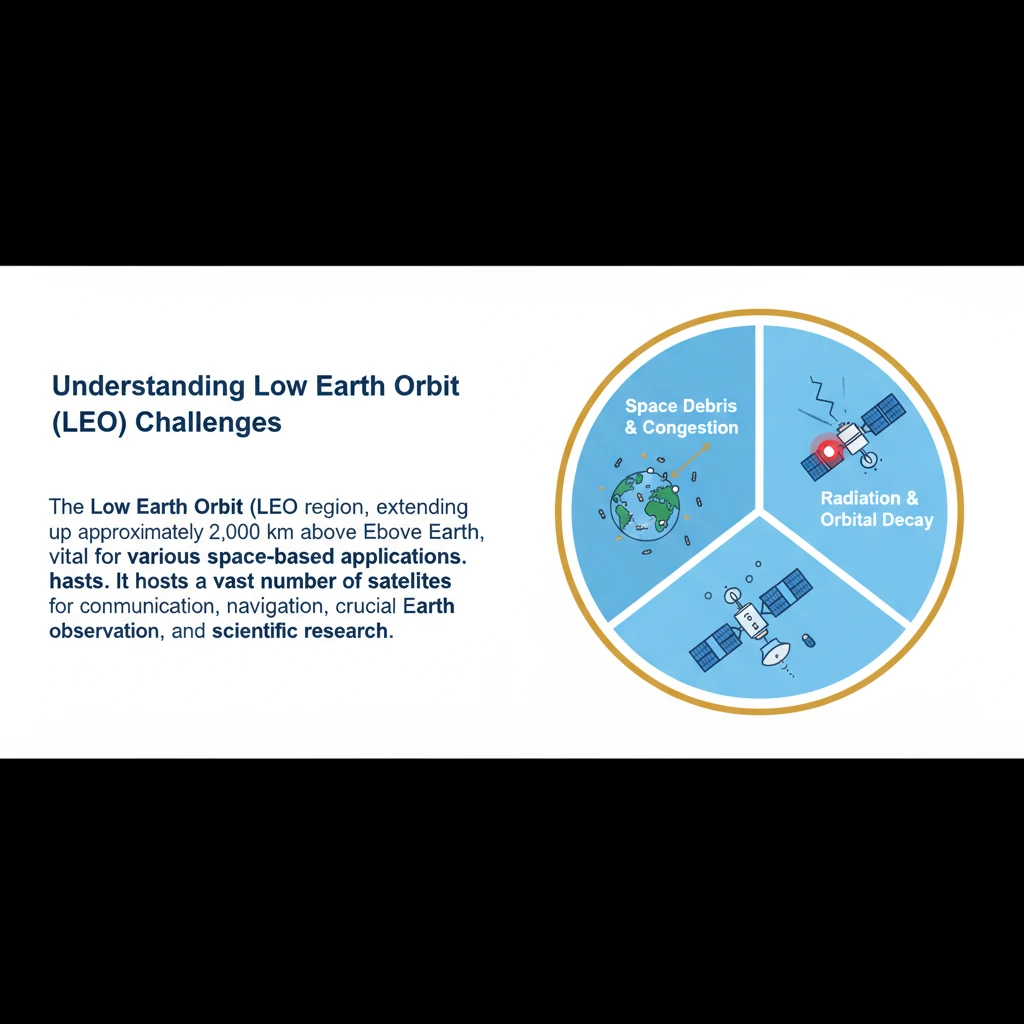
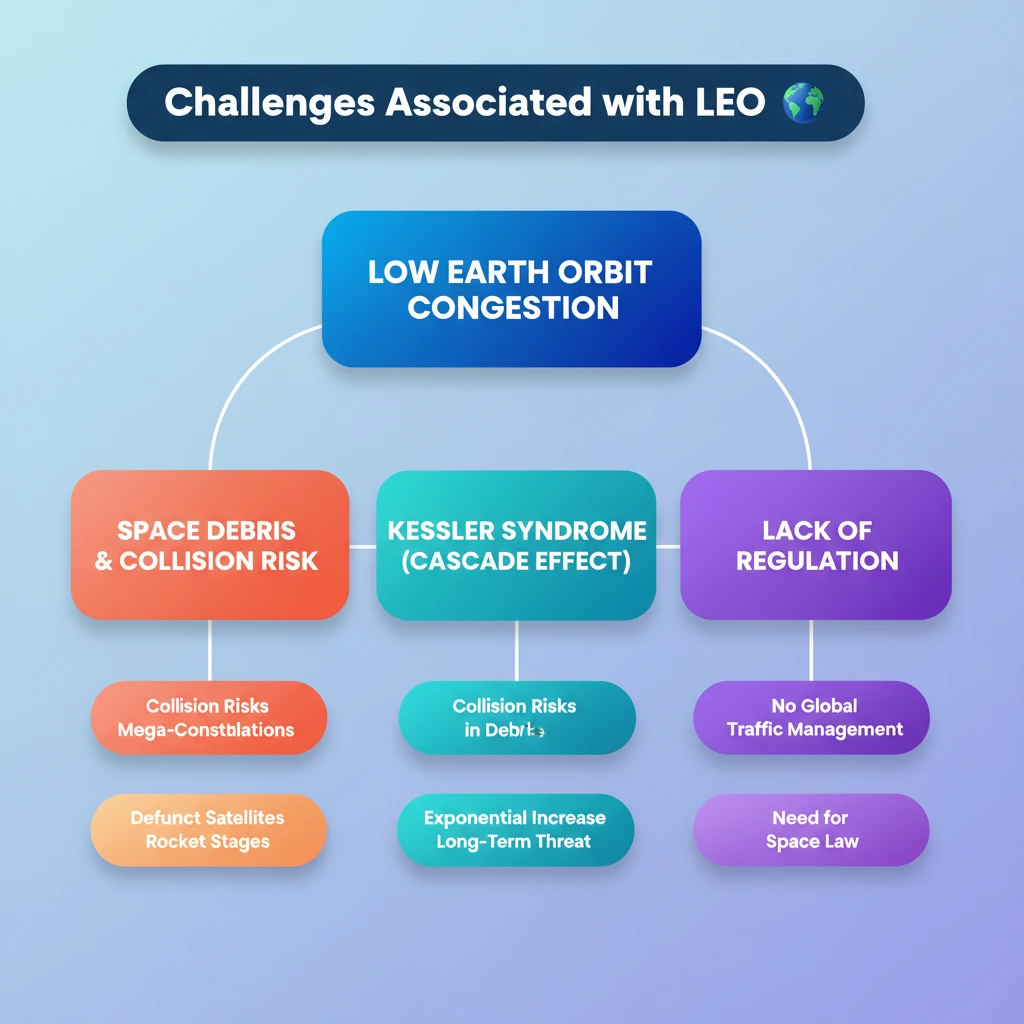
<h4>Understanding Low Earth Orbit (LEO) Challenges</h4><p>The <strong>Low Earth Orbit (LEO)</strong> region, extending up to approximately 2,000 km above Earth, is increasingly vital for various space-based applications. It hosts a vast number of <strong>satellites</strong> crucial for communication, navigation, Earth observation, and scientific research.</p><div class='info-box'><p><strong>LEO Definition:</strong> An orbit typically below 2,000 km altitude, characterized by relatively fast orbital periods and lower launch costs compared to higher orbits like GEO.</p></div><h4>The Problem of LEO Congestion</h4><p>The rapid proliferation of <strong>satellite constellations</strong>, particularly for broadband internet services, has led to significant <strong>congestion</strong> in LEO. This density of objects creates a complex and potentially hazardous environment for all space assets.</p><div class='key-point-box'><p><strong>Key Challenge:</strong> The sheer volume of operational and defunct objects in LEO poses a growing threat to sustainable space activities.</p></div><h4>Accumulation of Space Debris</h4><p>A primary concern associated with LEO congestion is the accumulation of <strong>space debris</strong>. This includes non-functional spacecraft, abandoned rocket stages, mission-related debris, and fragmentation products from collisions or explosions.</p><p>These fragments, ranging from microscopic paint flecks to large defunct satellites, travel at extremely high orbital velocities, making them dangerous projectiles.</p><h4>Sources of Space Debris in LEO</h4><ul><li><strong>Decommissioned Satellites:</strong> Old satellites that have reached the end of their operational life and remain in orbit.</li><li><strong>Broken Parts:</strong> Components that detach from active or defunct spacecraft due to wear, tear, or minor impacts.</li><li><strong>Spent Rocket Stages:</strong> The upper stages of launch vehicles that deliver payloads to orbit but then remain in space.</li><li><strong>Collision Fragments:</strong> Debris generated from accidental or intentional collisions between objects in orbit.</li></ul><h4>Collision Risks to Active Spacecraft</h4><p>The increasing amount of <strong>space debris</strong> significantly escalates the risk of <strong>collisions</strong>. Even small pieces of debris can cause catastrophic damage to operational satellites due to the immense kinetic energy involved at orbital speeds.</p><p>Such collisions can generate even more debris, leading to a cascading effect known as the <strong>Kessler Syndrome</strong>, where the density of debris becomes so high that further collisions become inevitable, rendering certain orbits unusable.</p><div class='exam-tip-box'><p><strong>UPSC Insight:</strong> Understanding the <strong>Kessler Syndrome</strong> and its implications is crucial for Mains answers on space policy and sustainability. Mentioning specific collision events can strengthen your arguments.</p></div>
💡 Key Takeaways
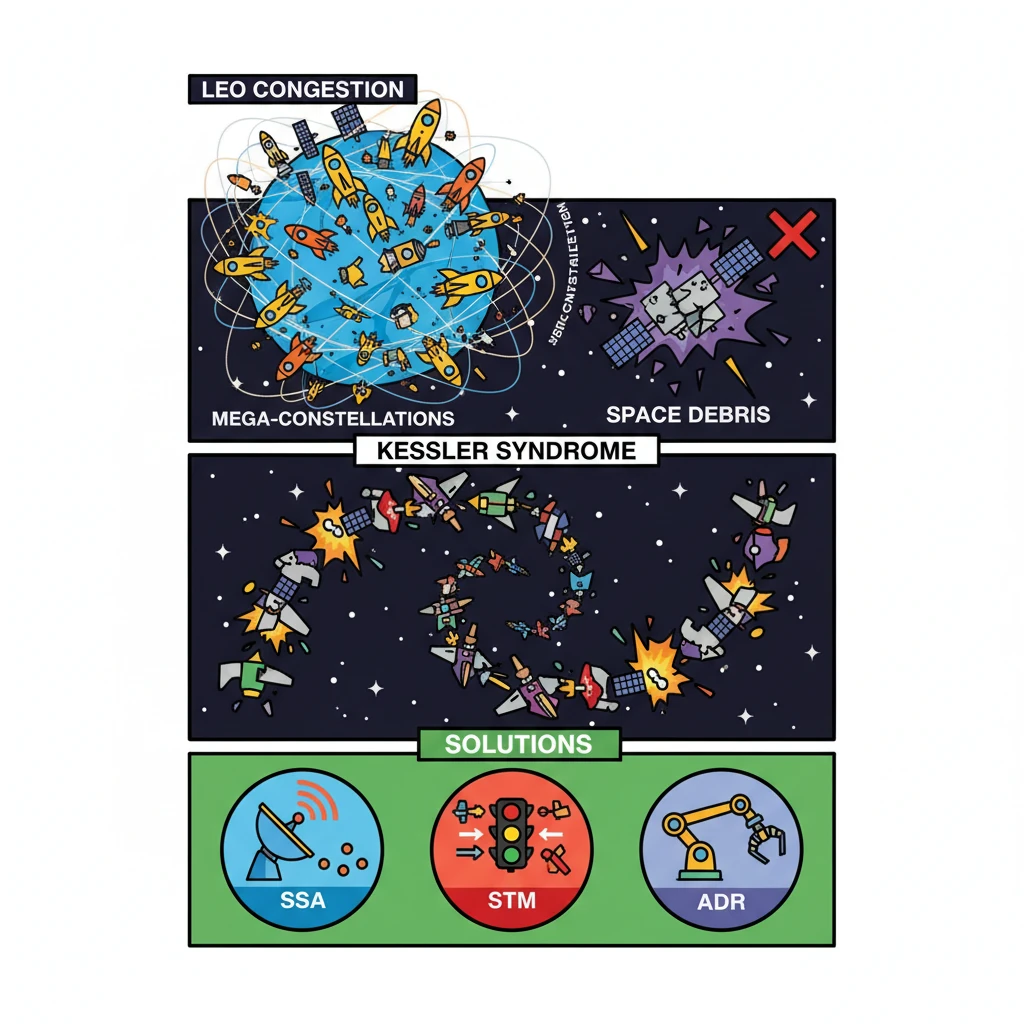
- •LEO congestion is driven by increasing satellite launches, especially mega-constellations.
- •Space debris (defunct satellites, rocket stages, fragments) poses significant collision risks.
- •The Kessler Syndrome describes a cascade of collisions making LEO unusable.
- •Solutions include Space Situational Awareness (SSA), Space Traffic Management (STM), and Active Debris Removal (ADR).
- •International cooperation and "design for demise" principles are crucial for LEO sustainability.
🧠 Memory Techniques
95% Verified Content
📚 Reference Sources
•NASA Orbital Debris Program Office
•European Space Agency (ESA) Space Debris Office
•United Nations Office for Outer Space Affairs (UNOOSA)
•ISRO publications on Space Situational Awareness