Gliese 12 b Potentially Habitable Exoplanet near Earth - Science And Technology | UPSC Learning
Topics
0 topics • 0 completed
🔍
No topics match your search
Gliese 12 b Potentially Habitable Exoplanet near Earth
Medium⏱️ 6 min read
science and technology
📖 Introduction
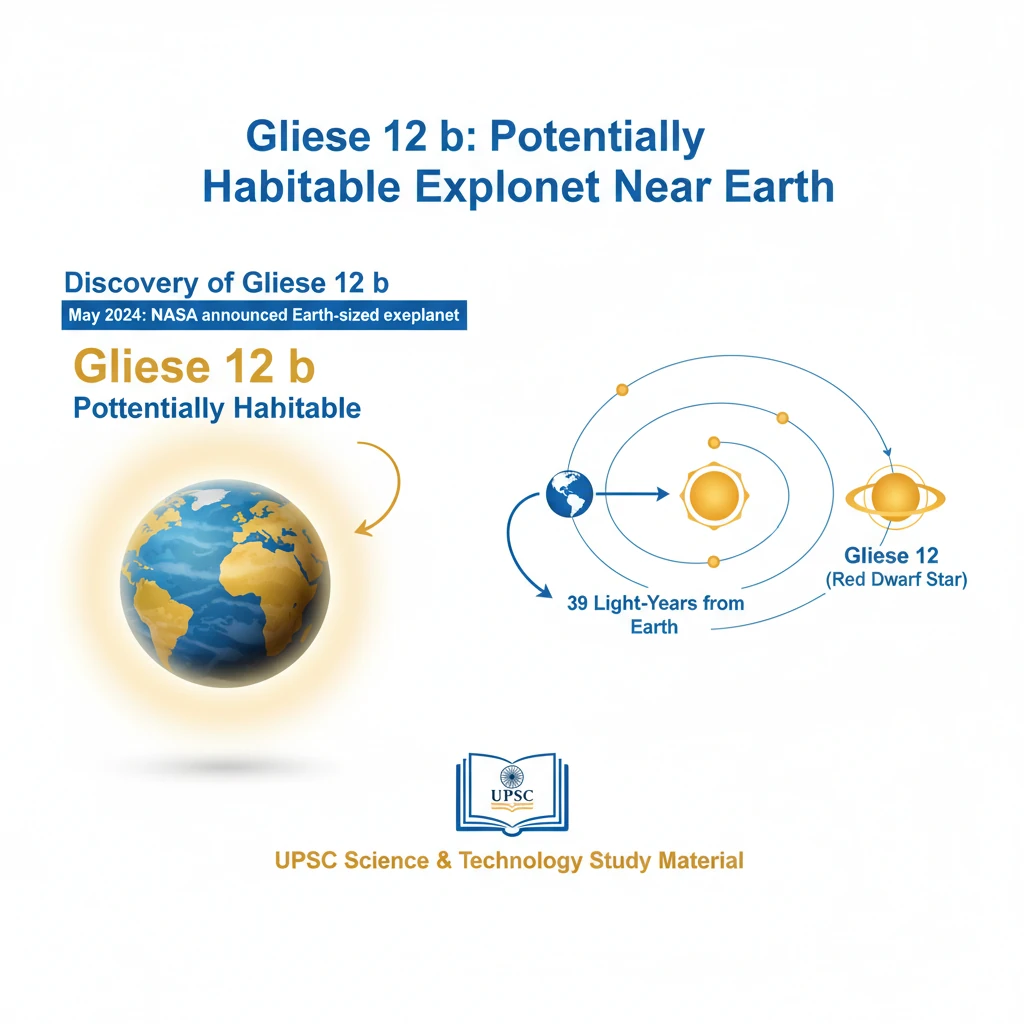
<h4>Discovery of Gliese 12 b</h4><p>In <strong>May 2024</strong>, <strong>NASA</strong> announced a significant discovery in the field of <strong>exoplanet</strong> research. This announcement pertained to an <strong>Earth-sized</strong> celestial body.</p><p>The newly identified exoplanet has been officially named <strong>Gliese 12 b</strong>. It is particularly noteworthy for being categorized as <strong>potentially habitable</strong>.</p><h4>Proximity to Earth and Location</h4><p><strong>Gliese 12 b</strong> is situated approximately <strong>40 light-years</strong> away from our home planet, <strong>Earth</strong>.</p><p>This relatively close distance makes it one of the <strong>closest known potentially habitable planets</strong> discovered outside our <strong>solar system</strong> to date.</p><div class='info-box'><p>A <strong>light-year</strong> is a unit of astronomical distance equivalent to the distance that light travels in one year, which is about 9.46 trillion kilometers.</p></div><h4>Surface Temperature and Habitability Potential</h4><p>The average surface temperature of <strong>Gliese 12 b</strong> has been measured at <strong>+42 °C</strong> (107 °F).</p><p>This temperature is considerably lower than that of the vast majority of the over <strong>5,000 exoplanets</strong> discovered so far, making it a prime candidate for further study.</p><div class='key-point-box'><p>A moderate surface temperature is a critical factor for the potential existence of <strong>liquid water</strong>, which is considered essential for life as we know it.</p></div><h4>Understanding 'Potentially Habitable'</h4><p>The designation <strong>'potentially habitable'</strong> indicates that a planet possesses conditions that *could* support life, rather than confirming its presence.</p><ul><li>It typically implies the planet is located within its star's <strong>habitable zone</strong> (Goldilocks Zone).</li><li>It suggests the possibility of conditions conducive to <strong>liquid water</strong> on its surface.</li><li>Further atmospheric analysis is required to confirm true habitability.</li></ul><div class='exam-tip-box'><p>UPSC often tests knowledge on recent <strong>space discoveries</strong> and the scientific criteria for <strong>exoplanet habitability</strong>. Understand the significance of temperature and distance.</p></div>
💡 Key Takeaways
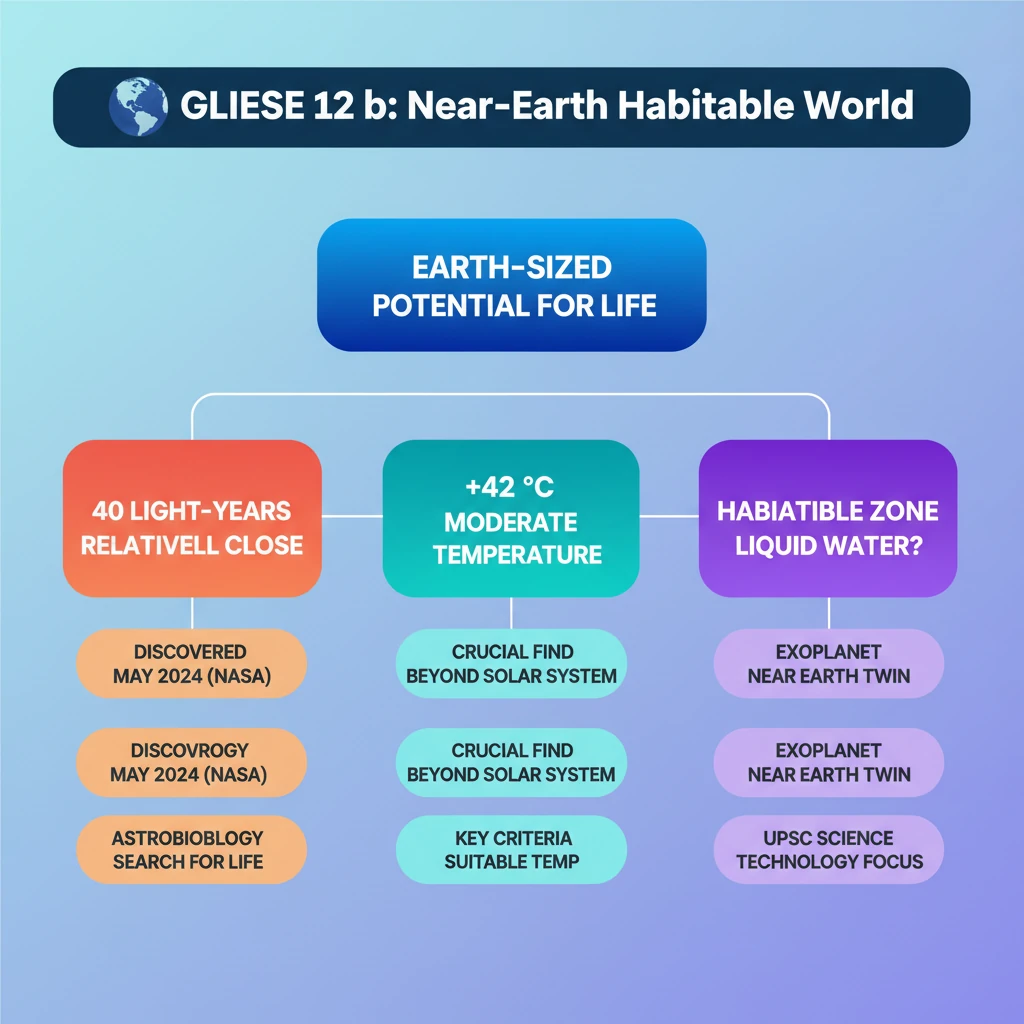
- •Gliese 12 b is an Earth-sized, potentially habitable exoplanet discovered by NASA in May 2024.
- •It is located 40 light-years away, making it one of the closest potentially habitable planets to Earth.
- •The exoplanet has a relatively moderate average surface temperature of +42 °C.
- •Its discovery is crucial for astrobiology and the search for liquid water and life beyond our solar system.
- •The concept of a 'habitable zone' and suitable temperature are key criteria for potential habitability.
🧠 Memory Techniques
95% Verified Content
📚 Reference Sources
•NASA official press releases and astronomical data (general knowledge)
•European Space Agency (ESA) publications on exoplanet discoveries