MACE Telescope in Ladakh - Science And Technology | UPSC Learning
Topics
0 topics • 0 completed
🔍
No topics match your search

MACE Telescope in Ladakh
Medium⏱️ 8 min read
science and technology
📖 Introduction
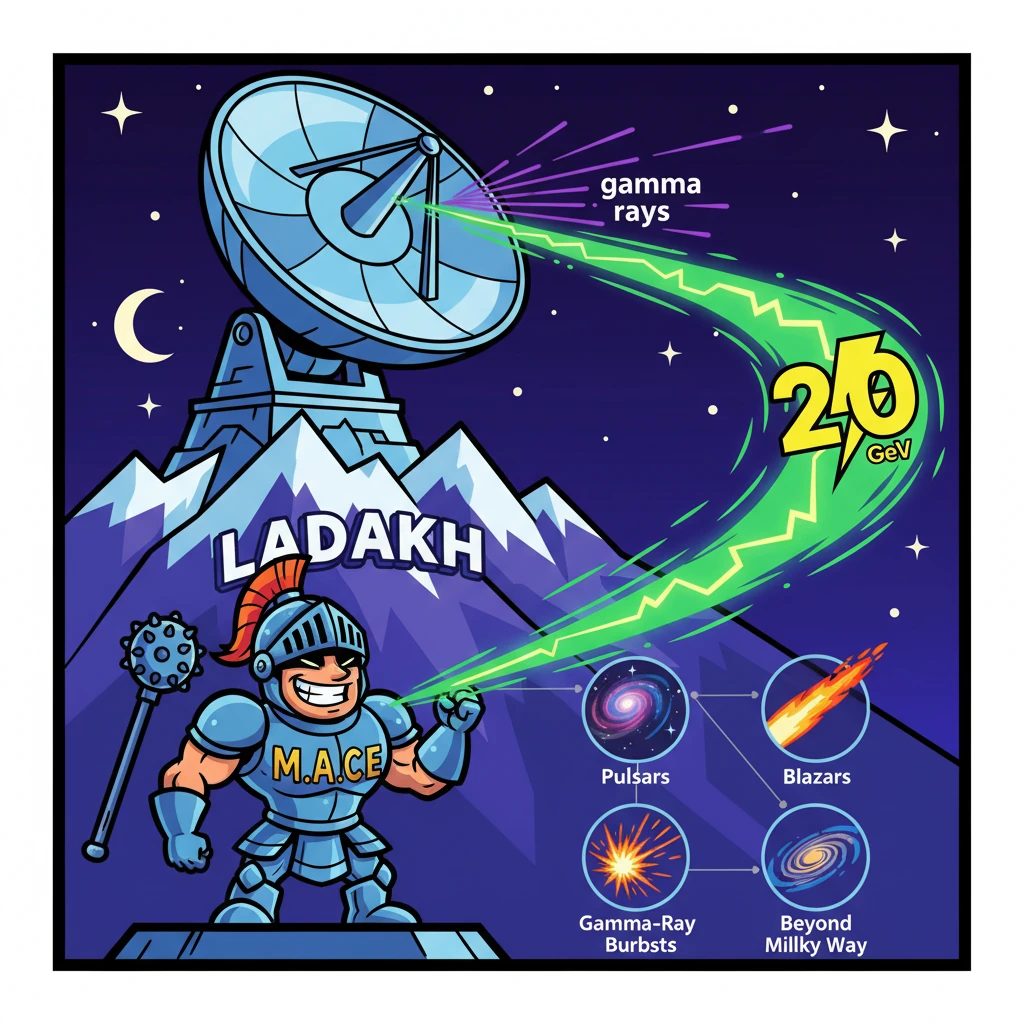
<h4>Introduction to the MACE Telescope</h4><p>The <strong>Major Atmospheric Cherenkov Experiment (MACE) telescope</strong> represents a significant leap in <strong>gamma-ray astronomy</strong>. Its recent inauguration marks a pivotal moment for India's capabilities in exploring the high-energy universe.</p><div class='key-point-box'><p>The <strong>MACE telescope</strong> is designed to detect <strong>gamma rays</strong>, which are the most energetic form of electromagnetic radiation. These observations provide crucial insights into extreme cosmic phenomena.</p></div><h4>Location and Inauguration</h4><p>The <strong>MACE telescope</strong> has been strategically inaugurated in <strong>Hanle, Ladakh</strong>. This high-altitude location offers excellent conditions for astronomical observations, particularly for ground-based gamma-ray detection.</p><div class='info-box'><p><strong>Location:</strong> <strong>Hanle</strong>, <strong>Ladakh</strong> 📍<br><strong>Significance:</strong> One of the highest astronomical sites globally, providing clear skies and minimal atmospheric interference.</p></div><h4>Purpose and Scientific Capabilities</h4><p>The primary purpose of the <strong>MACE telescope</strong> is to enable scientists to explore <strong>gamma rays</strong>. It is specifically tuned to detect gamma rays with extremely high energies.</p><p>These energies <strong>exceed 20 billion electron volts (eV)</strong>. This capability allows researchers to probe some of the most powerful processes in the cosmos.</p><h4>Sources of Observation</h4><p>The telescope is designed to study <strong>gamma rays</strong> emitted from various sources located <strong>beyond the Milky Way galaxy</strong>. These distant objects are often associated with highly energetic events.</p><div class='info-box'><p><strong>Key Sources Observed by MACE:</strong><ul><li><strong>Pulsars:</strong> Rapidly rotating neutron stars emitting beams of radiation.</li><li><strong>Blazars:</strong> Active galactic nuclei with relativistic jets pointed towards Earth.</li><li><strong>Gamma-Ray Bursts (GRBs):</strong> The most luminous electromagnetic events known, associated with supernovae or neutron star mergers.</li></ul></p></div><div class='exam-tip-box'><p><strong>UPSC Relevance:</strong> Understanding the <strong>MACE telescope</strong> is important for <strong>Science & Technology</strong> (GS Paper 3). Questions may focus on its location, purpose, or the types of cosmic phenomena it studies.</p></div>

💡 Key Takeaways
- •MACE (Major Atmospheric Cherenkov Experiment) telescope is located in Hanle, Ladakh.
- •It is a ground-based observatory for very high-energy gamma-ray astronomy.
- •MACE detects gamma rays with energies exceeding 20 billion electron volts (eV).
- •It observes celestial sources like pulsars, blazars, and gamma-ray bursts from beyond the Milky Way.
- •The telescope uses Cherenkov radiation technique to detect gamma rays indirectly.
- •MACE signifies a major advancement for India's capabilities in high-energy astrophysics.
- •It contributes to understanding extreme cosmic phenomena and fundamental physics.
🧠 Memory Techniques
98% Verified Content
📚 Reference Sources
•Official websites of Indian astronomical observatories (e.g., IIA, BARC)
•General astrophysics resources for definitions of gamma rays, pulsars, blazars, GRBs
•News reports on the inauguration of MACE Telescope