What is Earth’s Magnetic Field? - Science And Technology | UPSC Learning
Topics
0 topics • 0 completed
🔍
No topics match your search
What is Earth’s Magnetic Field?
Medium⏱️ 7 min read
science and technology
📖 Introduction
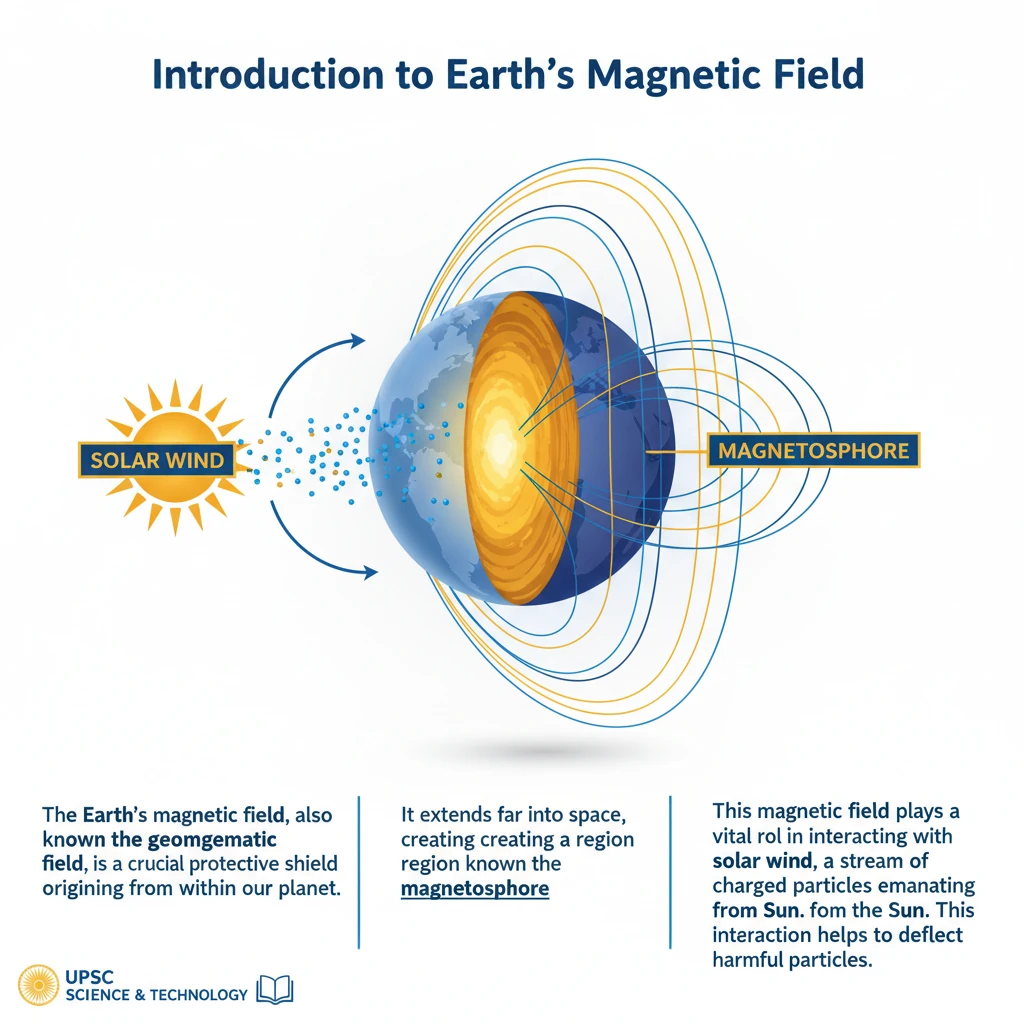
<h4>Introduction to Earth's Magnetic Field</h4><p>The <strong>Earth's magnetic field</strong>, also known as the <strong>geomagnetic field</strong>, is a crucial protective shield originating from within our planet. It extends far into space, creating a region known as the <strong>magnetosphere</strong>.</p><p>This magnetic field plays a vital role in interacting with the <strong>solar wind</strong>, a stream of charged particles emanating from the Sun. This interaction helps to deflect harmful radiation away from Earth.</p><div class='info-box'><p><strong>Definition:</strong> The <strong>geomagnetic field</strong> is the magnetic field that extends from the Earth's interior out into space, where it meets the solar wind.</p></div><h4>Mechanism of Generation: The Geodynamo Process</h4><p>The Earth's magnetic field is primarily generated by a complex process called the <strong>geodynamo process</strong>. This process occurs deep within the Earth's <strong>outer core</strong>.</p><p>The outer core is composed of highly conductive <strong>molten iron</strong> and <strong>nickel</strong>. These molten metals are in constant motion due to <strong>convection currents</strong>, driven by the Earth's internal heat.</p><p>As these molten metals move, they carry <strong>charged particles</strong>. The movement of these charged particles generates electrical currents, which in turn produce magnetic fields. This creates a self-sustaining loop.</p><div class='key-point-box'><p>The <strong>geodynamo process</strong> converts <strong>convective energy</strong> from the slow-moving molten iron in the outer core into <strong>electrical</strong> and <strong>magnetic energy</strong>, inducing a <strong>positive feedback loop</strong> that sustains the field.</p></div><h4>Magnetic Fields on Other Planets</h4><p>While Earth possesses a strong magnetic field, it is not unique. Other gas giants in our solar system, such as <strong>Jupiter</strong>, <strong>Saturn</strong>, <strong>Uranus</strong>, and <strong>Neptune</strong>, also exhibit strong magnetic fields.</p><p>The exact mechanisms for these planetary magnetic fields are still subjects of ongoing research and are not yet fully understood by scientists.</p><div class='info-box'><p><strong>Planetary Comparisons:</strong></p><ul><li><strong>Mars:</strong> Lacks a magnetic field because it has lost most of its inner heat and does not possess a liquid interior necessary for a geodynamo.</li><li><strong>Venus:</strong> Possesses a liquid core but spins too slowly to generate the necessary convection currents and a strong magnetic field.</li></ul></div>
💡 Key Takeaways
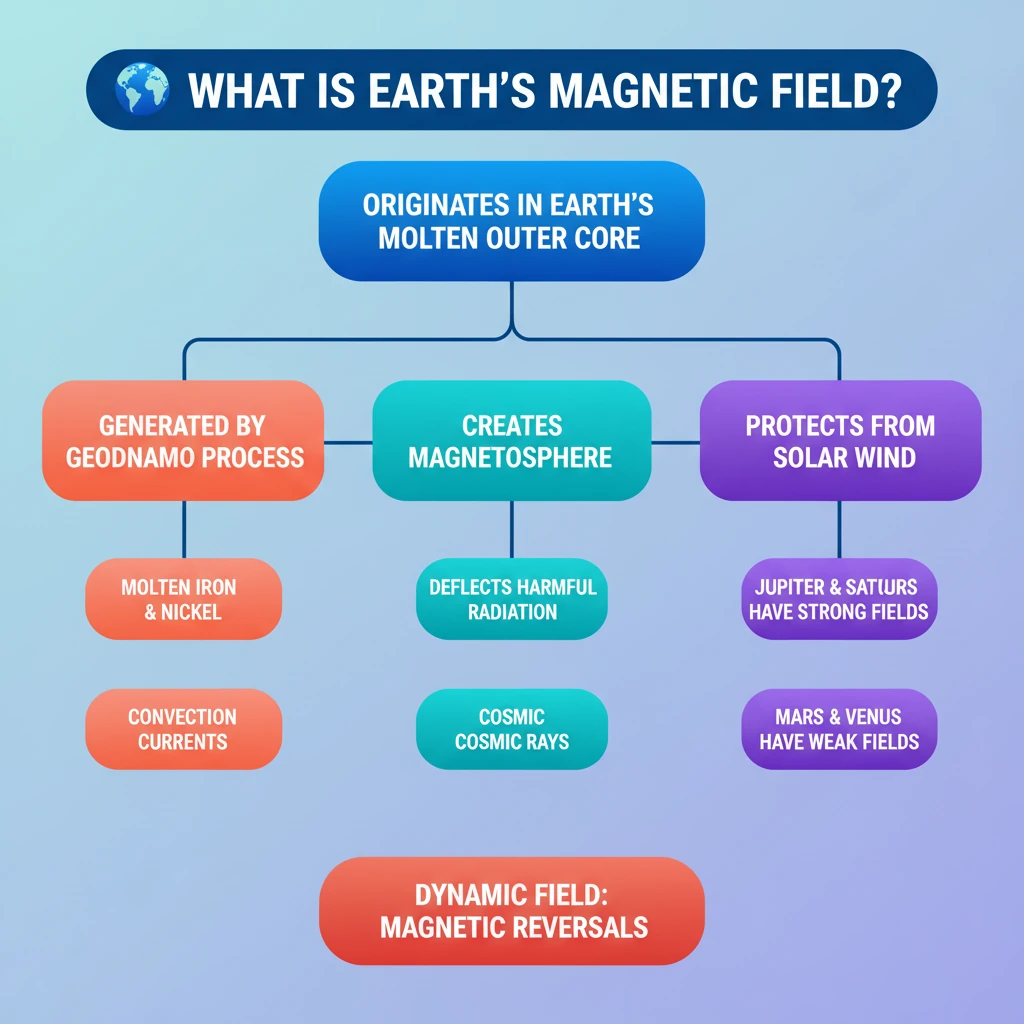
- •Earth's magnetic field, or geomagnetic field, originates in the planet's molten outer core.
- •It is generated by the geodynamo process, involving convection currents of molten iron and nickel.
- •The magnetic field creates the magnetosphere, which protects Earth from harmful solar wind and cosmic radiation.
- •Other planets like Jupiter and Saturn have strong magnetic fields, while Mars and Venus do not due to different internal conditions.
- •The field is dynamic, undergoing phenomena like magnetic reversals over geological timescales.
- •It is vital for satellite operations, animal navigation, and the long-term habitability of Earth.
🧠 Memory Techniques

98% Verified Content
📚 Reference Sources
•NASA Science: Earth's Magnetic Field
•National Geographic: Earth's Magnetic Field
•Encyclopaedia Britannica: Geomagnetism