Completion of SSLV Development Project - Science And Technology | UPSC Learning
Topics
0 topics • 0 completed
🔍
No topics match your search
Completion of SSLV Development Project
Medium⏱️ 10 min read
science and technology
📖 Introduction
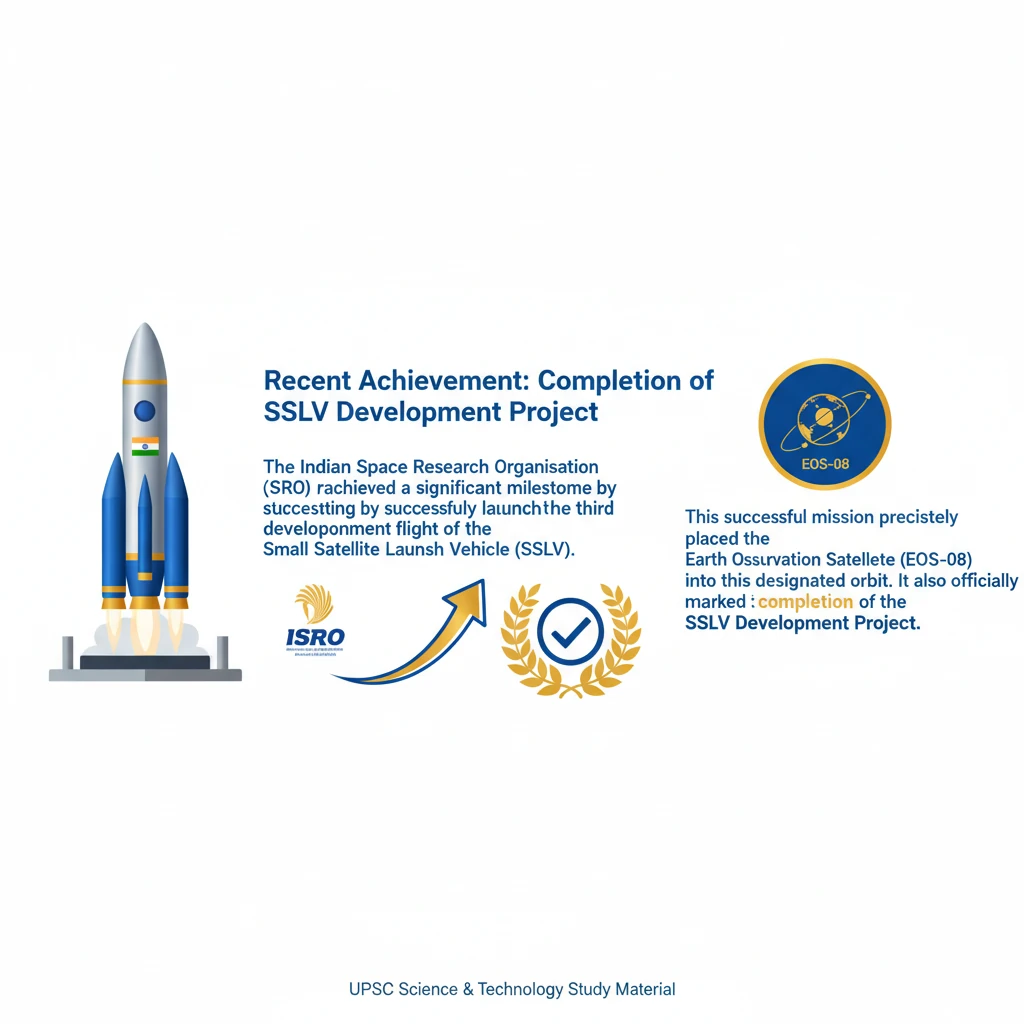
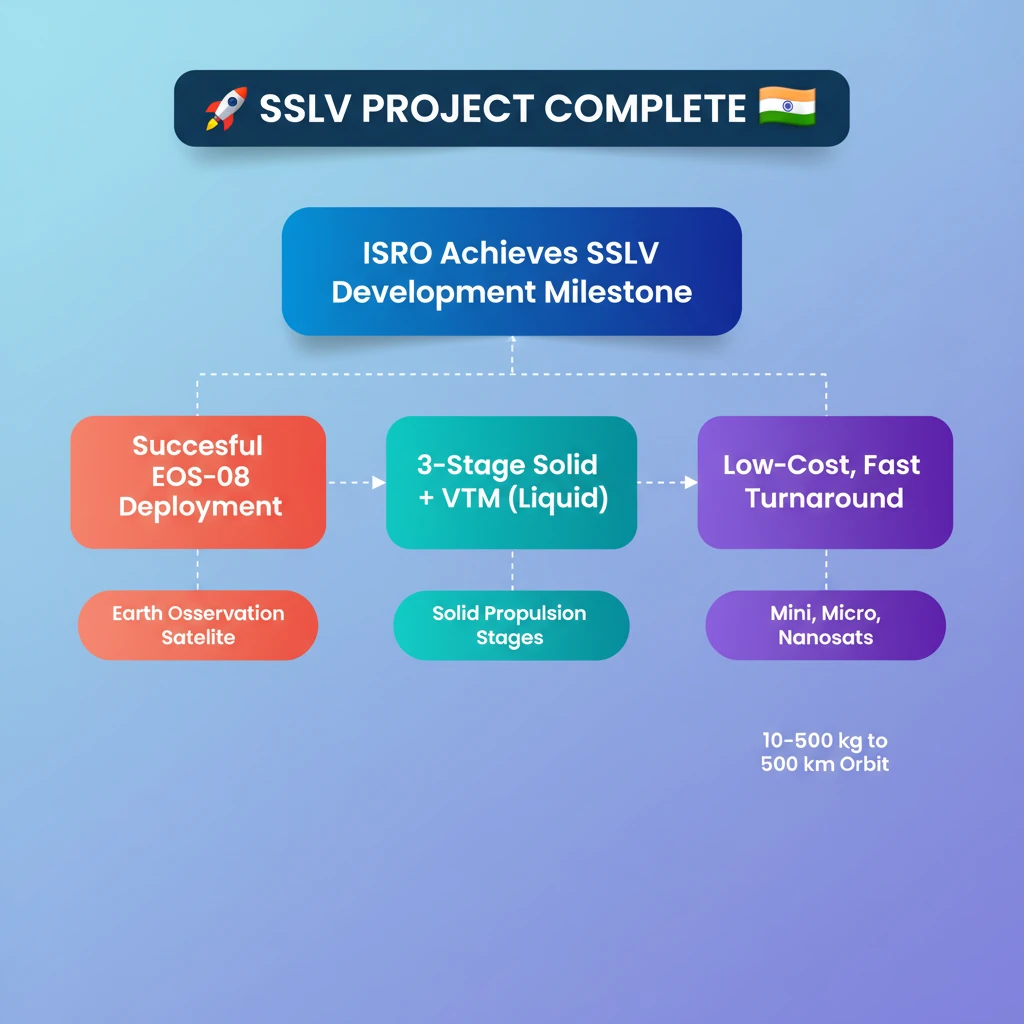
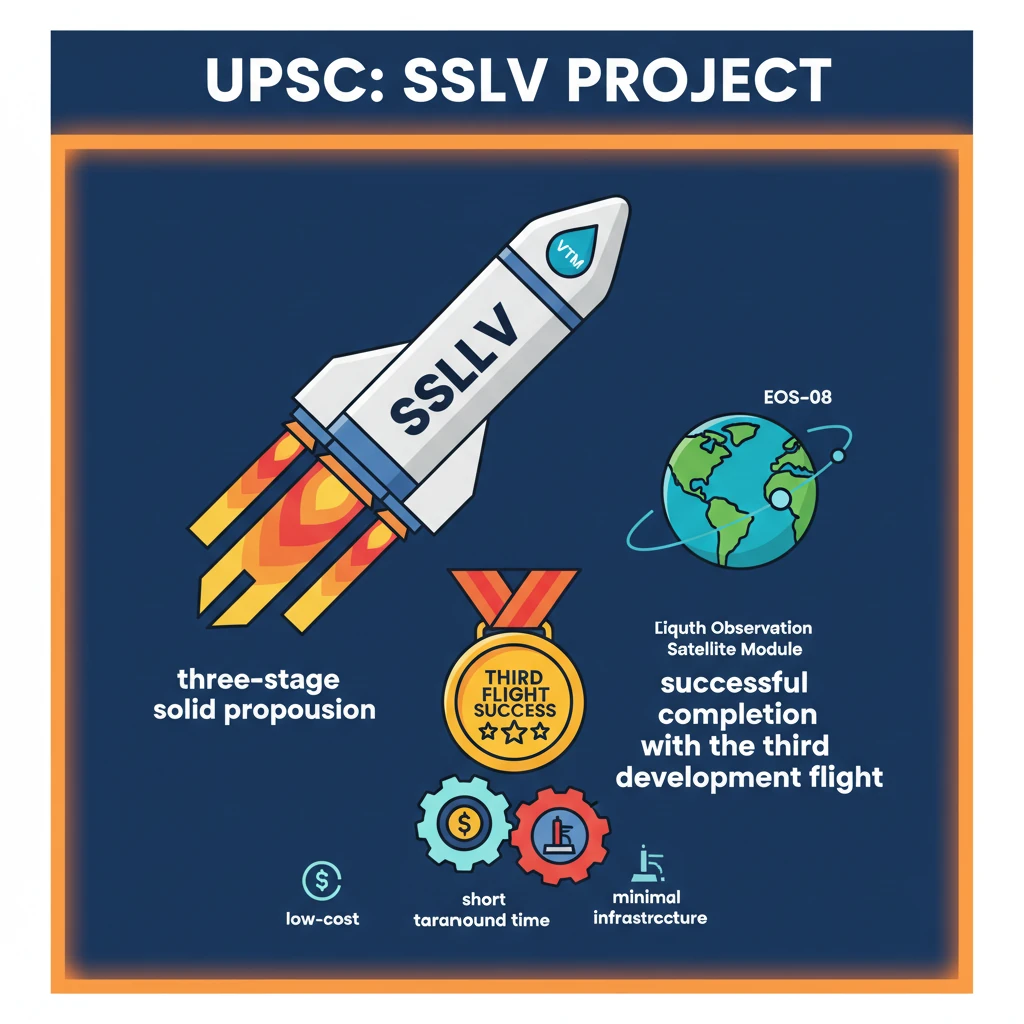
<h4>Recent Achievement: Completion of SSLV Development Project</h4><p>The <strong>Indian Space Research Organisation (ISRO)</strong> recently achieved a significant milestone by successfully launching the <strong>third developmental flight</strong> of the <strong>Small Satellite Launch Vehicle (SSLV)</strong>.</p><p>This successful mission precisely placed the <strong>Earth Observation Satellite (EOS-08)</strong> into its designated orbit. It also officially marked the <strong>completion</strong> of the <strong>ISRO/Department of Space’s SSLV Development Project</strong>.</p><div class='info-box'><p><strong>Key Event:</strong> Third developmental flight of <strong>SSLV</strong>.</p><p><strong>Payload:</strong> <strong>Earth Observation Satellite (EOS-08)</strong>.</p><p><strong>Outcome:</strong> Project completion and successful orbit insertion.</p></div><h4>Understanding the Small Satellite Launch Vehicle (SSLV)</h4><p>The <strong>SSLV</strong> is conceptualized as a versatile launch vehicle, primarily designed for placing smaller satellites into orbit efficiently. It is configured with a <strong>three-stage propulsion system</strong>.</p><div class='info-box'><p><strong>SSLV Configuration:</strong></p><ul><li><strong>Three Solid Propulsion Stages:</strong> These provide the primary thrust for the initial phases of the flight.</li><li><strong>Velocity Trimming Module (VTM):</strong> A liquid propulsion-based terminal stage used for precise velocity adjustments to accurately place the satellite in orbit.</li></ul></div><h4>Strategic Need for SSLVs</h4><p>The development of <strong>SSLVs</strong> addresses a crucial demand in the global space market for more agile and cost-effective launch solutions. The primary objectives behind its creation are:</p><div class='key-point-box'><p><strong>Objectives of SSLV Development:</strong></p><ul><li>To create <strong>low-cost launch vehicles</strong>.</li><li>To ensure <strong>short turnaround times</strong> between launches.</li><li>To require <strong>minimal infrastructural requirements</strong> for launch operations.</li></ul></div><h4>Payload Capacity and Orbital Capabilities</h4><p>The <strong>SSLV</strong> is specifically designed to cater to the growing segment of small satellites. It offers a reliable and dedicated launch option for various types of payloads.</p><div class='info-box'><p><strong>SSLV Capabilities:</strong></p><ul><li><strong>Payload Mass:</strong> Capable of launching <strong>Mini, Micro, or Nanosatellites</strong>, ranging from <strong>10 kg to 500 kg</strong>.</li><li><strong>Orbital Altitude:</strong> Can deploy satellites into a <strong>500 km Low Earth Orbit (LEO)</strong>.</p></div><h4>UPSC Relevance: India's Space Program</h4><div class='exam-tip-box'><p>The <strong>SSLV project completion</strong> signifies India's commitment to strengthening its indigenous space capabilities and capturing a larger share of the global commercial satellite launch market. This is relevant for <strong>GS Paper III: Science and Technology</strong>, specifically under 'Space' and 'Achievements of Indians in Science & Technology'.</p></div>
💡 Key Takeaways
- •ISRO successfully completed the SSLV Development Project with the third developmental flight.
- •The mission deployed the Earth Observation Satellite (EOS-08) precisely into orbit.
- •SSLV is a three-stage solid propulsion vehicle with a liquid propulsion-based Velocity Trimming Module (VTM).
- •It is designed for low-cost, short turnaround time, and minimal infrastructure launches.
- •Capable of launching Mini, Micro, or Nanosatellites (10-500 kg) into a 500 km orbit.
- •Strengthens India's commercial space capabilities and strategic autonomy in small satellite launches.
🧠 Memory Techniques
98% Verified Content
📚 Reference Sources
•ISRO Official Website (for general context on SSLV and EOS-08)