What are the Key Features of Thirty Meter Telescope (TMT)? - Science And Technology | UPSC Learning
Topics
0 topics • 0 completed
🔍
No topics match your search
What are the Key Features of Thirty Meter Telescope (TMT)?
Medium⏱️ 8 min read
science and technology
📖 Introduction
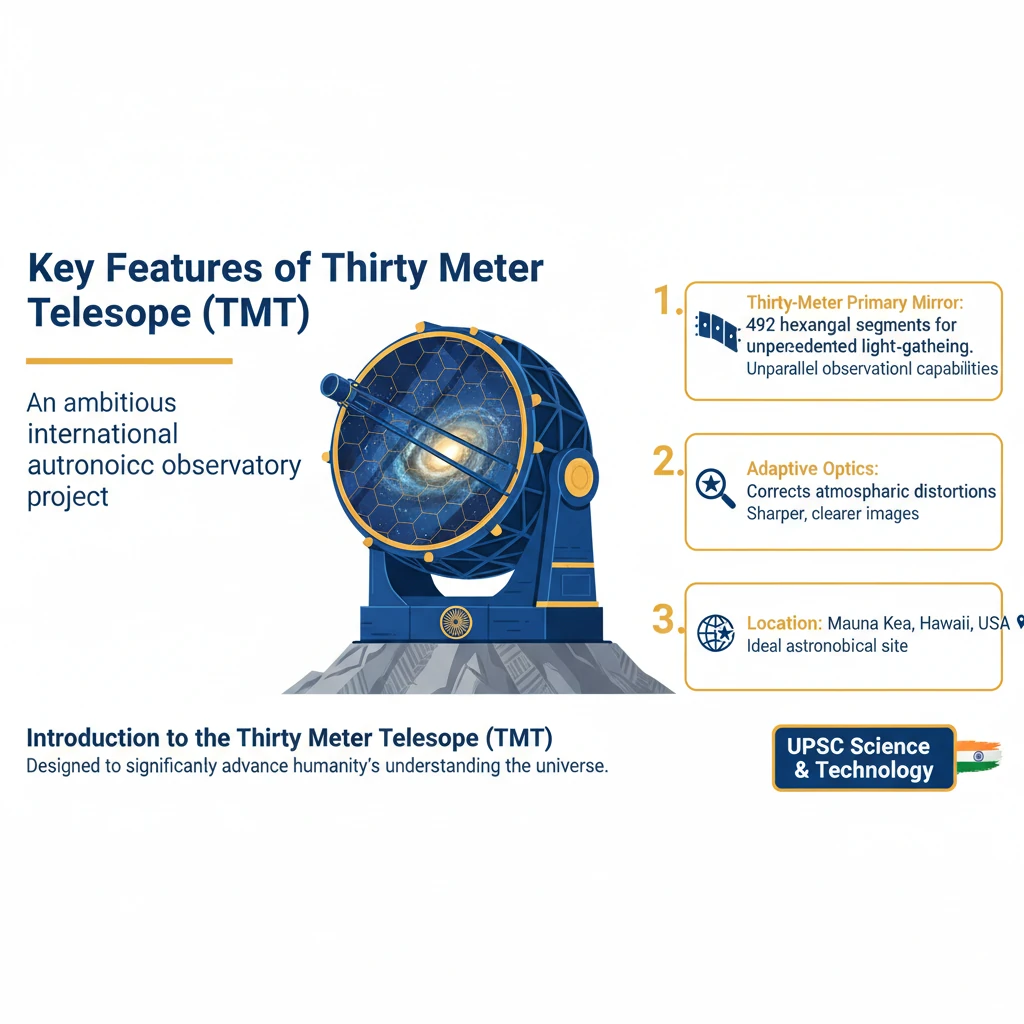
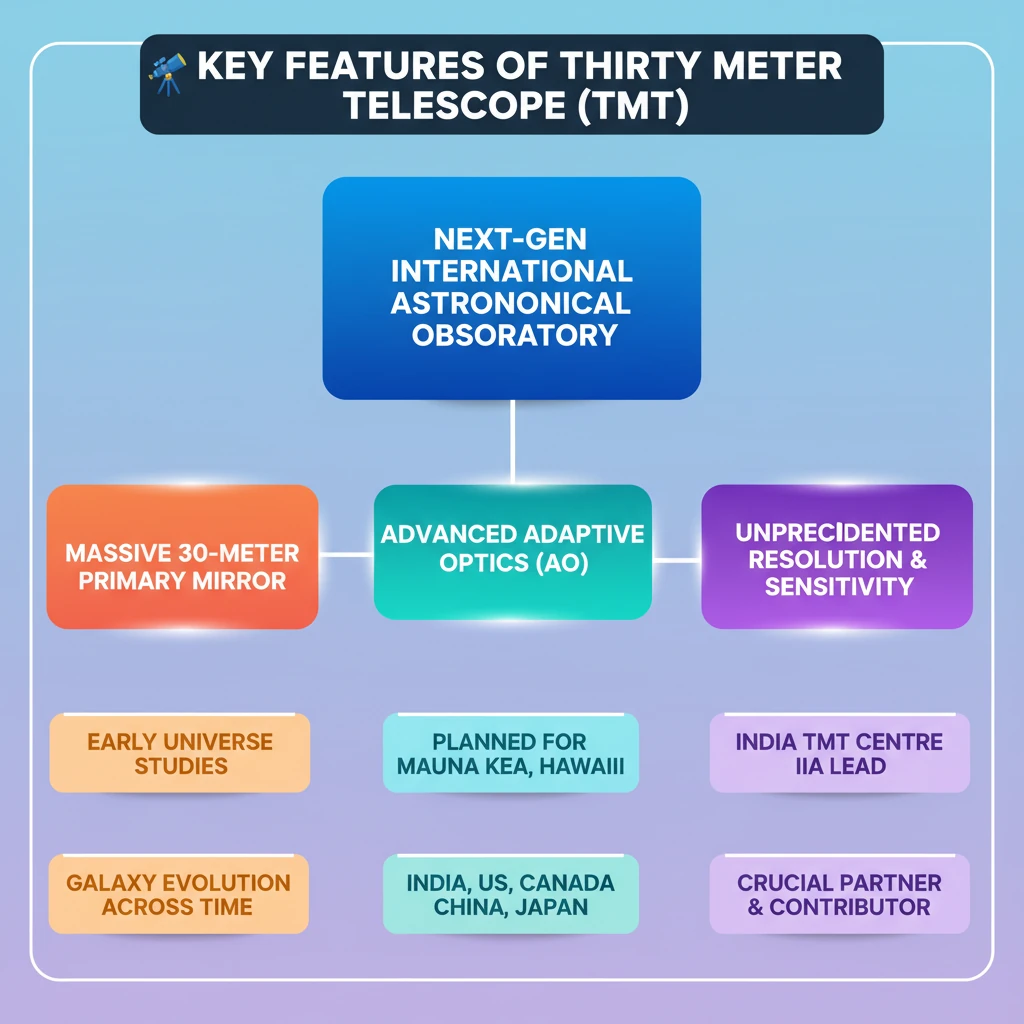
<h4>Introduction to the Thirty Meter Telescope (TMT)</h4><p>The <strong>Thirty Meter Telescope (TMT)</strong> is an ambitious international astronomical observatory project.</p><p>It is designed to significantly advance humanity's understanding of the <strong>universe</strong> through unparalleled observational capabilities.</p><div class='info-box'><p><strong>Location:</strong> The TMT is planned to be established at <strong>Mauna Kea</strong> in <strong>Hawaii</strong>, USA 📍, a site renowned for its excellent astronomical viewing conditions.</p></div><h4>International Collaboration and India's Role</h4><p>The <strong>TMT project</strong> involves a consortium of several nations working together to realize this monumental scientific endeavor.</p><p>Key partner countries contributing to this global initiative include <strong>India</strong>, the <strong>United States (US)</strong>, <strong>Canada</strong>, <strong>China</strong>, and <strong>Japan</strong>.</p><div class='key-point-box'><p><strong>India</strong> is a crucial partner in the TMT project. The <strong>India TMT Centre</strong>, primarily based at the <strong>Indian Institute of Astrophysics (IIA)</strong>, leads the national collaboration and contributions.</p></div><h4>Advanced Technical Features of TMT</h4><p>The <strong>TMT</strong> is engineered as a <strong>next-generation astronomical observatory</strong>, pushing the boundaries of ground-based astronomy.</p><p>It is designed to provide unprecedented <strong>resolution</strong> and <strong>sensitivity</strong>, allowing for detailed observations of distant and faint celestial objects.</p><ul><li><strong>Primary Mirror:</strong> It features a massive <strong>30-meter primary mirror</strong>, which is the core light-gathering component. This mirror is segmented, composed of 492 hexagonal segments.</li><li><strong>Adaptive Optics System:</strong> An advanced <strong>adaptive optics system</strong> is integral to TMT, designed to correct distortions caused by Earth's atmosphere, ensuring sharper images.</li><li><strong>State-of-the-Art Instruments:</strong> The telescope will be equipped with cutting-edge instruments optimized for various observational modes, including imaging and spectroscopy.</li></ul><h4>Primary Scientific Objectives</h4><p>The <strong>TMT</strong> has specific, ambitious scientific goals aimed at addressing fundamental questions about the cosmos.</p><ul><li><strong>Early Universe Studies:</strong> A key objective is to study the <strong>early universe</strong>, focusing on the formation and evolution of the <strong>first galaxies and stars</strong> that emerged shortly after the <strong>Big Bang</strong>.</li><li><strong>Galaxy Evolution:</strong> It will investigate the formation, structure, and evolution of <strong>galaxies across cosmic time</strong>, from their nascent stages to their mature forms.</li></ul><h4>Context in Ground-Based Astronomy</h4><p>The <strong>TMT</strong> is recognized as a cornerstone project representing the future of <strong>ground-based astronomy</strong>.</p><p>It is part of a new generation of extremely large telescopes designed to significantly surpass the capabilities of existing observatories.</p><div class='info-box'><p><strong>Peer Telescopes:</strong> The <strong>TMT</strong> stands alongside other monumental projects such as the <strong>Giant Magellan Telescope (GMT)</strong> and the <strong>European Southern Observatory’s Extremely Large Telescope (ELT)</strong>, collectively shaping the future of astronomical discovery.</p></div>
💡 Key Takeaways
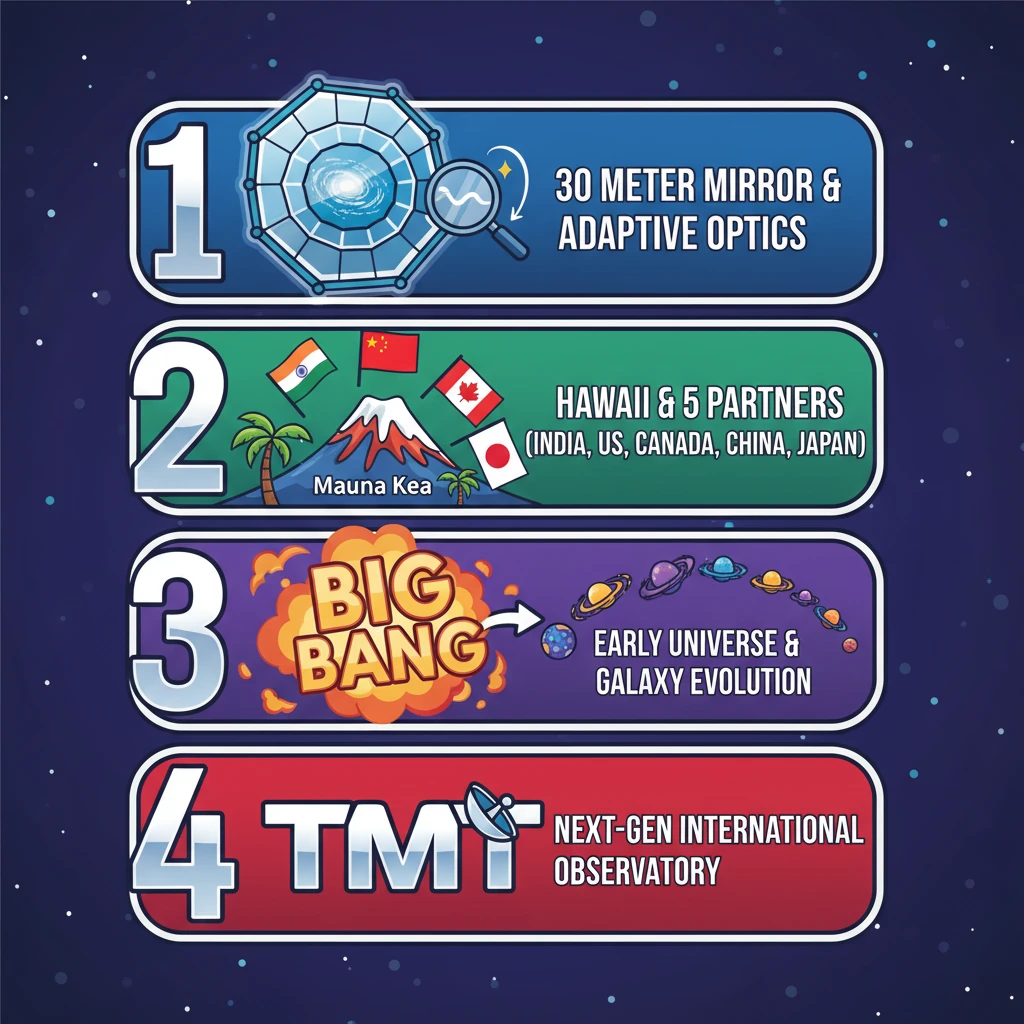
- •Thirty Meter Telescope (TMT) is a next-generation international astronomical observatory project.
- •It is planned for Mauna Kea, Hawaii, with key partners including India, US, Canada, China, and Japan.
- •Features a massive 30-meter primary mirror and advanced adaptive optics for unprecedented resolution and sensitivity.
- •Primary scientific goals are to study the early universe (post-Big Bang) and the evolution of galaxies across cosmic time.
- •India is a crucial partner, with the India TMT Centre at IIA leading the national collaboration and contributions.
- •TMT, along with GMT and ELT, represents the future of ground-based astronomy, pushing the boundaries of discovery.
🧠 Memory Techniques
95% Verified Content
📚 Reference Sources
•Official Thirty Meter Telescope (TMT) Project Website (tmt.org)
•Indian Institute of Astrophysics (IIA) publications and project pages related to TMT