Discovery of Dark Oxygen - Science And Technology | UPSC Learning
Topics
0 topics • 0 completed
🔍
No topics match your search
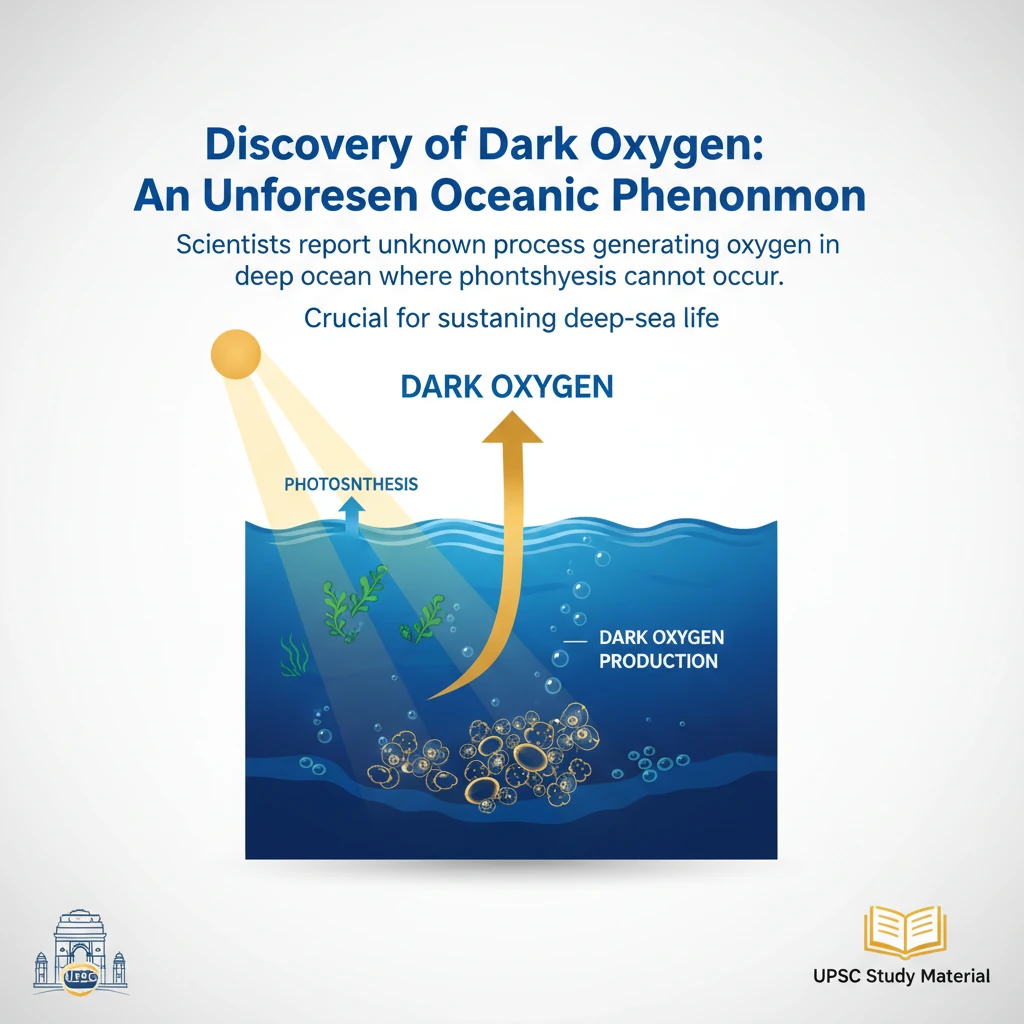
Discovery of Dark Oxygen
Medium⏱️ 8 min read
science and technology
📖 Introduction
<h4>Discovery of Dark Oxygen: An Unforeseen Oceanic Phenomenon</h4><p>Recently, scientists have made a significant report regarding an unknown process generating <strong>oxygen</strong> deep within the world's oceans. This occurs in regions where <strong>photosynthesis</strong>, the primary natural oxygen production method, cannot take place due to the complete absence of sunlight.</p><p>This groundbreaking discovery holds immense importance because <strong>oxygen</strong> is fundamental for supporting all forms of <strong>marine life</strong>. It strongly suggests the potential existence of previously unknown <strong>ecosystems</strong> thriving in these deep-sea environments.</p><div class='info-box'><p><strong>Key Observation:</strong> Scientists observed an unexpected increase in <strong>oxygen concentration</strong> in specific areas of the <strong>abyssal zone</strong>, a region characterized by extremely low sunlight insufficient for photosynthesis.</p></div><h4>What is Dark Oxygen?</h4><p>Researchers have termed this newly found source of oxygen, which is generated without the process of photosynthesis, as <strong>'dark oxygen'</strong>. This term highlights its mysterious origin in the dark, sunless depths of the ocean.</p><div class='key-point-box'><p><strong>Definition:</strong> <strong>Dark Oxygen</strong> refers to oxygen produced in the deep ocean where sunlight is absent, challenging the conventional understanding that photosynthesis is the sole biological source of oxygen.</p></div><h4>Possible Cause of Dark Oxygen Generation</h4><p>Typically, oxygen is supplied to deep ocean waters by the <strong>'Great Conveyor Belt'</strong>, a global oceanic circulation system. This system transports oxygen-rich surface waters to the depths.</p><p>Without local production, oxygen levels would normally decrease in the deep ocean as small marine animals consume it. The observation of increasing oxygen levels suggests an active, local production mechanism distinct from this global circulation.</p><div class='exam-tip-box'><p><strong>UPSC Insight:</strong> The discovery of <strong>Dark Oxygen</strong> is relevant for <strong>GS-III Science & Technology</strong> (new discoveries, oceanography) and <strong>Environment & Ecology</strong> (marine ecosystems, oxygen cycle). Be prepared to discuss its implications for marine life and climate science.</p></div><h4>Indian Submarine Strength: A Strategic Overview (Context from Source Material)</h4><p><em>(Note: The original source material included the following information about India's submarine fleet alongside the 'Discovery of Dark Oxygen' topic. This section presents that information separately for clarity and completeness.)</em></p><p>India possesses a formidable submarine fleet, including several nuclear-powered ballistic missile submarines (SSBNs) and nuclear-powered attack submarines (SSNs), alongside conventional diesel-electric submarines.</p><ul><li><strong>Indigenous Content:</strong> India's current submarine capabilities feature approximately <strong>75% indigenous content</strong>.</li><li><strong>Missile Capability:</strong> These submarines are equipped with <strong>Kalam-4 nuclear ballistic missiles</strong>, boasting a range of <strong>3,500 km</strong>, launched via vertical systems.</li></ul><div class='info-box'><p><strong>India's Nuclear Submarine Fleet:</strong></p><ul><li><strong>INS Arihant</strong> (Operational SSBN)</li><li><strong>INS Arighat</strong> (SSBN, commissioned/under trials)</li><li><strong>INS Aridhaman</strong> (SSBN, under construction)</li></ul></div><h4>Leased Submarines and Future Plans</h4><p>India has also leveraged leasing agreements to enhance its naval capabilities. A <strong>nuclear-powered attack submarine</strong> of the Russian <strong>Akula class</strong> is slated to join the force on lease in <strong>2028</strong>.</p><p>Previously, <strong>INS Chakra</strong>, another <strong>Akula class</strong> vessel, was taken on lease from Russia in <strong>2012</strong>, significantly boosting India's underwater warfare capabilities.</p><p>Looking ahead, the government plans the construction of <strong>three more advanced diesel attack submarines</strong>. These will be built at <strong>Mazagon Dockyards</strong> in collaboration with the <strong>French Naval Group</strong>, emphasizing indigenous manufacturing and international partnerships.</p><h4>Understanding Nuclear Submarine Propulsion</h4><p>A <strong>nuclear submarine</strong> utilizes a <strong>nuclear reactor</strong> for its propulsion system. This provides a distinct advantage over conventional submarines.</p><div class='key-point-box'><p><strong>Advantages of Nuclear Propulsion:</strong></p><ul><li><strong>Unlimited Range:</strong> A nuclear reactor provides virtually unlimited range.</li><li><strong>Extended Endurance:</strong> It offers exceptional endurance, allowing submarines to stay submerged for very long periods.</li></ul></div><p>The operational limits of a nuclear submarine are primarily dictated by factors such as <strong>food supplies</strong> for the crew, <strong>crew fatigue</strong>, and the necessity for periodic <strong>maintenance</strong>, rather than fuel capacity.</p><div class='exam-tip-box'><p><strong>UPSC Insight:</strong> India's submarine program is crucial for <strong>GS-III Internal Security</strong> (maritime security, deterrence) and <strong>GS-II International Relations</strong> (geopolitics, strategic partnerships). Questions may focus on indigenous defense capabilities and strategic implications.</p></div>
💡 Key Takeaways
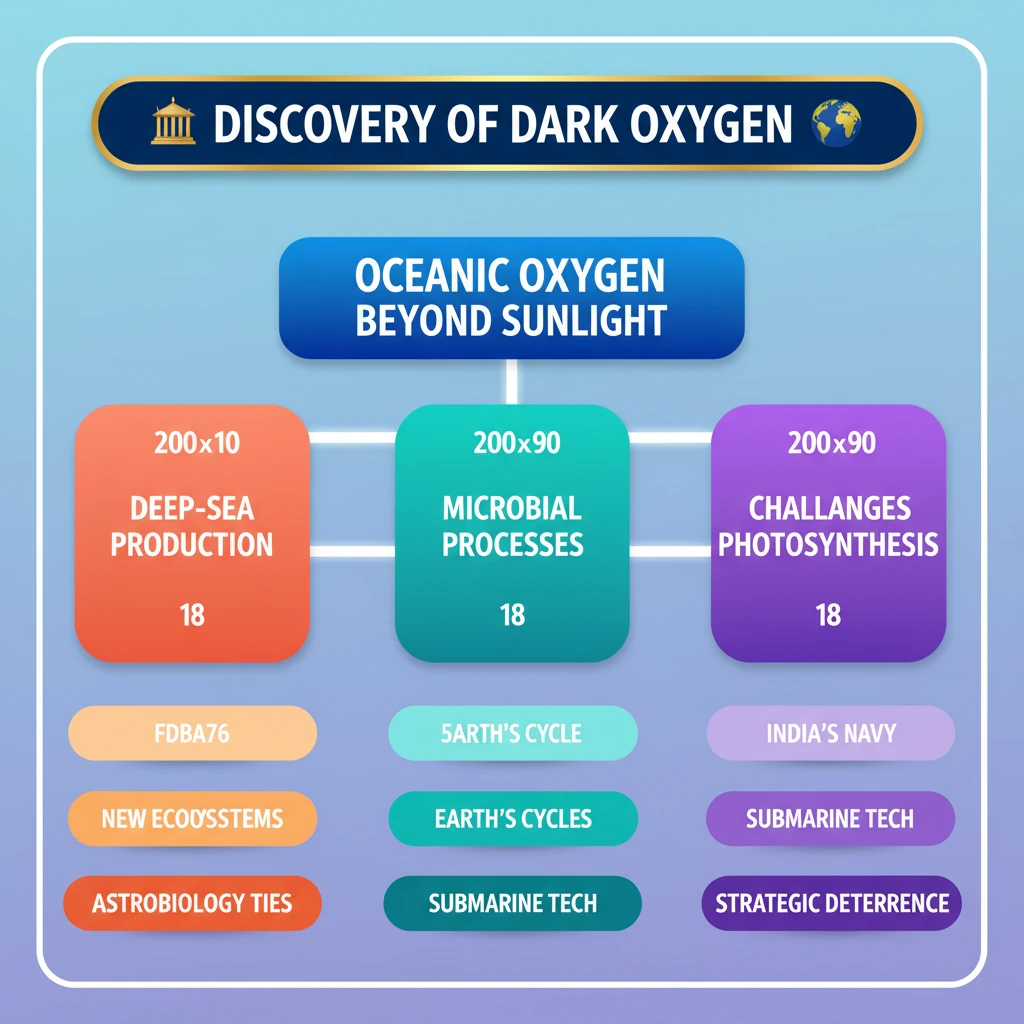
- •Dark Oxygen refers to oxygen produced deep in the oceans without sunlight, challenging the role of photosynthesis.
- •This discovery suggests previously unknown deep-sea ecosystems and microbial processes.
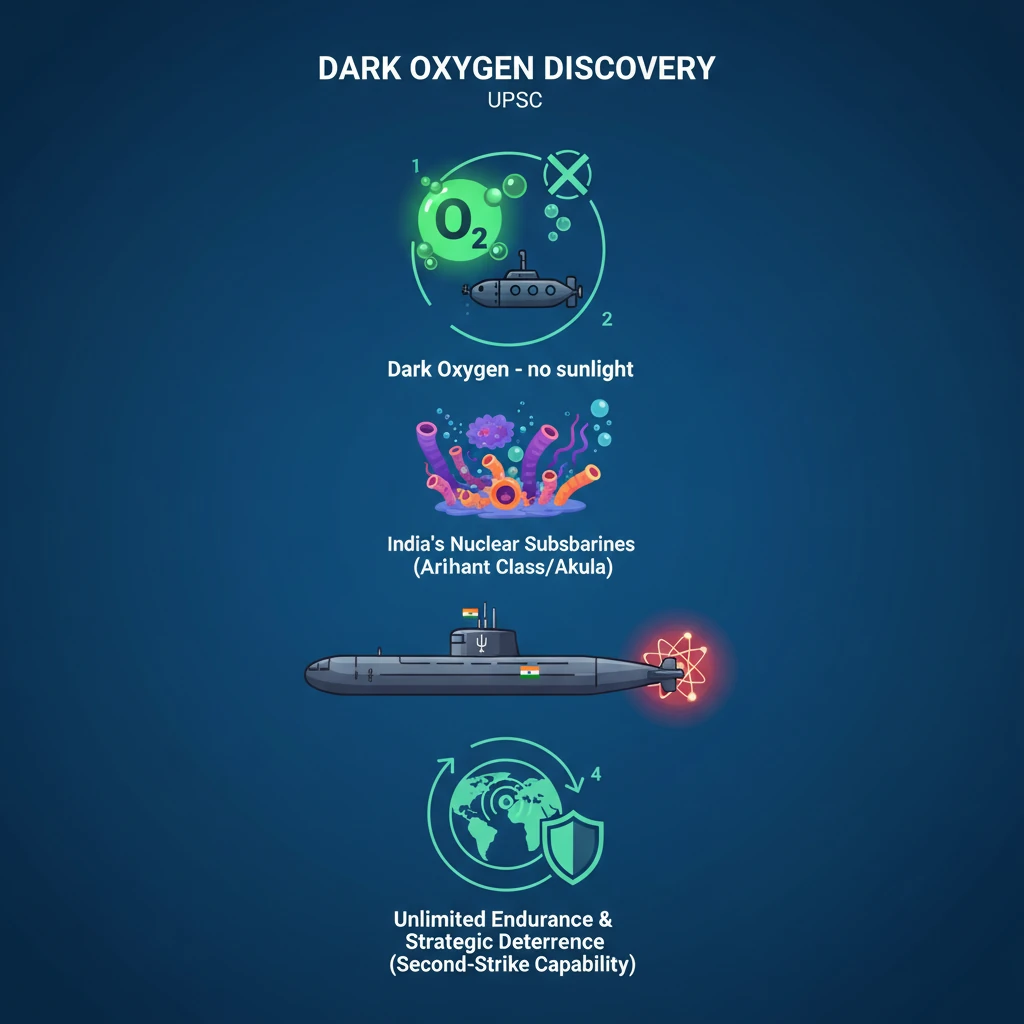
- •India's submarine fleet includes indigenous nuclear ballistic missile submarines (Arihant class) and leased Akula-class nuclear attack submarines.
- •Nuclear submarines provide unlimited range and endurance, crucial for India's strategic deterrence and second-strike capability.
- •The discovery of Dark Oxygen has implications for astrobiology and understanding Earth's biogeochemical cycles.
- •India's submarine program is vital for its maritime security, blue water navy aspirations, and 'Make in India' defense initiative.
🧠 Memory Techniques
95% Verified Content
📚 Reference Sources
•General scientific literature on deep-sea biology and oceanography
•Reports and analyses on India's naval capabilities and defense strategy