Eliminating Kala-azar - Science And Technology | UPSC Learning
Topics
0 topics • 0 completed
🔍
No topics match your search
Eliminating Kala-azar
Medium⏱️ 7 min read
science and technology
📖 Introduction
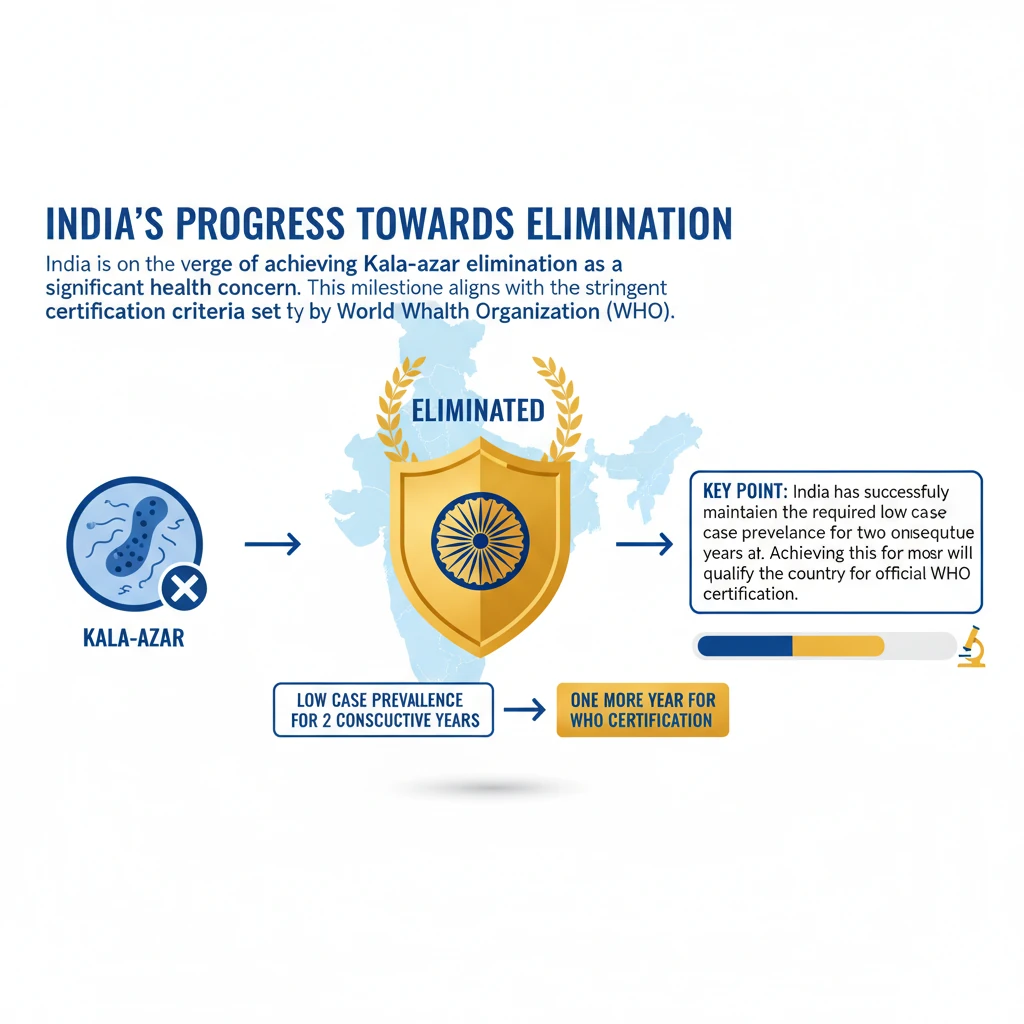
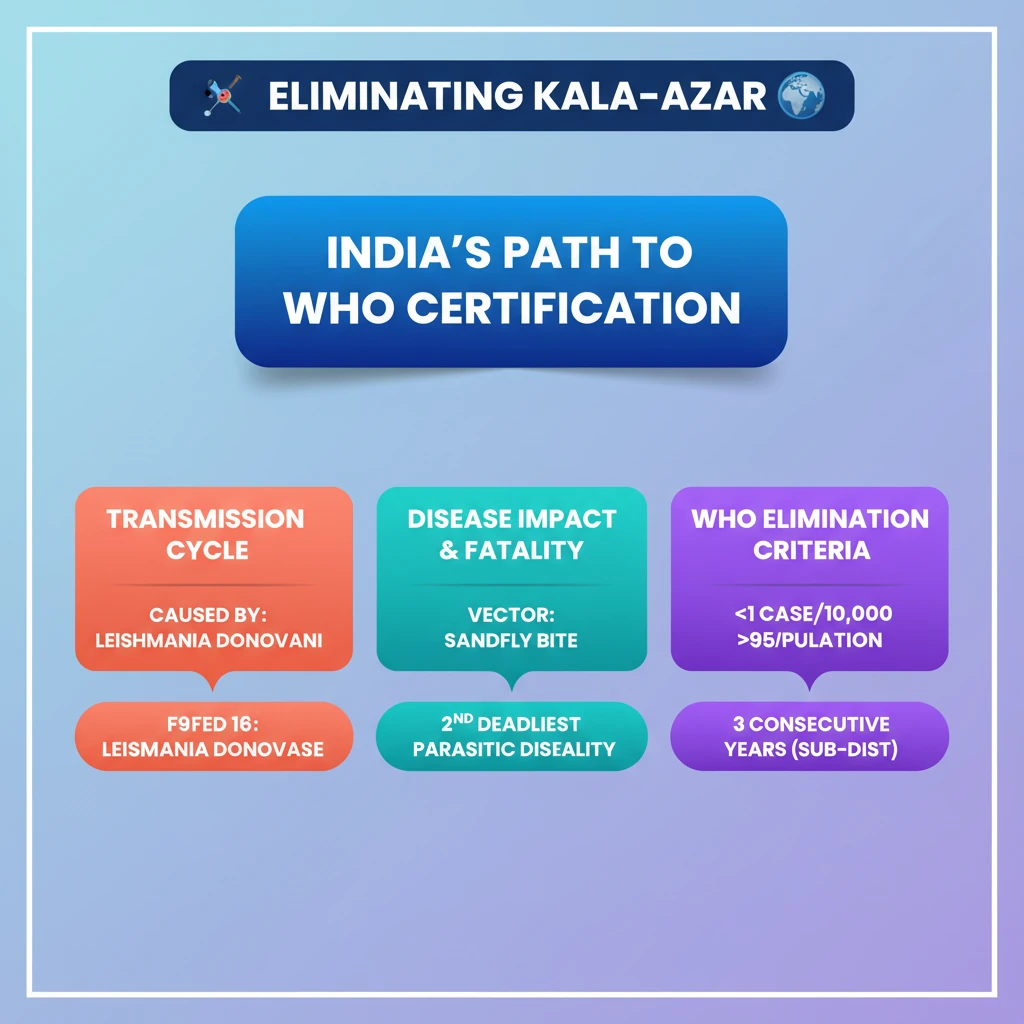
<h4>India's Progress Towards Elimination</h4><p>India is on the verge of achieving <strong>Kala-azar elimination</strong> as a significant public health concern. This milestone aligns with the stringent certification criteria set by the <strong>World Health Organization (WHO)</strong>.</p><div class='key-point-box'><p>India has successfully maintained the required low case prevalence for <strong>two consecutive years</strong>. Achieving this for one more year will qualify the country for official certification.</p></div><h4>WHO Certification Criteria</h4><p>To receive <strong>WHO certification</strong> for eliminating <strong>Kala-azar</strong>, a country must meet specific public health benchmarks. These criteria ensure sustained control and prevention of re-emergence.</p><div class='info-box'><p><strong>Key Criteria:</strong></p><ul><li>Maintain <strong>less than one case per 10,000 population</strong> at the sub-district level.</li><li>Sustain this low prevalence for <strong>three consecutive years</strong>.</li><li>Demonstrate interruption of <strong>local transmission</strong> for a set period.</li><li>Establish a robust system to prevent disease <strong>re-emergence</strong>.</li></ul></div><h4>Disease Overview: Kala-azar (Visceral Leishmaniasis)</h4><p><strong>Kala-azar</strong>, also known as <strong>visceral leishmaniasis</strong> or <strong>black fever</strong>, is a severe parasitic disease. It represents a significant health challenge, particularly in endemic regions.</p><div class='info-box'><p><strong>Causative Agent:</strong> The disease is caused by the protozoan parasite <strong><em>Leishmania donovani</em></strong>.</p><p><strong>Transmission:</strong> It is transmitted through the bite of an infected female <strong>sandfly</strong>.</p><p><strong>Severity:</strong> If left untreated, <strong>Kala-azar</strong> is fatal in over <strong>95% of cases</strong>.</p></div><p>Globally, <strong>Kala-azar</strong> is the <strong>second deadliest parasitic disease</strong> after <strong>malaria</strong>. Its elimination is crucial for public health and socio-economic development.</p><h4>Global and National Elimination Targets</h4><p>India had initially set an ambitious target to eliminate <strong>Kala-azar</strong> by <strong>2020</strong>. While this target was slightly missed, significant progress has been made.</p><div class='exam-tip-box'><p><strong>UPSC Insight:</strong> Note the difference between national and global targets. India's progress is a testament to focused public health interventions, relevant for <strong>GS2 (Health)</strong>.</p></div><p>The <strong>WHO</strong> aims for global elimination of <strong>Kala-azar</strong> by <strong>2030</strong>. This is part of its broader roadmap for addressing <strong>Neglected Tropical Diseases (NTDs)</strong>.</p><p>Upon achieving certification, India will become the <strong>second country in the world</strong>, after <strong>Bangladesh</strong>, to eliminate <strong>Kala-azar</strong> as a public health problem.</p>
💡 Key Takeaways
- •India is close to achieving WHO certification for Kala-azar elimination, needing one more year of sustained low incidence.
- •Kala-azar (visceral leishmaniasis) is caused by Leishmania donovani and transmitted by infected female sandflies.
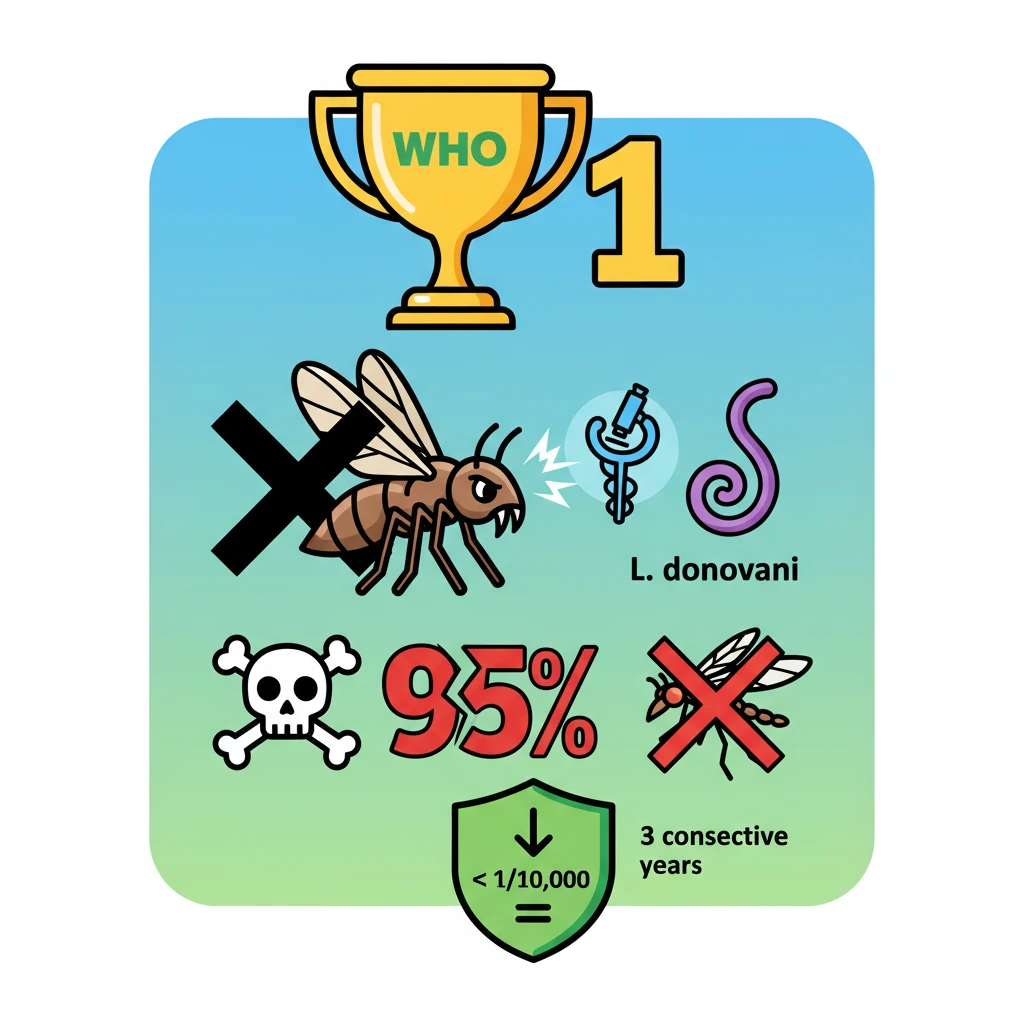
- •It is the second deadliest parasitic disease after malaria, fatal in over 95% of untreated cases.
- •WHO criteria require less than one case per 10,000 population at sub-district level for three consecutive years.
- •India will be the second country after Bangladesh to achieve this milestone, contributing to WHO's 2030 NTD roadmap.
🧠 Memory Techniques
95% Verified Content
📚 Reference Sources
•World Health Organization (WHO) website - Neglected Tropical Diseases (NTDs)
•Ministry of Health & Family Welfare, Government of India - National Health Programs