What Discovery of microRNA led to the Nobel Prize? - Science And Technology | UPSC Learning
Topics
0 topics • 0 completed
🔍
No topics match your search
What Discovery of microRNA led to the Nobel Prize?
Medium⏱️ 7 min read
science and technology
📖 Introduction
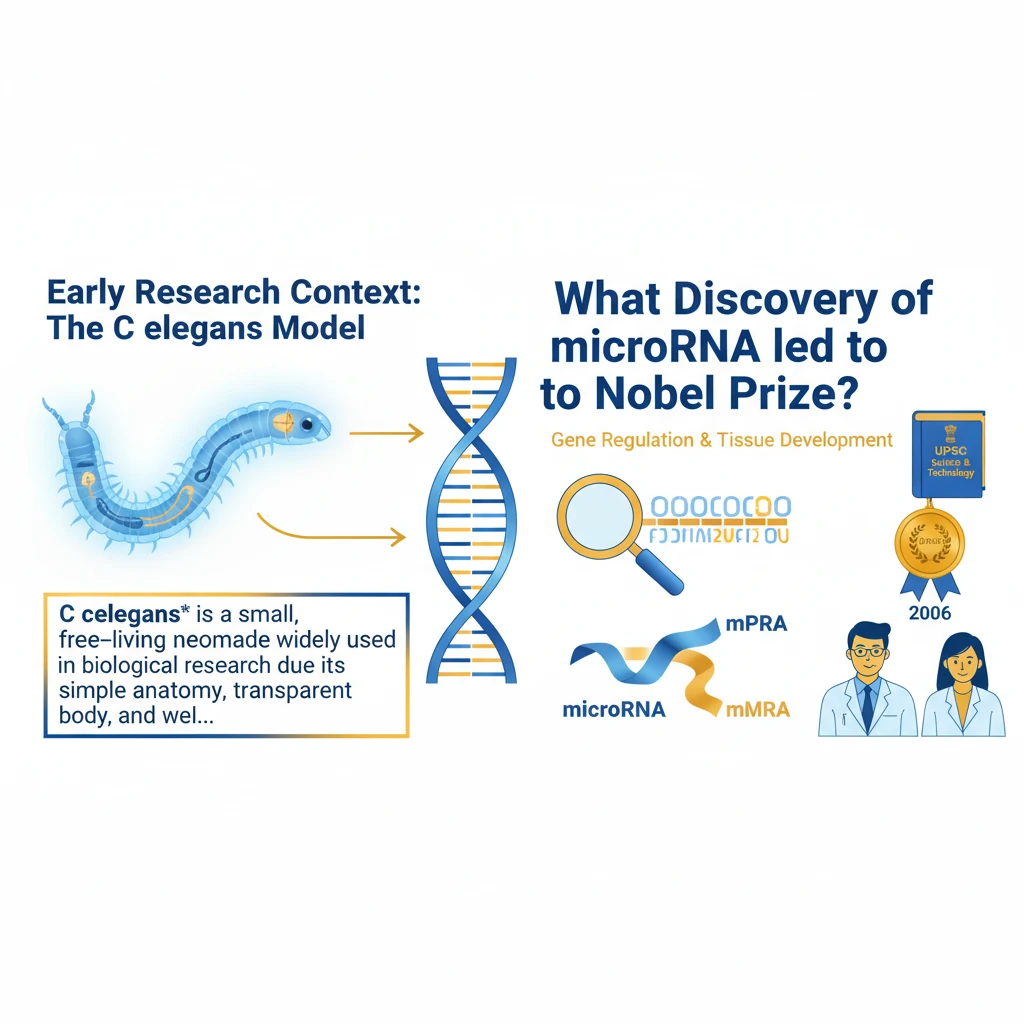
<h4>Early Research Context: The C. elegans Model</h4><p>The foundational research leading to the discovery of microRNA involved studying the roundworm, <strong>Caenorhabditis elegans (C. elegans)</strong>. Scientists aimed to understand the intricate processes of <strong>tissue development</strong> in this model organism.</p><div class='info-box'><p><strong>C. elegans</strong> is a small, free-living nematode widely used in biological research due to its simple anatomy, transparent body, and well-characterized genome, making it ideal for genetic studies.</p></div><p>Researchers focused on specific <strong>mutant strains</strong> of <strong>C. elegans</strong>, particularly those exhibiting abnormalities in their <strong>genetic programming</strong>. These mutations provided crucial clues about developmental timing.</p><h4>Ambros's Initial Discoveries</h4><p>Dr. <strong>Victor Ambros</strong> conducted significant research on the <strong>lin-4</strong> mutant strain. He observed that <strong>lin-4</strong> played a role in suppressing the activity of another gene, <strong>lin-14</strong>.</p><p>Initially, the precise mechanism of this suppression was unclear. Ambros's team cloned the <strong>lin-4</strong> gene and made a groundbreaking observation: it produced a <strong>short RNA molecule</strong>.</p><div class='key-point-box'><p>Crucially, this <strong>short RNA molecule</strong> from <strong>lin-4</strong> did not possess <strong>protein-coding potential</strong>. This suggested that the RNA itself might be directly involved in inhibiting <strong>lin-14</strong> activity.</p></div><h4>Ruvkun's Complementary Findings</h4><p>Independently, Dr. <strong>Gary Ruvkun</strong> investigated the same genetic pathway. His research revealed that <strong>lin-4</strong> did not prevent the production of <strong>lin-14 messenger RNA (mRNA)</strong>.</p><p>Instead, <strong>lin-4</strong> regulated <strong>lin-14</strong> at a later stage, specifically by inhibiting its <strong>protein production</strong>. This indicated a post-transcriptional regulatory mechanism.</p><p>Ruvkun further discovered that a short sequence within <strong>lin-4 RNA</strong> had <strong>key complementary segments</strong> that matched sequences in the <strong>lin-14 mRNA</strong>.</p><h4>The Joint Discovery: Mechanism of microRNA Action</h4><p>The combined insights of <strong>Ambros</strong> and <strong>Ruvkun</strong> led to the pivotal discovery of how <strong>microRNAs</strong> function. They concluded that the <strong>lin-4 microRNA</strong> physically attaches to the <strong>lin-14 mRNA</strong>.</p><div class='key-point-box'><p>This attachment of <strong>lin-4 microRNA</strong> to <strong>lin-14 mRNA</strong> effectively blocks the process of <strong>protein production</strong> from the <strong>lin-14 mRNA</strong>, thereby regulating gene expression.</p></div><h4>Significance and Further Discoveries</h4><p>The discovery of <strong>lin-4</strong> was monumental, identifying the first known <strong>microRNA</strong>. Its significance was further underscored by subsequent findings.</p><p>Ruvkun's group later identified another crucial microRNA named <strong>let-7</strong>. This discovery was particularly impactful because <strong>let-7</strong> was found to be present throughout the <strong>animal kingdom</strong>, highlighting the widespread importance of microRNAs.</p><div class='exam-tip-box'><p>The discovery of <strong>microRNAs</strong> revolutionized our understanding of <strong>gene regulation</strong>, moving beyond the traditional view of protein-coding genes as the sole regulators. This concept is vital for <strong>UPSC Mains GS Paper III (Science & Technology)</strong>, especially topics related to biotechnology and genetics.</p></div><h4>Understanding Key Terms</h4><ul><li><strong>Lin-4:</strong> It is a <strong>microRNA</strong>, identified from a study of <strong>developmental timing</strong> in the nematode <strong>Caenorhabditis elegans</strong>. It was the first to be discovered of the miRNAs, a class of <strong>non-coding RNAs</strong> involved in <strong>gene regulation</strong>.</li><li><strong>Lin-14:</strong> It is a <strong>heterochronic gene</strong> that controls the <strong>timing of developmental events</strong> in nematode <strong>Caenorhabditis elegans</strong>.</li><li><strong>Heterochronic genes:</strong> These are genes that control the <strong>timing of cell and tissue development</strong> in an organism.</li></ul>
💡 Key Takeaways
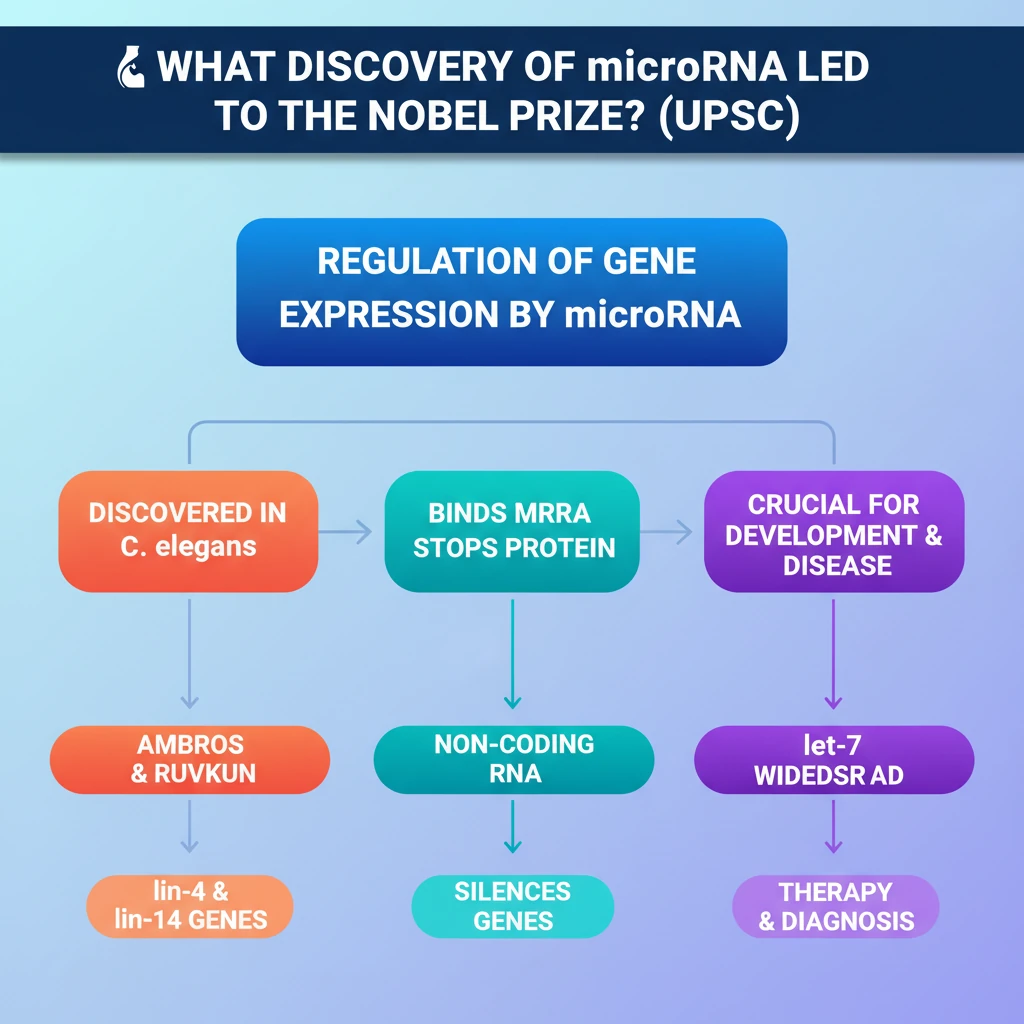
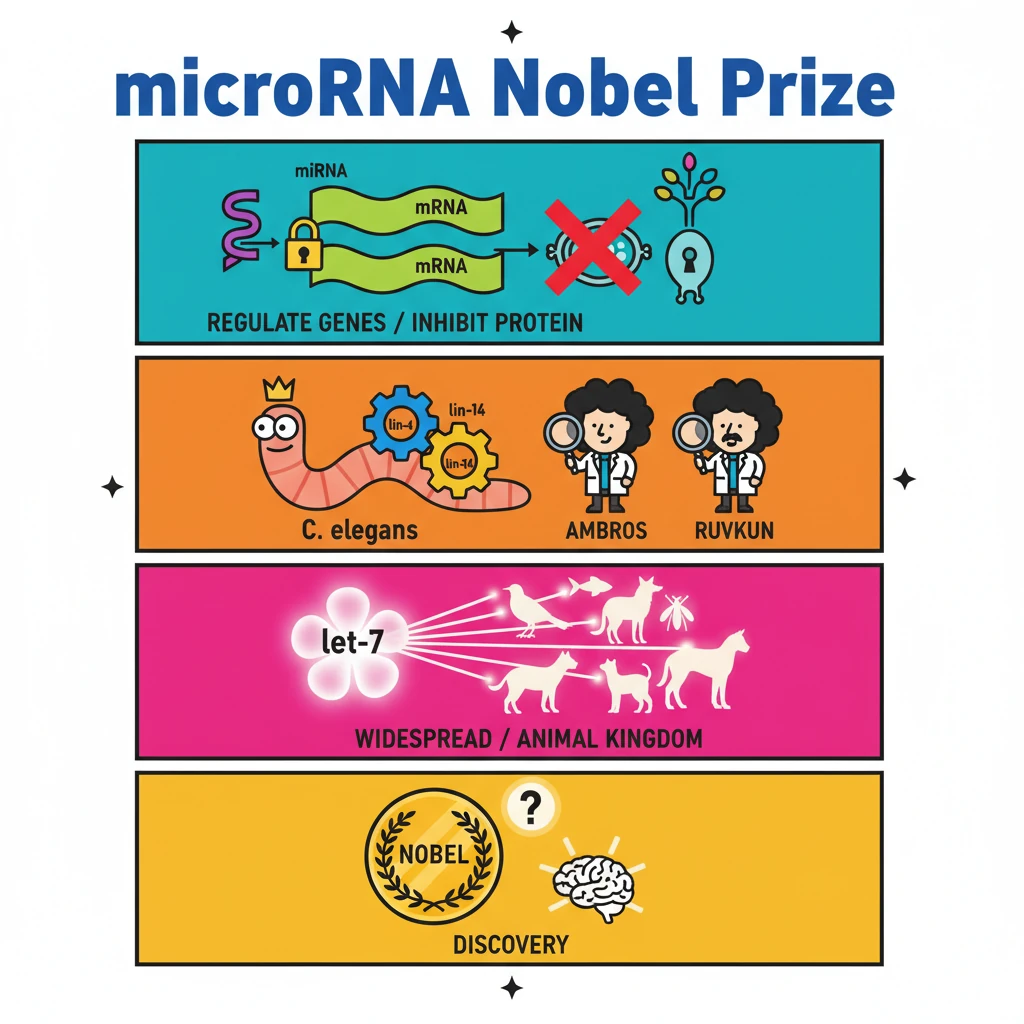
- •MicroRNAs are small, non-coding RNA molecules that regulate gene expression.
- •Discovered by Ambros and Ruvkun in <strong>C. elegans</strong> (<strong>lin-4</strong> microRNA regulating <strong>lin-14</strong>).
- •They act by binding to mRNA, inhibiting protein production.
- •The discovery of <strong>let-7</strong> showed microRNAs are widespread across the animal kingdom.
- •MicroRNAs are crucial for development and are significant in disease diagnosis and therapy.
🧠 Memory Techniques
95% Verified Content