India’s Satellite Launch by SpaceX - Science And Technology | UPSC Learning
Topics
0 topics • 0 completed
🔍
No topics match your search
India’s Satellite Launch by SpaceX
Medium⏱️ 6 min read
science and technology
📖 Introduction
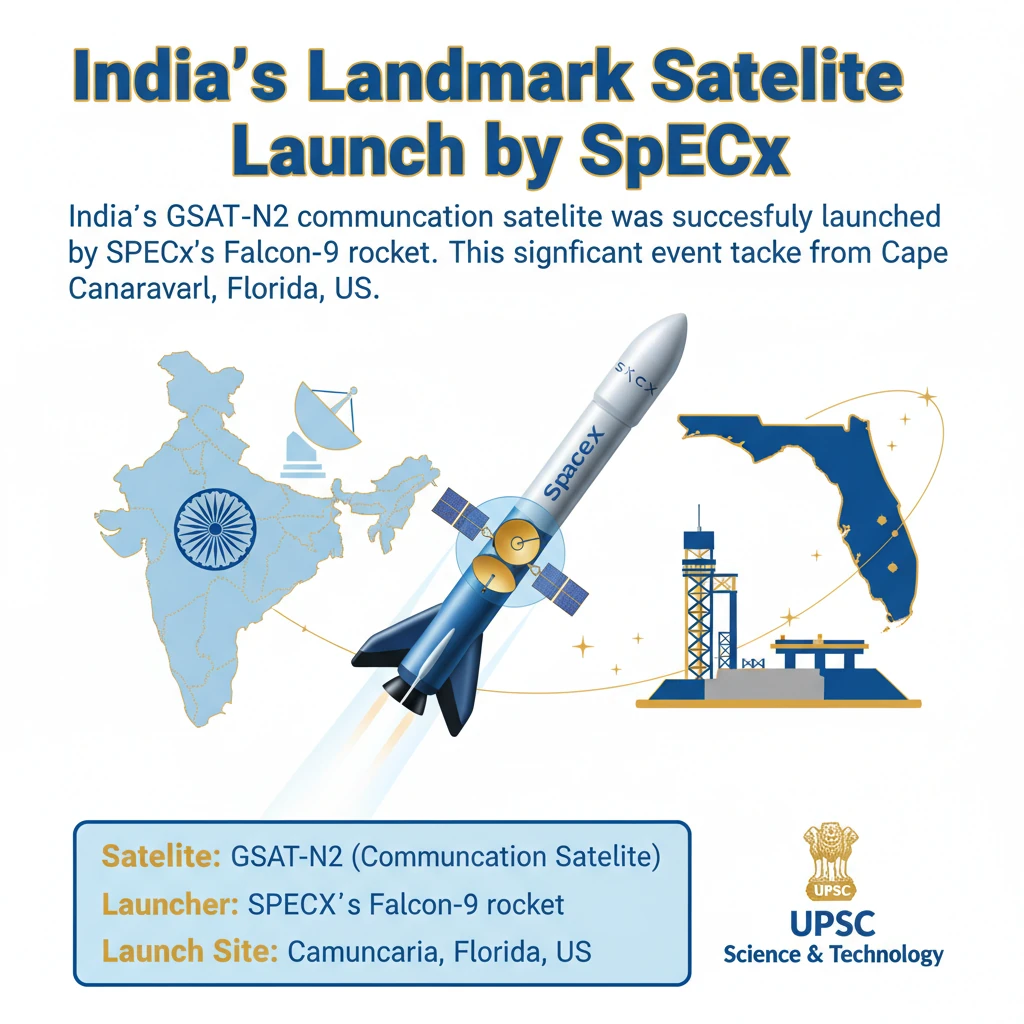
<h4>India's Landmark Satellite Launch by SpaceX</h4><p>India's <strong>GSAT-N2</strong> communication satellite was successfully launched by <strong>SpaceX's Falcon-9</strong> rocket. This significant event took place from <strong>Cape Canaveral, Florida, US</strong>.</p><div class='info-box'><p><strong>Satellite:</strong> <strong>GSAT-N2</strong> (Communication Satellite)<br><strong>Launcher:</strong> <strong>SpaceX's Falcon-9</strong> rocket<br><strong>Launch Site:</strong> <strong>Cape Canaveral, Florida, US</strong></p></div><h4>Initial Orbit: Geosynchronous Transfer Orbit (GTO)</h4><p>The <strong>Falcon-9</strong> launched the <strong>GSAT-N2</strong> into a <strong>geosynchronous transfer orbit (GTO)</strong>. This is an <strong>elliptical orbit</strong>, serving as the crucial first step towards reaching a stable <strong>geosynchronous or geostationary orbit (GSO)</strong>.</p><div class='info-box'><p><strong>Geosynchronous Transfer Orbit (GTO):</strong> An elliptical orbit with an altitude of around <strong>37,000 km</strong> at its highest point (apoapsis).</p></div><h4>Transition to Geostationary Orbit (GSO)</h4><p>To achieve <strong>Geostationary Orbit (GSO)</strong>, the spacecraft performs a critical maneuver. It circularises the <strong>GTO</strong> orbit by turning parallel to the equator at its <strong>apoapsis</strong>.</p><p>Subsequently, the satellite fires its own rocket engine. This propulsion pushes it into the desired circular <strong>GSO</strong>, where it appears stationary relative to the Earth's surface.</p><div class='info-box'><p><strong>Apoapsis:</strong> The point in an orbit when an object is farthest away from the body it is orbiting.</p></div><h4>India's First Collaboration with SpaceX</h4><p>This launch marks a historic moment as it is <strong>India's first collaboration</strong> with <strong>Elon Musk's SpaceX</strong>. It signifies a growing trend of international partnerships in India's space sector.</p><div class='key-point-box'><p>This collaboration highlights India's strategic move towards leveraging global private sector capabilities for its space missions.</p></div><h4>Role of NewSpace India Limited (NSIL)</h4><p>The <strong>GSAT-N2</strong> satellite belongs to <strong>NewSpace India Limited (NSIL)</strong>. <strong>NSIL</strong> is the commercial arm of <strong>ISRO</strong>, responsible for commercializing India's space capabilities.</p><div class='info-box'><p><strong>NSIL's Mandate:</strong> To build, launch, own, and operate satellites in a <strong>“demand-driven mode”</strong> to meet the service needs of users, both domestic and international.</p></div><p>The <strong>GSAT-N2</strong> is notably the <strong>second demand-driven satellite of NSIL</strong>. These satellites are designed and launched based on specific user requirements, ensuring optimal utilization of space assets.</p><ul><li><strong>First demand-driven satellite of NSIL:</strong> <strong>GSAT-24</strong>, launched in <strong>June 2022</strong>.</li></ul>
💡 Key Takeaways
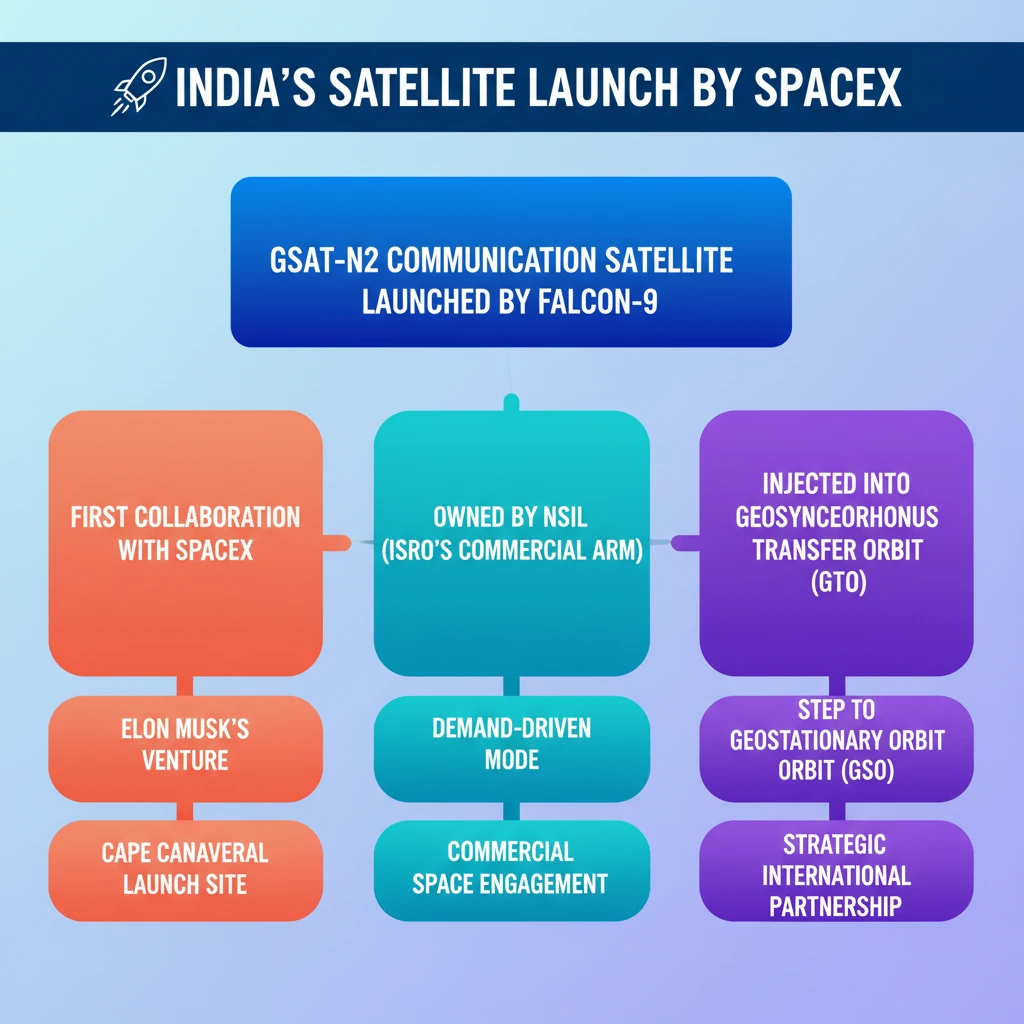
- •India's GSAT-N2 communication satellite was launched by SpaceX's Falcon-9 rocket from Cape Canaveral.
- •This marks India's first collaboration with Elon Musk's SpaceX.
- •GSAT-N2 is owned by NewSpace India Limited (NSIL), ISRO's commercial arm, operating in a demand-driven mode.
- •The satellite was injected into a Geosynchronous Transfer Orbit (GTO), a step towards achieving Geostationary Orbit (GSO).
- •This event highlights India's growing commercial space engagement and strategic international partnerships.
🧠 Memory Techniques

95% Verified Content
📚 Reference Sources
•Official ISRO/NSIL Press Releases (assumed)
•SpaceX Mission Archives (assumed)