Thirty Meter Telescope (TMT) - Science And Technology | UPSC Learning
Topics
0 topics • 0 completed
🔍
No topics match your search
Thirty Meter Telescope (TMT)
Medium⏱️ 8 min read
science and technology
📖 Introduction
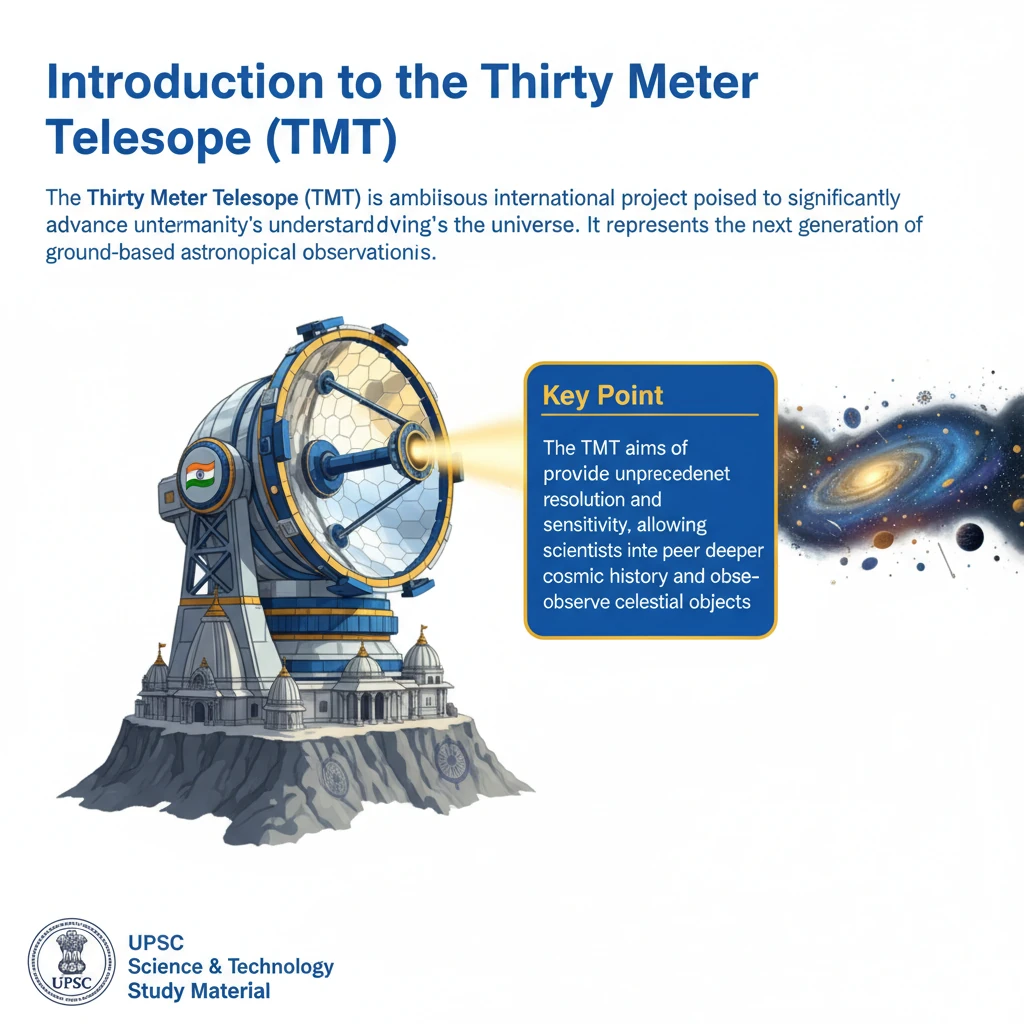
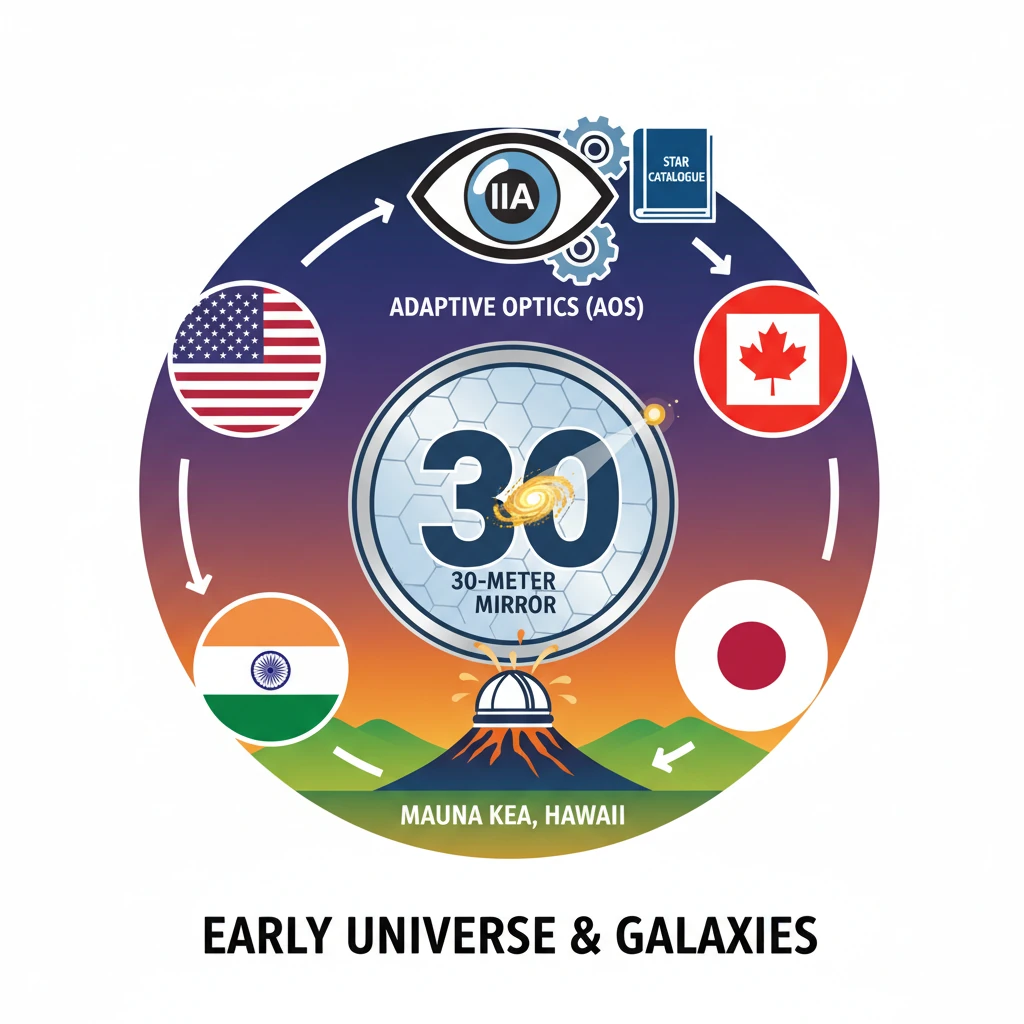
<h4>Introduction to the Thirty Meter Telescope (TMT)</h4><p>The <strong>Thirty Meter Telescope (TMT)</strong> is an ambitious international project poised to significantly advance humanity's understanding of the universe. It represents the next generation of ground-based astronomical observatories.</p><div class='key-point-box'><p>The TMT aims to provide <strong>unprecedented resolution and sensitivity</strong>, allowing scientists to peer deeper into cosmic history and observe celestial objects with remarkable clarity.</p></div><h4>International Collaboration and Location</h4><p>The TMT project is a collaborative effort involving several leading nations in scientific research. Key partners include <strong>India</strong>, the <strong>United States (US)</strong>, <strong>Canada</strong>, <strong>China</strong>, and <strong>Japan</strong>.</p><div class='info-box'><p><strong>Project Location:</strong> The TMT is currently under construction at <strong>Mauna Kea</strong> in <strong>Hawaii</strong>, a site renowned for its excellent astronomical viewing conditions.</p></div><p><strong>India</strong> plays a crucial role as a key partner, with the <strong>India TMT Centre (ITMT)</strong> at the <strong>Indian Institute of Astrophysics (IIA)</strong> in Bengaluru leading the national collaboration and contributions.</p><h4>Technological Core: The 30-Meter Primary Mirror</h4><p>The defining feature of the TMT is its massive <strong>30-meter primary mirror</strong>. This colossal mirror is designed to collect significantly more light than existing telescopes, enhancing observational capabilities.</p><div class='info-box'><p><strong>Key Specification:</strong> The <strong>30-meter primary mirror</strong> provides a light-gathering area far superior to current instruments, enabling observations of faint and distant objects.</p></div><h4>Advanced Adaptive Optics System (AOS)</h4><p>Complementing the large mirror is an advanced <strong>Adaptive Optics System (AOS)</strong>. This technology is critical for correcting distortions caused by Earth's atmosphere, ensuring sharper images.</p><div class='key-point-box'><p>The <strong>AOS</strong> actively compensates for atmospheric turbulence, allowing the TMT to achieve near space-telescope resolution from the ground.</p></div><p>State-of-the-art instruments will further enhance the TMT's observational power, making it a versatile tool for various astronomical investigations.</p><h4>Primary Scientific Goals of TMT</h4><p>The TMT is designed to address fundamental questions in astrophysics and cosmology. Its primary goals are focused on understanding the universe's origins and evolution.</p><ul><li><strong>Early Universe Studies:</strong> To investigate the formation and evolution of the <strong>first galaxies and stars</strong> that emerged shortly after the <strong>Big Bang</strong>.</li><li><strong>Galaxy Evolution:</strong> To study the formation, structure, and evolution of <strong>galaxies</strong> across vast cosmic timescales.</li></ul><h4>The Future of Ground-Based Astronomy</h4><p>The TMT is part of a new generation of "Extremely Large Telescopes" that are set to revolutionize ground-based astronomy. These telescopes represent the cutting edge of observational capabilities.</p><div class='info-box'><p><strong>Other Next-Gen Telescopes:</strong> Alongside the TMT, the <strong>Giant Magellan Telescope (GMT)</strong> and the <strong>European Southern Observatory’s Extremely Large Telescope (ELT)</strong> are also under development, heralding a new era of astronomical discovery.</p></div>
💡 Key Takeaways
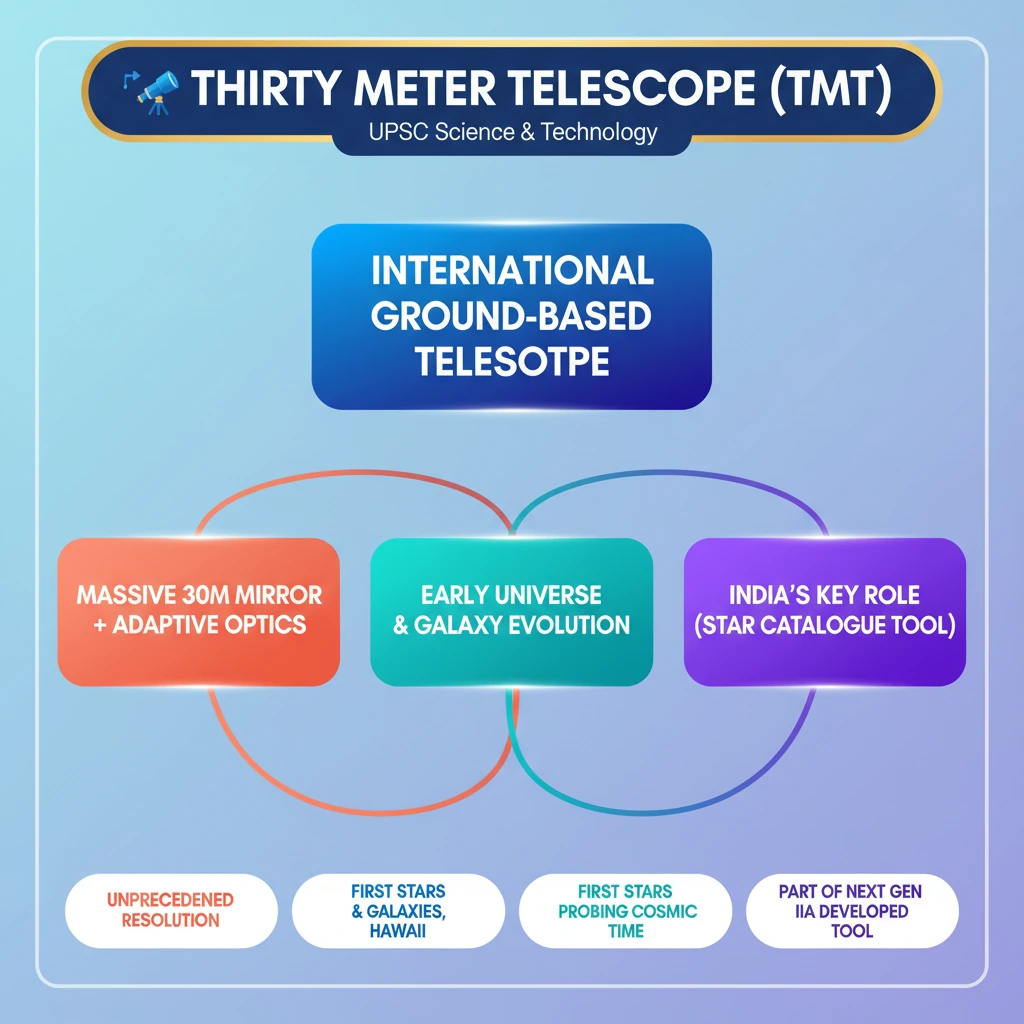
- •TMT is a 30-meter international ground-based telescope at Mauna Kea, Hawaii, involving India, US, Canada, China, and Japan.
- •It features a massive 30-meter primary mirror and an advanced Adaptive Optics System (AOS) for unprecedented resolution and sensitivity.
- •Primary goals include studying the early universe, first stars/galaxies, and galaxy evolution across cosmic time.
- •Indian researchers at IIA developed a star catalogue tool for TMT's AOS, highlighting India's key technical contribution.
- •TMT is part of the next generation of 'Extremely Large Telescopes' (ELTs) alongside GMT and ESO's ELT, revolutionizing ground-based astronomy.
🧠 Memory Techniques
95% Verified Content