What are Reusable Launch Vehicles (RLVs)? - Science And Technology | UPSC Learning
Topics
0 topics • 0 completed
🔍
No topics match your search
What are Reusable Launch Vehicles (RLVs)?
Medium⏱️ 8 min read
science and technology
📖 Introduction
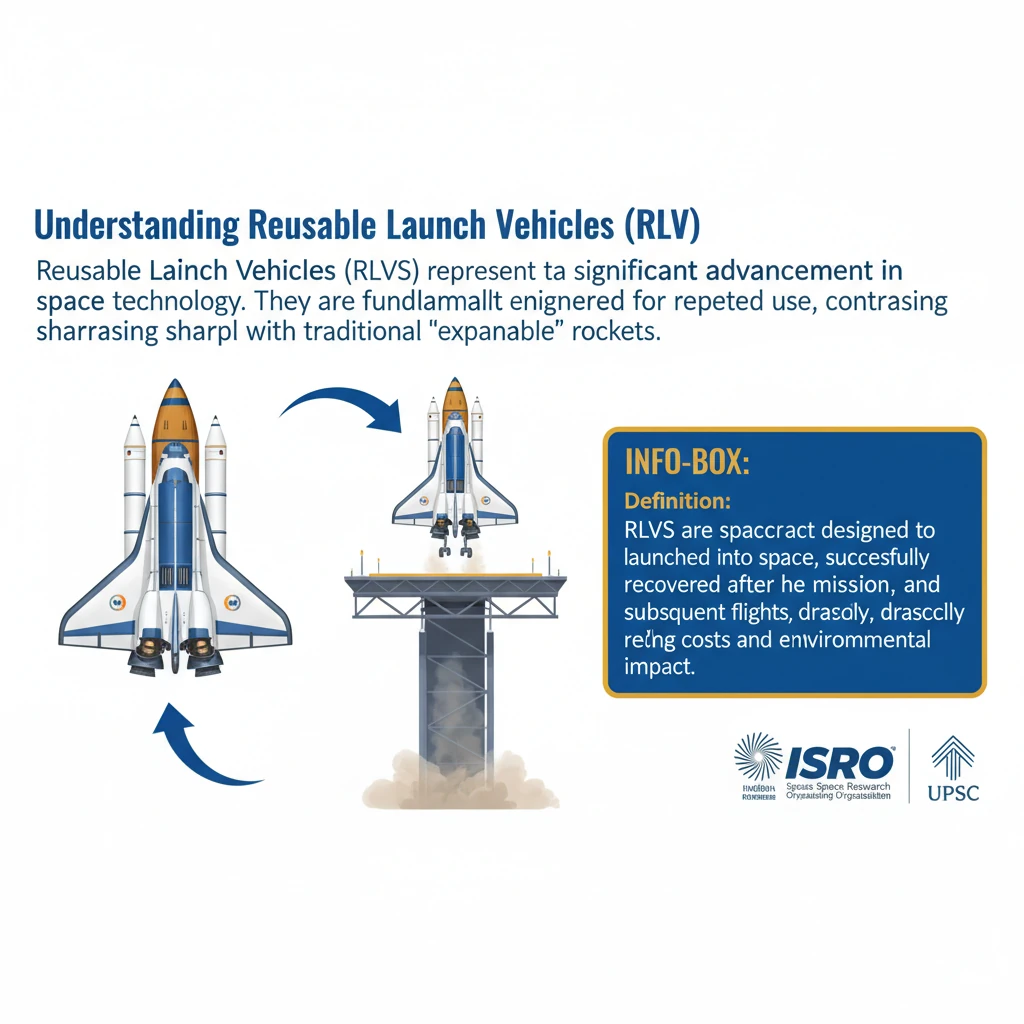
<h4>Understanding Reusable Launch Vehicles (RLVs)</h4><p><strong>Reusable Launch Vehicles (RLVs)</strong> represent a significant advancement in space technology. They are fundamentally <strong>spacecraft</strong> engineered for repeated use, contrasting sharply with traditional 'expendable' rockets.</p><div class='info-box'><p><strong>Definition:</strong> RLVs are <strong>spacecraft</strong> designed to be <strong>launched</strong> into space, successfully <strong>recovered</strong> after their mission, and then <strong>launched again multiple times</strong> for subsequent missions.</p></div><h4>Core Principle of Reusability</h4><p>The primary goal of RLVs is to drastically reduce the cost of space access. By making launch vehicle components reusable, the need to build new rockets for every mission is eliminated, similar to how commercial airplanes operate.</p><div class='key-point-box'><p><strong>Key Concept:</strong> Reusability transforms space access from a single-use, high-cost endeavor into a more sustainable and economically viable operation, paving the way for frequent and cheaper space missions.</p></div><h4>Components and Operation</h4><p>RLVs typically consist of various stages, with at least one or more stages designed for recovery. This often involves advanced propulsion, guidance, and landing systems.</p><ul><li><strong>Launch:</strong> The RLV lifts off, carrying its payload towards orbit.</li><li><strong>Separation:</strong> After expending its fuel, the reusable stage separates from the upper stage (which might be expendable or also reusable).</li><li><strong>Recovery:</strong> The reusable stage performs maneuvers to return to Earth, often involving engine burns for controlled descent and precise landing (e.g., vertical landing or runway landing).</li><li><strong>Refurbishment:</strong> After recovery, the vehicle undergoes inspection, maintenance, and refueling to prepare for its next mission.</li></ul><div class='exam-tip-box'><p><strong>UPSC Insight:</strong> Understanding the mechanics of 'recovery' – such as propulsive landings or winged glidebacks – is crucial. Differentiate between partially and fully reusable systems.</p></div>
💡 Key Takeaways
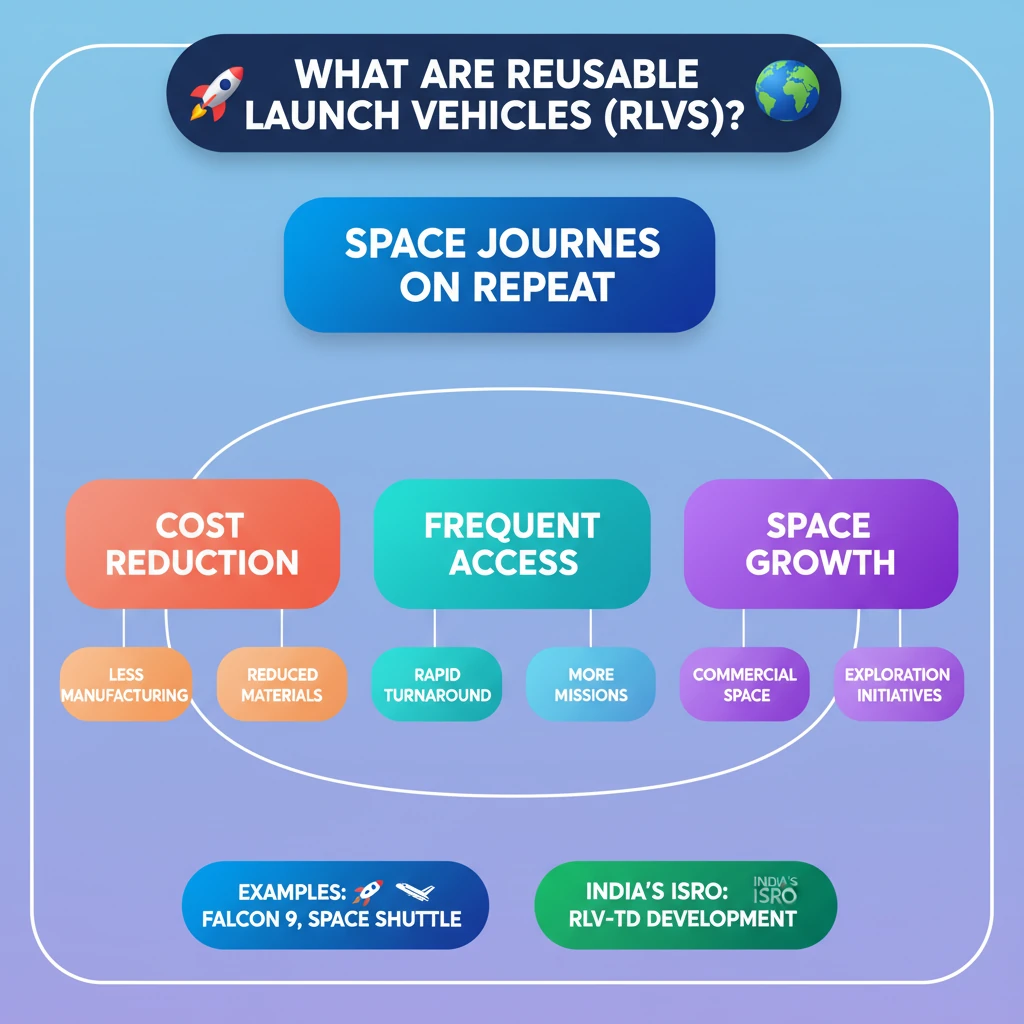
- •Reusable Launch Vehicles (RLVs) are spacecraft designed for multiple launches, recoveries, and re-launches.
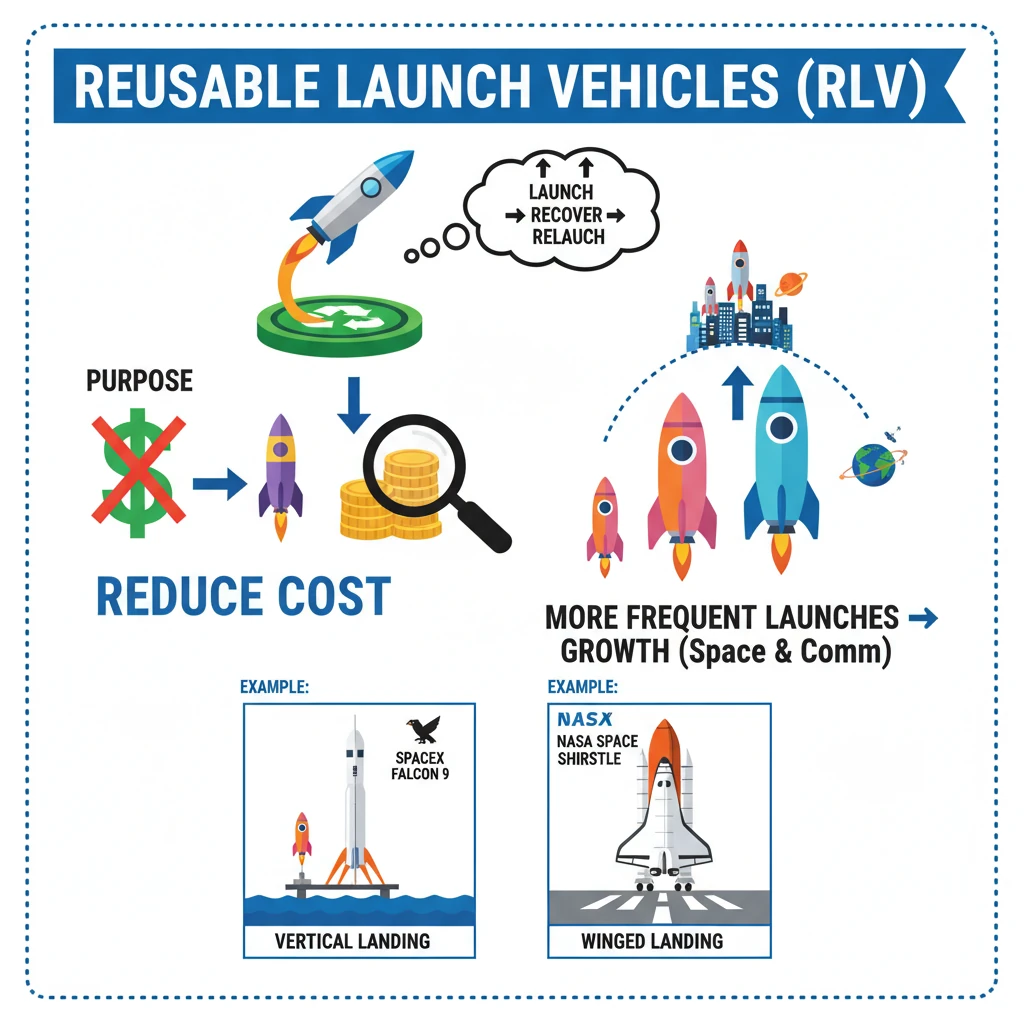
- •The core purpose of RLVs is to significantly reduce the cost of accessing space.
- •RLVs enable more frequent launches, fostering growth in commercial space and exploration.
- •Examples include SpaceX Falcon 9 (vertical landing) and the historical NASA Space Shuttle (winged landing).
- •ISRO is developing its own RLV-TD to achieve indigenous and cost-effective space access.
- •RLVs are crucial for the 'New Space Economy,' space tourism, and strategic national interests.
🧠 Memory Techniques
98% Verified Content
📚 Reference Sources
•NASA official website (nasa.gov)
•SpaceX official website (spacex.com)
•European Space Agency (ESA) publications
•Reputable science and technology news outlets (e.g., The Hindu, Indian Express, Space.com)