Synchronization protocols such as Network Time Protocol (NTP) and Precision Time Protocol (PTP) will be adopted by government institutions and public organizations. - Science And Technology | UPSC Learning
Topics
0 topics • 0 completed
🔍
No topics match your search
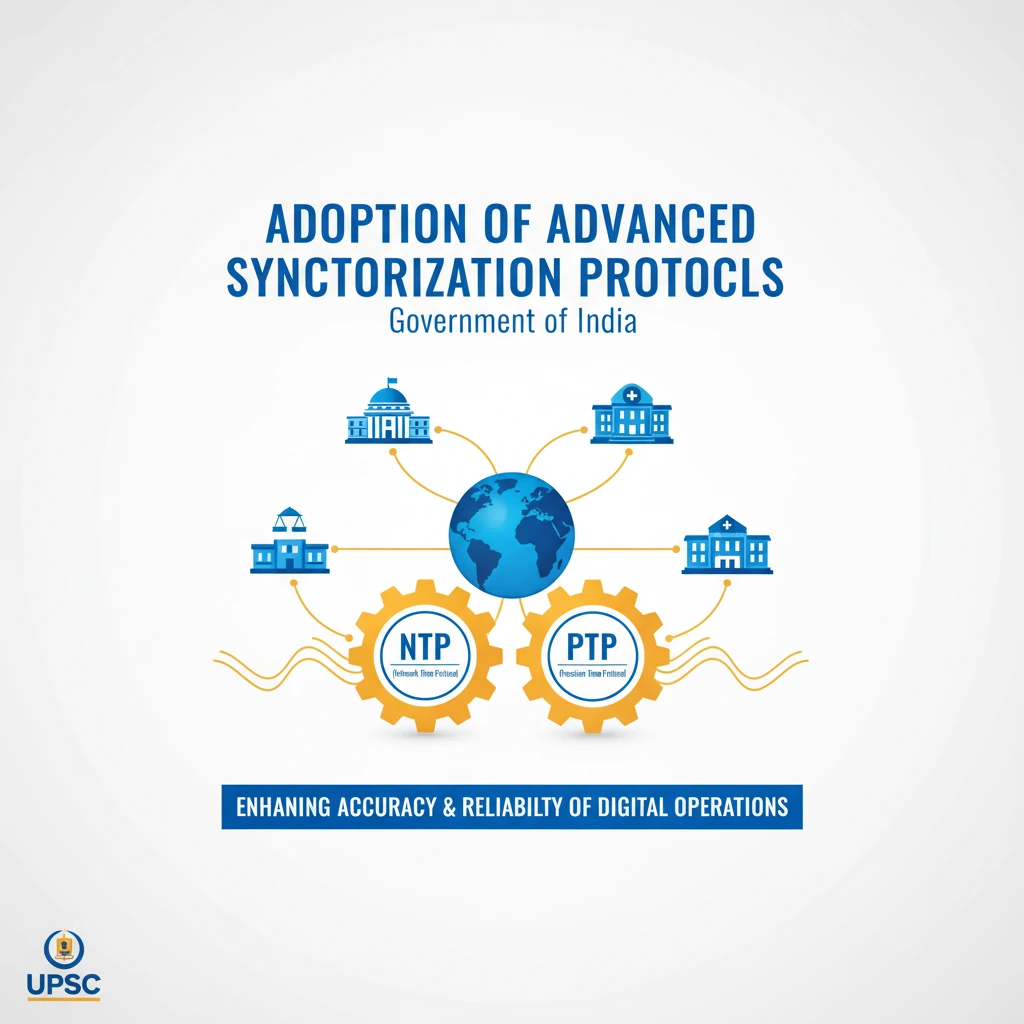
Synchronization protocols such as Network Time Protocol (NTP) and Precision Time Protocol (PTP) will be adopted by government institutions and public organizations.
Medium⏱️ 8 min read
science and technology
📖 Introduction
<h4>Adoption of Advanced Synchronization Protocols</h4><p>The Government of India is set to implement advanced <strong>synchronization protocols</strong> such as <strong>Network Time Protocol (NTP)</strong> and <strong>Precision Time Protocol (PTP)</strong>. This initiative will see these protocols adopted across various <strong>government institutions</strong> and <strong>public organizations</strong>.</p><p>This strategic move aims to enhance the accuracy and reliability of digital operations nationwide. It signifies a commitment to modernizing India's digital infrastructure and aligning with global technological standards.</p><h4>Benefits of Protocol Adoption</h4><p>The adoption of <strong>NTP</strong> and <strong>PTP</strong> will bring numerous advantages across critical sectors. These benefits are pivotal for India's technological advancement and economic stability.</p><ul><li><strong>Higher Precision in Critical Sectors:</strong> Industries like <strong>5G</strong>, <strong>Artificial Intelligence (AI)</strong>, <strong>Internet of Things (IoT)</strong>, <strong>navigation systems</strong>, and <strong>power grid synchronization</strong> will operate with significantly higher precision and efficiency.</li><li><strong>Enhanced Financial Security:</strong> <strong>Financial transactions</strong> and adherence to <strong>regulatory compliance</strong> will become more accurate, thereby increasing resistance against fraud and ensuring transparency.</li><li><strong>Improved Operational Efficiency:</strong> The synchronization of <strong>digital devices</strong> and <strong>communication networks</strong> will lead to improved operational efficiency and better service delivery to consumers.</li><li><strong>Strengthening Digital Infrastructure:</strong> This adoption will bolster <strong>India’s digital infrastructure</strong>, positioning the country as an attractive hub for global technology investments.</li><li><strong>Global Alignment:</strong> It ensures alignment with <strong>international best practices</strong> in areas such as <strong>timekeeping</strong>, <strong>aviation</strong>, and <strong>telecommunication standards</strong>, enhancing India's global standing.</li></ul><h4>CSIR-National Physical Laboratory (NPL)</h4><p>The <strong>CSIR-National Physical Laboratory (NPL)</strong> plays a crucial role in India's scientific and technological advancements. It is one of the nation’s earliest and most significant national laboratories.</p><div class='info-box'><p><strong>Foundation and Inauguration:</strong> The foundation stone for NPL was laid by <strong>Jawaharlal Nehru</strong> in <strong>1947</strong>. It was formally inaugurated by <strong>Sardar Vallabhbhai Patel</strong> in <strong>1950</strong>, marking a significant milestone in India's post-independence scientific journey.</p></div><h4>Functions of NPL</h4><p>NPL is entrusted with vital responsibilities concerning physical measurements and standards in India. Its functions are fundamental to maintaining accuracy and consistency across various scientific and industrial domains.</p><ul><li><strong>Maintaining SI Units:</strong> NPL is responsible for realizing and maintaining <strong>physical measurement units</strong> defined in the <strong>International System (SI units)</strong>. This includes fundamental units like <strong>metre</strong>, <strong>kilogram</strong>, <strong>second</strong>, <strong>kelvin</strong>, <strong>ampere</strong>, and <strong>candela</strong>.</li><li><strong>Industrial Support:</strong> It actively aids industries by providing expertise in <strong>precision measurements</strong>. NPL also certifies <strong>emission-monitoring instruments</strong>, ensuring environmental compliance and accuracy.</li></ul><h4>Key Contributions of NPL</h4><p>NPL has made significant contributions, particularly in the realm of timekeeping and calibration services, which are critical for national infrastructure.</p><ul><li><strong>Atomic Clocks and IST:</strong> NPL developed advanced <strong>Atomic clocks</strong> and is responsible for maintaining <strong>Indian Standard Time (IST)</strong>. This is achieved using highly precise <strong>Cesium atomic clocks</strong> (which work using <strong>Cesium atoms</strong>) and a <strong>Hydrogen maser</strong> (which uses <strong>hydrogen atoms</strong> to serve precision frequency).</li><li><strong>Calibration Services:</strong> It provides apex <strong>calibration services</strong> to various sectors, ensuring the accuracy and reliability of measuring instruments nationwide.</li><li><strong>Accreditation Support:</strong> NPL also supports the <strong>National Accreditation Board for Testing and Calibration Laboratories (NABL)</strong>, which is vital for maintaining quality standards in testing and calibration.</li></ul><div class='exam-tip-box'><p><strong>UPSC Insight:</strong> Understanding the role of institutions like <strong>CSIR-NPL</strong> and the significance of <strong>synchronization protocols</strong> is crucial for <strong>GS Paper 3 (Science & Technology)</strong>. Questions can cover their functions, benefits, and impact on national development and digital infrastructure.</p></div>
💡 Key Takeaways
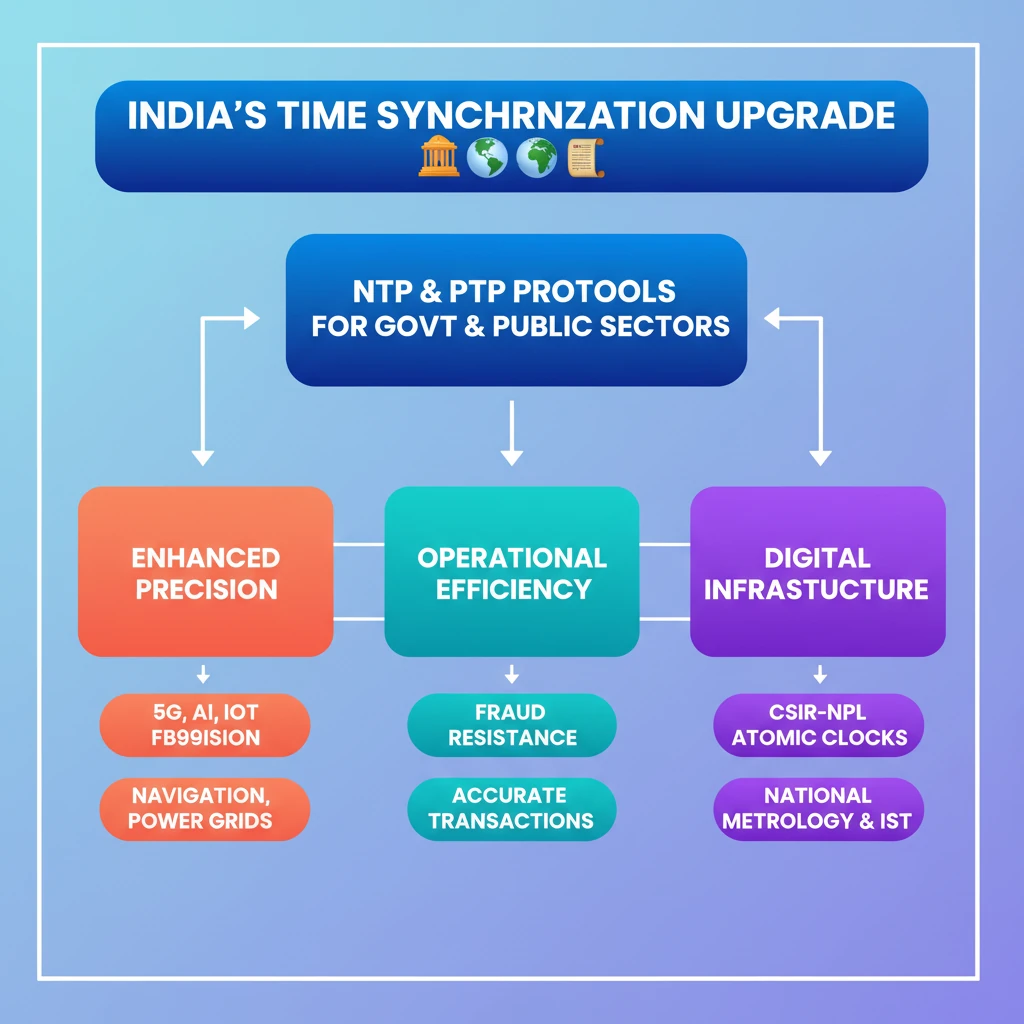
- •India is adopting NTP and PTP for precise time synchronization across government and public sectors.
- •These protocols enhance precision in 5G, AI, IoT, navigation, power grids, and financial transactions.
- •Benefits include improved operational efficiency, fraud resistance, and strengthened digital infrastructure.
- •CSIR-National Physical Laboratory (NPL) maintains SI units and Indian Standard Time (IST) using atomic clocks.
- •NPL's contributions are vital for national metrology, industrial precision, and calibration services.
- •The initiative aligns India with international timekeeping standards, boosting global tech investment appeal.
🧠 Memory Techniques

95% Verified Content
📚 Reference Sources
•CSIR-National Physical Laboratory (NPL) Official Website
•Government of India Policy Documents (related to Digital India and critical infrastructure)