Global Examples for Wolbachia Implementation - Science And Technology | UPSC Learning
Topics
0 topics • 0 completed
🔍
No topics match your search
Global Examples for Wolbachia Implementation
Medium⏱️ 8 min read
science and technology
📖 Introduction
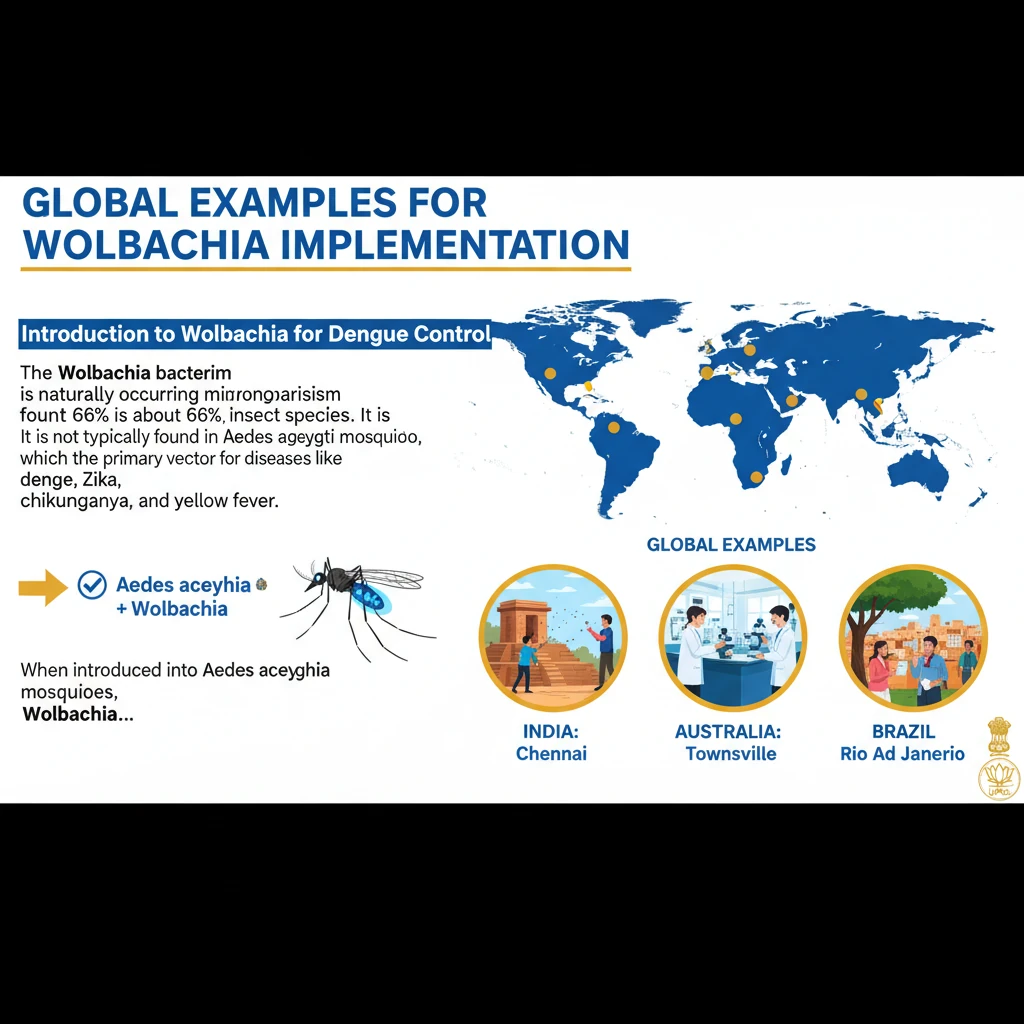
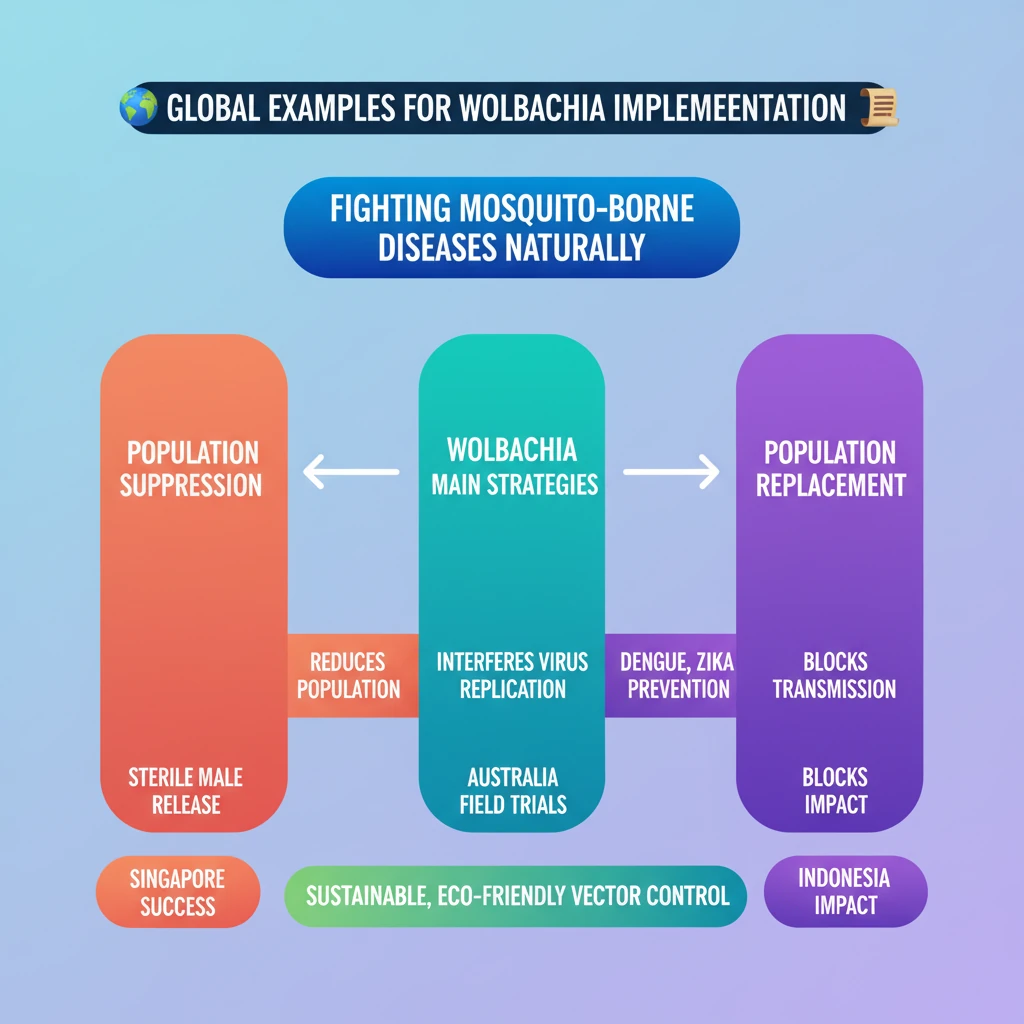
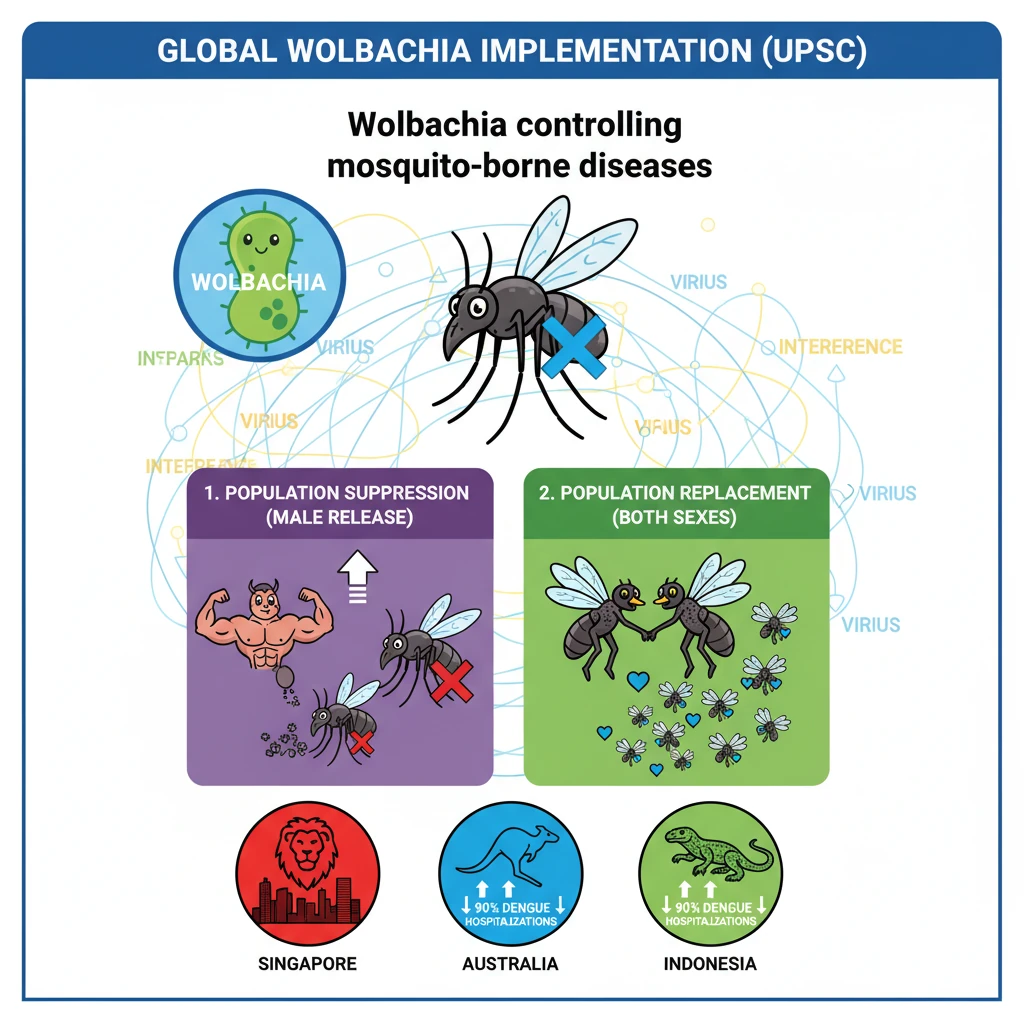
<h4>Introduction to Wolbachia for Dengue Control</h4><p>The <strong>Wolbachia</strong> bacterium is a naturally occurring microorganism found in about 60% of insect species. It is not typically found in the <strong>Aedes aegypti mosquito</strong>, which is the primary vector for diseases like <strong>dengue</strong>, <strong>Zika</strong>, <strong>chikungunya</strong>, and <strong>yellow fever</strong>.</p><p>When introduced into <strong>Aedes aegypti mosquitoes</strong>, <strong>Wolbachia</strong> can prevent the transmission of these viruses to humans. This makes it a promising biological control method for mosquito-borne diseases.</p><div class='key-point-box'><p><strong>Key Concept:</strong> <strong>Wolbachia</strong> interferes with virus replication within the mosquito, significantly reducing its ability to transmit pathogens. This offers an environmentally friendly alternative to traditional insecticide-based methods.</p></div><h4>Global Implementation Strategies</h4><p>Two main strategies are employed for <strong>Wolbachia</strong> implementation: <strong>Population Suppression</strong> and <strong>Population Replacement</strong>. Both aim to reduce disease transmission but through different mechanisms.</p><div class='info-box'><p><strong>Population Suppression:</strong> Involves releasing <strong>Wolbachia-infected male mosquitoes</strong>. When these males mate with wild females, the eggs do not hatch, leading to a reduction in the mosquito population over time. This is akin to a sterile insect technique.</p><p><strong>Population Replacement:</strong> Involves releasing <strong>Wolbachia-infected male and female mosquitoes</strong>. The <strong>Wolbachia</strong> then spreads through the wild mosquito population, making them less capable of transmitting viruses. The goal is to replace the wild, disease-carrying population with a <strong>Wolbachia-infected</strong>, non-transmitting population.</p></div><h4>Singapore's Experience with Wolbachia</h4><p><strong>Singapore</strong> has actively pursued <strong>Wolbachia</strong> implementation, primarily focusing on <strong>population suppression</strong>. The strategy involved the release of <strong>Wolbachia-infected male mosquitoes</strong> into targeted areas.</p><div class='info-box'><p><strong>Outcome:</strong> This approach led to a significant reduction in the <strong>Aedes population</strong>. Crucially, a <strong>77% decrease in dengue cases</strong> was observed in the release areas, demonstrating the effectiveness of the method.</p></div><h4>Australia's Success with Population Replacement</h4><p><strong>Australia</strong> adopted a <strong>population replacement strategy</strong> to combat <strong>dengue</strong>. This involved introducing <strong>Wolbachia-infected mosquitoes</strong> (both male and female) to establish the bacteria in the wild population.</p><div class='info-box'><p><strong>Outcome:</strong> The strategy successfully led to a stable integration of the <strong>wMel strain genome</strong> into the wild <strong>Aedes aegypti populations</strong>. This resulted in significant and sustained reductions in <strong>dengue incidence</strong> across the treated regions.</p></div><h4>Indonesia's Landmark Trial</h4><p><strong>Indonesia</strong> conducted a crucial <strong>randomised controlled trial</strong> to rigorously assess the impact of <strong>Wolbachia</strong>. This trial provided strong scientific evidence for the method's efficacy.</p><div class='info-box'><p><strong>Outcome:</strong> Areas where <strong>wMel strain mosquitoes</strong> were released experienced a remarkable <strong>77% reduction in dengue cases</strong>. Furthermore, there was an <strong>86% decrease in dengue-related hospitalizations</strong>, highlighting the public health benefit.</p></div><div class='exam-tip-box'><p><strong>UPSC Insight:</strong> These global examples are critical for <strong>GS Paper 3 (Science & Technology)</strong>. Be prepared to discuss <strong>Wolbachia technology</strong>, its mechanisms, and successful case studies as a sustainable vector control measure. Mentioning specific countries and their results adds weight to your answers.</p></div>
💡 Key Takeaways
- •Wolbachia is a natural bacterium used to control mosquito-borne diseases like dengue.
- •Two main strategies: Population Suppression (releasing infected males) and Population Replacement (releasing both sexes to spread Wolbachia).
- •Global examples (Singapore, Australia, Indonesia) show high efficacy in reducing dengue cases and hospitalizations.
- •Wolbachia interferes with virus replication in mosquitoes, making them less likely to transmit diseases.
- •It offers a sustainable, environmentally friendly alternative to traditional chemical vector control methods.
🧠 Memory Techniques
98% Verified Content
📚 Reference Sources
•World Mosquito Program (WMP) official website
•World Health Organization (WHO) reports on vector control
•The New England Journal of Medicine (NEJM) - Randomized trial of Wolbachia to control dengue in Indonesia (2020)