India’s First 3D-Printed Rocket Launched - Science And Technology | UPSC Learning
Topics
0 topics • 0 completed
🔍
No topics match your search
India’s First 3D-Printed Rocket Launched
Medium⏱️ 8 min read
science and technology
📖 Introduction
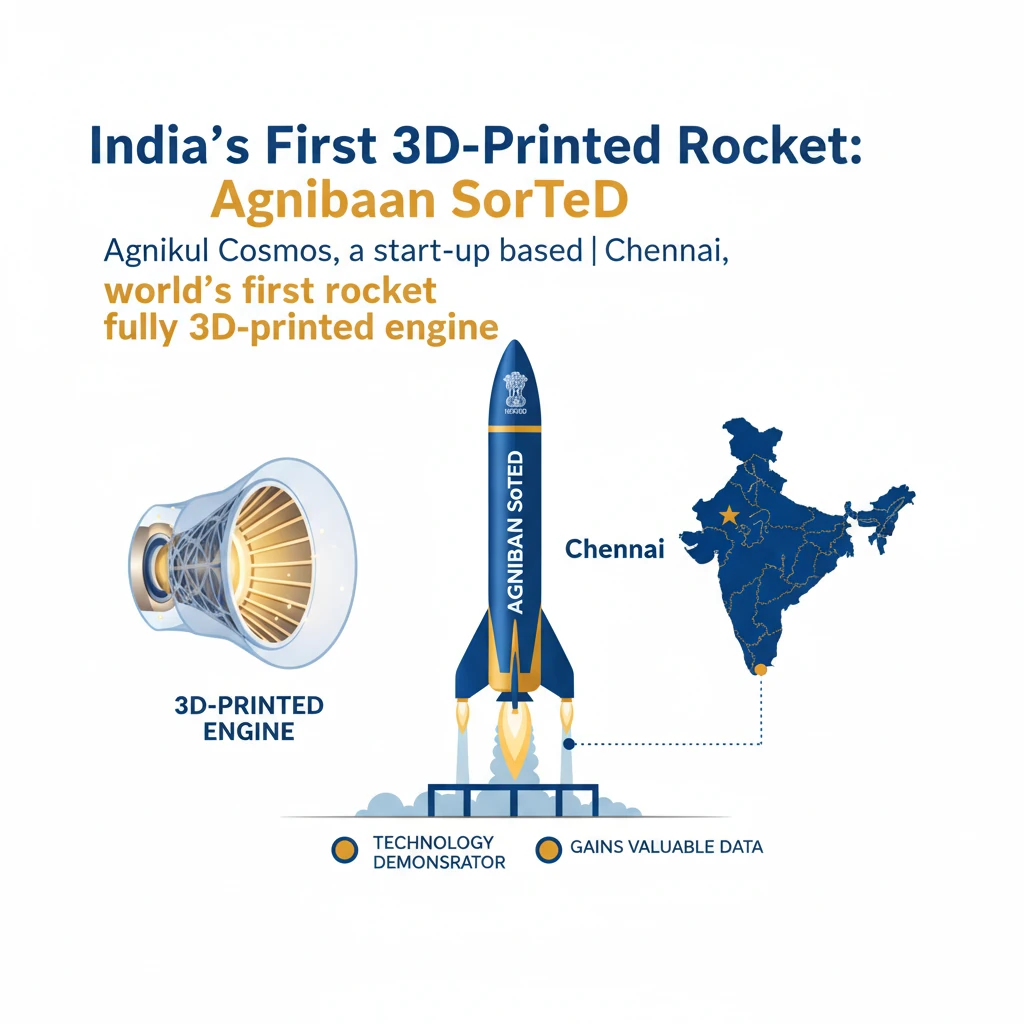
<h4>India's First 3D-Printed Rocket: Agnibaan SOrTeD</h4><p><strong>Agnikul Cosmos</strong>, a start-up based in <strong>Chennai</strong>, has achieved a significant milestone by launching <strong>Agnibaan SubOrbital Technology Demonstrator (SOrTeD)</strong>. This marks the <strong>world’s first rocket</strong> powered by a fully <strong>3D-printed engine</strong>.</p><p>The primary objective of this test flight was to showcase the company’s internally developed technologies. It also aimed to gather crucial flight data for future advancements in space technology.</p><div class='key-point-box'><p>The <strong>Agnibaan SOrTeD</strong> launch represents several 'firsts' for the Indian space ecosystem, highlighting indigenous capabilities and private sector innovation.</p></div><h4>Key Milestones Achieved</h4><ul><li><strong>Launch from a Private Pad:</strong> It was launched from <strong>Dhanush</strong>, India's first private launchpad located at <strong>Sriharikota</strong>.</li><li><strong>Homegrown Semi-Cryo Engine:</strong> The rocket is powered by an indigenously developed <strong>semi-cryogenic engine</strong>.</li><li><strong>World's 1st Single-Piece 3D-Printed Engine:</strong> Its engine is the first fully <strong>3D-printed</strong>, single-piece design globally.</li></ul><h4>Propulsion System Details</h4><p>The <strong>Agnibaan SOrTeD</strong> rocket utilizes a specific combination of propellants for its engine. It is powered by <strong>liquid oxygen</strong> and <strong>kerosene</strong>.</p><div class='info-box'><p><strong>Propellant Type:</strong> The rocket uses a combination of <strong>liquid oxygen (LOX)</strong> as the oxidizer and <strong>kerosene</strong> as the fuel. This is a common and efficient propellant choice for many rocket engines.</p></div><h4>Support and Collaboration</h4><p>The successful launch was a collaborative effort, receiving vital support from key national space organizations. Both the <strong>Indian Space Research Organisation (ISRO)</strong> and the <strong>Indian National Space Promotion and Authorisation Centre (IN-SPACe)</strong> played crucial roles in facilitating this mission.</p><div class='exam-tip-box'><p>This event is highly relevant for <strong>UPSC GS Paper 3 (Science & Technology)</strong>, particularly for topics on <strong>Space Technology</strong>, <strong>Indigenous Technology Development</strong>, and the <strong>Role of Private Sector in Space</strong>. Emphasize the 'firsts' achieved.</p></div>
💡 Key Takeaways
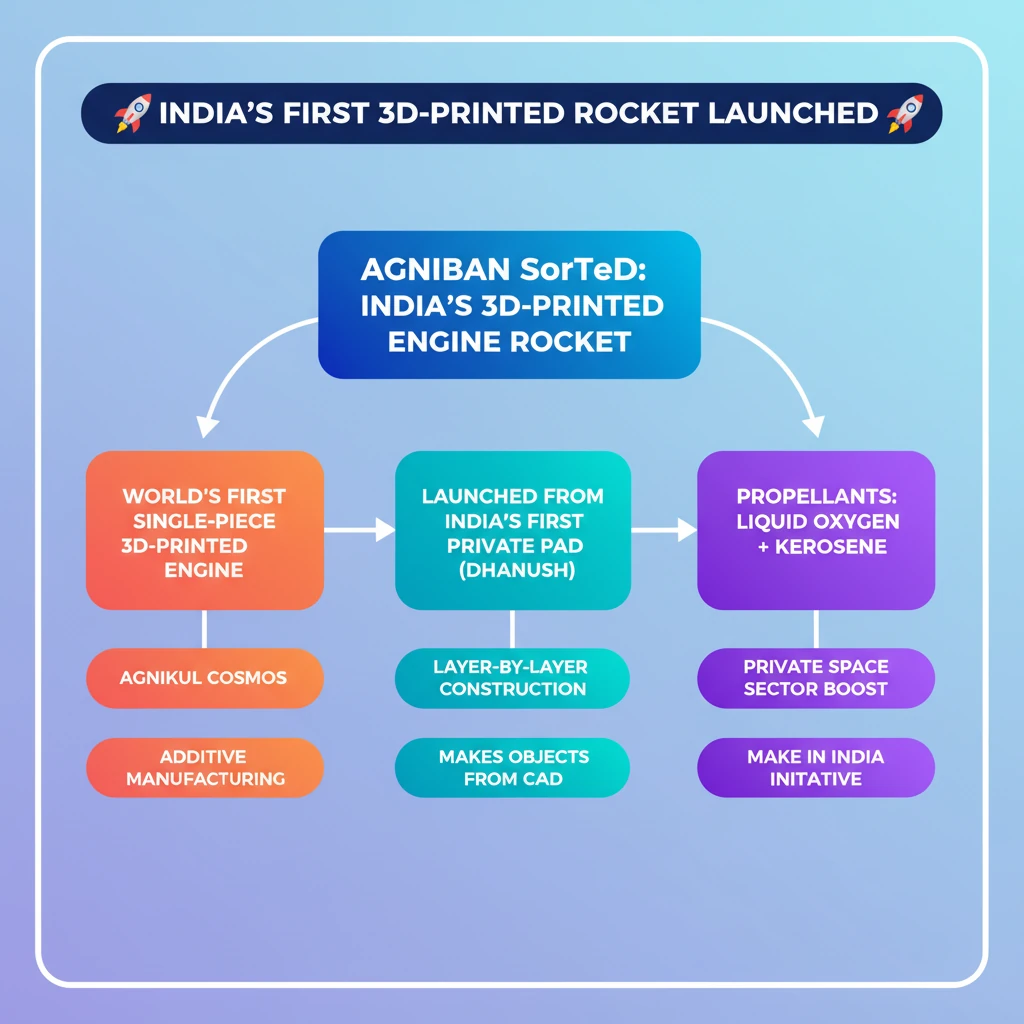
- •Agnikul Cosmos launched Agnibaan SOrTeD, India's first rocket with a fully 3D-printed engine.
- •This was the world's first rocket with a single-piece 3D-printed engine and launched from India's first private pad (Dhanush).
- •The engine uses liquid oxygen and kerosene as propellants.
- •3D printing (additive manufacturing) builds objects layer by layer from CAD, opposite to subtractive manufacturing.
- •The launch signifies India's growing private space sector, 'Make in India' success, and technological advancement supported by ISRO and IN-SPACe.
🧠 Memory Techniques

98% Verified Content
📚 Reference Sources
•Agnikul Cosmos Official Website
•ISRO (Indian Space Research Organisation) Press Releases
•IN-SPACe (Indian National Space Promotion and Authorisation Centre) Publications