What is Lower Earth Orbit (LEO)? - Science And Technology | UPSC Learning
Topics
0 topics • 0 completed
🔍
No topics match your search

What is Lower Earth Orbit (LEO)?
Medium⏱️ 7 min read
science and technology
📖 Introduction
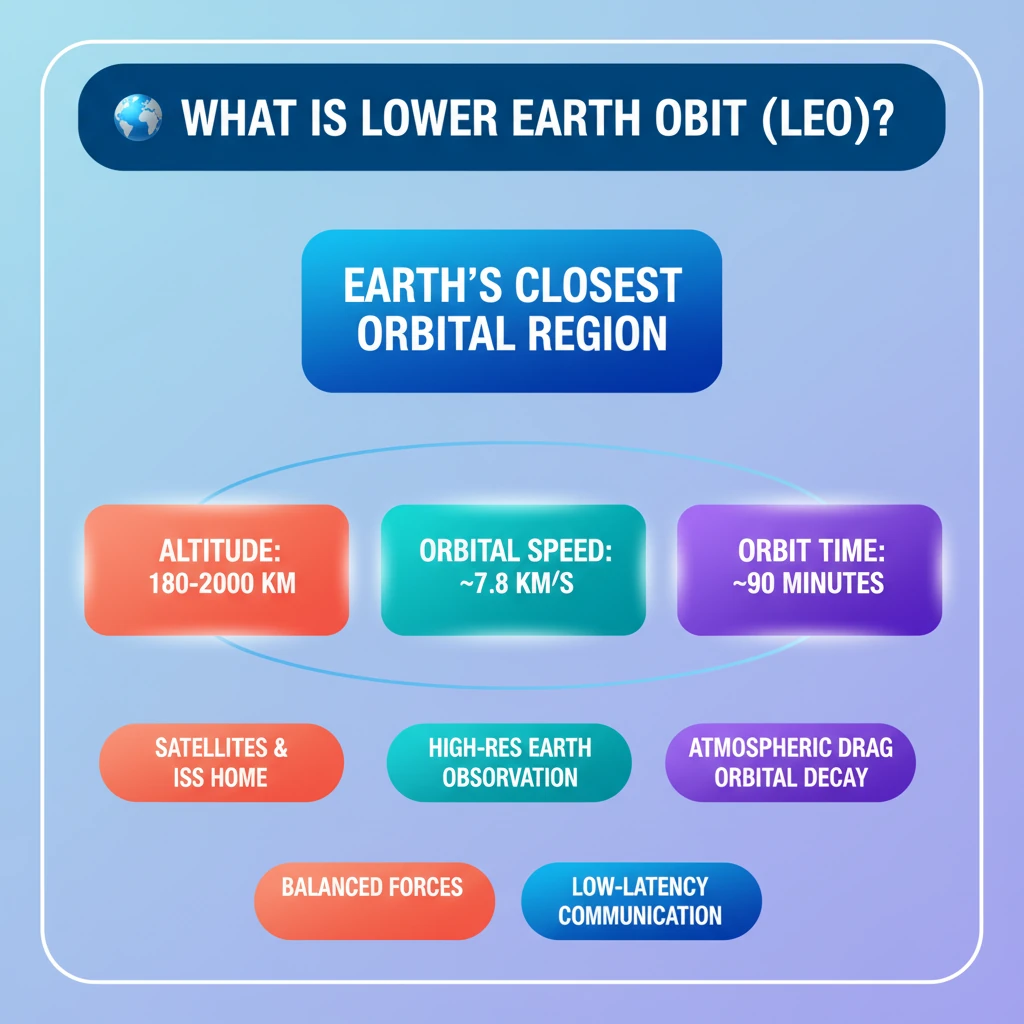
<h4>Understanding Low Earth Orbit (LEO)</h4><p><strong>Low Earth Orbit (LEO)</strong> refers to an orbital region around <strong>Earth</strong>, characterized by its relatively close proximity to the planet's surface.</p><div class='info-box'><p><strong>Altitude Range:</strong> LEO typically spans altitudes from <strong>180 km</strong> to <strong>2,000 km</strong> above Earth.</p></div><p>This region is the closest to the Earth’s surface and is the most frequently utilized orbital space for a wide array of <strong>satellites</strong>.</p><p>It is also famously home to the <strong>International Space Station (ISS)</strong>, a key platform for human space exploration.</p><h4>Orbital Mechanics of LEO Satellites</h4><p>For a satellite to successfully maintain its position in <strong>LEO</strong>, it must achieve a specific velocity that precisely balances gravitational forces.</p><div class='info-box'><p><strong>Required Speed:</strong> Satellites in LEO travel at approximately <strong>7.8 kilometers per second</strong>.</p></div><p>At this high speed, the <strong>centrifugal force</strong> generated by the satellite's motion directly counteracts the <strong>gravitational pull</strong> of the Earth.</p><p>This delicate balance enables the satellite to maintain a stable orbit without falling back to Earth.</p><p>As a result, LEO satellites complete one full orbit around Earth in a relatively short duration, typically around <strong>90 minutes</strong>.</p><p>Unlike <strong>suborbital objects</strong>, which return to Earth, or objects exceeding <strong>escape velocity</strong> (approximately 25,000 mph), LEO objects remain in orbit indefinitely.</p><p>Their orbital stability can only be affected by external forces such as residual <strong>atmospheric drag</strong> or phenomena leading to <strong>orbital decay</strong>.</p><h4>Importance and Applications of LEO</h4><p><strong>LEO</strong> is strategically vital due to its unique characteristics, making it ideal for numerous space applications.</p><h5>Satellite Applications</h5><p>LEO is the preferred orbit for <strong>Earth observation satellites</strong>. Their close proximity enables them to capture <strong>high-resolution images</strong> and gather detailed data.</p><p>Many <strong>communication satellites</strong> and <strong>scientific missions</strong> also leverage LEO for enhanced <strong>transmission speeds</strong> and significantly <strong>reduced latency</strong>, crucial for modern global connectivity.</p><p>Furthermore, LEO satellites play a critical role in the functionality of <strong>Global Positioning Systems (GPS)</strong>, providing precise location data.</p><h5>International Space Station (ISS)</h5><p>The <strong>International Space Station (ISS)</strong>, a symbol of international collaboration in space, orbits within the <strong>LEO</strong> region.</p><p>Its location in LEO ensures its accessibility for continuous <strong>human space exploration</strong> and a broad spectrum of <strong>scientific research</strong>.</p><p>This proximity facilitates regular <strong>resupply missions</strong> and simplifies the logistics of <strong>crew transport</strong> to and from the station.</p><h5>Cost-Effectiveness and Accessibility</h5><p>Launching satellites into <strong>LEO</strong> is generally more <strong>cost-effective</strong> and accessible compared to deploying them into higher orbits, such as <strong>Geostationary Orbit (GEO)</strong>.</p><p>The lower altitudes of LEO translate directly into reduced <strong>energy requirements</strong> needed for rockets to propel payloads into orbit, making launches more economical.</p><div class='exam-tip-box'><p><strong>UPSC Insight:</strong> Understanding the advantages of <strong>LEO</strong> over <strong>GEO</strong> (e.g., latency, resolution, cost) is crucial for questions on space technology and its applications. Be prepared to compare and contrast.</p></div>
💡 Key Takeaways
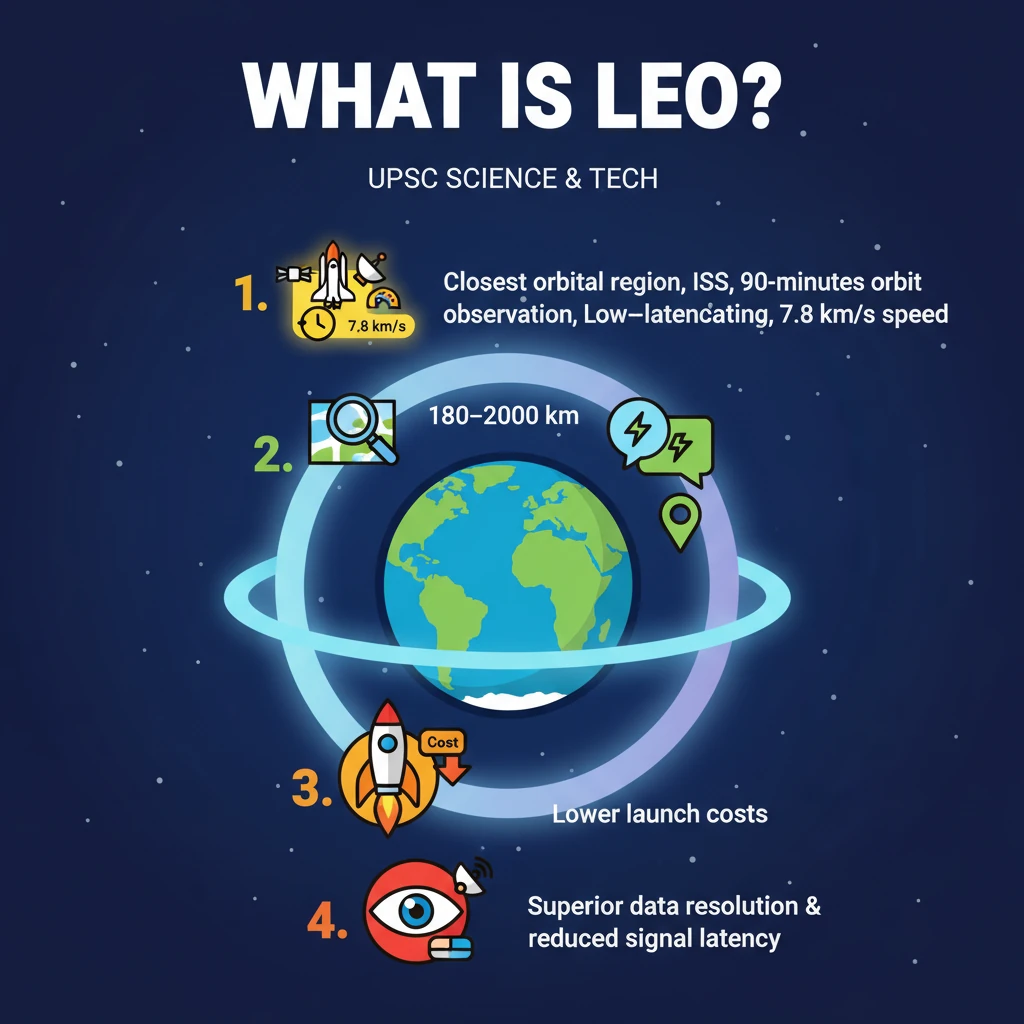
- •LEO is Earth's closest orbital region (180-2000 km altitude), most utilized for satellites and the ISS.
- •Satellites in LEO orbit at ~7.8 km/s, completing an orbit in approximately 90 minutes due to balanced gravitational and centrifugal forces.
- •Key applications include high-resolution Earth observation, low-latency communication, GPS, and scientific research on the ISS.
- •LEO offers advantages like superior data resolution, reduced signal latency, and lower launch costs compared to higher orbits like GEO.
- •Orbital stability in LEO is affected by atmospheric drag, leading to gradual orbital decay over time.
🧠 Memory Techniques
98% Verified Content