Adaptive Optics (NFIRAOS) & NIR Star Catalogue Tool for TMT - Science And Technology | UPSC Learning
Topics
0 topics • 0 completed
🔍
No topics match your search
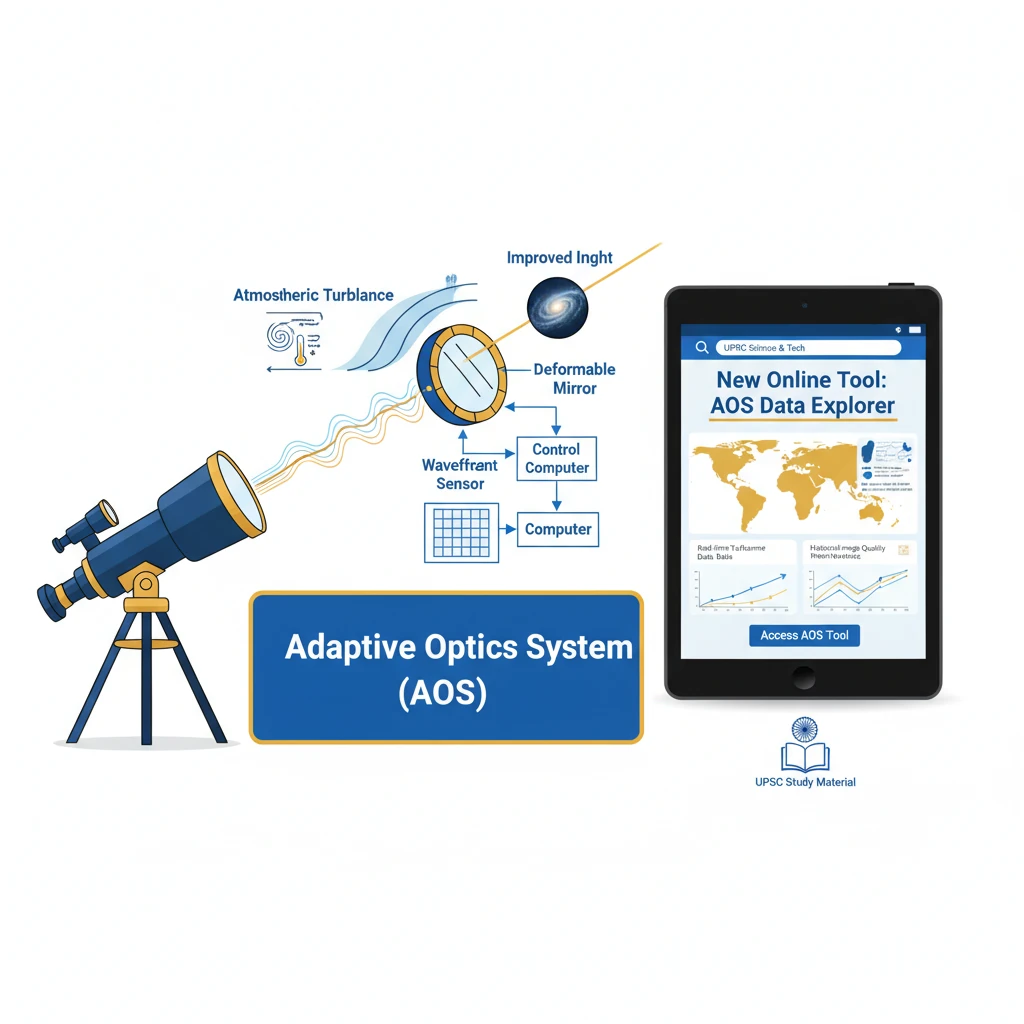
Adaptive Optics (NFIRAOS) & NIR Star Catalogue Tool for TMT
Medium⏱️ 8 min read
science and technology
📖 Introduction
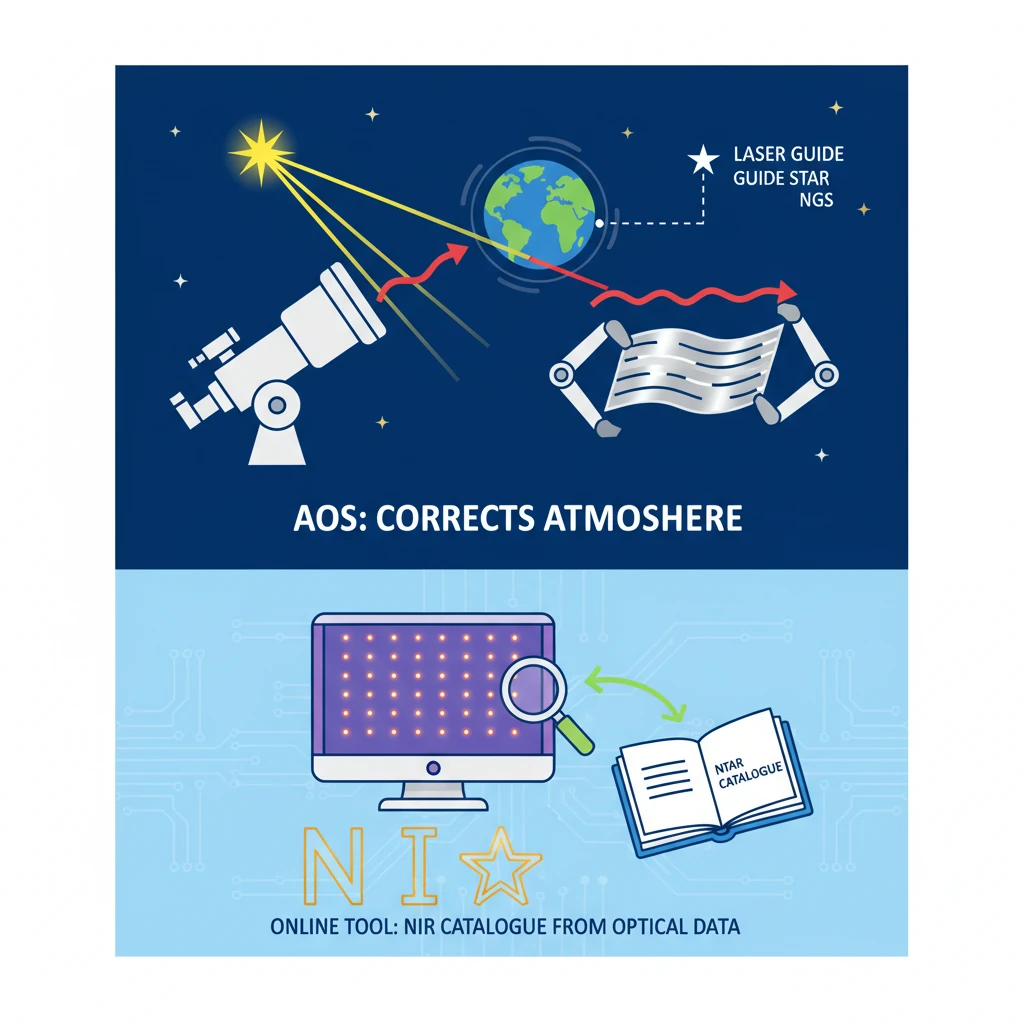
<h4>Introduction to Adaptive Optics System (AOS)</h4><p>The <strong>Adaptive Optics System (AOS)</strong> is a crucial technology designed to correct distortions caused by the Earth's atmosphere. These distortions severely limit the clarity and resolution of images captured by ground-based telescopes.</p><div class='info-box'><p><strong>Atmospheric Turbulence:</strong> This refers to the varying refractive index of air due to temperature and pressure differences, causing light from celestial objects to shimmer and blur.</p></div><h4>NFIRAOS: The TMT's Advanced AOS</h4><p>The <strong>Thirty Meter Telescope (TMT)</strong> employs a sophisticated AOS known as the <strong>Narrow Field Infrared Adaptive Optics System (NFIRAOS)</strong>. This system is engineered to significantly enhance the <strong>image resolution</strong> of the telescope.</p><p><strong>NFIRAOS</strong> achieves this by utilizing advanced components such as <strong>deformable mirrors</strong> and specialized <strong>laser guide stars (LGS)</strong>. These elements work in tandem to counteract the blurring effects of <strong>atmospheric turbulence</strong>.</p><h4>Functioning with Laser Guide Stars (LGS)</h4><p>The <strong>NFIRAOS</strong> facility is capable of projecting up to nine powerful <strong>lasers</strong> into the night sky. These lasers create artificial points of light, effectively serving as <strong>artificial guide stars</strong>.</p><div class='key-point-box'><p>While <strong>laser guide stars (LGS)</strong> are effective, they are also affected by <strong>atmospheric turbulence</strong>. This makes precise measurement of the atmosphere's <strong>tip-tilt</strong> (overall image motion) uncertain using LGS alone.</p></div><h4>Role of Natural Guide Stars (NGS)</h4><p>To accurately correct the effects of <strong>atmospheric turbulence</strong>, particularly the <strong>tip-tilt</strong>, the <strong>Adaptive Optics system</strong> requires additional feedback. This feedback comes from observing <strong>three real stars</strong>, which are known as <strong>Natural Guide Stars (NGS)</strong>.</p><p>These <strong>NGS</strong> provide the necessary stable reference points to calibrate the system and ensure precise atmospheric correction, working in conjunction with the <strong>LGS</strong>.</p><h4>New Online Tool for Near Infrared (NIR) Stars</h4><p>Recognizing the need for efficient identification of <strong>Natural Guide Stars</strong>, researchers have developed an <strong>automated code</strong>. This code functions as a new <strong>online tool</strong>.</p><p>The primary purpose of this <strong>online tool</strong> is to create a comprehensive <strong>catalogue of Near Infrared (NIR) stars</strong>. Such a catalogue is vital for selecting suitable <strong>NGS</strong> for <strong>AOS</strong> operations.</p><div class='info-box'><p>The <strong>automated code</strong> can compute the expected <strong>near-infrared magnitudes</strong> of stellar sources. It achieves this by using their known <strong>optical magnitudes</strong>, which are typically identified in various <strong>optical sky surveys</strong>.</p></div>
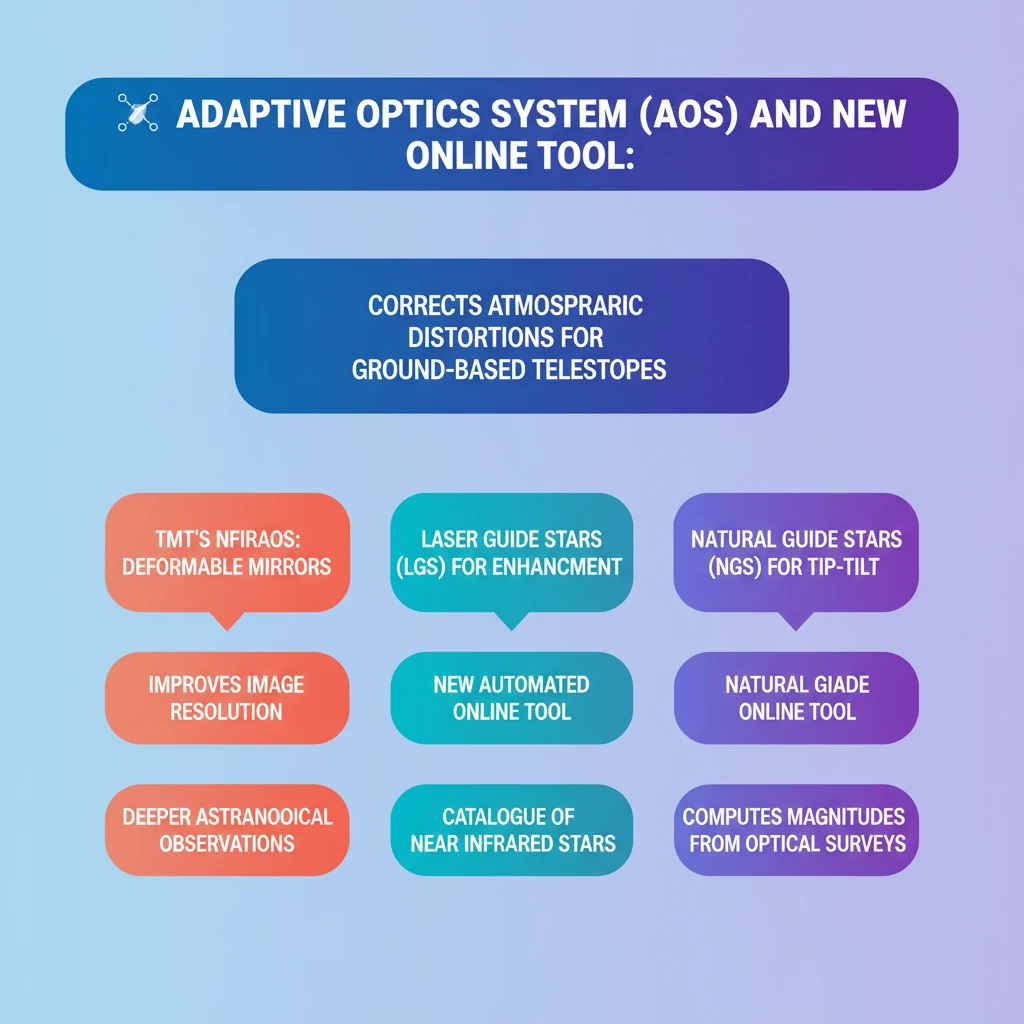
💡 Key Takeaways
- •Adaptive Optics System (AOS) corrects atmospheric distortions for ground-based telescopes.
- •TMT's NFIRAOS uses deformable mirrors and laser guide stars (LGS) for image enhancement.
- •Natural Guide Stars (NGS) are essential for precise atmospheric tip-tilt correction.
- •A new automated online tool creates a catalogue of Near Infrared (NIR) stars by computing magnitudes from optical surveys.
- •AOS significantly improves image resolution, enabling deeper astronomical observations.
- •Beyond astronomy, AOS has crucial applications in medical imaging, particularly for the human retina.
🧠 Memory Techniques
95% Verified Content
📚 Reference Sources
•Thirty Meter Telescope (TMT) Official Website
•European Southern Observatory (ESO) Adaptive Optics Information
•NASA Adaptive Optics Resources
•Journal articles on Adaptive Optics in Astronomy and Ophthalmology