Launch of Tanager-1 - Science And Technology | UPSC Learning
Topics
0 topics • 0 completed
🔍
No topics match your search
Launch of Tanager-1
Medium⏱️ 8 min read
science and technology
📖 Introduction
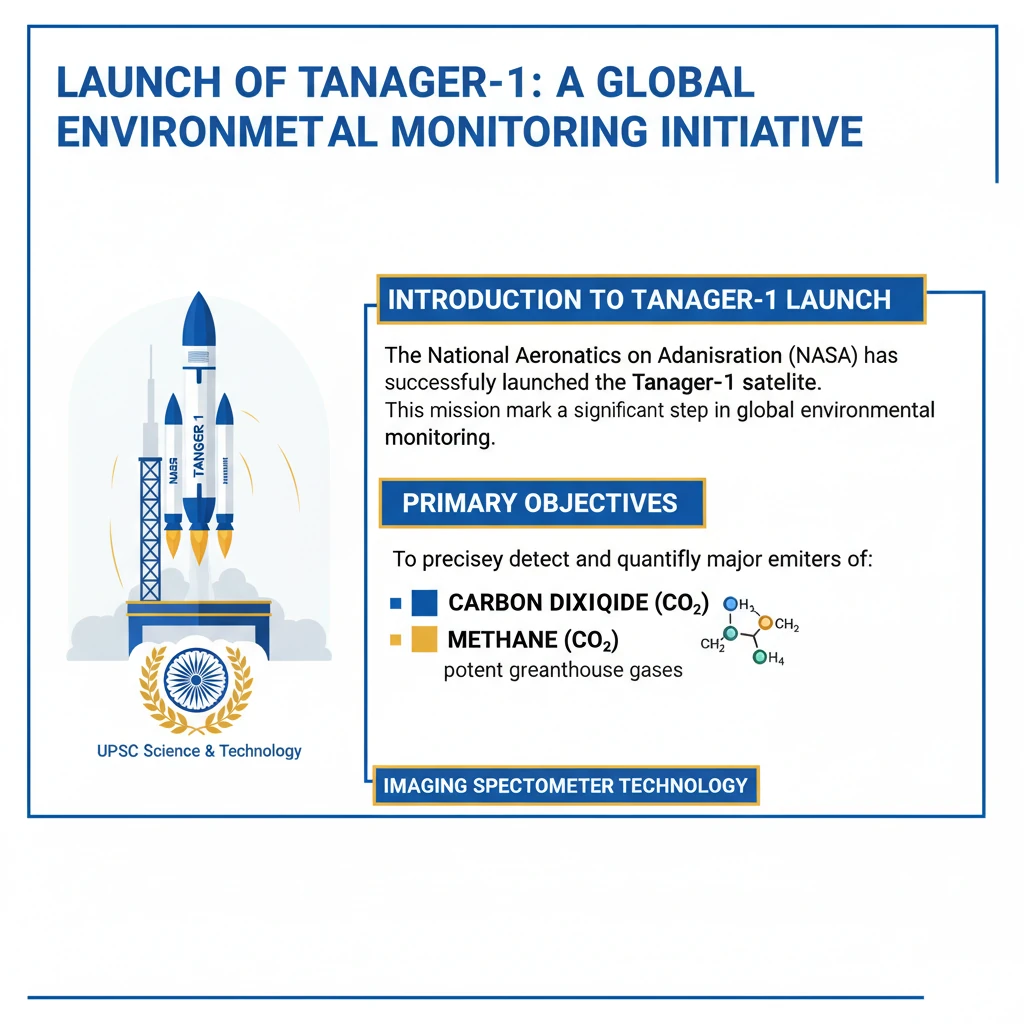
<h4>Introduction to Tanager-1 Launch</h4><p>The <strong>National Aeronautics and Space Administration (NASA)</strong> has successfully launched the <strong>Tanager-1 satellite</strong>. This mission marks a significant step in global environmental monitoring.</p><p>The primary objective of <strong>Tanager-1</strong> is to precisely detect and quantify major emitters of <strong>carbon dioxide (CO2)</strong> and <strong>methane (CH4)</strong>, two potent greenhouse gases.</p><h4>Imaging Spectrometer Technology</h4><p><strong>Tanager-1</strong> employs advanced <strong>imaging spectrometer technology</strong>. This sophisticated instrument is designed to measure specific wavelengths of light that are reflected by Earth's surface.</p><div class='info-box'><p><strong>How it Works:</strong></p><ul><li>Different gases, such as <strong>methane</strong> and <strong>carbon dioxide</strong>, absorb distinct wavelengths of light.</li><li>This absorption creates unique spectral "<strong>fingerprints</strong>" that the imaging spectrometer can accurately identify.</li></ul></div><h4>Global Emission Measurement Capability</h4><p>A key capability of <strong>Tanager-1</strong> is its ability to measure <strong>point-source emissions</strong>. This means it can pinpoint emissions down to the level of individual facilities and equipment.</p><div class='key-point-box'><p>This global-scale, high-resolution measurement capability is crucial for identifying specific sources of greenhouse gas emissions, enabling more targeted mitigation efforts.</p></div><h4>Predecessor: MethaneSAT</h4><p>Prior to <strong>Tanager-1</strong>, <strong>NASA</strong> had also launched <strong>MethaneSAT</strong>. This earlier satellite was specifically designed to track and measure <strong>methane emissions</strong> across various regions.</p><h4>Understanding Methane: A Potent Greenhouse Gas</h4><p><strong>Methane (CH4)</strong> is recognized as a powerful <strong>greenhouse gas</strong>. It is the second-largest contributor to <strong>global warming</strong>, following <strong>carbon dioxide</strong>.</p><div class='info-box'><p><strong>Key Methane Facts:</strong></p><ul><li>Responsible for approximately <strong>30% of global heating</strong>.</li><li>According to the <strong>United Nations Environment Programme (UNEP)</strong>, over a <strong>20-year period</strong>, methane is <strong>80 times more potent</strong> at warming the atmosphere than carbon dioxide.</li></ul></div><div class='exam-tip-box'><p><strong>UPSC Insight:</strong> Understanding the relative potency and sources of different greenhouse gases like <strong>methane</strong> and <strong>carbon dioxide</strong> is vital for both Prelims (factual) and Mains (environmental policy, climate change) questions.</p></div>
💡 Key Takeaways
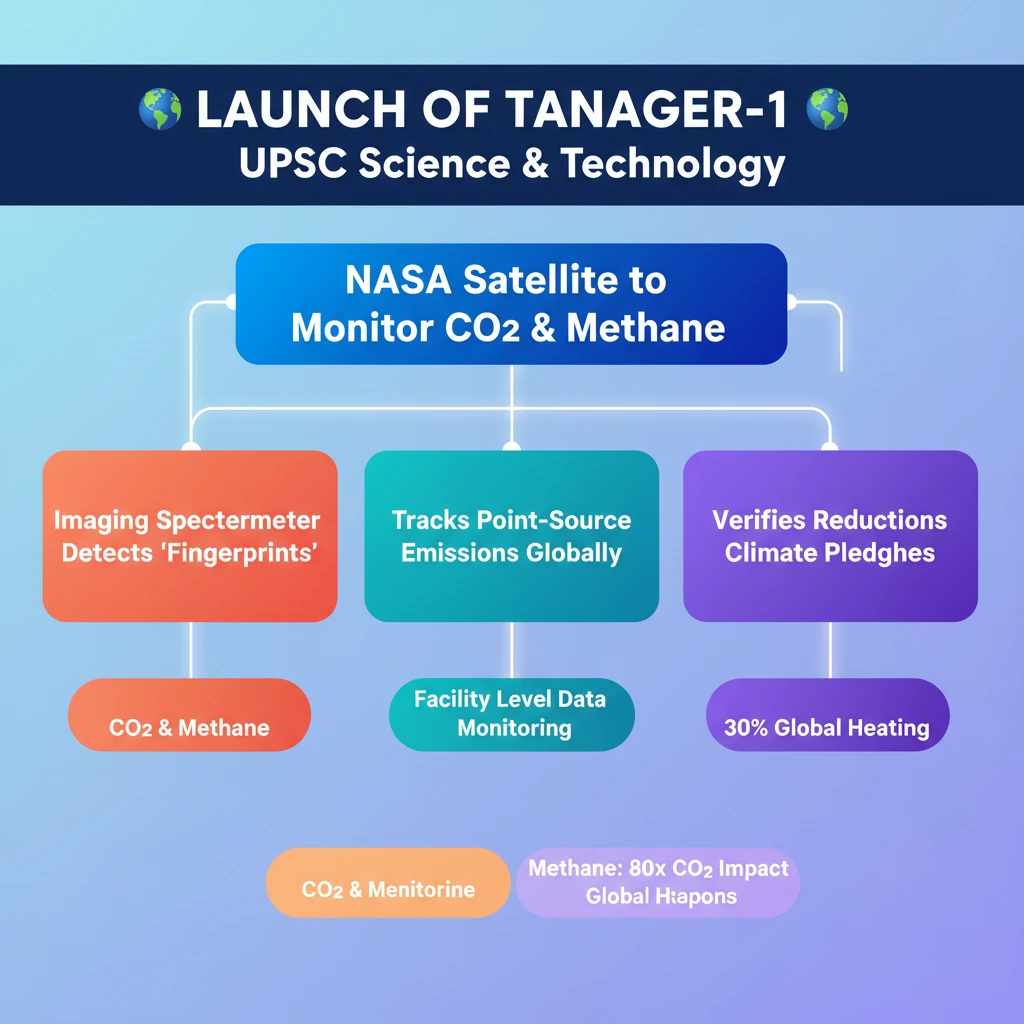
- •Tanager-1 is a NASA satellite designed to detect major emitters of CO2 and Methane globally.
- •It uses imaging spectrometer technology to identify spectral "fingerprints" of these gases.
- •The satellite can measure point-source emissions from individual facilities.
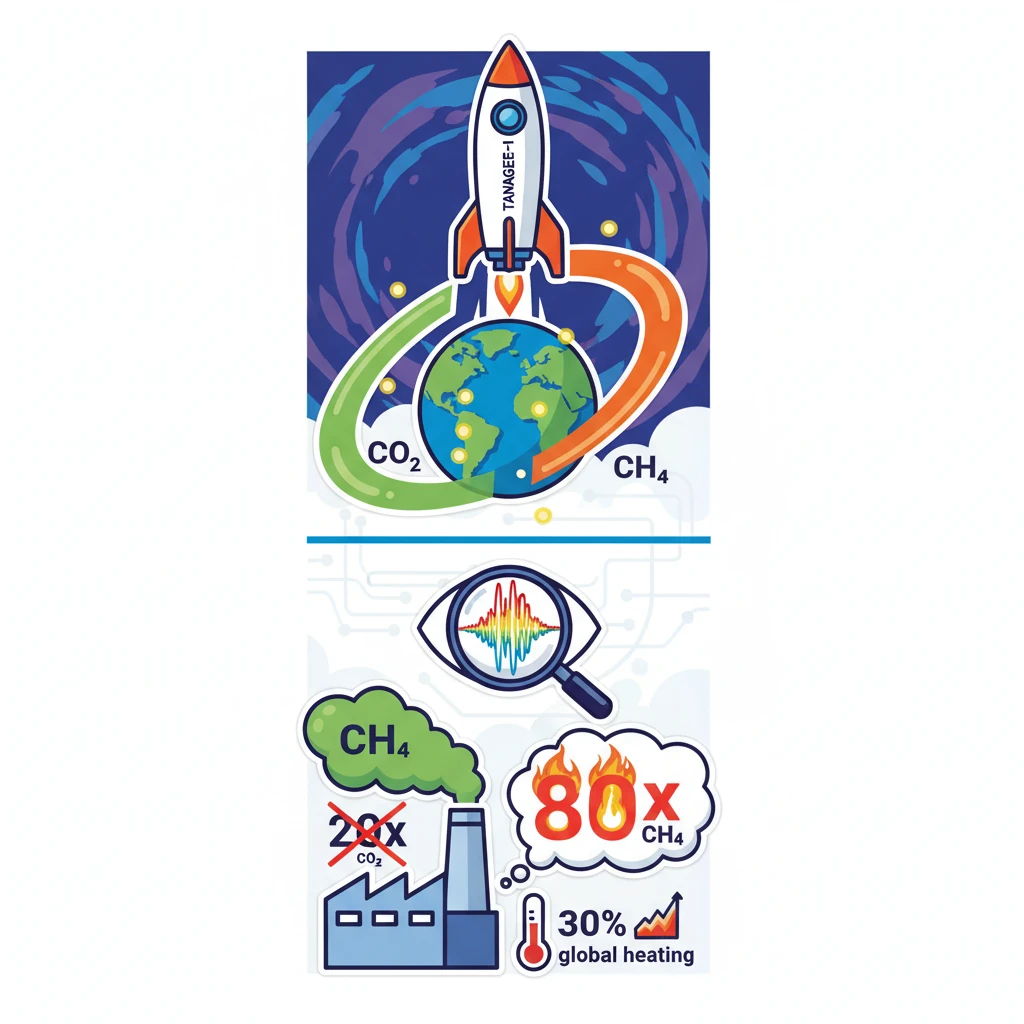
- •Methane is a potent greenhouse gas, 80 times more warming than CO2 over 20 years, and contributes 30% to global heating.
- •Missions like Tanager-1 are crucial for tracking climate change, verifying emission reductions, and supporting international climate pledges.
🧠 Memory Techniques
98% Verified Content
📚 Reference Sources
•NASA Official Website (for Tanager-1 and MethaneSAT details)
•United Nations Environment Programme (UNEP) reports on Methane