World AIDS Day 2024 - Science And Technology | UPSC Learning
Topics
0 topics • 0 completed
🔍
No topics match your search
World AIDS Day 2024
Medium⏱️ 8 min read
science and technology
📖 Introduction
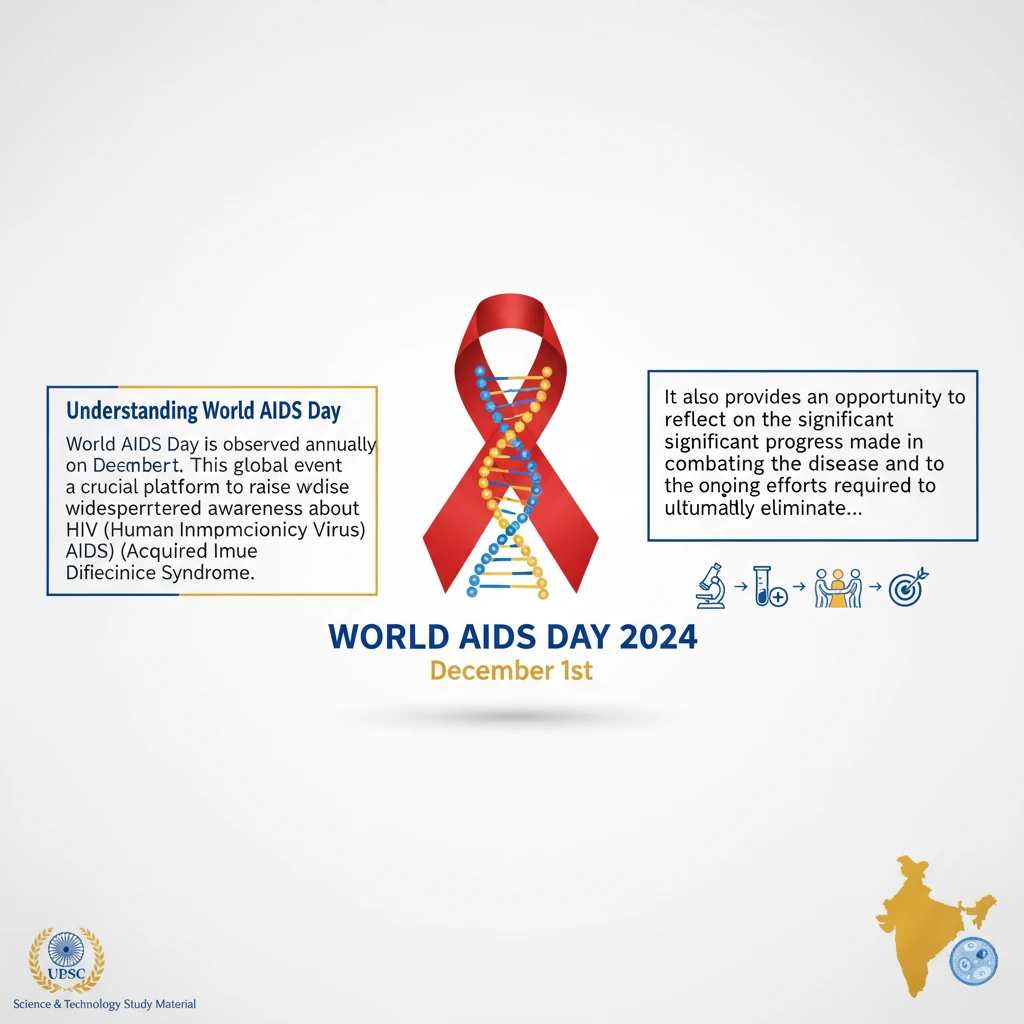
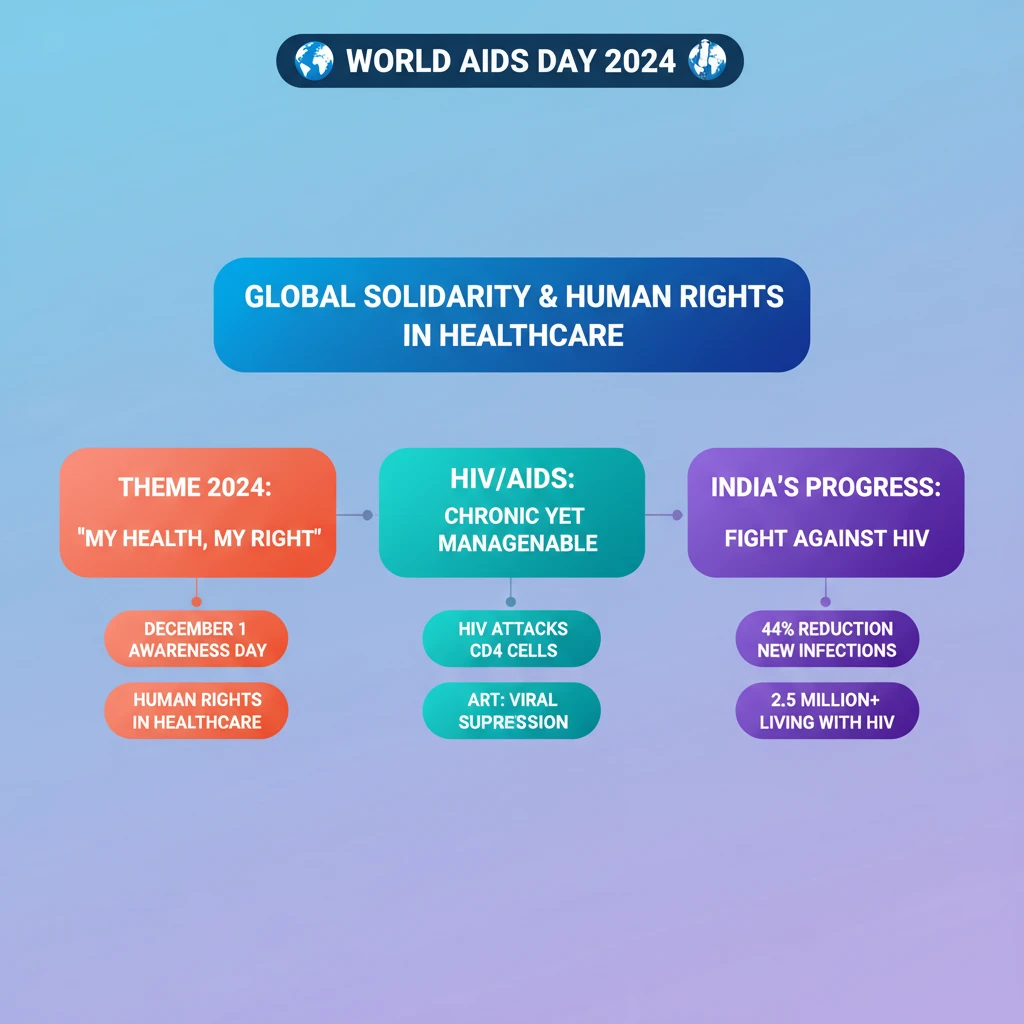
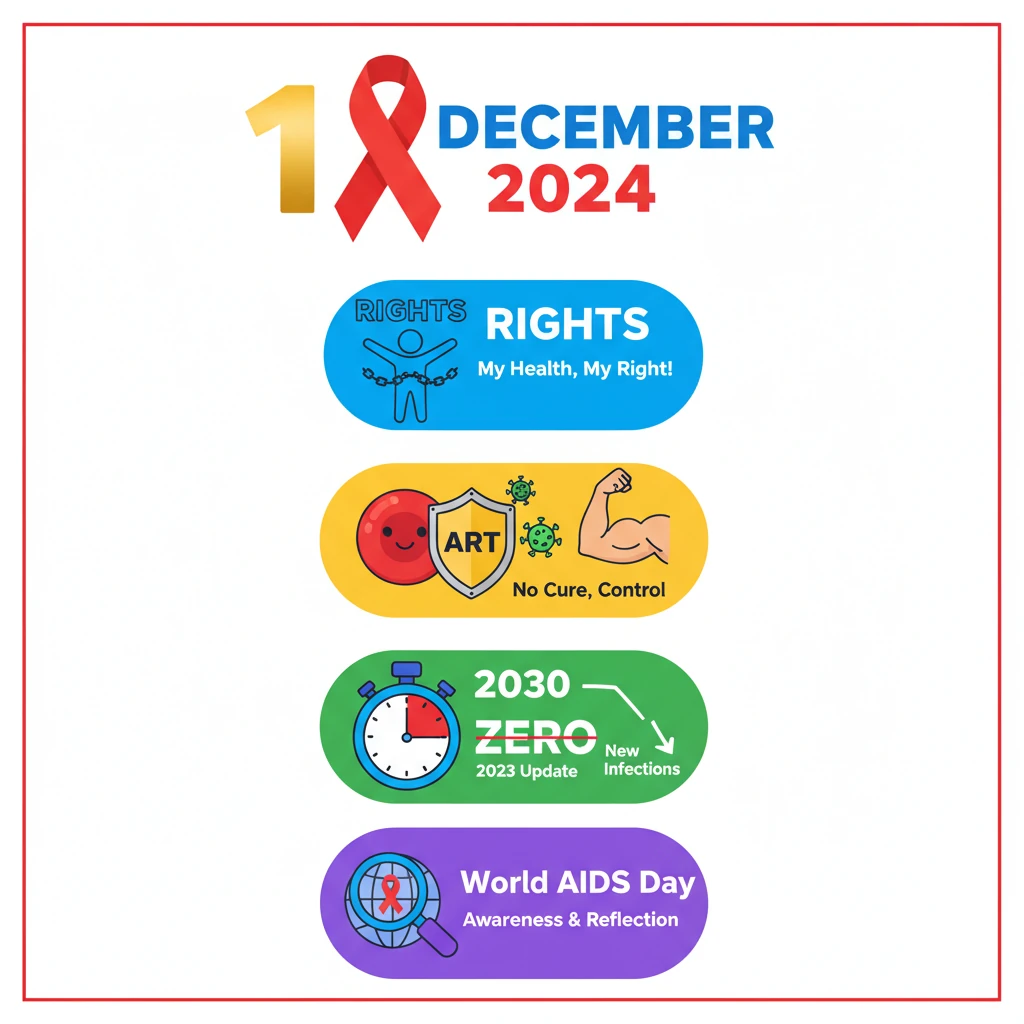
<h4>Understanding World AIDS Day</h4><p><strong>World AIDS Day</strong> is observed annually on <strong>December 1st</strong>. This global event serves as a crucial platform to raise widespread awareness about <strong>HIV (Human Immunodeficiency Virus)</strong> and <strong>AIDS (Acquired Immune Deficiency Syndrome)</strong>.</p><p>It also provides an opportunity to reflect on the significant progress made in combating the disease and to highlight the ongoing efforts required to ultimately eliminate it.</p><div class='info-box'><p><strong>Key Date:</strong> <strong>December 1st</strong> every year.</p><p><strong>Primary Purpose:</strong> Raise awareness, reflect on progress, highlight ongoing efforts to eliminate <strong>HIV/AIDS</strong>.</p></div><h4>The 2024 Theme</h4><p>The theme for <strong>World AIDS Day 2024</strong> is <strong>“Take the rights path: My health, my right!”</strong>. This theme emphasizes the fundamental right of every individual to health and the importance of a rights-based approach in the fight against <strong>HIV/AIDS</strong>.</p><h4>What is AIDS?</h4><p><strong>AIDS</strong> is a chronic, life-threatening condition caused by the <strong>Human Immunodeficiency Virus (HIV)</strong>. The virus specifically targets and attacks the body's immune system.</p><div class='info-box'><p><strong>HIV Mechanism:</strong> <strong>HIV</strong> primarily targets <strong>CD4 cells</strong>. These are a type of <strong>white blood cell</strong> that are vital components of the body's immune system.</p><p><strong>Consequence:</strong> Damage to <strong>CD4 cells</strong> severely compromises the immune system, making the body vulnerable to various infections and diseases.</p></div><p>While there is currently <strong>no cure</strong> for <strong>HIV/AIDS</strong>, significant advancements have been made in treatment. <strong>Antiretroviral therapy (ART)</strong> is a highly effective treatment that can suppress the virus.</p><p><strong>ART</strong> helps to restore the count of <strong>CD4 cells</strong>, thereby improving the immune system and allowing people with <strong>HIV</strong> to lead long, healthy, and productive lives.</p><h4>Global and National Progress Against HIV/AIDS</h4><p>Significant strides have been made globally in the fight against <strong>HIV/AIDS</strong>. The <strong>Global AIDS Update 2023</strong> highlights a noticeable decline in new <strong>HIV infections</strong> worldwide.</p><div class='key-point-box'><p><strong>Global Goal:</strong> The international community is actively working towards the ambitious goal of <strong>eliminating AIDS by 2030</strong>.</p></div><p><strong>India</strong> has also demonstrated commendable progress in its response to the epidemic. The country has a substantial population living with <strong>HIV</strong>, but efforts are yielding positive results.</p><div class='info-box'><p><strong>HIV in India:</strong> Over <strong>2.5 million people</strong> in India live with <strong>HIV</strong>.</p><p><strong>Reduction in New Infections:</strong> India has achieved a significant <strong>44% reduction</strong> in new <strong>HIV infections since 2010</strong>.</p></div><h4>India's Strategic Response: NACP</h4><p><strong>India's</strong> comprehensive approach to combating <strong>HIV/AIDS</strong> is spearheaded by the <strong>National AIDS and STD Control Programme (NACP)</strong>. This program has been instrumental in guiding the national response for decades.</p><div class='info-box'><p><strong>NACP Launch:</strong> The <strong>National AIDS and STD Control Programme (NACP)</strong> was initially launched in <strong>1992</strong>.</p><p><strong>Phased Implementation:</strong> It has been implemented in multiple phases, with <strong>Phase I</strong> beginning in <strong>1992</strong> and subsequent phases continuing until <strong>2017</strong>.</p></div><p>The current phase, <strong>NACP Phase V (2021-2026)</strong>, outlines ambitious targets and strategies to further curb the epidemic. This phase is critical for achieving the national and global elimination goals.</p><div class='key-point-box'><p><strong>NACP Phase V (2021-2026) Objectives:</strong></p><ul><li>Reduce new <strong>HIV infections</strong> and <strong>AIDS-related deaths</strong> by <strong>80%</strong> (using <strong>2010</strong> as the baseline).</li><li>Eliminate <strong>vertical transmission</strong> of <strong>HIV</strong> (from mother to child).</li><li>Actively combat <strong>HIV-related stigma and discrimination</strong> within society.</li></ul></div><div class='exam-tip-box'><p><strong>UPSC Insight:</strong> Understanding the evolution of <strong>NACP</strong> through its phases and the specific targets of <strong>NACP Phase V</strong> is crucial for Mains <strong>GS-II (Social Justice)</strong> and <strong>GS-III (Science & Technology)</strong> questions related to public health initiatives and disease control.</p></div>
💡 Key Takeaways
- •World AIDS Day is observed annually on December 1st to raise awareness about HIV/AIDS and reflect on progress.
- •The 2024 theme, 'Take the rights path: My health, my right!', emphasizes human rights in healthcare.
- •AIDS is a chronic condition caused by HIV, which attacks CD4 cells; while there's no cure, Antiretroviral Therapy (ART) effectively suppresses the virus.
- •Global efforts aim to eliminate AIDS by 2030, with the Global AIDS Update 2023 showing a decline in new infections.
- •India has made significant progress, with a 44% reduction in new HIV infections since 2010, and over 2.5 million people living with HIV.
- •India's National AIDS and STD Control Programme (NACP), launched in 1992, is currently in Phase V (2021-2026), targeting an 80% reduction in new infections and deaths, elimination of vertical transmission, and combating stigma.
🧠 Memory Techniques
95% Verified Content
📚 Reference Sources
•UNAIDS - Global AIDS Update 2023
•National AIDS Control Organization (NACO), Government of India - NACP Phase V documents