Hafnium: Properties, Uses in Nuclear Reactors & Alloys - Science And Technology | UPSC Learning
Topics
0 topics • 0 completed
🔍
No topics match your search
Hafnium: Properties, Uses in Nuclear Reactors & Alloys
Easy⏱️ 5 min read
science and technology
📖 Introduction
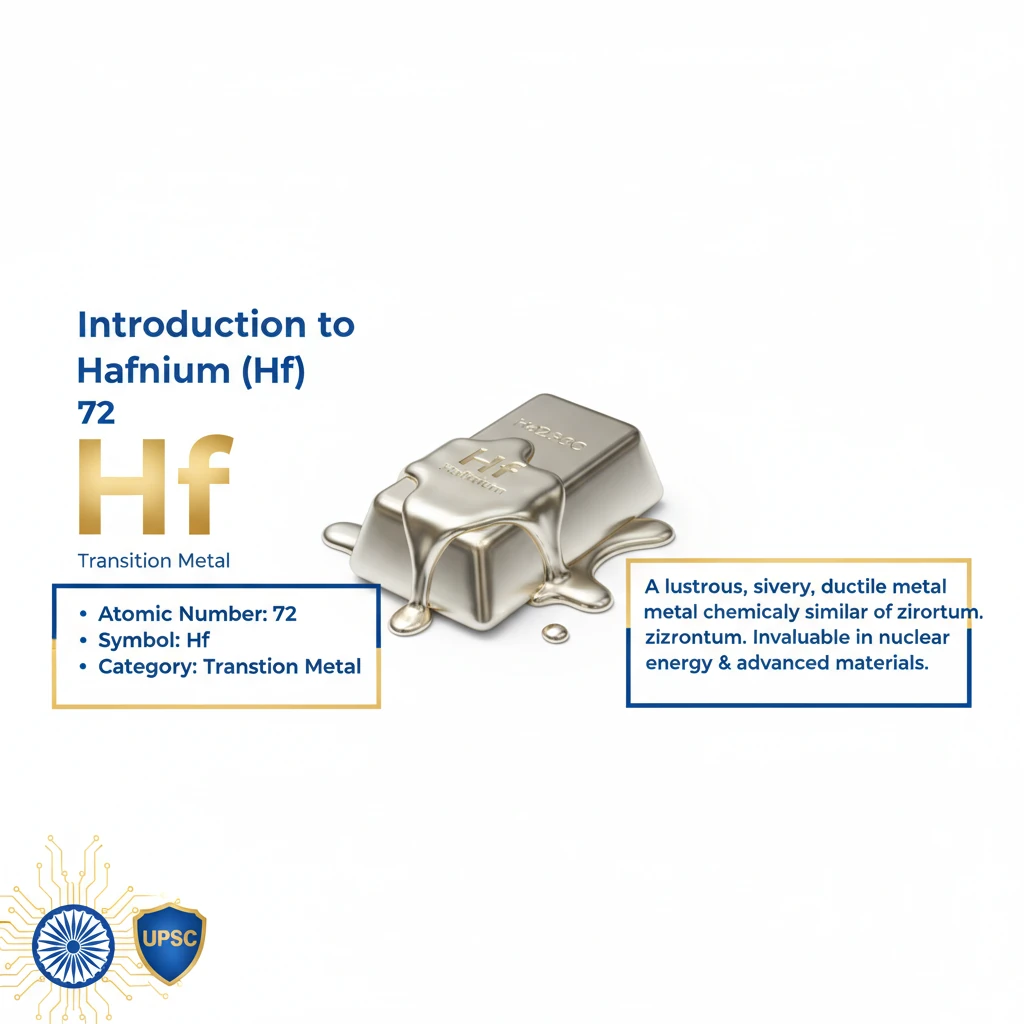
<h4>Introduction to Hafnium</h4><p><strong>Hafnium</strong> (Hf) is a lustrous, silvery, ductile metal that is chemically similar to zirconium. It is a transition metal found in Group 4 of the periodic table.</p><p>Its unique properties make it invaluable in several high-technology applications, particularly in nuclear energy and advanced materials.</p><div class='info-box'><p><strong>Atomic Number:</strong> 72</p><p><strong>Symbol:</strong> Hf</p><p><strong>Category:</strong> Transition Metal</p></div><h4>Key Applications of Hafnium</h4><p><strong>Hafnium</strong> possesses several distinct characteristics that dictate its primary industrial uses. Its high neutron absorption cross-section is particularly significant.</p><div class='key-point-box'><p><strong>Primary Uses:</strong></p><ul><li><strong>Nuclear Reactor Control Rods:</strong> Excellent neutron absorber.</li><li><strong>Vacuum Tube Getters:</strong> Removes trace gases.</li><li><strong>Alloying Agent:</strong> Enhances properties of other metals.</li></ul></div><h4>Hafnium in Nuclear Reactors</h4><p>One of the most critical applications of <strong>Hafnium</strong> is in <strong>nuclear reactors</strong>. It is a highly effective absorber of <strong>neutrons</strong>.</p><p>This property makes it ideal for manufacturing <strong>control rods</strong>, which are used to regulate the rate of fission in a nuclear reactor. By inserting or withdrawing these rods, the chain reaction can be controlled, ensuring safe and efficient operation.</p><div class='exam-tip-box'><p><strong>UPSC Insight:</strong> Understanding the role of materials like <strong>Hafnium</strong> in nuclear technology is crucial for <strong>Science & Technology (GS Paper III)</strong>. Questions often focus on the principles and applications of nuclear energy.</p></div><h4>Hafnium as a Getter in Vacuum Tubes</h4><p><strong>Hafnium</strong> is also employed in <strong>vacuum tubes</strong> as a <strong>getter</strong>. A getter is a material designed to combine with and remove trace gases from a vacuum system.</p><p>In vacuum tubes, even minute amounts of residual gases can impair performance. <strong>Hafnium's</strong> reactivity allows it to scavenge these unwanted gas molecules, thereby maintaining a high vacuum.</p><h4>Hafnium as an Alloying Agent</h4><p>Beyond its specialized roles, <strong>Hafnium</strong> serves as an <strong>alloying agent</strong> in various metals. When added to other metals, it can significantly improve their mechanical and thermal properties.</p><p>It is commonly used as an alloying element with metals such as <strong>iron</strong>, <strong>titanium</strong>, and <strong>niobium</strong>. These alloys find applications in aerospace, gas turbines, and other high-performance components where strength and heat resistance are critical.</p>
💡 Key Takeaways
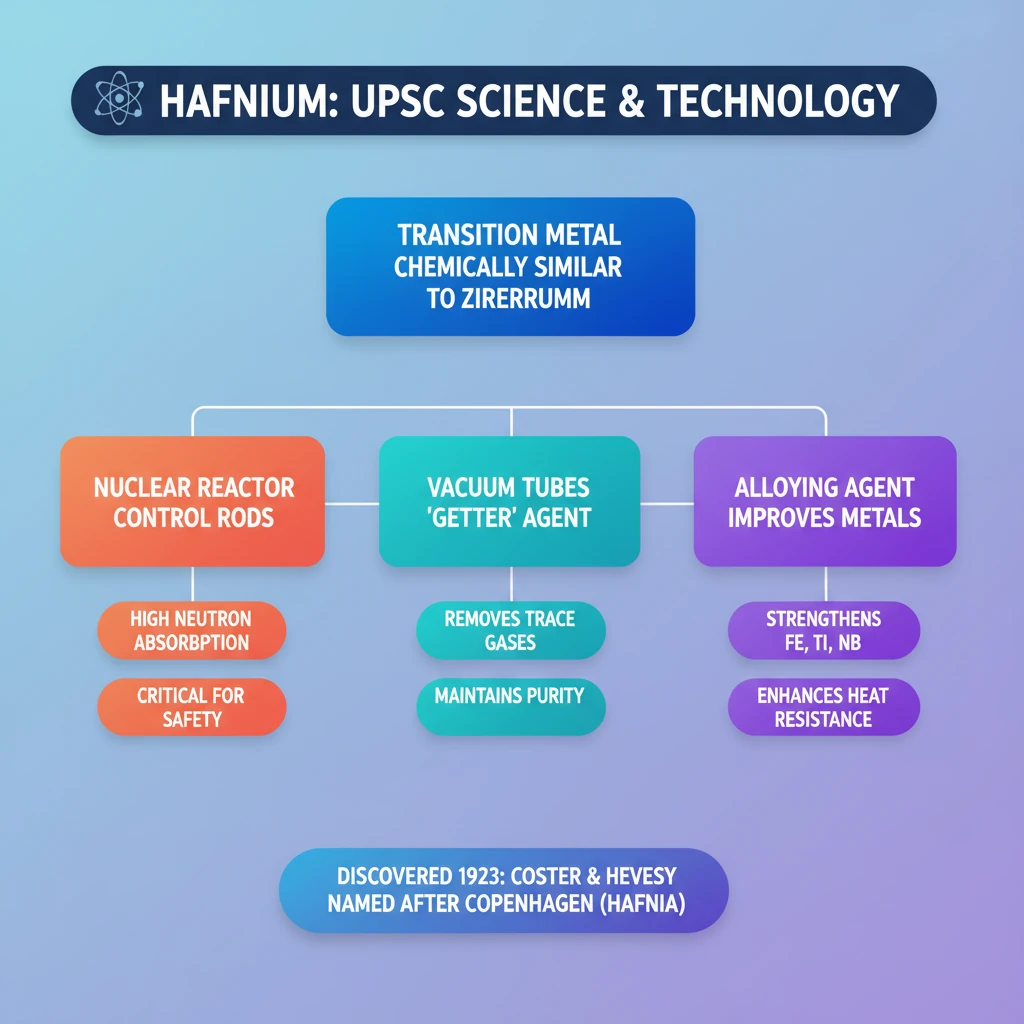
- •Hafnium is a transition metal, chemically similar to zirconium.
- •Its primary uses are in nuclear reactor control rods due to high neutron absorption.
- •It acts as a 'getter' in vacuum tubes, removing trace gases.
- •Hafnium is an alloying agent, improving properties of metals like iron, titanium, and niobium.
- •Discovered in 1923 by Coster and Hevesy, named after Copenhagen (Hafnia).
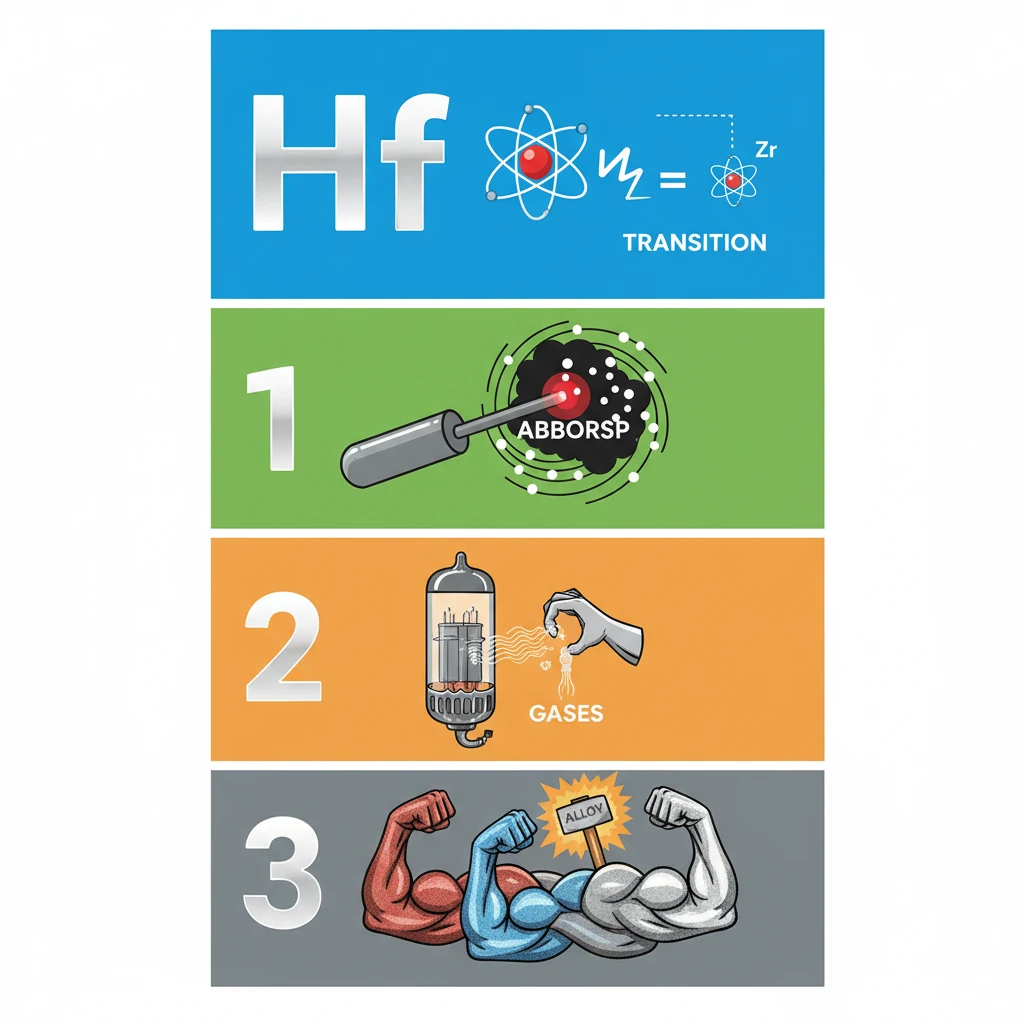
🧠 Memory Techniques
98% Verified Content
📚 Reference Sources
•General scientific knowledge bases (e.g., IUPAC, Encyclopaedia Britannica for discovery details)