JUICE Probe’s Double Slingshot Manoeuvre - Science And Technology | UPSC Learning
Topics
0 topics • 0 completed
🔍
No topics match your search
JUICE Probe’s Double Slingshot Manoeuvre
Medium⏱️ 8 min read
science and technology
📖 Introduction
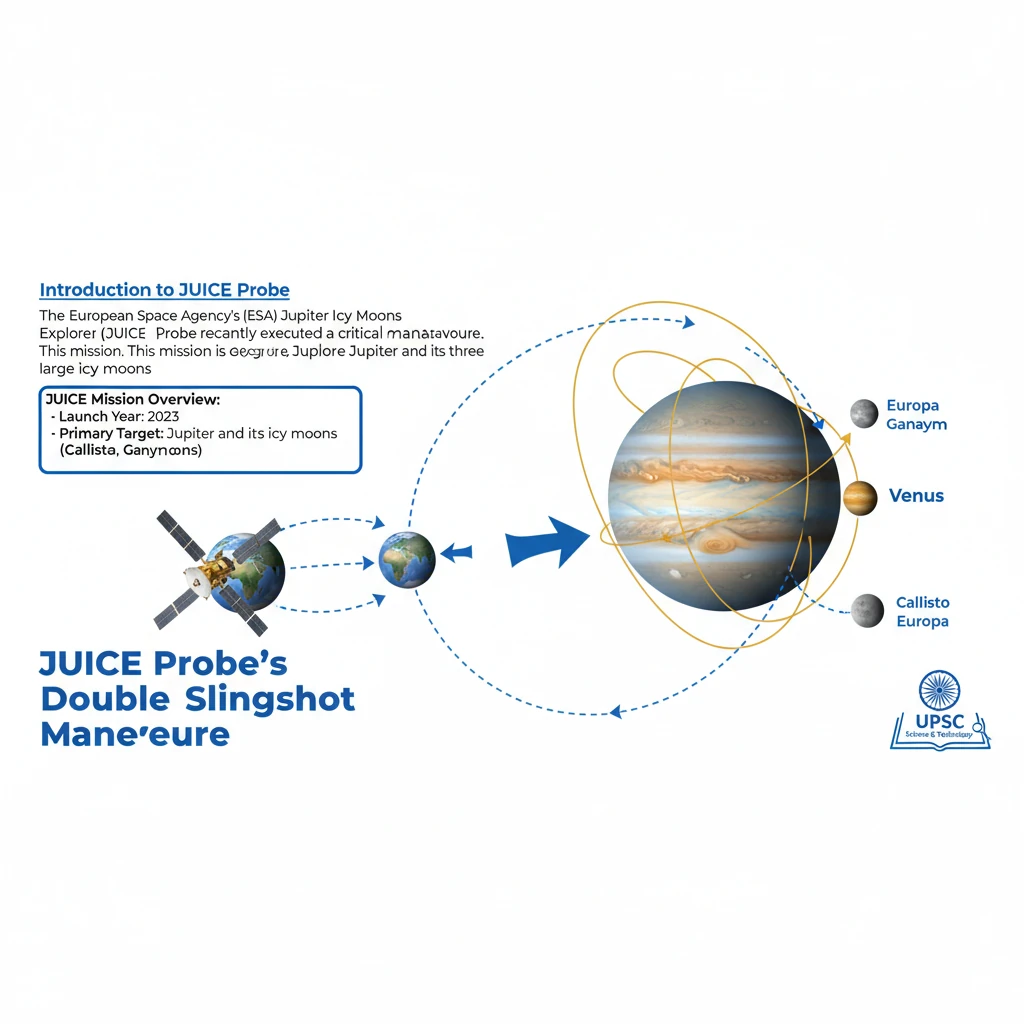
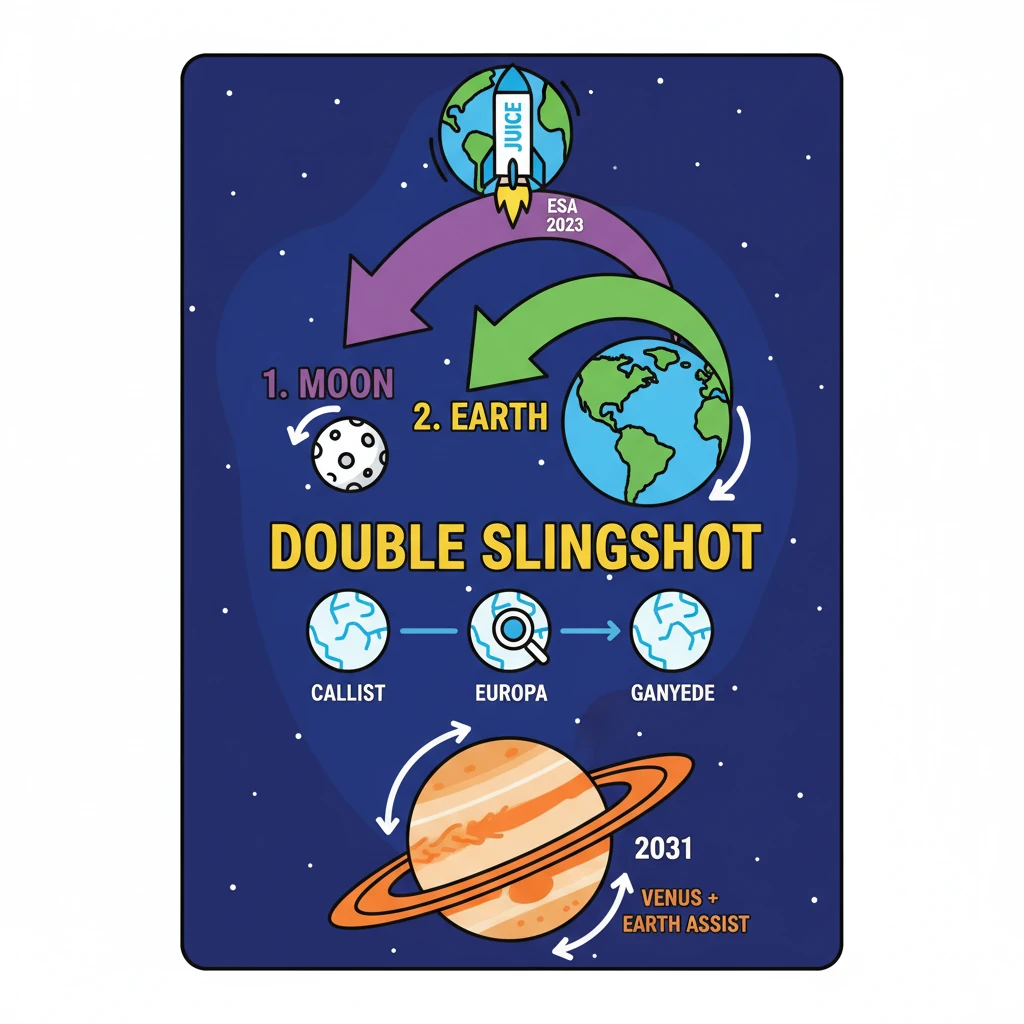
<h4>Introduction to JUICE Probe</h4><p>The <strong>European Space Agency’s (ESA)</strong> <strong>Jupiter Icy Moons Explorer (JUICE) Probe</strong> recently executed a critical manoeuvre. This mission is designed to explore <strong>Jupiter</strong> and its three large <strong>icy moons</strong>.</p><div class='info-box'><p><strong>JUICE Mission Overview:</strong></p><ul><li><strong>Launch Year:</strong> 2023</li><li><strong>Primary Target:</strong> Jupiter and its icy moons (<strong>Callisto</strong>, <strong>Europa</strong>, <strong>Ganymede</strong>)</li><li><strong>Key Objective:</strong> Study the potential for these moons to support life.</li></ul></div><h4>The Double Slingshot Manoeuvre</h4><p>The <strong>JUICE Probe</strong> successfully performed a complex <strong>double slingshot manoeuvre</strong>. This involved utilizing the gravitational forces of two celestial bodies in rapid succession: the <strong>Moon</strong> and then <strong>Earth</strong>.</p><p>Initially, <strong>JUICE</strong> flew approximately <strong>434 miles</strong> from the <strong>Moon’s surface</strong>. This close approach slightly altered its trajectory, setting it up for the next crucial phase.</p><p>Following the lunar flyby, the probe then passed about <strong>9,225 miles</strong> from <strong>Earth’s surface</strong>. This allowed <strong>Earth’s significant gravity</strong> to provide a powerful assist, accelerating the spacecraft.</p><h4>Gravity Assist Method Explained</h4><div class='key-point-box'><p><strong>Concept of Gravity Assist:</strong></p><p>The <strong>gravity assist method</strong>, also known as a <strong>gravitational slingshot</strong>, is a technique used by spacecraft to save propellant. It leverages the gravitational pull of planets or moons to alter a spacecraft's speed and trajectory without firing its engines extensively.</p></div><p>This technique is vital for long-duration interplanetary missions, enabling spacecraft to reach distant targets more efficiently. It significantly reduces the amount of fuel required for propulsion.</p><h4>JUICE's Future Trajectory</h4><p>The successful execution of this <strong>double slingshot manoeuvre</strong> has placed <strong>JUICE</strong> firmly on its course towards <strong>Jupiter</strong>. The probe is projected to reach the gas giant by <strong>2031</strong>.</p><p>To achieve its final destination, <strong>JUICE</strong> will perform three additional <strong>single gravity assists</strong>:</p><ul><li><strong>Venus</strong> in <strong>2025</strong></li><li><strong>Earth</strong> again in <strong>2026</strong></li><li><strong>Earth</strong> once more in <strong>2029</strong></li></ul><h4>JUICE Probe's Exploration Goals</h4><p>Upon reaching the <strong>Jupiter system</strong>, <strong>JUICE</strong> will conduct multiple <strong>fly-bys</strong> of <strong>Callisto</strong>, <strong>Europa</strong>, and <strong>Ganymede</strong>. These fly-bys are crucial for initial data collection.</p><p>Ultimately, the probe will enter orbit around <strong>Ganymede</strong>, making it the first spacecraft to orbit an <strong>icy moon</strong> other than Earth's. This phase will focus on in-depth studies of <strong>Ganymede's</strong> environment and potential habitability.</p><div class='exam-tip-box'><p><strong>UPSC Insight:</strong> Understanding mission objectives and the scientific rationale behind exploring <strong>icy moons</strong> like <strong>Ganymede</strong> and <strong>Europa</strong> is crucial for <strong>GS Paper 3 (Science & Technology)</strong>. Focus on the search for extraterrestrial life and the technological advancements involved.</p></div><h4>Other Missions to Jupiter and its Moons</h4><p>The <strong>ESA-led JUICE mission</strong> builds upon previous exploration efforts, notably <strong>NASA’s 1990s Galileo mission</strong>, which also orbited <strong>Jupiter</strong>.</p><p>Several other missions have explored or are currently exploring the <strong>Jupiter system</strong>:</p><ul><li><strong>Juno Mission (NASA):</strong> Currently orbiting Jupiter, studying its atmosphere and magnetic field.</li><li><strong>Cassini-Huygens (NASA and ESA):</strong> Although primarily a Saturn mission, it performed a Jupiter flyby for gravity assist.</li><li><strong>Galileo (NASA):</strong> First spacecraft to orbit Jupiter and conduct long-term studies of its atmosphere and moons.</li></ul>
💡 Key Takeaways
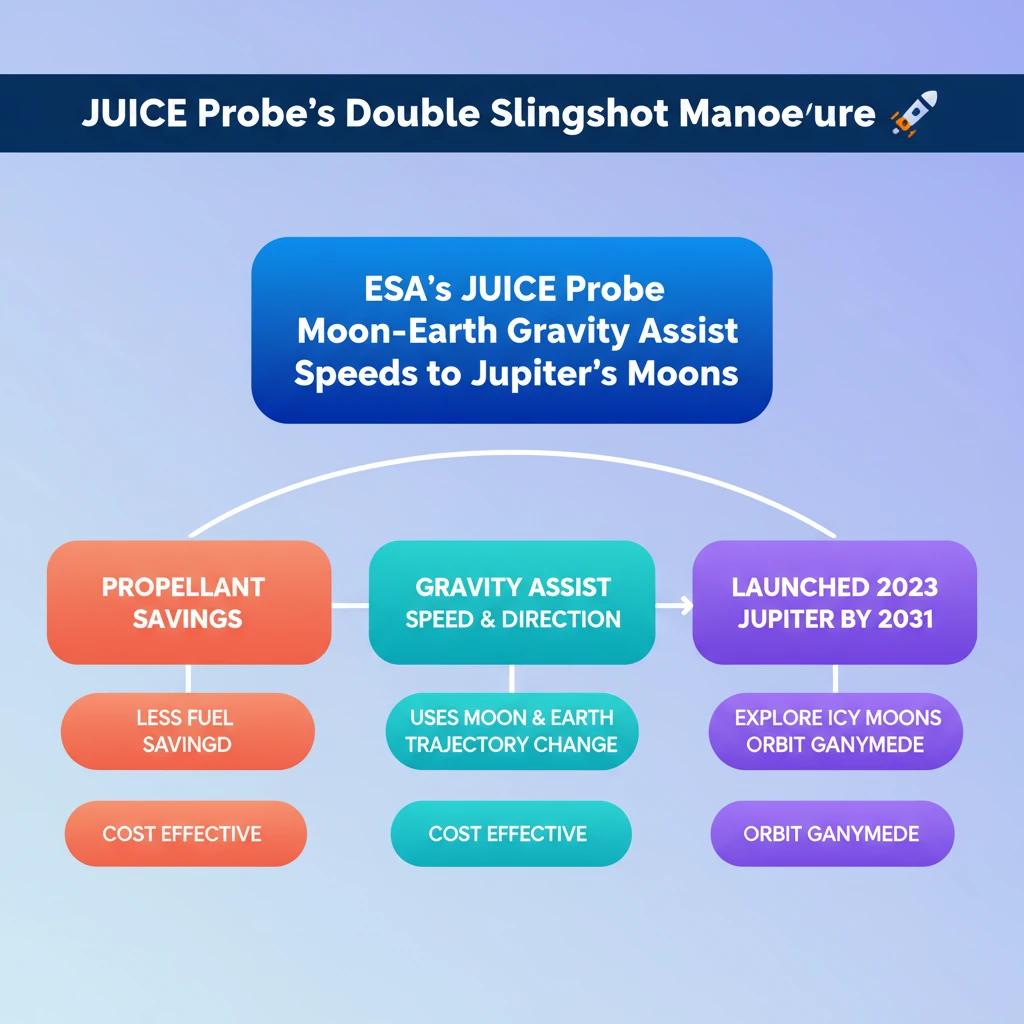
- •JUICE Probe (ESA) launched in 2023 to explore Jupiter's icy moons: Callisto, Europa, Ganymede.
- •Performed a unique 'double slingshot' using Moon and Earth gravity to gain speed and alter trajectory.
- •Gravity assist saves propellant by using celestial bodies' gravitational pull for speed and direction changes.
- •JUICE aims to reach Jupiter by 2031, with further assists from Venus and Earth.
- •Will orbit Ganymede to study its potential to support life, building on Galileo mission's discoveries.
🧠 Memory Techniques
98% Verified Content
📚 Reference Sources
•European Space Agency (ESA) Official Website (for JUICE mission details)
•NASA Official Website (for Galileo, Juno, Voyager mission details)