Bose-Einstein Condensate (BEC) & Quantum Statistics - Science And Technology | UPSC Learning
Topics
0 topics • 0 completed
🔍
No topics match your search
Bose-Einstein Condensate (BEC) & Quantum Statistics
Medium⏱️ 9 min read
science and technology
📖 Introduction
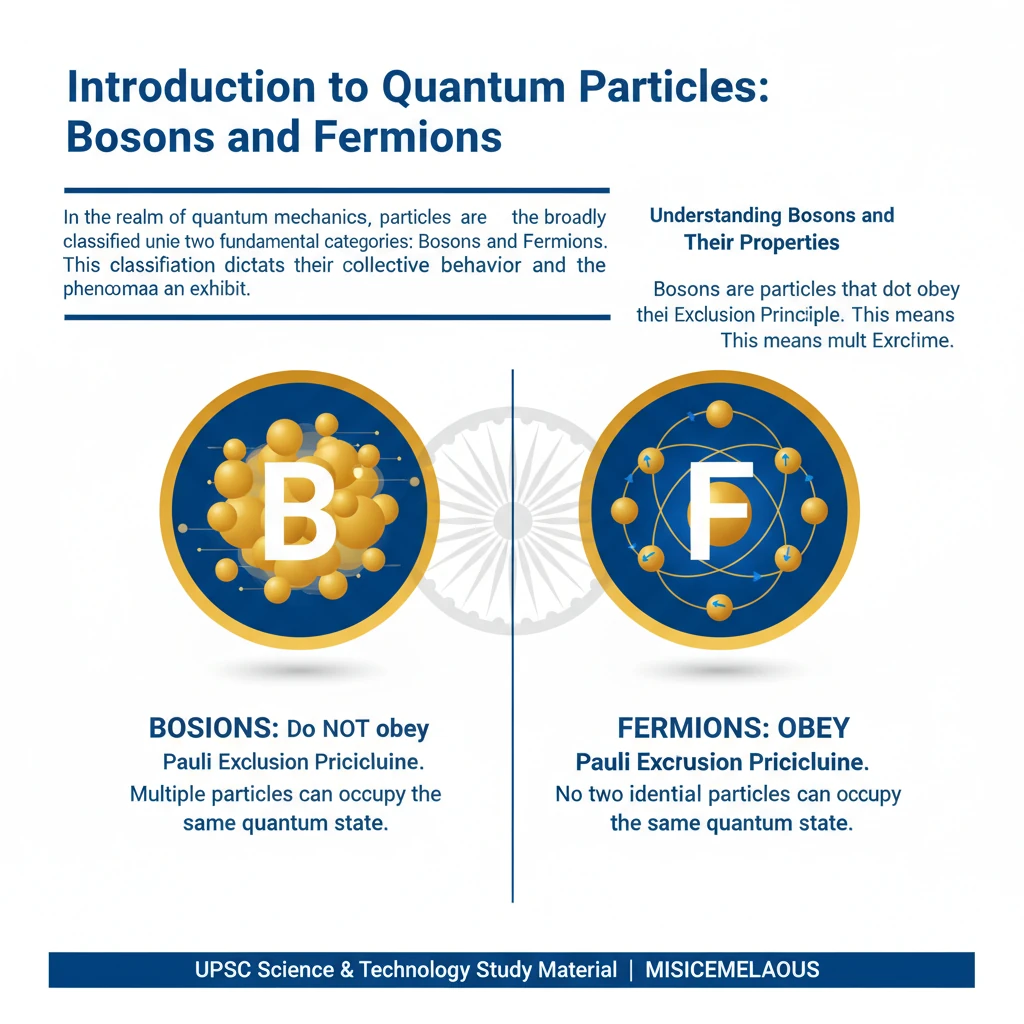
<h4>Introduction to Quantum Particles: Bosons and Fermions</h4><p>In the realm of <strong>quantum mechanics</strong>, particles are broadly classified into two fundamental categories: <strong>Bosons</strong> and <strong>Fermions</strong>. This classification dictates their collective behavior and the phenomena they exhibit.</p><h4>Understanding Bosons and Their Properties</h4><p><strong>Bosons</strong> are particles that do not obey the <strong>Pauli Exclusion Principle</strong>. This means multiple bosons can occupy the exact same quantum state simultaneously.</p><div class='key-point-box'><p>This unique property of <strong>bosons</strong> enables macroscopic quantum phenomena such as <strong>superconductivity</strong> and <strong>superfluidity</strong>, where particles act as a single, coherent quantum entity.</p></div><p>Examples of bosons include <strong>photons</strong> (light particles), <strong>gluons</strong> (strong force carriers), and the <strong>Higgs boson</strong>.</p><h4>Fermions and the Pauli Exclusion Principle</h4><p>In contrast to bosons, <strong>Fermions</strong> strictly adhere to the <strong>Pauli Exclusion Principle</strong>. This fundamental principle states that no two identical fermions can occupy the same quantum state simultaneously within an atom.</p><div class='info-box'><p><strong>Pauli Exclusion Principle:</strong> This principle asserts that no two electrons in an atom can have the same four electronic <strong>quantum numbers</strong> (principal, azimuthal, magnetic, and spin quantum numbers). This governs the fundamental <strong>structure of matter</strong>.</p></div><p>Examples of fermions include <strong>electrons</strong>, <strong>protons</strong>, and <strong>neutrons</strong>, which are the building blocks of ordinary matter.</p><h4>Bose-Einstein Condensate (BEC): The Fifth State of Matter</h4><p>The concept of the <strong>Bose-Einstein Condensate (BEC)</strong> emerged from the pioneering work of <strong>Satyendra Nath Bose</strong>, which was later expanded upon by <strong>Albert Einstein</strong>. It represents a unique and exotic state of matter.</p><div class='info-box'><p><strong>Bose-Einstein Condensate (BEC):</strong> This state is formed when a gas of <strong>bosonic atoms</strong> is cooled to temperatures extremely close to <strong>absolute zero (-273.15° C)</strong>. At this point, the individual atoms lose their separate identities and merge into a single <strong>quantum entity</strong>, exhibiting pronounced <strong>wave-like properties</strong>.</p></div><p>In a BEC, a significant fraction of the bosons occupy the lowest possible quantum state, behaving as one "superatom."</p><h4>Experimental Confirmation and Nobel Recognition</h4><p>For many decades, the <strong>Bose-Einstein Condensate</strong> remained a theoretical prediction. However, it was triumphantly confirmed experimentally in <strong>1995</strong>.</p><p>Physicists <strong>Eric Cornell</strong> and <strong>Carl Wieman</strong> successfully created the first BEC in their laboratory. Their groundbreaking work earned them the <strong>Nobel Prize in Physics</strong> in <strong>2001</strong>, shared with Wolfgang Ketterle.</p><div class='exam-tip-box'><p>Remember the year of experimental confirmation (<strong>1995</strong>) and the Nobel Prize year (<strong>2001</strong>) along with the key scientists <strong>Eric Cornell</strong> and <strong>Carl Wieman</strong> for Prelims factual questions.</p></div><h4>Enduring Relevance in Modern Physics</h4><p>The principles laid down by <strong>Satyendra Nath Bose</strong>, particularly <strong>Bose-Einstein statistics</strong>, continue to hold profound relevance in contemporary physics and beyond.</p><p>Discoveries such as the elusive <strong>Higgs boson</strong>, often dubbed the '<strong>God Particle</strong>', directly align with bosonic principles. The <strong>Higgs boson</strong> is a fundamental elementary particle in the <strong>Standard Model of particle physics</strong>.</p><p>Furthermore, advancements in cutting-edge fields like <strong>quantum computing</strong> heavily rely on understanding and manipulating quantum states, including those involving bosonic systems and BECs.</p><p>The impact of <strong>Bose-Einstein statistics</strong> extends beyond pure physics, influencing areas such as <strong>cosmology</strong> (study of the universe) and <strong>condensed matter science</strong> (study of materials' macroscopic properties).</p><h4>Satyendra Nath Bose: Awards and Honours</h4><p><strong>Satyendra Nath Bose</strong> is revered as a towering figure in Indian science and is widely known as the '<strong>Father of the God Particle</strong>' for his foundational work.</p><div class='info-box'><p><strong>Key Honours for S.N. Bose:</strong><ul><li><strong>Padma Vibhushan:</strong> Awarded in <strong>1954</strong>, one of India's highest civilian honours.</li><li><strong>National Professor:</strong> Appointed in <strong>1959</strong>, this was the highest honour for a scholar in India, a position he held for <strong>15 years</strong>.</li></ul></p></div><p>His legacy continues to inspire generations of scientists globally.</p>
💡 Key Takeaways
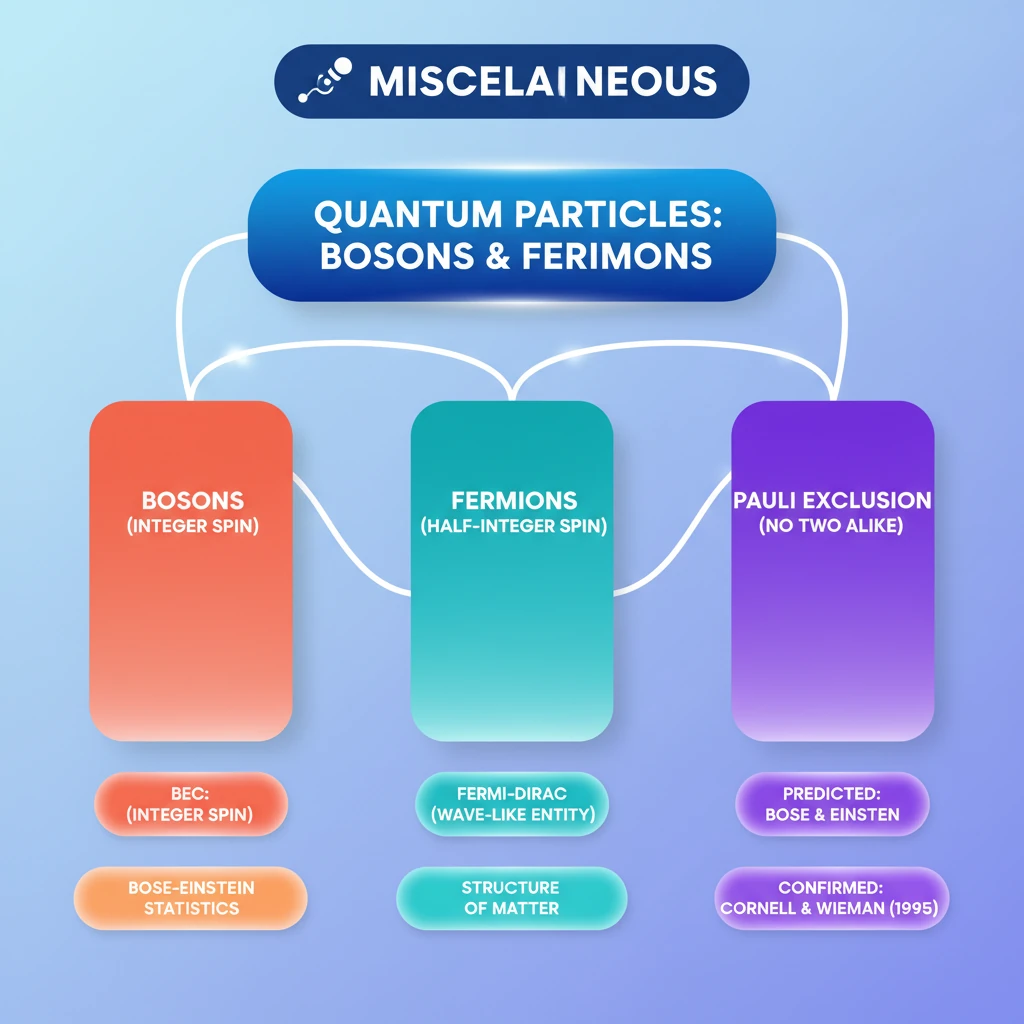
- •Particles are classified as <strong>Bosons</strong> (integer spin, obey Bose-Einstein statistics) or <strong>Fermions</strong> (half-integer spin, obey Fermi-Dirac statistics and Pauli Exclusion Principle).
- •The <strong>Pauli Exclusion Principle</strong> states no two identical fermions can occupy the same quantum state, governing the structure of matter.
- •A <strong>Bose-Einstein Condensate (BEC)</strong> is an exotic state where bosonic atoms cooled near absolute zero merge into a single quantum entity with wave-like properties.
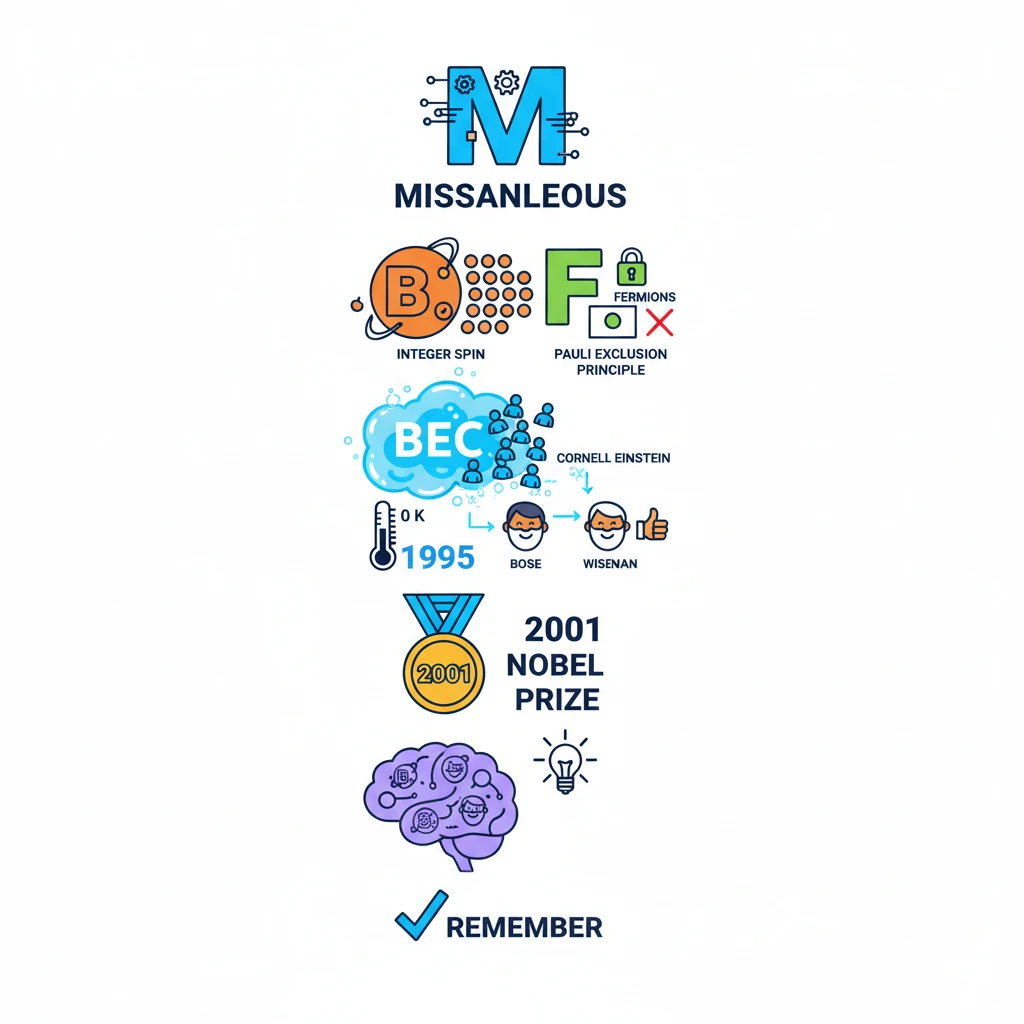
- •BEC was predicted by <strong>Bose</strong> and <strong>Einstein</strong> and experimentally confirmed in <strong>1995</strong> by <strong>Cornell</strong> and <strong>Wieman</strong>, earning them the <strong>Nobel Prize in 2001</strong>.
- •Bose's principles are crucial for understanding the <strong>Higgs boson</strong>, <strong>quantum computing</strong>, <strong>cosmology</strong>, and <strong>condensed matter science</strong>.
- •<strong>Satyendra Nath Bose</strong>, known as the '<strong>Father of the God Particle</strong>', received the <strong>Padma Vibhushan (1954)</strong> and was named <strong>India's National Professor (1959)</strong>.
🧠 Memory Techniques
95% Verified Content
📚 Reference Sources
•NCERT Physics Textbooks (Class XI, XII)
•Standard Quantum Mechanics Textbooks
•Nobel Prize Official Website (Physics Laureates 2001)
•Encyclopaedia Britannica (for definitions and historical context)