What are the Newly Approved Space Projects? - Science And Technology | UPSC Learning
Topics
0 topics • 0 completed
🔍
No topics match your search
What are the Newly Approved Space Projects?
Medium⏱️ 8 min read
science and technology
📖 Introduction
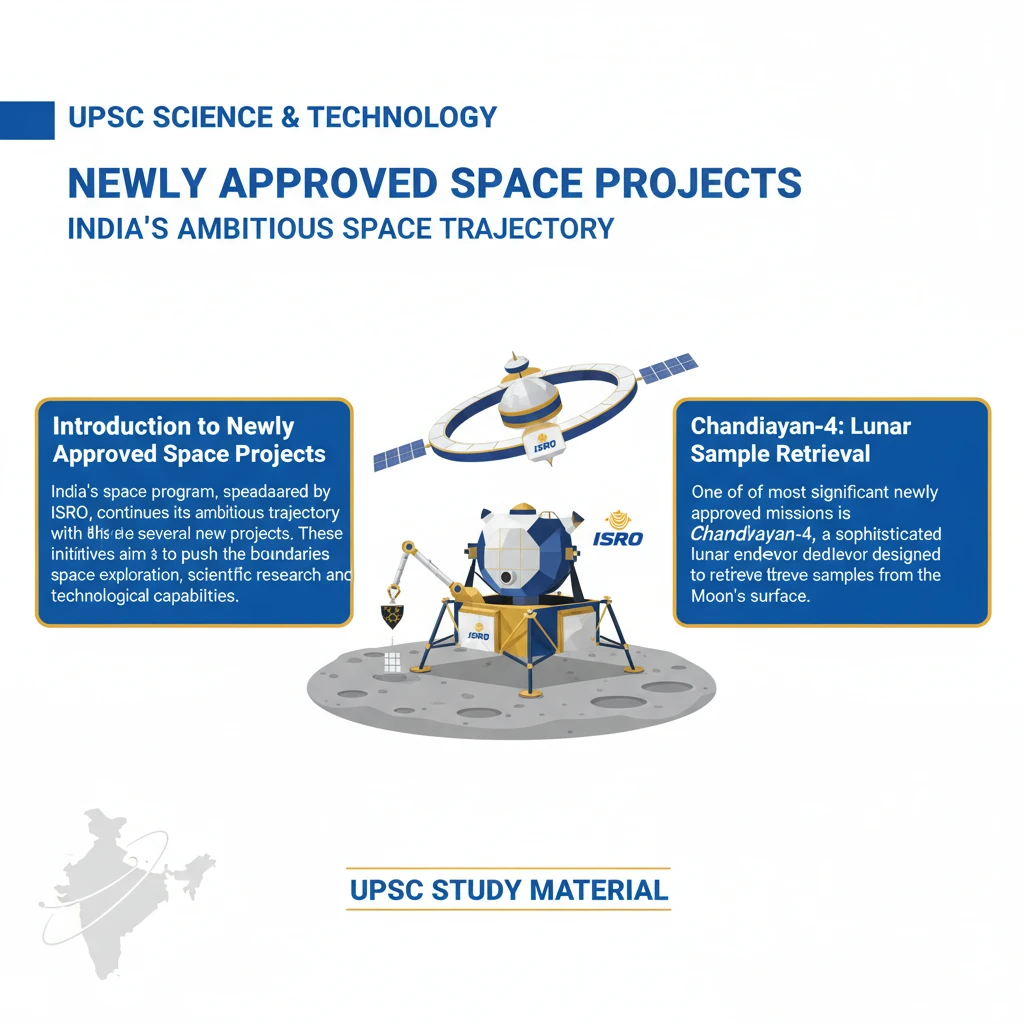
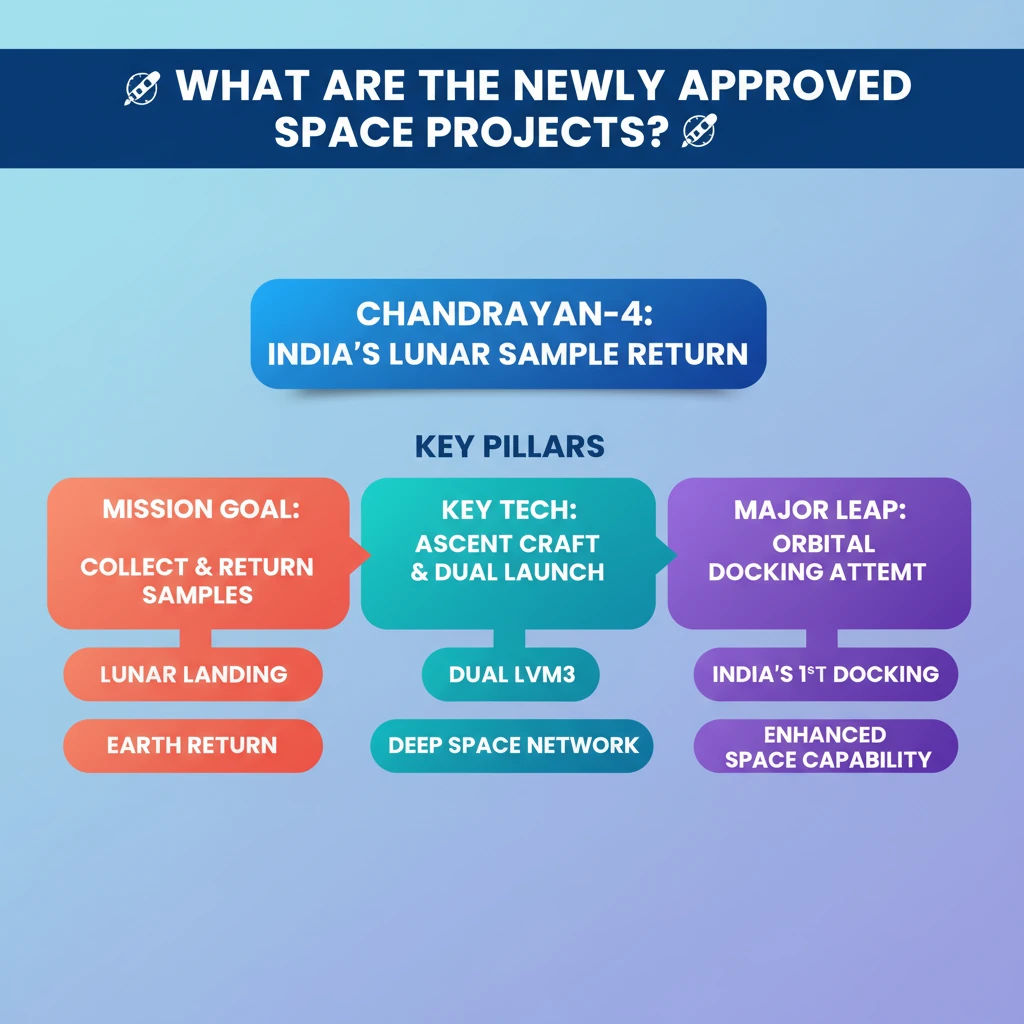
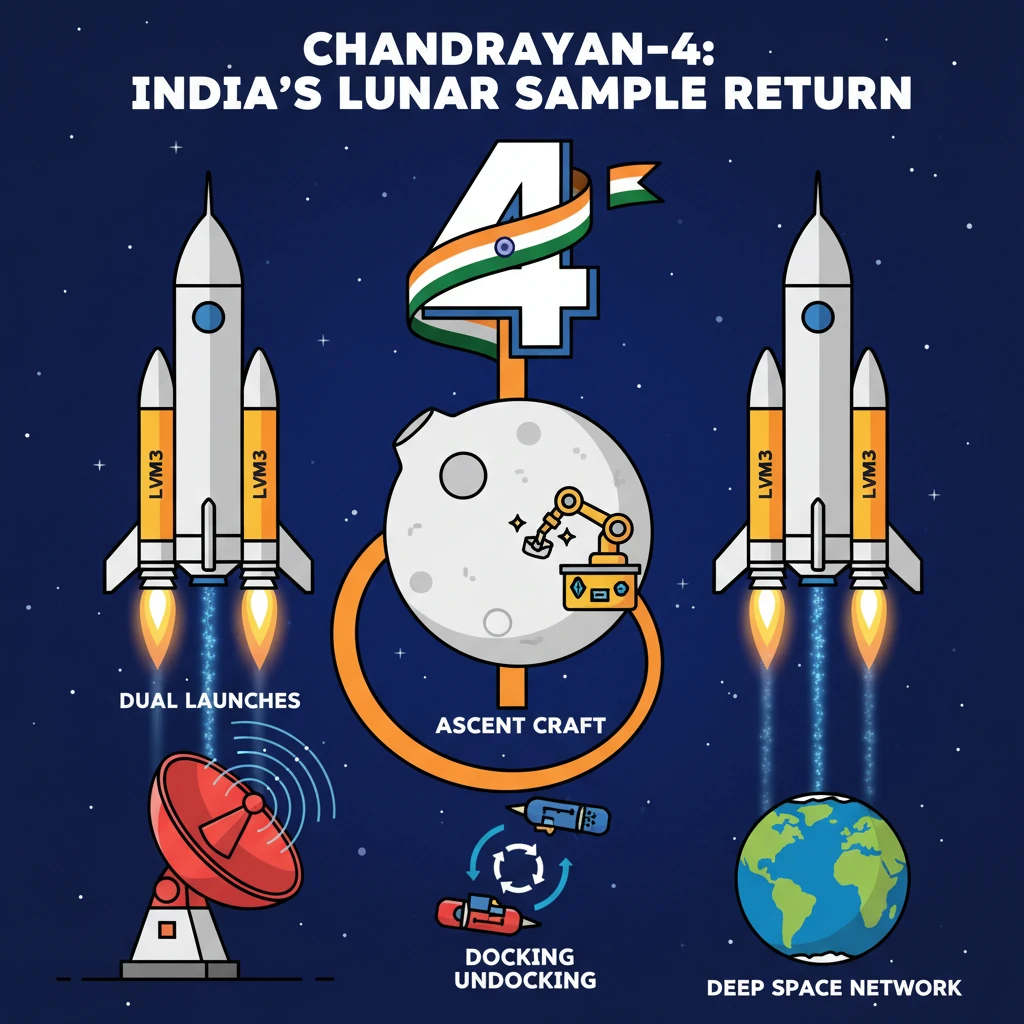
<h4>Introduction to Newly Approved Space Projects</h4><p>India's space program, spearheaded by <strong>ISRO</strong>, continues its ambitious trajectory with the approval of several new projects. These initiatives aim to push the boundaries of space exploration, scientific research, and technological capabilities.</p><p>One of the most significant newly approved missions is <strong>Chandrayaan-4</strong>, a sophisticated lunar endeavor designed to retrieve samples from the Moon's surface.</p><h4>Chandrayaan-4: A Lunar Sample Return Mission</h4><p>The <strong>Chandrayaan-4 mission</strong> represents a major leap in India's lunar exploration capabilities. Its primary objective is to successfully land on the <strong>lunar surface</strong>, collect geological samples, and safely return them to Earth for detailed scientific analysis.</p><div class='info-box'><p><strong>Mission Objective:</strong> To land on the Moon, collect samples, store them in a <strong>vacuum container</strong>, and bring them back to Earth.</p></div><p>This mission is far more complex than its predecessors, requiring advanced technological developments and multiple launches.</p><h4>Key Technological Components and Operations</h4><p>The successful execution of <strong>Chandrayaan-4</strong> will involve several critical technological advancements and intricate operations:</p><ul><li><strong>Ascent Craft Development:</strong> Designing and building a specialized craft capable of lifting off from the lunar surface with the collected samples.</li><li><strong>Dual Launch Vehicle Mk III Launches:</strong> The mission will necessitate two separate launches using the powerful <strong>Launch Vehicle Mk III</strong> (LVM3) to deploy different components of the mission architecture.</li><li><strong>Deep Space Network Support:</strong> Extensive support from India's <strong>Deep Space Network</strong> will be crucial for continuous communication and tracking of the spacecraft throughout its journey.</li></ul><div class='key-point-box'><p><strong>Advanced Orbital Maneuvers:</strong> A highlight of <strong>Chandrayaan-4</strong> is the inclusion of <strong>docking and undocking</strong> operations. This involves two spacecraft precisely aligning and coming together in orbit, a complex maneuver India has not attempted in space so far. This capability is vital for assembling multi-module missions in space and for future human spaceflight endeavors.</p></div><div class='exam-tip-box'><p><strong>UPSC Insight:</strong> Questions on India's space missions often focus on their <strong>objectives</strong>, <strong>technological innovations</strong>, and <strong>strategic importance</strong>. Understanding the specifics of missions like <strong>Chandrayaan-4</strong>, especially its advanced capabilities like sample return and orbital docking, is crucial for both Prelims (factual) and Mains (analytical) answers in <strong>GS Paper 3: Science & Technology</strong>.</p></div>
💡 Key Takeaways
- •Chandrayaan-4 is India's newly approved lunar sample return mission.
- •It aims to land on the Moon, collect samples, and bring them back to Earth.
- •Key technological advancements include ascent craft, dual LVM3 launches, and deep space network support.
- •The mission will feature India's first attempt at orbital docking and undocking.
- •This project signifies a major leap in India's space capabilities and scientific exploration.
🧠 Memory Techniques
95% Verified Content
📚 Reference Sources
•ISRO official website (for general mission details and context)
•Publicly available news reports on Chandrayaan-4 and other Indian space missions