Marburg Virus Disease (MVD) Outbreak - Science And Technology | UPSC Learning
Topics
0 topics • 0 completed
🔍
No topics match your search
Marburg Virus Disease (MVD) Outbreak
Medium⏱️ 7 min read
science and technology
📖 Introduction
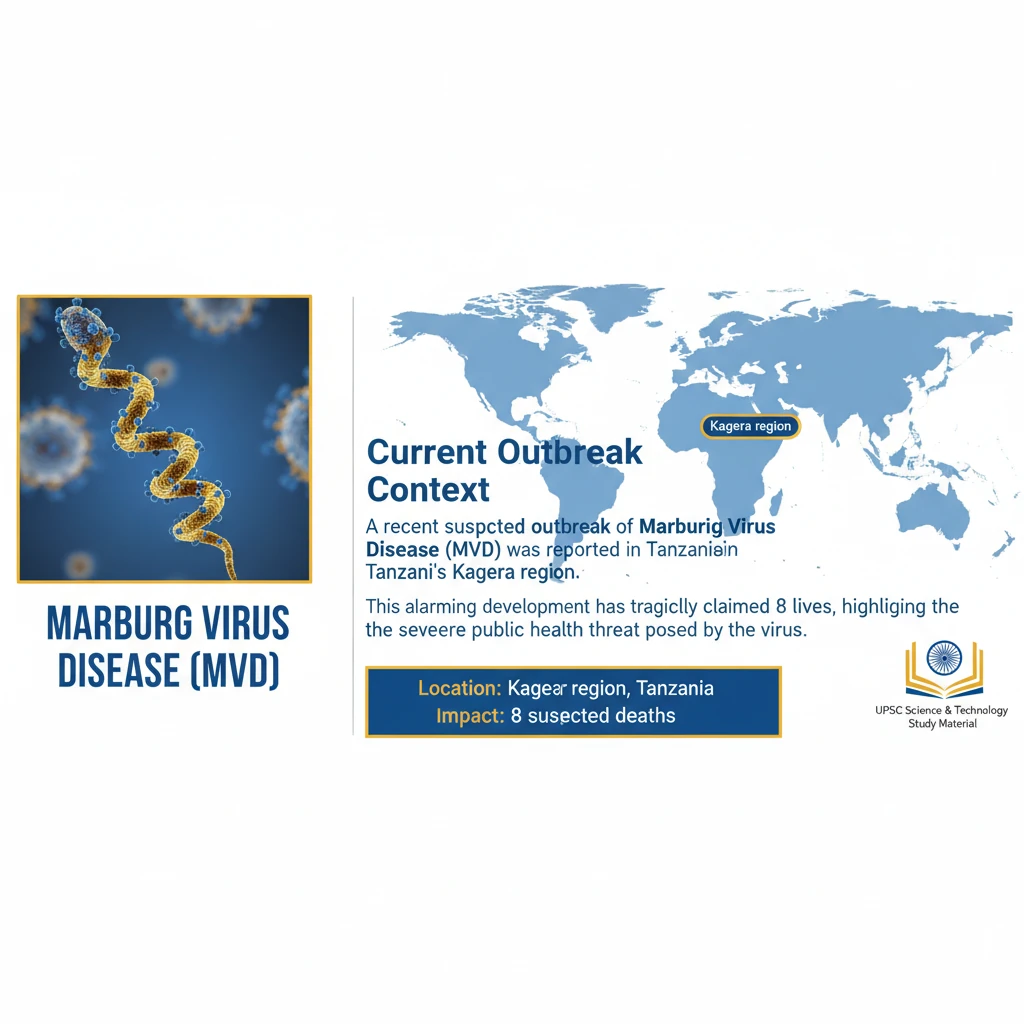
<h4>Current Outbreak Context</h4><p>A recent suspected outbreak of <strong>Marburg Virus Disease (MVD)</strong> has been reported in <strong>Tanzania's Kagera region</strong>. This alarming development has tragically claimed <strong>8 lives</strong>, highlighting the severe public health threat posed by the virus.</p><div class='info-box'><p><strong>Location:</strong> <strong>Kagera region</strong>, <strong>Tanzania</strong></p><p><strong>Impact:</strong> <strong>8 suspected deaths</strong></p></div><h4>Understanding Marburg Virus Disease (MVD)</h4><p><strong>Marburg Virus Disease (MVD)</strong> is a severe and often fatal <strong>hemorrhagic fever</strong>. It is caused by the <strong>Marburg virus</strong>, a highly pathogenic member of the Filoviridae family, which also includes the Ebola virus.</p><div class='key-point-box'><p><strong>Key Characteristic:</strong> <strong>MVD</strong> is characterized by extremely high <strong>fatality rates</strong>, often reaching up to <strong>89%</strong> in reported outbreaks. This underscores its lethal nature.</p></div><p>Currently, there are <strong>no approved specific treatments</strong> or vaccines available for <strong>MVD</strong>. Patient care primarily focuses on supportive measures to manage symptoms and complications.</p><h4>Key Symptoms of MVD</h4><p>The symptoms of <strong>Marburg Virus Disease</strong> can be sudden and severe, often resembling those of <strong>Ebola virus disease</strong>. Early recognition is crucial for containment and patient management.</p><ul><li><strong>Fever:</strong> High body temperature is typically one of the first signs.</li><li><strong>Headache:</strong> Severe and persistent headaches are common.</li><li><strong>Vomiting Blood:</strong> Gastrointestinal distress, including hematemesis, can occur as the disease progresses.</li><li><strong>Bleeding:</strong> Hemorrhagic manifestations, such as internal and external bleeding, are characteristic of the disease.</li></ul><h4>Transmission Pathways</h4><p>The <strong>Marburg virus</strong> is primarily a <strong>zoonotic disease</strong>, meaning it originates in animals and can transmit to humans. The natural reservoir for the virus is the <strong>African fruit bat (Rousettus aegyptiacus)</strong>.</p><div class='info-box'><p><strong>Primary Reservoir:</strong> <strong>African fruit bat</strong> (scientific name: <strong>Rousettus aegyptiacus</strong>)</p></div><p>Human-to-human transmission occurs through <strong>direct contact</strong> with the <strong>bodily fluids</strong> of infected individuals. These fluids include blood, secretions, organs, or semen, as well as contaminated surfaces and materials.</p><h4>Diagnostic Methods</h4><p>Accurate and rapid diagnosis of <strong>MVD</strong> is vital for implementing effective control measures and preventing further spread. Diagnostic tests confirm the presence of the virus in patient samples.</p><div class='info-box'><p><strong>Confirmed Diagnosis:</strong> Achieved using laboratory tests such as <strong>RT-PCR (Reverse Transcription Polymerase Chain Reaction)</strong>. This molecular test detects the genetic material of the <strong>Marburg virus</strong>.</p></div><div class='exam-tip-box'><p><strong>UPSC Insight:</strong> Understanding <strong>zoonotic diseases</strong>, their <strong>transmission routes</strong>, and <strong>diagnostic techniques</strong> like <strong>RT-PCR</strong> is crucial for <strong>Science & Technology</strong> (GS Paper III) and <strong>Public Health</strong> (GS Paper II) topics. Be prepared to discuss similarities and differences with other viral hemorrhagic fevers like <strong>Ebola</strong>.</p></div>
💡 Key Takeaways
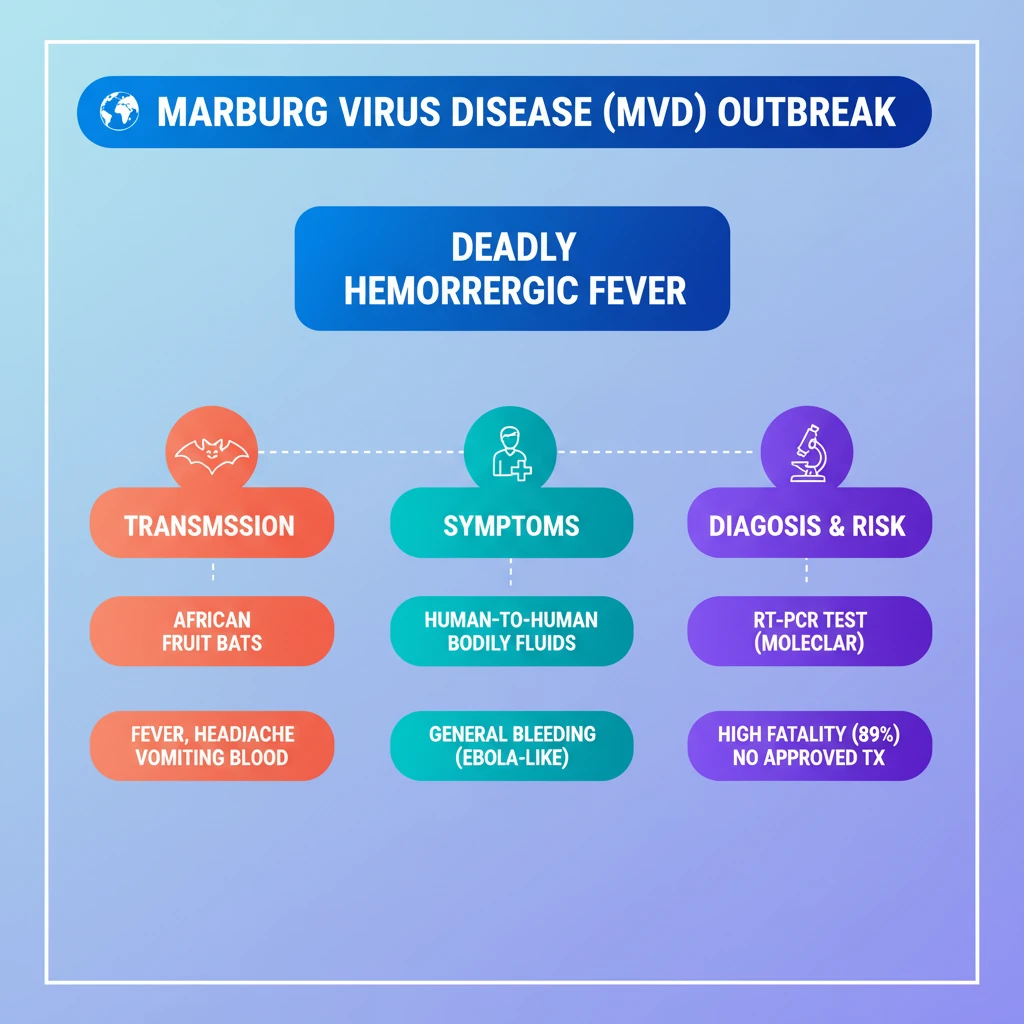
- •Marburg Virus Disease (MVD) is a deadly hemorrhagic fever with high fatality rates (up to 89%), currently without approved treatments.
- •A recent suspected outbreak in Tanzania's Kagera region tragically claimed 8 lives, highlighting its severe threat.
- •MVD is transmitted to humans from African fruit bats (Rousettus aegyptiacus) and spreads human-to-human via direct contact with bodily fluids.
- •Symptoms include fever, headache, vomiting blood, and general bleeding, closely resembling Ebola virus disease.
- •Diagnosis is confirmed using molecular tests like RT-PCR (Reverse Transcription Polymerase Chain Reaction).
- •MVD outbreaks underscore critical issues in global health security, zoonotic disease management, and the urgent need for R&D in infectious diseases.
🧠 Memory Techniques
98% Verified Content
📚 Reference Sources
•World Health Organization (WHO) - Marburg Virus Disease Fact Sheet
•Centers for Disease Control and and Prevention (CDC) - Marburg Hemorrhagic Fever