International Space Station (ISS) - Science And Technology | UPSC Learning
Topics
0 topics • 0 completed
🔍
No topics match your search
International Space Station (ISS)
Medium⏱️ 6 min read
science and technology
📖 Introduction
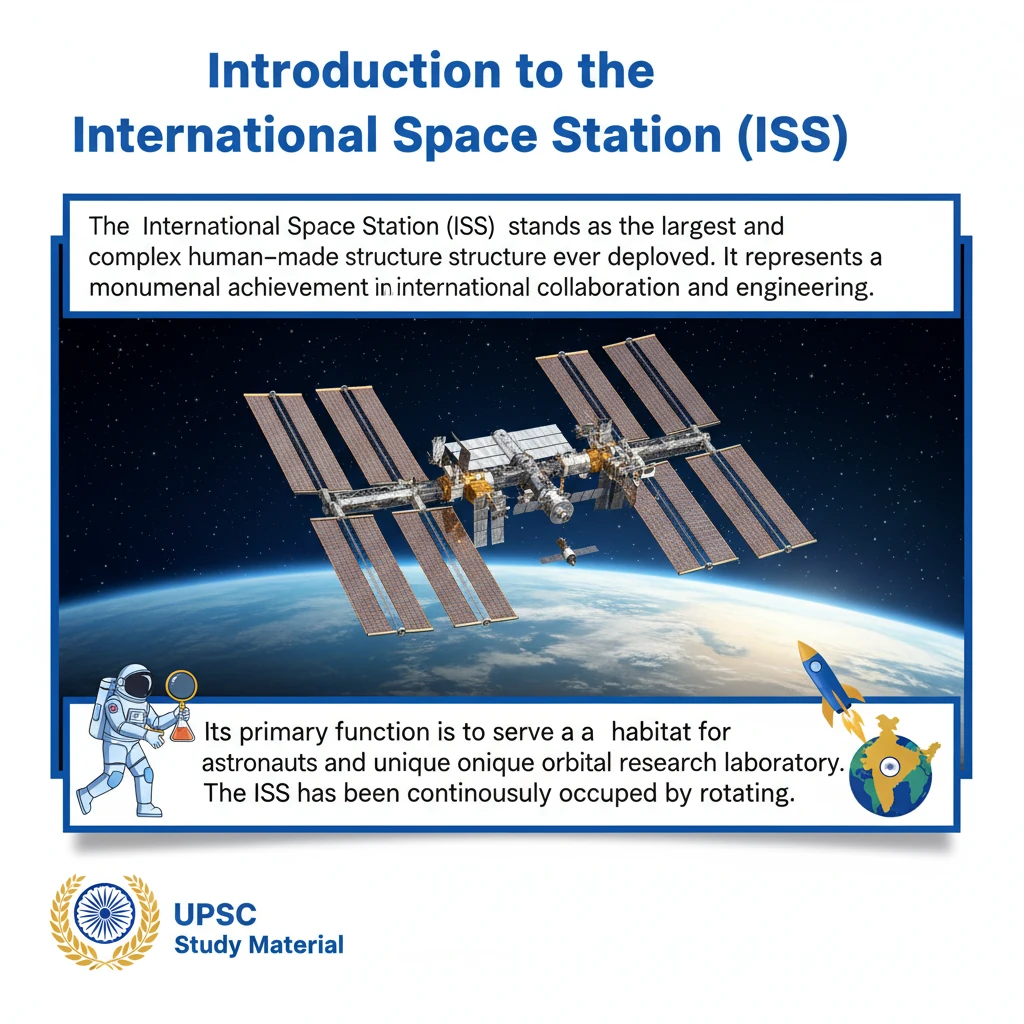
<h4>Introduction to the International Space Station (ISS)</h4><p>The <strong>International Space Station (ISS)</strong> stands as the largest and most complex human-made structure ever deployed in <strong>space</strong>. It represents a monumental achievement in international collaboration and engineering.</p><p>Its primary function is to serve as a <strong>habitat for astronauts</strong> and a unique <strong>orbital research laboratory</strong>. The ISS has been continuously occupied by rotating crews since <strong>November 2, 2000</strong>.</p><div class='key-point-box'><p><strong>Key Concept:</strong> The <strong>ISS</strong> is a symbol of global scientific cooperation and humanity's enduring quest for knowledge beyond Earth.</p></div><h4>Launch and Continuous Occupation</h4><p>The first component of the <strong>ISS</strong>, the <strong>Zarya module</strong>, was launched on <strong>November 20, 1998</strong>. This marked the beginning of its assembly in low Earth orbit.</p><p>Since <strong>November 2000</strong>, the station has maintained a continuous human presence, hosting astronauts and cosmonauts from various countries for long-duration missions.</p><div class='info-box'><p><strong>Launch Date:</strong> <strong>November 20, 1998</strong> (First component)</p><p><strong>Continuous Occupation:</strong> Since <strong>November 2, 2000</strong></p></div><h4>International Collaboration and Participating Agencies</h4><p>The <strong>ISS</strong> is a testament to global cooperation, involving a consortium of five leading space agencies from around the world. This partnership pools resources, expertise, and technology.</p><p>The collaborative nature ensures diverse scientific perspectives and shared responsibilities in maintaining this complex orbital outpost.</p><div class='info-box'><p><strong>Participating Space Agencies:</strong></p><ul><li><strong>United States:</strong> <strong>NASA</strong> (National Aeronautics and Space Administration)</li><li><strong>Russia:</strong> <strong>Roscosmos</strong> (State Space Corporation Roscosmos)</li><li><strong>Europe:</strong> <strong>ESA</strong> (European Space Agency)</li><li><strong>Japan:</strong> <strong>JAXA</strong> (Japan Aerospace Exploration Agency)</li><li><strong>Canada:</strong> <strong>CSA</strong> (Canadian Space Agency)</li></ul></div><h4>Orbital Parameters and Altitude</h4><p>The <strong>ISS</strong> maintains a relatively low Earth orbit, allowing for easier access and resupply missions. Its proximity to Earth also facilitates observations of our planet.</p><p>This specific altitude is crucial for various scientific experiments, including those studying microgravity and Earth's atmosphere.</p><div class='info-box'><p><strong>Orbital Altitude:</strong> Approximately <strong>400 kilometres</strong> above Earth's surface.</p></div><div class='exam-tip-box'><p><strong>UPSC Insight:</strong> Questions on <strong>international space collaborations</strong>, the <strong>benefits of microgravity research</strong>, and the <strong>geopolitical implications of space assets</strong> often feature the <strong>ISS</strong> as a prime example. Understand its multifaceted roles.</p></div>
💡 Key Takeaways
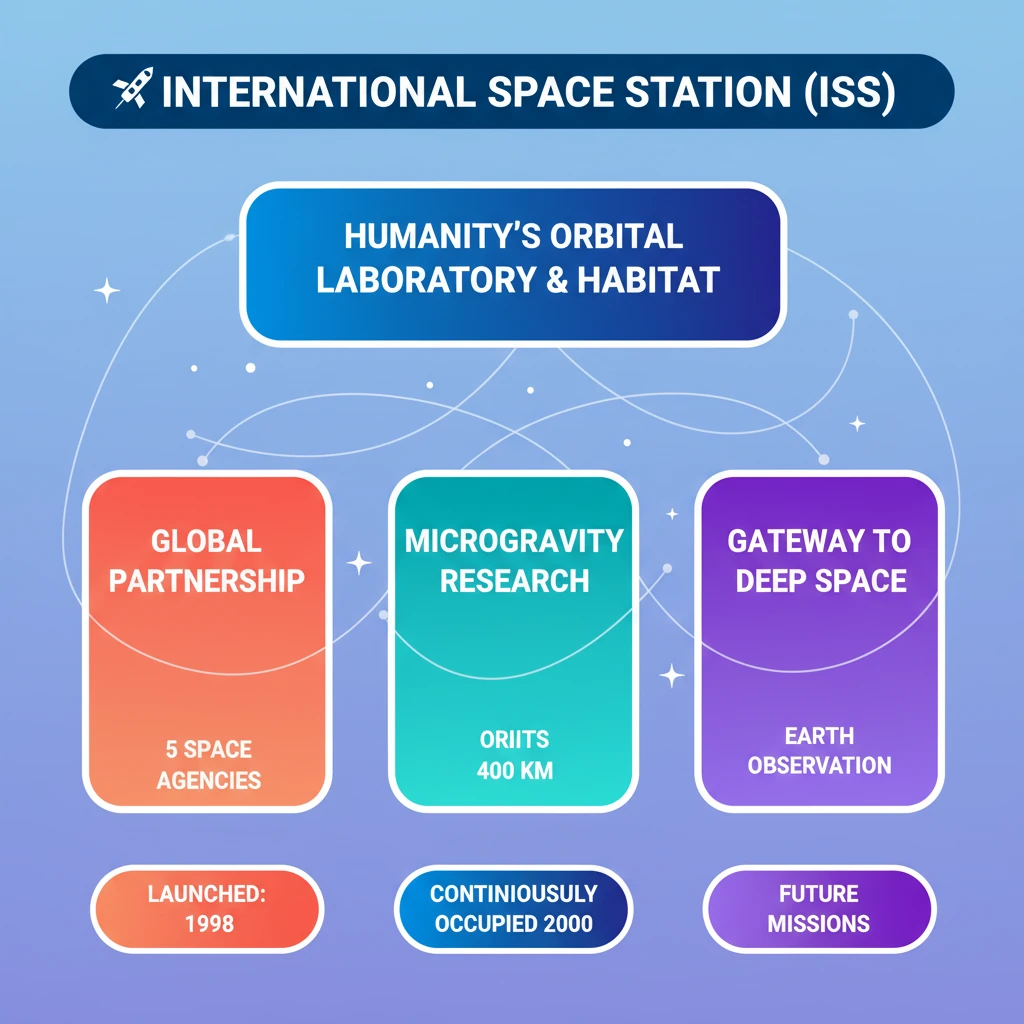
- •The International Space Station (ISS) is the largest human-made structure in space, launched in 1998.
- •It has been continuously occupied since 2000, serving as a habitat and research laboratory.
- •A joint effort of five major space agencies: NASA, Roscosmos, ESA, JAXA, and CSA.
- •Orbits approximately 400 kilometres above Earth, enabling microgravity research and Earth observation.
- •Represents a pinnacle of international scientific and technological cooperation, paving the way for future deep-space missions and commercial space ventures.
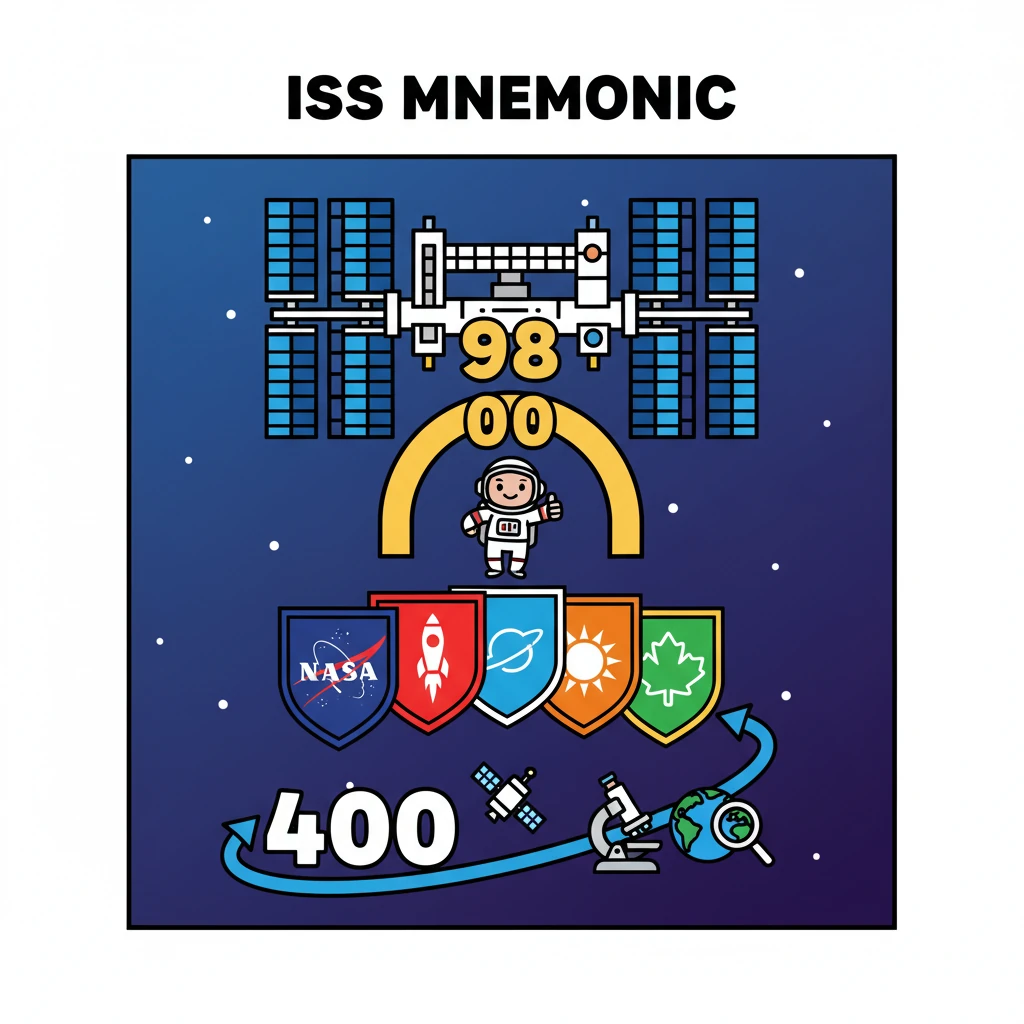
🧠 Memory Techniques
98% Verified Content
📚 Reference Sources
•NASA (National Aeronautics and Space Administration) - Official ISS pages
•ESA (European Space Agency) - Official ISS pages
•Roscosmos (State Space Corporation Roscosmos) - Official information