Black Holes: Formation, Types, and Significance for UPSC - Science And Technology | UPSC Learning
Topics
0 topics • 0 completed
🔍
No topics match your search
Black Holes: Formation, Types, and Significance for UPSC
Medium⏱️ 8 min read
science and technology
📖 Introduction
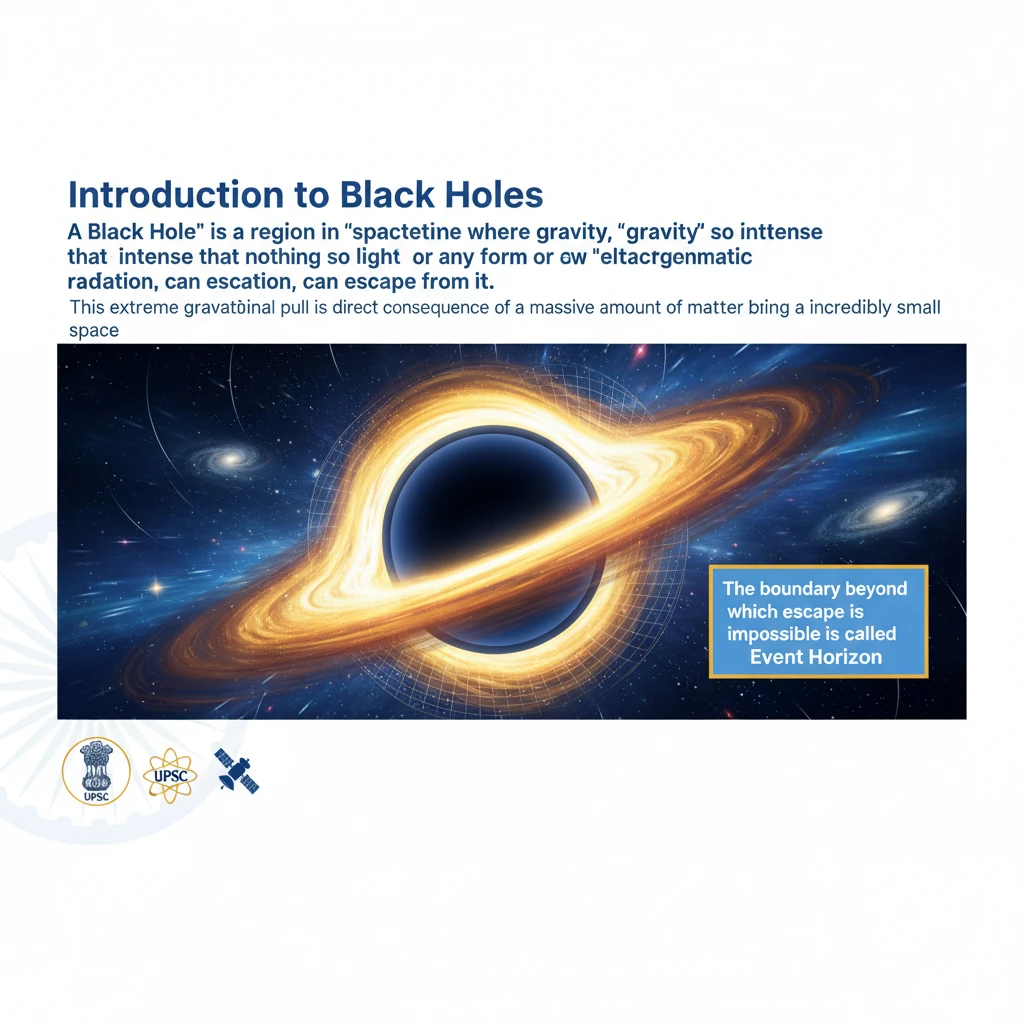
<h4>Introduction to Black Holes</h4><p>A <strong>Black Hole</strong> is a region in <strong>spacetime</strong> where <strong>gravity</strong> is so intense that nothing, not even <strong>light</strong> or any form of <strong>electromagnetic radiation</strong>, can escape from it.</p><p>This extreme gravitational pull is a direct consequence of a massive amount of matter being compressed into an incredibly small space.</p><div class='info-box'><p>The boundary beyond which escape is impossible is known as the <strong>Event Horizon</strong>.</p></div><h4>Formation of Black Holes</h4><p>Black holes typically form from the catastrophic collapse of a <strong>massive star</strong> at the end of its life cycle.</p><p>This process often culminates in a violent stellar explosion known as a <strong>supernova</strong>.</p><div class='key-point-box'><p>If the remaining core of the collapsed star is sufficiently massive (generally more than three times the mass of our Sun), it continues to contract indefinitely under its own gravity, forming a black hole.</p></div><h4>Types of Black Holes</h4><p>Black holes are categorized primarily by their <strong>mass</strong>. The universe hosts different types, each with distinct formation mechanisms and characteristics.</p><ul><li><strong>Stellar Black Hole</strong>: These are formed by the <strong>gravitational collapse</strong> of a <strong>single massive star</strong>. They are typically 3 to 100 times the mass of our <strong>Sun</strong>.</li><li><strong>Intermediate Black Hole (IMBH)</strong>: Their masses fall between <strong>100 and 100,000 times that of the Sun</strong>. Their formation mechanisms are still a subject of active research, possibly through mergers of smaller black holes or collapse of dense star clusters.</li><li><strong>Supermassive Black Hole (SMBH)</strong>: These are the largest type, with masses ranging from <strong>millions to billions of times that of the Sun</strong>. They are found at the <strong>centres of most galaxies</strong>, including our own <strong>Milky Way galaxy</strong>, where <strong>Sagittarius A*</strong> resides.</li></ul><div class='exam-tip-box'><p>Understanding the different types of black holes and their formation is crucial for questions related to <strong>astronomy</strong> and <strong>space science</strong> in <strong>UPSC Prelims</strong>.</p></div>
💡 Key Takeaways
- •Black holes are regions of spacetime with immense gravity, preventing anything, including light, from escaping.
- •They form primarily from the collapse of massive stars in supernovae.
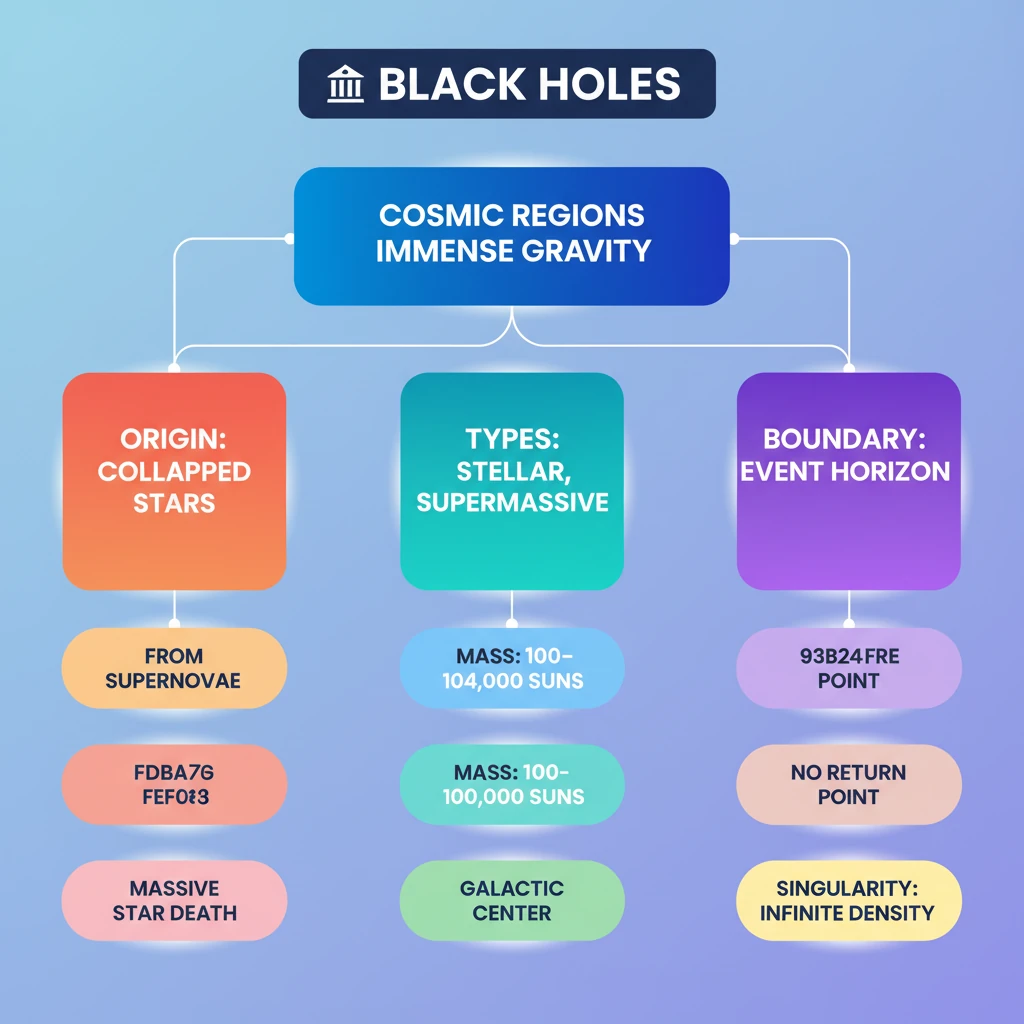
- •Three main types exist: Stellar (from single stars), Intermediate (100-100,000 solar masses), and Supermassive (millions to billions of solar masses at galaxy centers).
- •The Event Horizon is the boundary of no return, and the Singularity is the point of infinite density.
- •Research on black holes, including gravitational waves and direct imaging, is crucial for understanding gravity, spacetime, and galaxy evolution.
🧠 Memory Techniques

95% Verified Content
📚 Reference Sources
•NASA Science: Black Holes
•ESA (European Space Agency) resources on Black Holes
•Event Horizon Telescope (EHT) Collaboration publications
•LIGO Scientific Collaboration publications