Gene Therapy for Hemophilia A - Science And Technology | UPSC Learning
Topics
0 topics • 0 completed
🔍
No topics match your search

Gene Therapy for Hemophilia A
Medium⏱️ 8 min read
science and technology
📖 Introduction
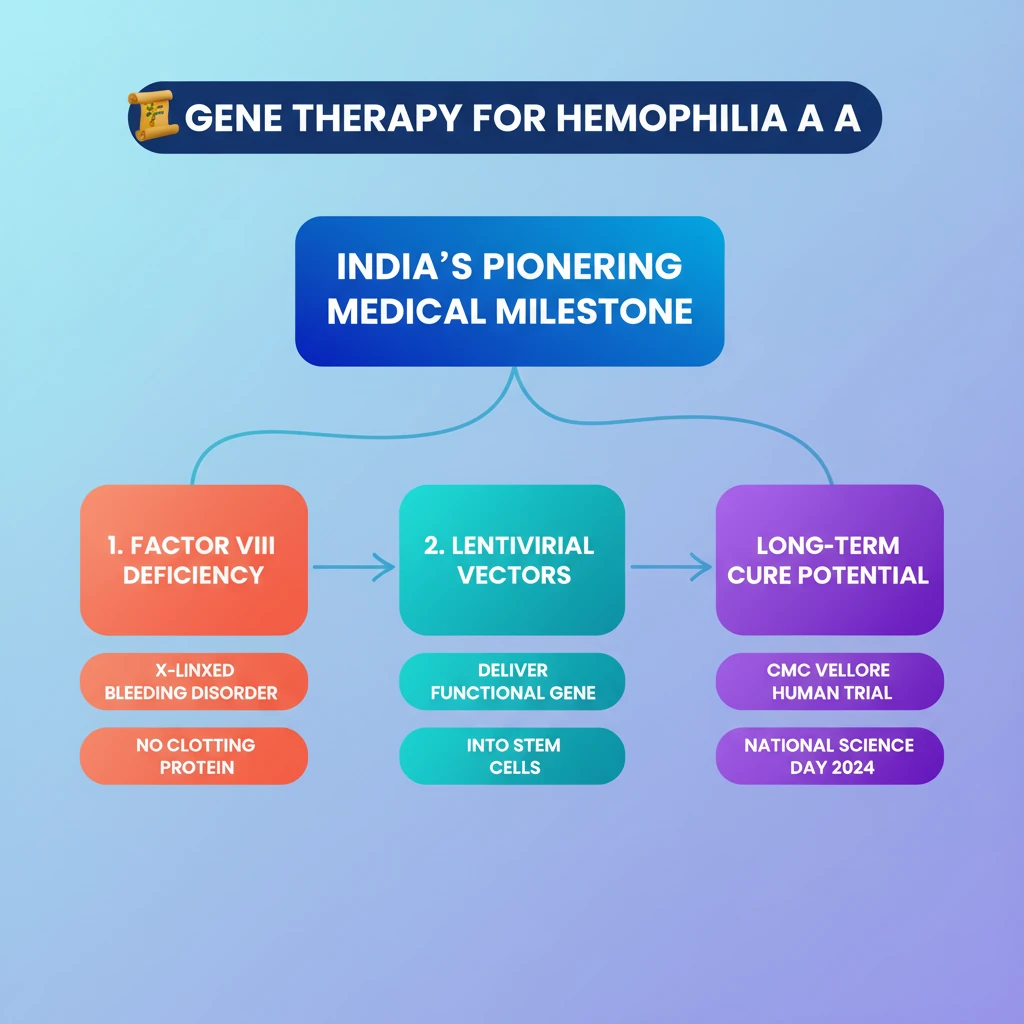
<h4>India's Landmark Gene Therapy Trial for Hemophilia A</h4><p>Recently, the <strong>Union Minister of Science & Technology</strong> announced a significant milestone for India. The country successfully conducted its <strong>first human clinical trial of gene therapy for Hemophilia A</strong> (<strong>Factor VIII deficiency</strong>).</p><p>This pioneering trial took place at <strong>Christian Medical College (CMC), Vellore</strong>. The announcement was made during the <strong>National Science Day 2024</strong> programme, highlighting India's advancements in <strong>Science and Technology (S&T)</strong>.</p><div class='exam-tip-box'><p><strong>UPSC Insight:</strong> This news is crucial for <strong>Science & Technology (GS-III)</strong>, demonstrating India's capabilities in advanced medical research. Be prepared for questions on <strong>gene therapy applications</strong> and <strong>indigenous S&T initiatives</strong>.</p></div><h4>Understanding Hemophilia A</h4><p><strong>Hemophilia</strong> is a group of <strong>rare bleeding disorders</strong> characterized by a congenital deficiency in specific <strong>clotting factors</strong>. Among these, <strong>Hemophilia A</strong> is the most prevalent form.</p><div class='info-box'><p><strong>Definition:</strong> <strong>Hemophilia A</strong> results from a deficiency in <strong>Factor VIII</strong>, a crucial blood clotting protein. This deficiency impairs the blood's ability to clot effectively.</p></div><p>Individuals with <strong>Hemophilia A</strong> experience prolonged bleeding after injuries because their blood takes longer than usual to form a clot.</p><h4>Causes of Hemophilia A</h4><p><strong>Hemophilia A</strong> is primarily an <strong>inherited (genetic) disorder</strong>. It follows an <strong>X-linked recessive pattern</strong> of inheritance, meaning the gene responsible for <strong>Factor VIII</strong> production is located on the <strong>X chromosome</strong>.</p><div class='key-point-box'><p><strong>X-linked Recessive Inheritance:</strong></p><ul><li><strong>Males (XY):</strong> Inherit one <strong>X chromosome</strong> from their mother. If this X chromosome carries the defective gene, they will develop <strong>Hemophilia A</strong>.</li><li><strong>Females (XX):</strong> Inherit two <strong>X chromosomes</strong>. Typically, if one X chromosome has the defective gene, the other X chromosome provides enough <strong>Factor VIII</strong>, making them asymptomatic carriers.</li><li><strong>Rare Cases in Females:</strong> Females can develop <strong>Hemophilia A</strong> if they inherit two defective copies, one from each parent. This is much less common.</li></ul></div><h4>Symptoms of Hemophilia A</h4><p>The severity of <strong>Hemophilia A</strong> symptoms varies, depending on the level of <strong>Factor VIII activity</strong> in the blood. Common symptoms include:</p><ul><li><strong>Easy bruising</strong> and excessive bleeding from minor injuries (e.g., cuts, scrapes).</li><li><strong>Bleeding into the joints</strong> (especially knees, elbows, and ankles), leading to significant pain, swelling, and stiffness.</li><li><strong>Prolonged bleeding</strong> after surgical procedures or dental work.</li></ul><h4>Traditional Treatments for Hemophilia A</h4><p>Traditional treatment for <strong>Hemophilia A</strong> focuses on replacing the missing blood clotting factor to enable proper blood clotting. This is typically achieved through injections of <strong>clotting factor concentrates</strong> into a person's veins.</p><div class='info-box'><p><strong>Types of Clotting Factor Concentrates:</strong></p><ul><li><strong>Plasma-derived Factor Concentrates:</strong> These are obtained from human plasma, which contains various proteins, including clotting factors.</li><li><strong>Recombinant Factor Concentrates:</strong> Introduced in <strong>1992</strong>, these are engineered using <strong>DNA Technology</strong>. They do not rely on human plasma, eliminating the risk of viral transmission.</li></ul></div><h4>Gene Therapy: A Promising New Approach</h4><p>While traditional treatments manage symptoms, <strong>gene therapy</strong> is gaining prominence as a potential long-term solution. Recent trials, including India's first, utilize innovative methods to address the root cause.</p><div class='key-point-box'><p><strong>Mechanism of Gene Therapy for Hemophilia A:</strong></p><p>A special type of virus, known as a <strong>lentiviral vector</strong>, is used to deliver a gene that produces <strong>Factor VIII</strong> into the patient's own <strong>stem cells</strong>. These modified stem cells are then re-introduced into the body.</p><p>As these modified stem cells develop into specific types of blood cells, they continuously produce the missing <strong>Factor VIII</strong>, potentially offering a sustained therapeutic effect.</p></div><h4>Acquired Hemophilia A</h4><p>Although <strong>Hemophilia A</strong> is typically inherited, it can also manifest later in life. This condition, known as <strong>acquired hemophilia A</strong>, is rare.</p><div class='info-box'><p><strong>Acquired Hemophilia A:</strong> This form occurs when the body produces <strong>auto-antibodies</strong> that target and neutralize <strong>Factor VIII</strong>. It differs from the congenital form in its onset and progression.</p></div><h4>National Science Day and World Haemophilia Day</h4><p>The announcement of India's gene therapy trial coincided with <strong>National Science Day 2024</strong>, celebrated annually on <strong>February 28th</strong>.</p><div class='info-box'><p><strong>National Science Day:</strong> Commemorates the discovery of the <strong>'Raman Effect'</strong> in <strong>1928</strong> by <strong>Sir Chandrasekhara Venkata Raman</strong>. This discovery earned him the <strong>Nobel Prize in 1930</strong>. The <strong>Raman Effect</strong> is a method for identifying materials based on how they scatter light.</p></div><p>Additionally, <strong>World Haemophilia Day</strong> is observed annually on <strong>April 17th</strong>. This day aims to raise awareness about <strong>hemophilia</strong> and other inherited bleeding disorders.</p><div class='info-box'><p><strong>World Haemophilia Day:</strong> Celebrated in honor of <strong>Frank Schnabel</strong>, the founder of the <strong>World Federation of Haemophilia (WHF)</strong>.</p></div>
💡 Key Takeaways
- •India conducted its first human gene therapy trial for Hemophilia A at CMC Vellore, a significant medical milestone.
- •Hemophilia A is an X-linked recessive bleeding disorder caused by a deficiency of Factor VIII, a crucial clotting protein.
- •Gene therapy for Hemophilia A uses lentiviral vectors to insert a functional Factor VIII gene into stem cells for sustained protein production.
- •Traditional treatments include plasma-derived and recombinant Factor VIII concentrates, with gene therapy offering a potential long-term cure.
- •The trial's announcement on National Science Day 2024 highlights India's progress in S&T and commitment to advanced medical research.
🧠 Memory Techniques

95% Verified Content
📚 Reference Sources
•World Federation of Hemophilia (WFH) official resources
•National Science Day official information (Govt. of India)
•General knowledge on gene therapy and Hemophilia A