What are the Key Facts About the Study - Science And Technology | UPSC Learning
Topics
0 topics • 0 completed
🔍
No topics match your search
What are the Key Facts About the Study
Medium⏱️ 6 min read
science and technology
📖 Introduction
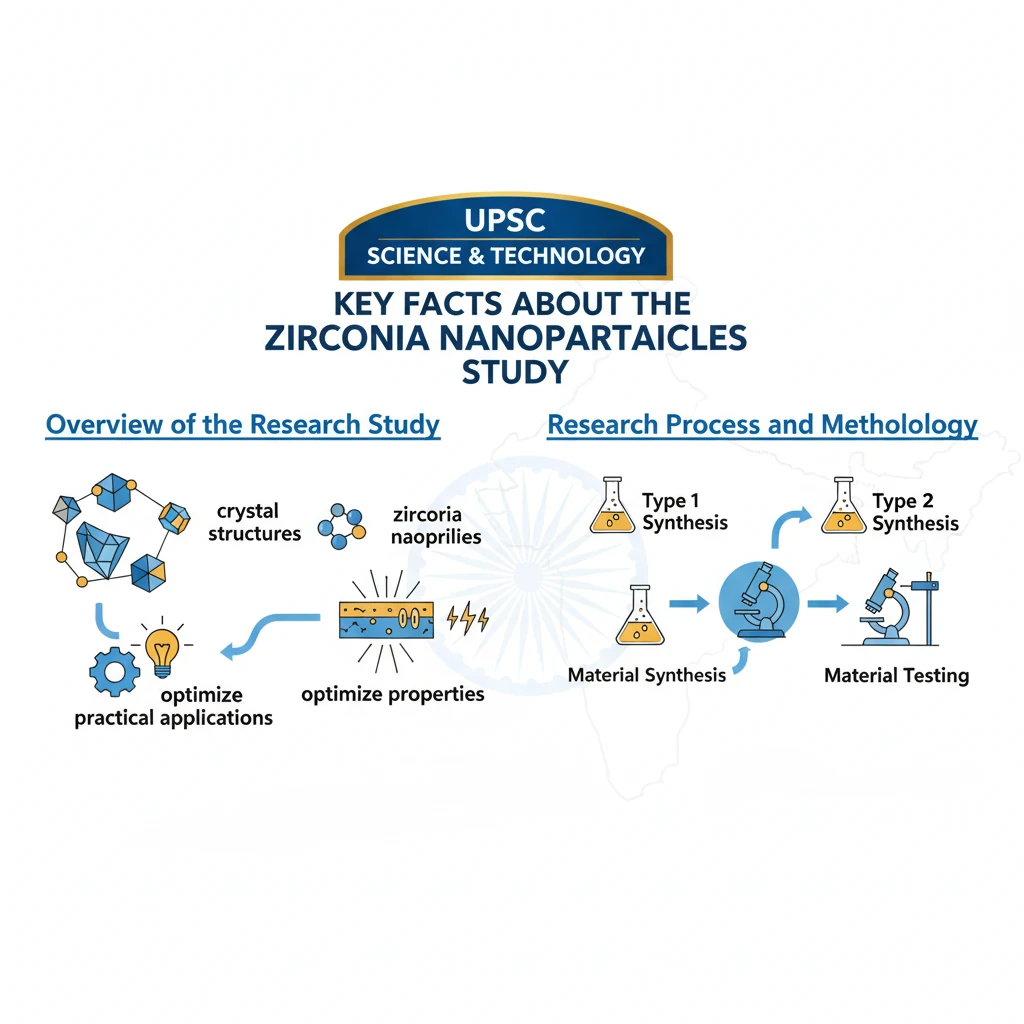
<h4>Introduction to Zirconia Nanoparticle Study</h4><p>This study investigated the impact of different <strong>crystal structures</strong> of <strong>zirconia nanoparticles</strong> on the <strong>piezoelectric capabilities</strong> of a composite material. Researchers aimed to understand how these structural variations influence performance.</p><div class='info-box'><p><strong>Piezoelectricity:</strong> The ability of certain materials to generate an electric charge in response to applied mechanical stress.</p></div><h4>Methodology: Creating Zirconia Nanocomposites</h4><p>The research involved a multi-step process to synthesize the desired composite films. It began with the creation of specific <strong>Metal-organic frameworks (MOFs)</strong>.</p><ul><li><strong>Step 1: MOF Synthesis.</strong> Researchers initially synthesized two distinct types of <strong>zirconia-based Metal-organic frameworks (MOFs)</strong>, specifically <strong>UiO-66</strong> and <strong>UiO-67</strong>.</li><li><strong>Step 2: Nanoparticle Conversion.</strong> These synthesized MOFs were then converted into <strong>zirconia nanoparticles</strong>. This step is crucial for obtaining the desired material at the nanoscale.</li><li><strong>Step 3: Composite Film Formation.</strong> The resulting <strong>zirconia nanoparticles</strong> were subsequently mixed with a specific <strong>piezoelectric polymer</strong> known as <strong>poly(vinylidene difluoride) (PVDF)</strong>. This mixture was used to create <strong>polymer nanocomposite films</strong>.</li></ul><div class='info-box'><p><strong>Metal-Organic Frameworks (MOFs):</strong> These are crystalline materials formed by linking <strong>metal ions</strong> or clusters with rigid <strong>organic molecules</strong>. They are known for creating highly porous, one-, two-, or three-dimensional structures.</p></div><h4>Key Findings of the Research</h4><p>The study yielded significant insights into the factors influencing the <strong>piezoelectric performance</strong> of the composite materials.</p><div class='key-point-box'><p>Researchers discovered that both the <strong>surface properties</strong> and the <strong>crystal structure</strong> (e.g., <strong>monoclinic</strong>, <strong>tetragonal</strong>) of the <strong>zirconia nanoparticles</strong> had a substantial impact on the overall <strong>piezoelectric performance</strong> of the polymer nanocomposite.</p></div><h4>Practical Applications of Piezoelectric Nanocomposites</h4><p>The findings from this research have several promising practical applications, particularly in the fields of security and energy generation.</p><ul><li><strong>Security Alert Systems:</strong> A prototype <strong>Bluetooth-based security alert system</strong> has been developed. This system utilizes a <strong>piezoelectric pavement prototype</strong> capable of generating voltage from <strong>footsteps</strong>.</li><li><strong>Alert Mechanism:</strong> If <strong>unauthorized entry</strong> is detected by the system, it automatically activates and transmits alerts to a connected device, such as an <strong>Android smartphone</strong>, via <strong>Bluetooth</strong>.</li><li><strong>Electricity Generation:</strong> Beyond security, the prototype also demonstrates the capability to generate <strong>electrical energy</strong> directly from <strong>mechanical energy input</strong>. This highlights its potential for sustainable energy solutions.</li></ul><p>This dual functionality is particularly beneficial for improving <strong>energy efficiency</strong> in <strong>smart cities</strong> and enhancing the capabilities of <strong>automated security systems</strong>.</p>
💡 Key Takeaways
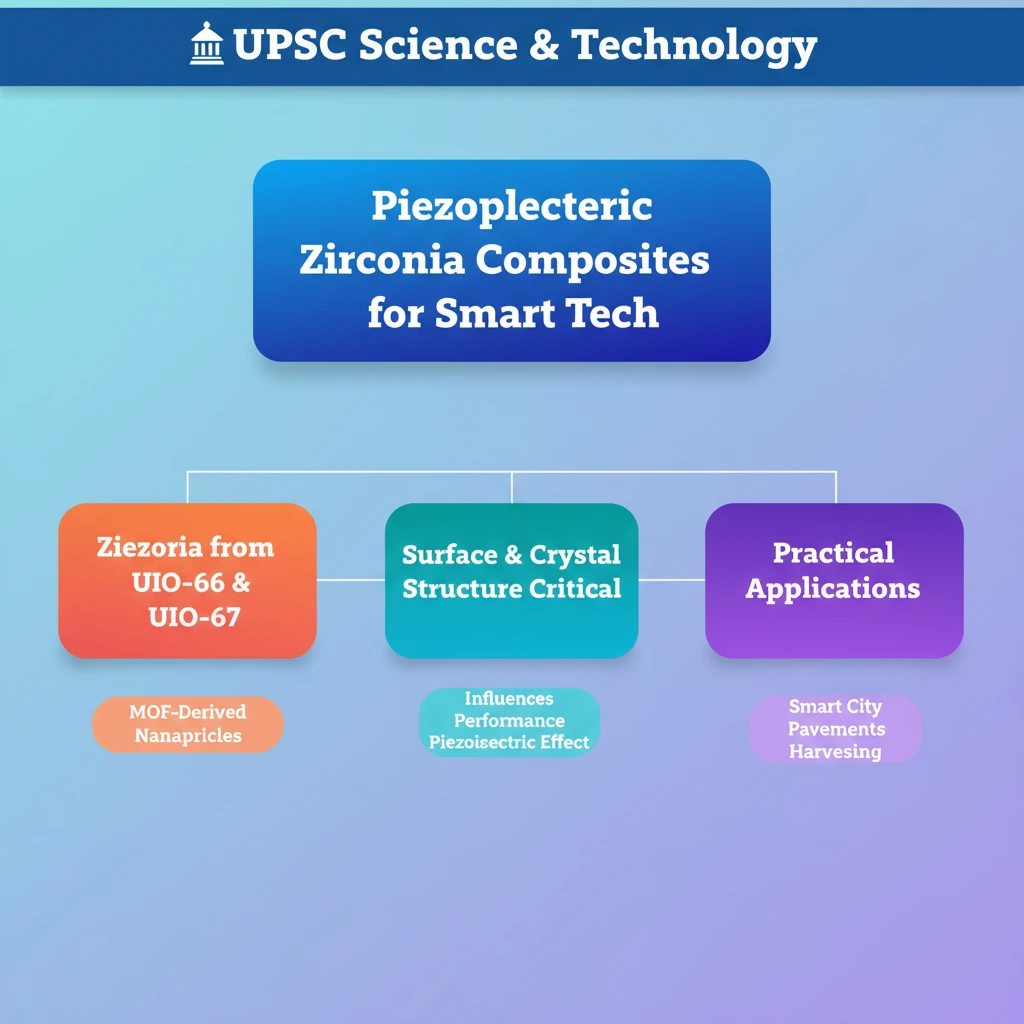
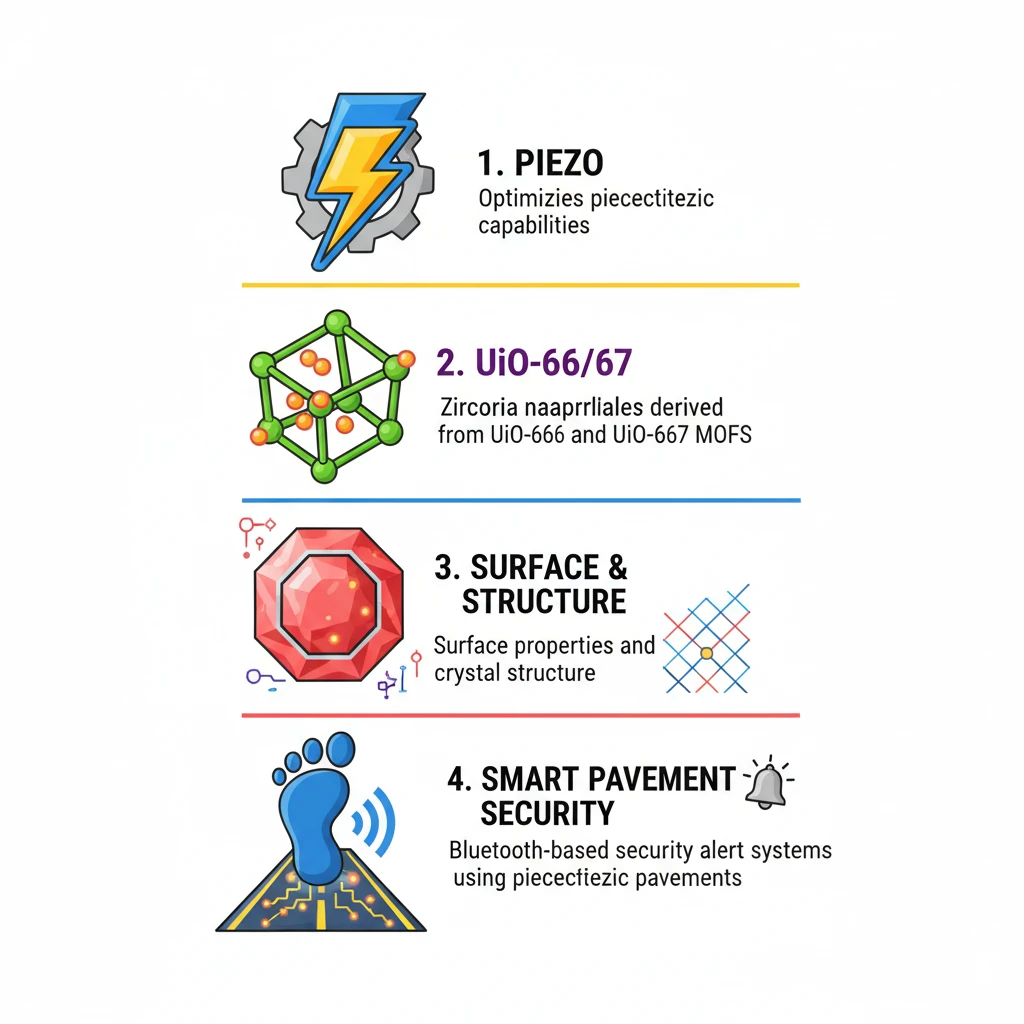
- •Zirconia nanoparticle crystal structure (monoclinic, tetragonal) significantly impacts piezoelectric performance.
- •Metal-organic frameworks (MOFs) like UiO-66 and UiO-67 are key precursors for synthesizing these nanoparticles.
- •Poly(vinylidene difluoride) (PVDF) polymer nanocomposite films are created for enhanced piezoelectric properties.
- •Practical applications include Bluetooth-based security alert systems using piezoelectric pavement.
- •The technology also enables electricity generation from mechanical energy, useful for smart cities and automated systems.
🧠 Memory Techniques
95% Verified Content
📚 Reference Sources
•General knowledge on Piezoelectricity, MOFs, and Nanotechnology