GSAT-20 (GSAT-N2) Aboard SpaceX’s Falcon-9 - Science And Technology | UPSC Learning
Topics
0 topics • 0 completed
🔍
No topics match your search
GSAT-20 (GSAT-N2) Aboard SpaceX’s Falcon-9
Medium⏱️ 6 min read
science and technology
📖 Introduction
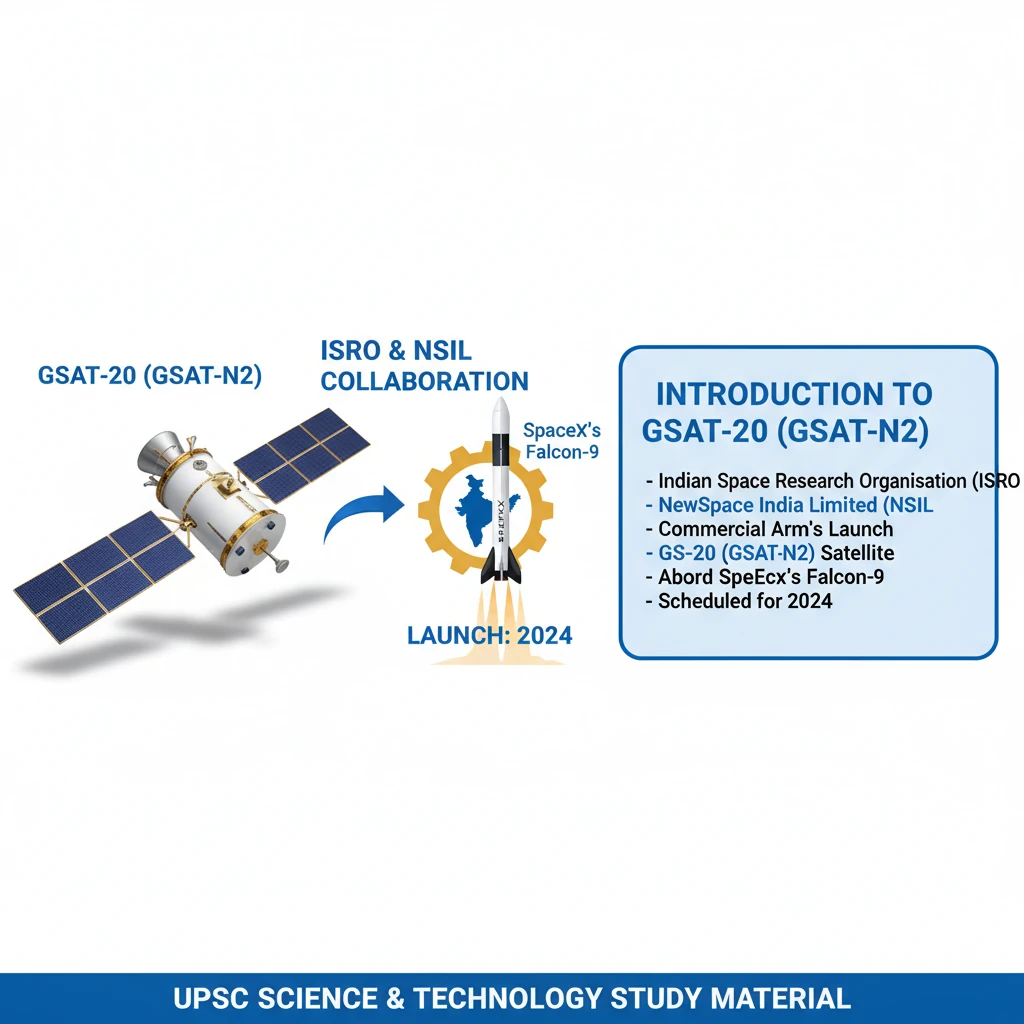
<h4>Introduction to GSAT-20 (GSAT-N2)</h4><p>The <strong>Indian Space Research Organisation's (ISRO)</strong> commercial arm, <strong>NewSpace India Limited (NSIL)</strong>, is preparing for a significant launch. They are set to deploy the <strong>GSAT-20 (GSAT-N2)</strong> satellite.</p><p>This launch is scheduled for <strong>2024</strong> and will be carried out aboard <strong>SpaceX's Falcon-9</strong> rocket.</p><h4>Why GSAT-20 (GSAT-N2) is in News</h4><p>The upcoming launch of <strong>GSAT-20 (GSAT-N2)</strong> is a major development in India's space communication efforts. It signifies a strategic collaboration with a global private space entity, <strong>SpaceX</strong>.</p><div class='key-point-box'><p>This mission aims to significantly enhance India's domestic satellite communication capabilities, particularly in providing high-speed internet access across the nation.</p></div><h4>Understanding GSAT-20 (GSAT-N2)</h4><p><strong>GSAT-20</strong>, also known as <strong>GSAT-N2</strong>, is categorized as a <strong>high throughput Ka-band satellite</strong>. Its primary objective is to provide advanced communication services across India.</p><p>The satellite is specifically designed to address the escalating demand for <strong>broadband communication</strong> within the country. It promises to deliver robust connectivity solutions.</p><div class='info-box'><p><strong>Key Services Provided by GSAT-20:</strong><ul><li><strong>High-speed broadband internet connectivity</strong></li><li><strong>Digital video transmission</strong></li><li><strong>Radio transmission</strong></li></ul></p></div><h4>Coverage and Capacity of GSAT-20</h4><p><strong>GSAT-20</strong> is engineered to offer comprehensive coverage across the entire Indian geographical area. This includes challenging and remote regions.</p><p>Crucially, its reach extends to far-flung territories such as the <strong>Andaman and Nicobar Islands</strong> and the <strong>Lakshadweep islands</strong>, ensuring inclusive connectivity.</p><div class='info-box'><p><strong>HTS Capacity:</strong> The satellite boasts an improved <strong>High Throughput Satellite (HTS) capacity</strong> of nearly <strong>64 Gbps</strong>.</p><p><strong>Beam Design:</strong> It incorporates <strong>32 beams</strong>, which are specifically designed to cater to the demanding service needs of underserved areas, aiming to bridge the digital divide.</p></div><h4>The Ka-band Technology</h4><p>The <strong>Ka-band</strong> is a critical technology utilized by <strong>GSAT-20</strong>. It refers to a specific range of radio frequencies.</p><div class='info-box'><p><strong>Ka-band Frequencies:</strong> The <strong>Ka-band</strong> operates within radio frequencies ranging from <strong>27 to 40 GHz</strong>.</p><p><strong>Benefits:</strong> This frequency band facilitates <strong>high-speed satellite data transfers</strong>. It achieves wide coverage through the use of highly focused <strong>spot beams</strong>, enhancing efficiency and data rates.</p></div><h4>SpaceX's Falcon-9 Rocket</h4><p>The launch vehicle for <strong>GSAT-20</strong> is <strong>SpaceX's Falcon-9</strong>. This rocket is renowned for its advanced capabilities in space transportation.</p><div class='info-box'><p><strong>Falcon-9 Specifications:</strong><ul><li>World’s first <strong>orbital class reusable, two-stage rocket</strong>.</li><li>Designed and manufactured by <strong>SpaceX</strong>.</li><li>Purpose: Reliable and safe transport of people and payloads into <strong>Earth orbit and beyond</strong>.</li></ul></p></div><div class='exam-tip-box'><p>For <strong>UPSC Prelims</strong>, remember key facts like <strong>GSAT-20 (GSAT-N2)</strong>, <strong>NSIL</strong>, <strong>SpaceX Falcon-9</strong>, <strong>Ka-band</strong>, and its <strong>HTS capacity</strong>. For <strong>Mains</strong>, focus on its implications for <strong>Digital India</strong>, rural connectivity, and India's space diplomacy.</p></div>
💡 Key Takeaways
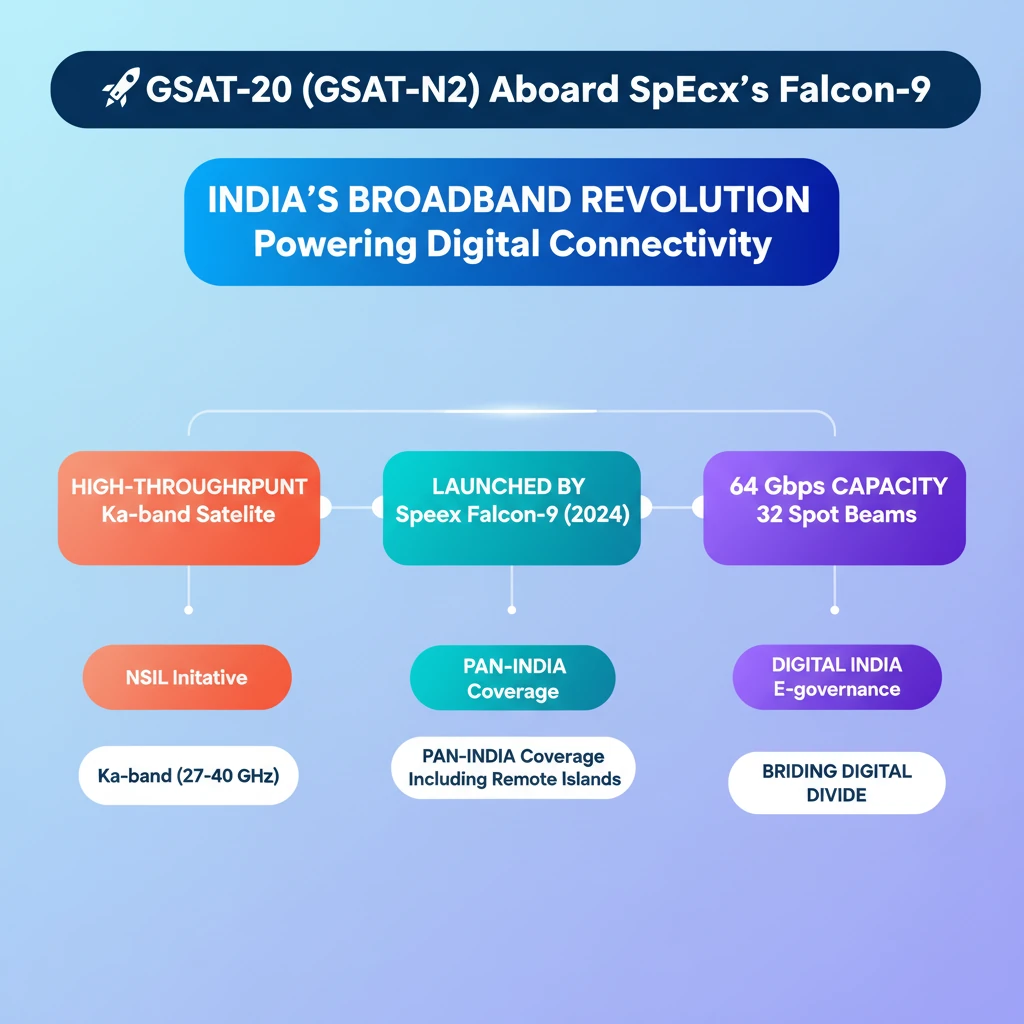
- •GSAT-20 (GSAT-N2) is a high throughput Ka-band satellite for India's broadband needs.
- •It will be launched by NewSpace India Limited (NSIL) aboard SpaceX's Falcon-9 rocket in 2024.
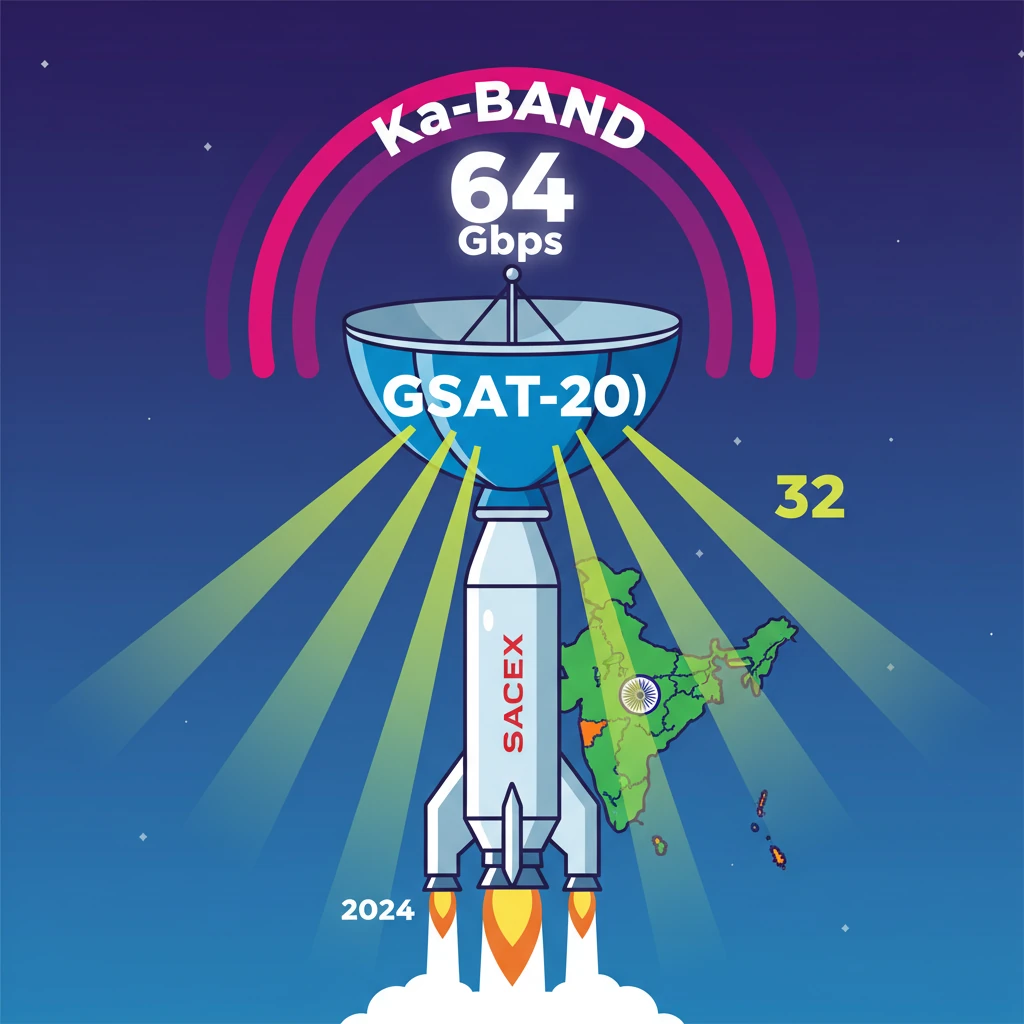
- •The satellite offers 64 Gbps capacity with 32 spot beams, covering all of India, including remote islands.
- •Ka-band (27-40 GHz) enables high-speed data transfer through focused spot beams.
- •This mission is crucial for Digital India, e-governance, and bridging the digital divide in remote regions.
🧠 Memory Techniques
98% Verified Content
📚 Reference Sources
•ISRO Official Website (for general satellite information and NSIL's role)
•SpaceX Official Website (for Falcon-9 details)