Gene Editing vs. Gene Sequencing: Key Differences for UPSC - Science And Technology | UPSC Learning
Topics
0 topics • 0 completed
🔍
No topics match your search
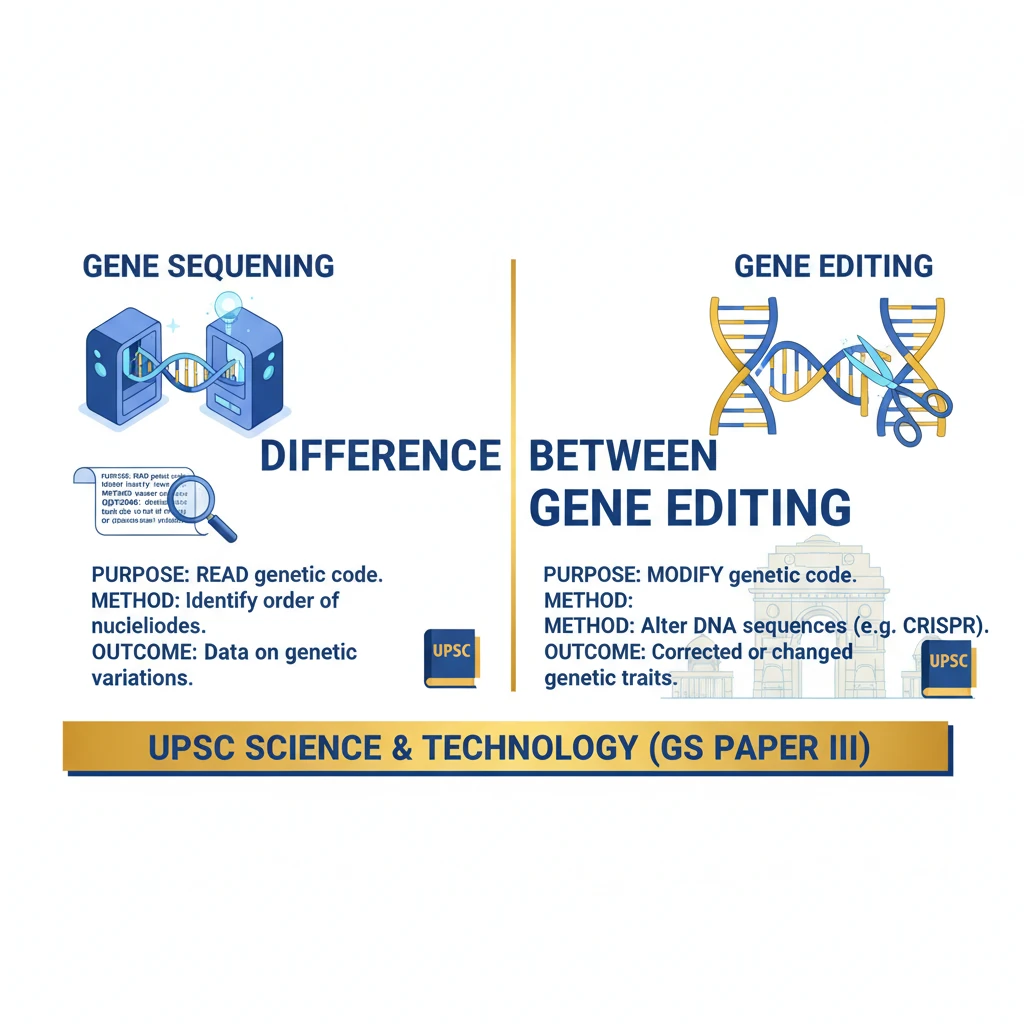
Gene Editing vs. Gene Sequencing: Key Differences for UPSC
Medium⏱️ 10 min read
science and technology
📖 Introduction
<h4>Introduction to Genetic Technologies</h4><p>Understanding the fundamental differences between <strong>gene sequencing</strong> and <strong>gene editing</strong> is crucial in the rapidly evolving field of biotechnology. While both involve manipulating or analyzing genetic material, their purposes, methodologies, and outcomes are distinct.</p><div class='exam-tip-box'><p>For UPSC, clearly distinguishing these concepts is vital for questions on <strong>Science & Technology (GS Paper III)</strong>, especially concerning advancements in biotechnology and their societal implications.</p></div><h4>Core Differences: Gene Sequencing vs. Gene Editing</h4><p>The table below provides a concise comparison of <strong>gene sequencing</strong> and <strong>gene editing</strong> across key characteristics, highlighting their divergent roles in modern genetics.</p><table class='info-table'><tr><th>Characteristic</th><th>Gene Sequencing</th><th>Gene Editing</th></tr><tr><td><strong>Definition</strong></td><td>The process of determining the precise order of <strong>nucleotides</strong> (A, T, C, G) in a <strong>DNA</strong> or <strong>RNA</strong> molecule.</td><td>The process of making targeted modifications to the <strong>DNA sequence</strong> of a gene or genes.</td></tr><tr><td><strong>Purpose</strong></td><td>To obtain the complete or partial sequence of a <strong>gene</strong>, a set of genes, or an entire <strong>genome</strong>.</td><td>To introduce desired changes, such as correcting genetic defects, modifying gene expression, or introducing new genetic traits.</td></tr><tr><td><strong>Techniques</strong></td><td><strong>Sanger sequencing</strong>, <strong>Next-Generation Sequencing (NGS)</strong>, and others.</td><td><strong>CRISPR-Cas9</strong>, <strong>zinc finger nucleases</strong>, <strong>TALENs</strong>, and other specialised tools.</td></tr><tr><td><strong>Outcome</strong></td><td>Provides information about the genetic makeup and composition of an organism.</td><td>Allows for the direct manipulation and alteration of the <strong>genetic code</strong>.</td></tr><tr><td><strong>Modification</strong></td><td>Does not directly modify the <strong>genetic material</strong>.</td><td>Enables the addition, removal, or alteration of specific <strong>DNA sequences</strong>.</td></tr></table><h4>Understanding Gene Sequencing</h4><p><strong>Gene sequencing</strong> is essentially "reading" the genetic code. It deciphers the exact order of the four chemical building blocks, or <strong>nucleotides</strong> (Adenine, Thymine, Cytosine, Guanine), that make up <strong>DNA</strong> or <strong>RNA</strong>.</p><div class='info-box'><p><strong>Definition:</strong> <strong>Gene sequencing</strong> is the laboratory technique used to determine the precise order of <strong>nucleotides</strong> within a <strong>DNA</strong> or <strong>RNA</strong> molecule.</p></div><p>The primary <strong>purpose</strong> of sequencing is to gain comprehensive insights into an organism's genetic blueprint. This can range from sequencing a single gene to an entire <strong>genome</strong>.</p><div class='key-point-box'><p><strong>Key Purpose:</strong> To map the genetic information, providing a foundational understanding of an organism's heredity, traits, and potential vulnerabilities.</p></div><p>Common <strong>techniques</strong> include older methods like <strong>Sanger sequencing</strong> and more advanced platforms such as <strong>Next-Generation Sequencing (NGS)</strong>, which allows for rapid and high-throughput analysis.</p><ul><li><strong>Sanger Sequencing:</strong> A traditional method for sequencing individual <strong>DNA fragments</strong>.</li><li><strong>Next-Generation Sequencing (NGS):</strong> High-throughput technologies capable of sequencing millions of <strong>DNA fragments</strong> simultaneously, revolutionizing genomics.</li></ul><p>The <strong>outcome</strong> of gene sequencing is a vast amount of data detailing the genetic composition. This data is purely informational and does not involve altering the genetic material itself.</p><div class='highlight-box'><p><strong>Important Note:</strong> <strong>Gene sequencing</strong> is a diagnostic and informational tool; it does <strong>not directly modify</strong> the genetic material.</p></div><h4>Understanding Gene Editing</h4><p>In contrast, <strong>gene editing</strong> is about "writing" or "rewriting" the genetic code. It involves making precise, targeted changes to the <strong>DNA sequence</strong> within a living organism's cells.</p><div class='info-box'><p><strong>Definition:</strong> <strong>Gene editing</strong> refers to a set of technologies that give scientists the ability to change an organism's <strong>DNA</strong>. These technologies allow genetic material to be added, removed, or altered at particular locations in the <strong>genome</strong>.</p></div><p>The main <strong>purpose</strong> of gene editing is to introduce specific, desired changes. This could involve correcting genetic mutations that cause diseases, enhancing certain traits, or disabling problematic genes.</p><div class='key-point-box'><p><strong>Key Purpose:</strong> To directly manipulate the <strong>genetic code</strong> to achieve therapeutic benefits, agricultural improvements, or fundamental biological research.</p></div><p>Several sophisticated <strong>techniques</strong> are employed for gene editing. The most prominent among these is <strong>CRISPR-Cas9</strong>, known for its precision and relative ease of use.</p><ul><li><strong>CRISPR-Cas9:</strong> A revolutionary system derived from bacterial immune defenses, enabling highly specific cuts in <strong>DNA</strong>.</li><li><strong>Zinc Finger Nucleases (ZFNs):</strong> Engineered proteins that can bind to specific <strong>DNA sequences</strong> and cut the <strong>DNA</strong>.</li><li><strong>TALENs (Transcription Activator-Like Effector Nucleases):</strong> Similar to ZFNs, these are engineered proteins that can target and cut specific <strong>DNA sequences</strong>.</li></ul><p>The direct <strong>outcome</strong> of gene editing is a permanent alteration of the organism's <strong>genetic code</strong>. This modification can lead to changes in gene function or expression.</p><div class='highlight-box'><p><strong>Important Note:</strong> <strong>Gene editing</strong> actively modifies the <strong>genetic material</strong> by adding, removing, or altering specific <strong>DNA sequences</strong>, leading to functional changes.</p></div>
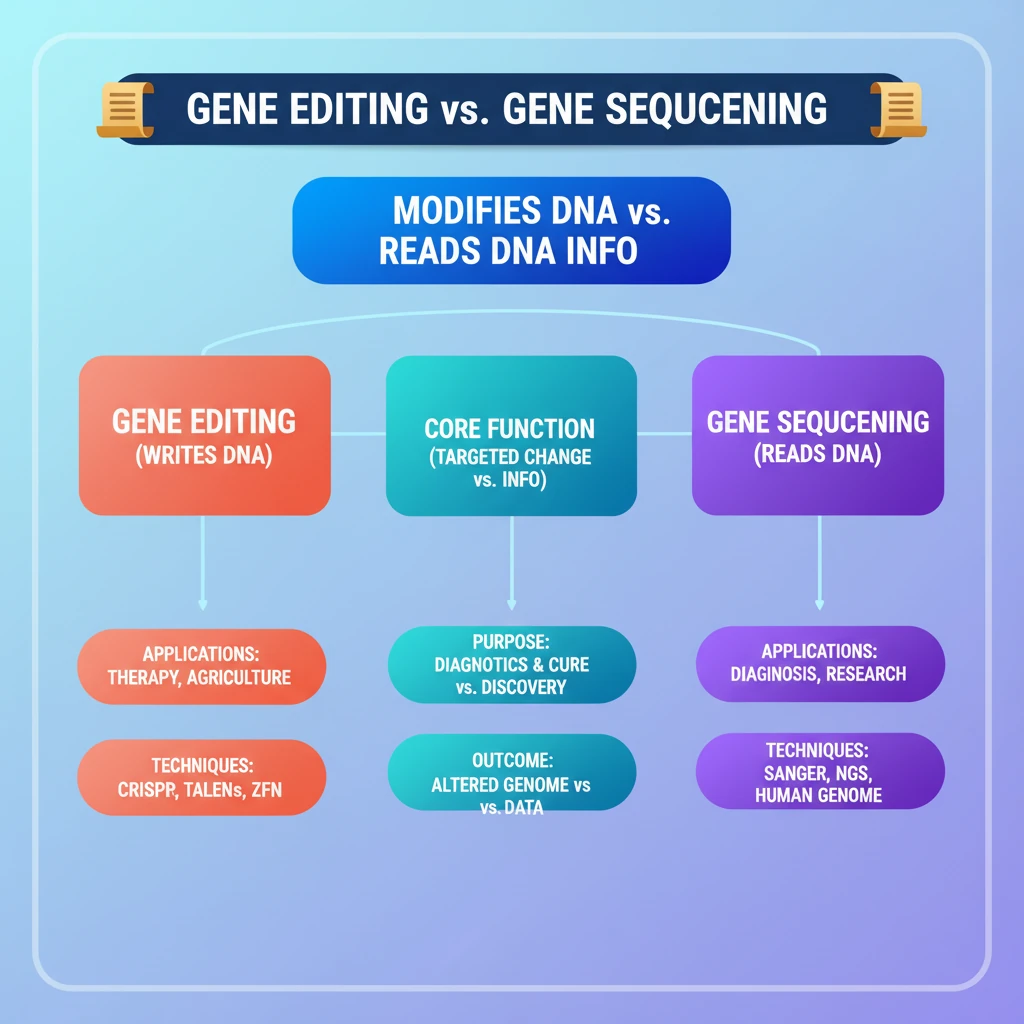
💡 Key Takeaways
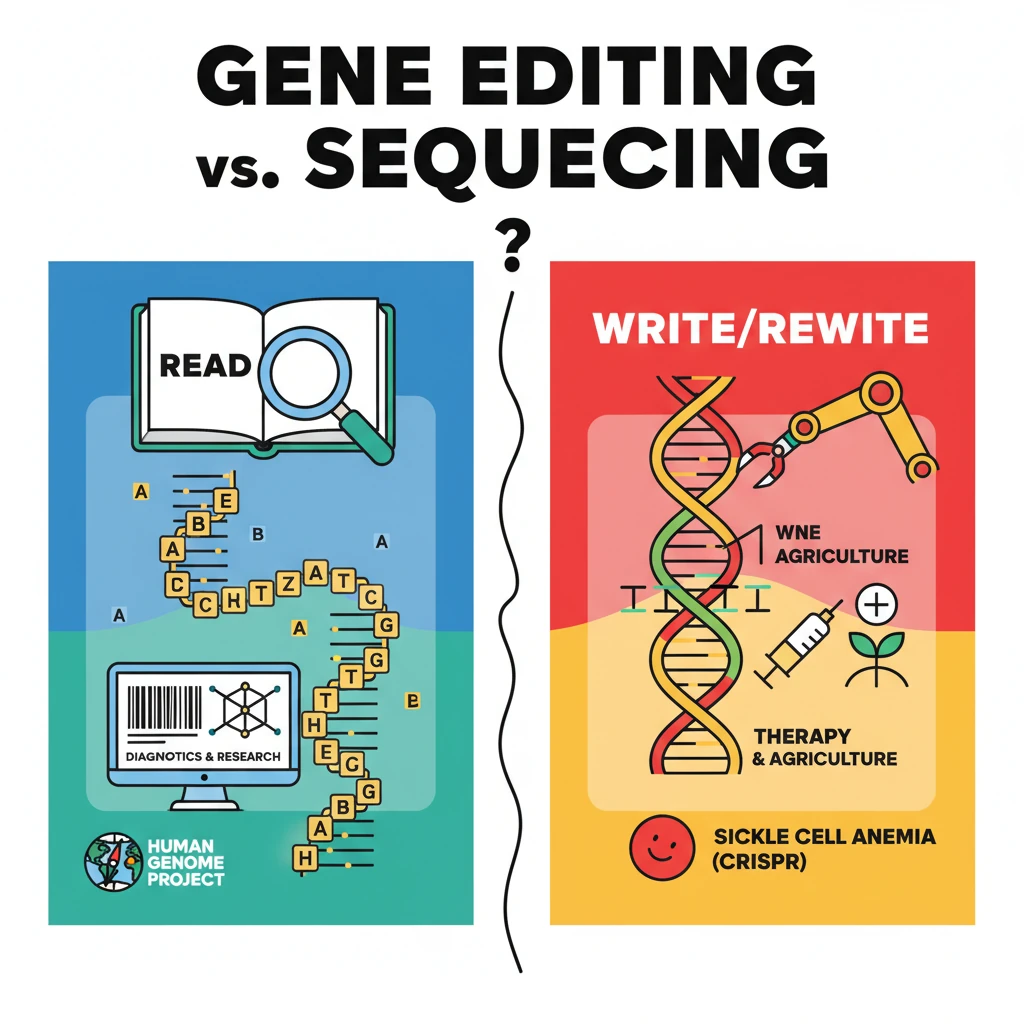
- •Gene Sequencing 'reads' the DNA sequence, providing information without modification.
- •Gene Editing 'writes' or 'rewrites' DNA, making targeted changes to the genetic code.
- •Sequencing is used for diagnostics, research, and understanding genetic makeup (e.g., Human Genome Project).
- •Editing is used for therapeutic interventions, agricultural improvements, and basic research (e.g., CRISPR for sickle cell anemia).
- •Key techniques for sequencing include Sanger and NGS; for editing, CRISPR-Cas9, ZFNs, and TALENs.
- •Both technologies have profound current relevance in precision medicine, agriculture, and raise significant ethical and regulatory considerations.
🧠 Memory Techniques
98% Verified Content
📚 Reference Sources
•Centers for Disease Control and Prevention (CDC): 'What is Sickle Cell Disease?'
•Nature Biotechnology, Science, Cell (peer-reviewed journals for CRISPR-Cas9 discoveries and applications)
•World Health Organization (WHO) reports on biotechnology and ethics
•Indian Council of Medical Research (ICMR) guidelines on biomedical research