Hayflick Limit: Cellular Senescence and its Role in Ageing - Science And Technology | UPSC Learning
Topics
0 topics • 0 completed
🔍
No topics match your search
Hayflick Limit: Cellular Senescence and its Role in Ageing
Medium⏱️ 6 min read
science and technology
📖 Introduction
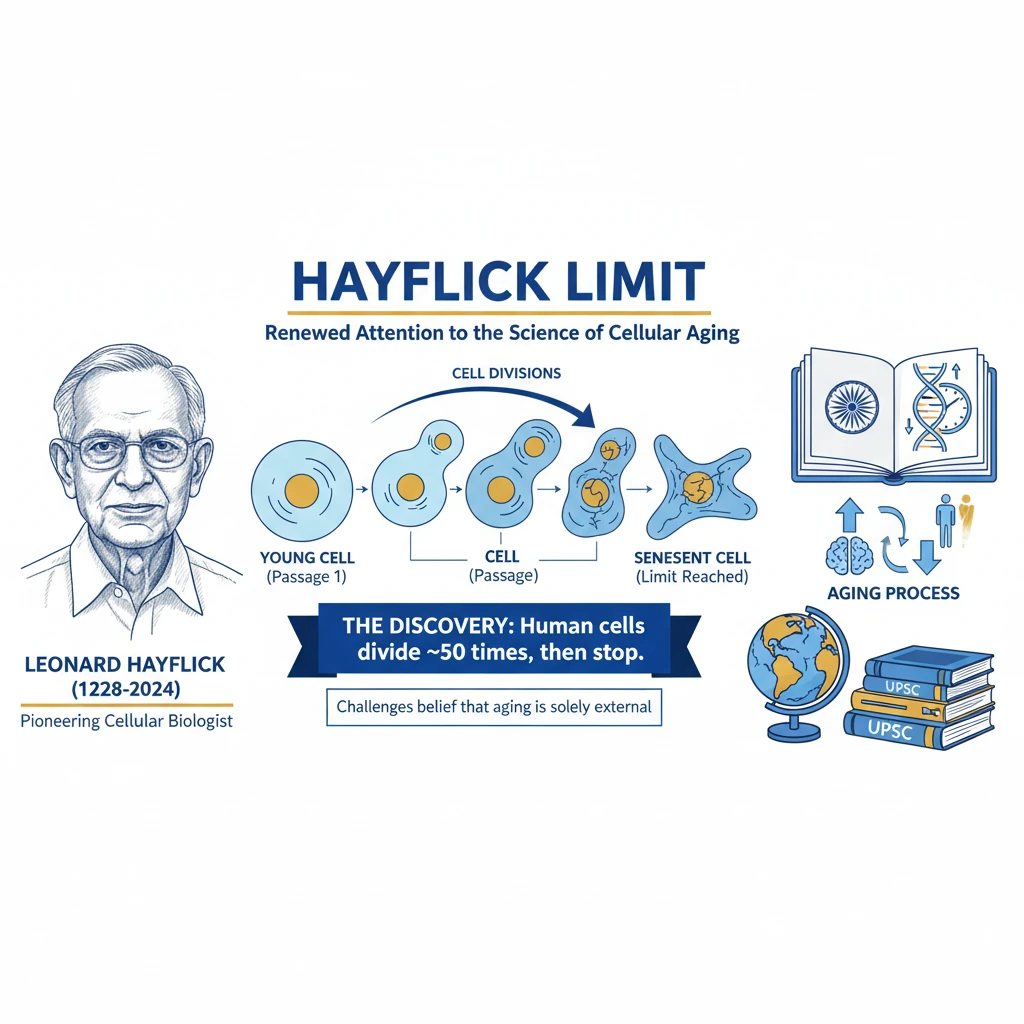
<h4>Introduction: Renewed Attention to Hayflick Limit</h4><p>The recent passing of prominent biomedical researcher <strong>Leonard Hayflick</strong> has brought significant focus back to his pivotal discovery: the <strong>Hayflick Limit</strong>.</p><p>This concept fundamentally reshaped our understanding of the <strong>aging process</strong>, moving beyond the sole influence of external factors.</p><h4>Challenging Previous Beliefs on Aging</h4><p>Before <strong>Hayflick's</strong> work, aging was primarily attributed to external factors such as <strong>disease</strong> and adverse <strong>environmental conditions</strong>.</p><p>His discovery introduced the idea of an <strong>inherent cellular mechanism</strong> contributing to the decline associated with age.</p><h4>Defining the Hayflick Limit</h4><div class='info-box'><p>In the <strong>1960s</strong>, <strong>Leonard Hayflick</strong> discovered that <strong>somatic cells</strong> (non-reproductive cells) possess a finite capacity for division.</p></div><p>These cells can only divide approximately <strong>40 to 60 times</strong> before they permanently cease dividing, a phenomenon termed <strong>cellular senescence</strong>.</p><h4>Cellular Senescence and Aging</h4><p>The cessation of cell division leads to an accumulation of these <strong>senescent cells</strong> within the body.</p><p>This accumulation is now considered a crucial factor in the overall <strong>aging process</strong> and the associated physical decline.</p><h4>The Inherent Cellular Clock</h4><div class='key-point-box'><p>The <strong>Hayflick Limit</strong> proposes the existence of an <strong>inherent cellular clock</strong> within organisms, including humans.</p></div><p>This internal clock dictates the maximum potential lifespan for a species, setting a biological upper limit.</p><h4>Human Lifespan and the Hayflick Limit</h4><p>For humans, this biological limit is estimated to be around <strong>125 years</strong>.</p><p>Beyond this estimated maximum, it is suggested that neither external factors nor genetic modifications can significantly extend life according to this principle.</p><h4>Species-Specific Hayflick Limits</h4><p><strong>Hayflick</strong> and other researchers meticulously documented variations in the <strong>Hayflick limits</strong> across different animal species.</p><p>This comparative study underscored the species-specific nature of cellular division capacity and lifespan potential.</p>
💡 Key Takeaways
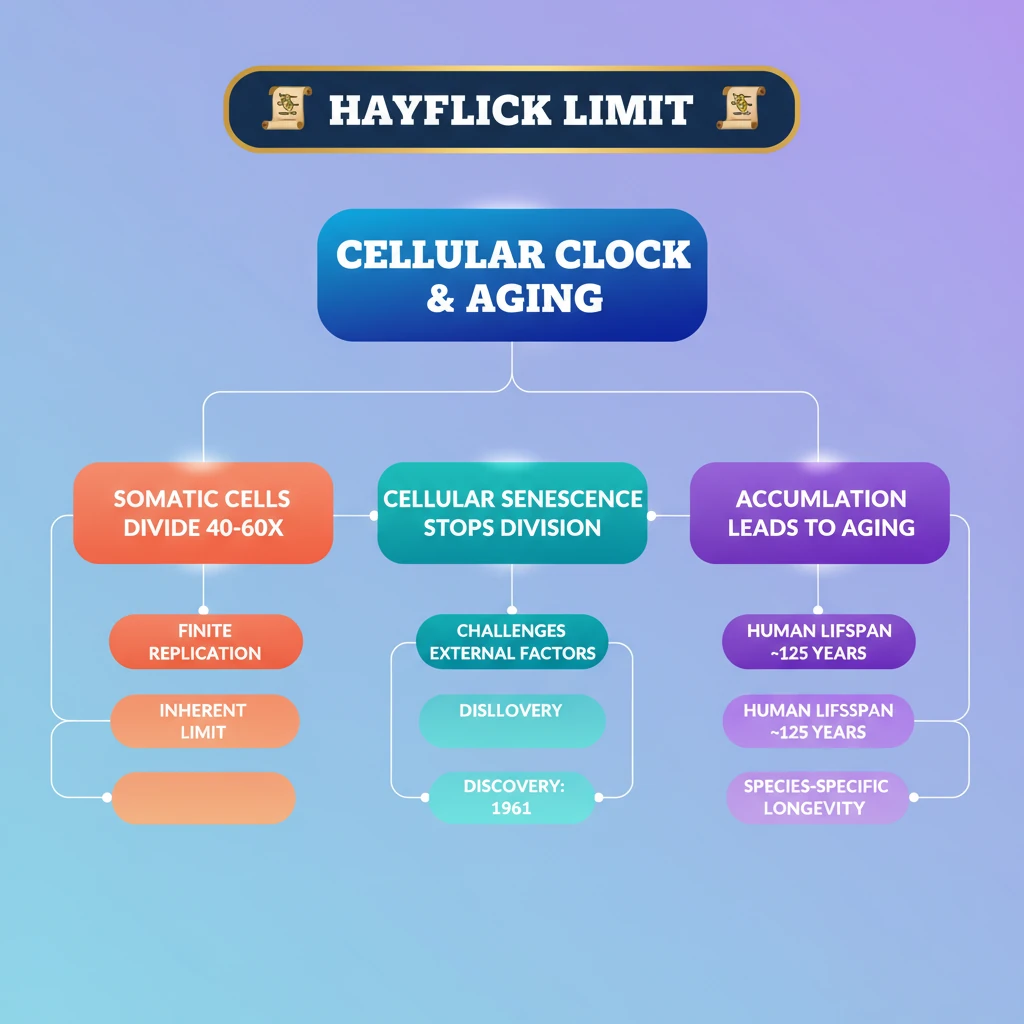
- •The <strong>Hayflick Limit</strong> states that <strong>somatic cells</strong> can only divide a finite number of times (40-60) before stopping.
- •This cessation of division is called <strong>cellular senescence</strong>, and its accumulation contributes to aging.
- •The discovery challenged the belief that aging was solely due to external factors, introducing the concept of an <strong>inherent cellular clock</strong>.
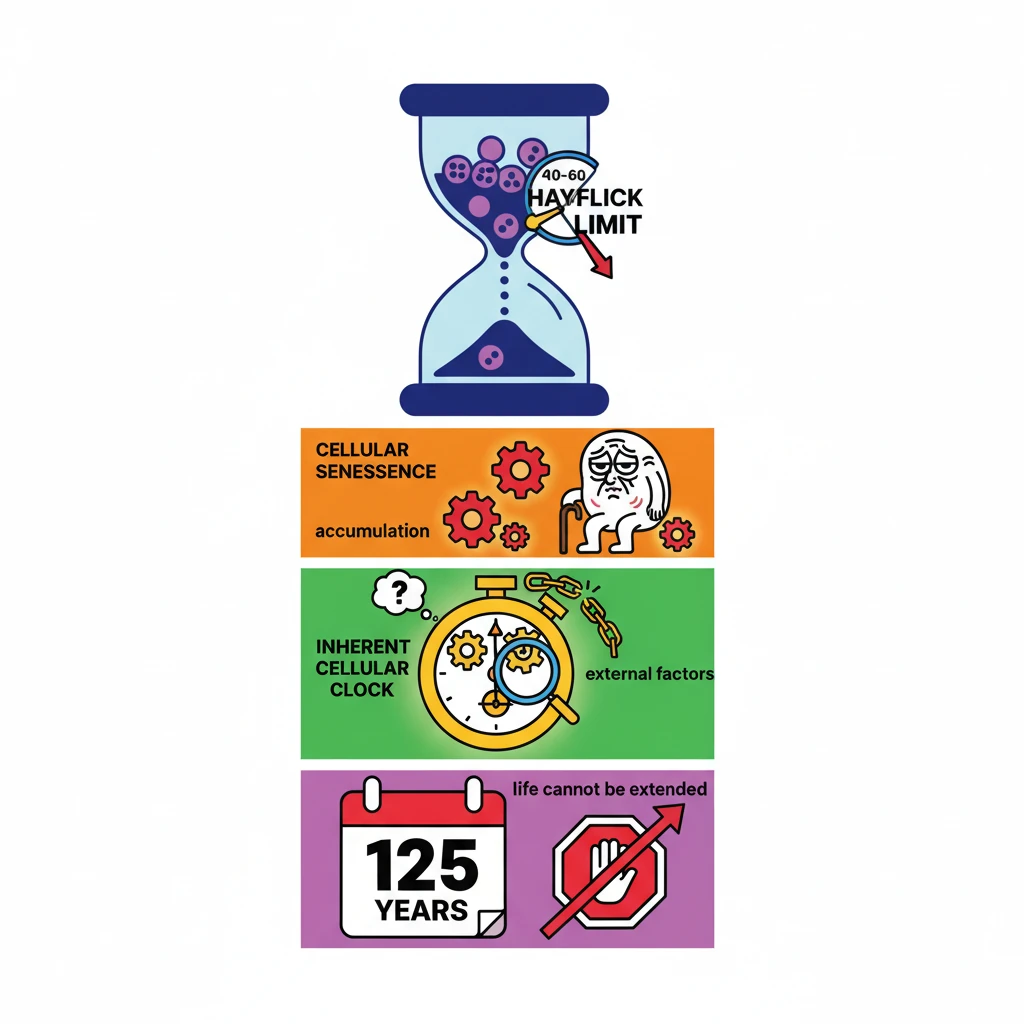
- •For humans, the maximum lifespan is estimated around <strong>125 years</strong>, beyond which this limit suggests life cannot be extended.
- •Different species exhibit different <strong>Hayflick Limits</strong>, highlighting species-specific biological determinants of longevity.
🧠 Memory Techniques
95% Verified Content