Piezoelectric Materials: Properties, Examples, and Applications - Science And Technology | UPSC Learning
Topics
0 topics • 0 completed
🔍
No topics match your search
Piezoelectric Materials: Properties, Examples, and Applications
Medium⏱️ 7 min read
science and technology
📖 Introduction
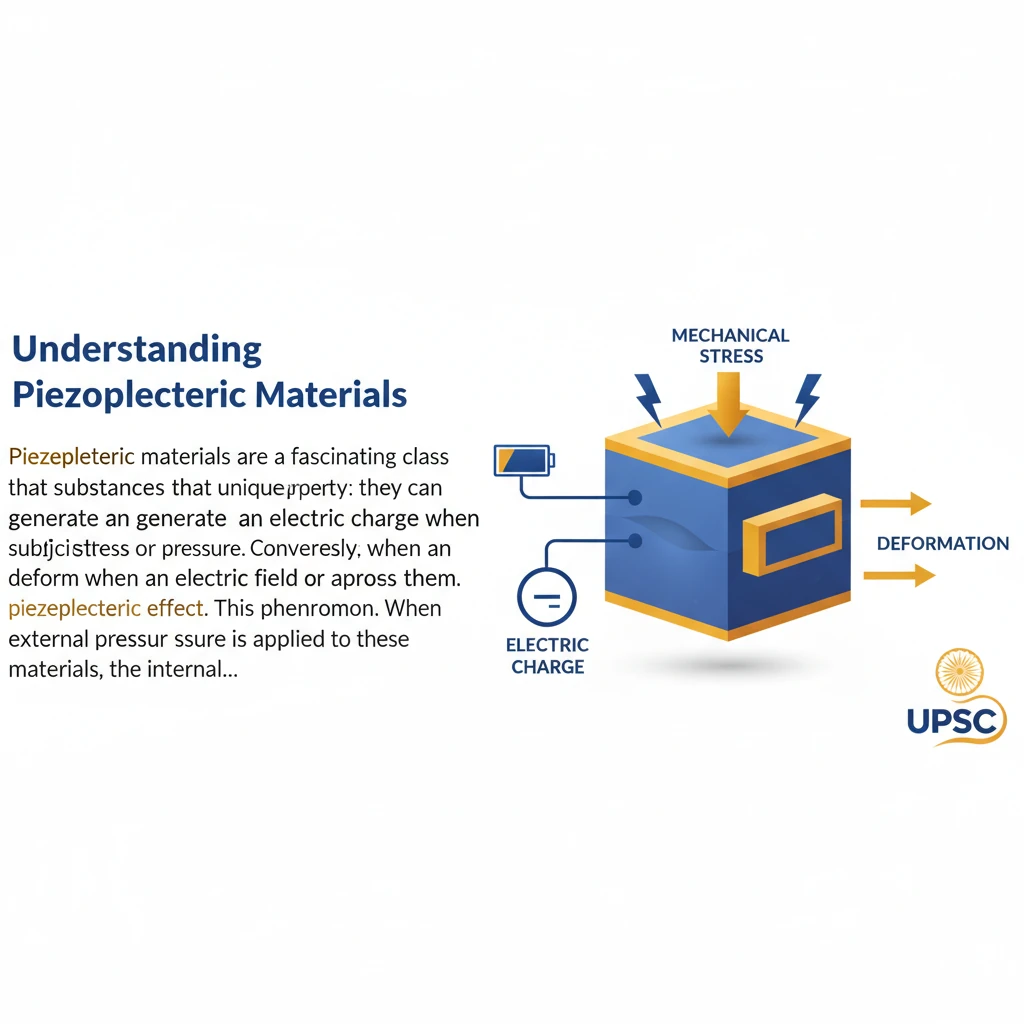
<h4>Understanding Piezoelectric Materials</h4><p><strong>Piezoelectric materials</strong> are a fascinating class of substances that exhibit a unique property: they can generate an <strong>electric charge</strong> when subjected to <strong>mechanical stress</strong> or pressure. Conversely, they deform when an electric field is applied across them. This phenomenon is known as the <strong>piezoelectric effect</strong>.</p><p>When external pressure is applied to these materials, the internal centres of positive and negative charges within their crystal structure shift. This displacement leads to the creation of an external <strong>electric field</strong>, effectively converting mechanical energy into electrical energy.</p><div class='key-point-box'><p><strong>Key Concept: Piezoelectric Effect</strong></p><ul><li><strong>Direct Piezoelectric Effect:</strong> Mechanical stress generates an electric charge.</li><li><strong>Inverse Piezoelectric Effect:</strong> An applied electric field causes mechanical deformation.</li></ul></div><h4>Types of Piezoelectric Materials</h4><p>Piezoelectric properties are found across a diverse range of materials, from naturally occurring crystals to advanced synthetic polymers and ceramics.</p><ul><li><strong>Natural Materials:</strong> These include minerals like <strong>Quartz</strong>, <strong>topaz</strong>, and <strong>tourmaline</strong>.</li><li><strong>Organic Materials:</strong> Biological substances such as <strong>silk</strong>, <strong>wood</strong>, and <strong>bone</strong> also exhibit piezoelectricity.</li><li><strong>Ceramics:</strong> Synthetically produced ceramics like <strong>Lead Zirconate Titanate (PZT)</strong> and <strong>barium titanate (BT)</strong> are widely used due to their strong piezoelectric response.</li><li><strong>Polymers:</strong> Certain polymers, such as <strong>PVDF</strong> (Polyvinylidene Fluoride) and <strong>PVDF-TrFE</strong> (Poly(vinylidene fluoride-trifluoroethylene) copolymer), are engineered for piezoelectric applications.</li></ul><div class='info-box'><p><strong>Ferroelectric Materials:</strong> A special class, like <strong>Barium Titanate (BaTiO3)</strong>, can generate an electric charge even without direct mechanical pressure, often due to spontaneous polarization that can be reoriented by an electric field.</p></div><h4>Applications of Piezoelectric Materials</h4><p>The ability of piezoelectric materials to interconvert mechanical and electrical energy makes them invaluable in numerous technological applications across various sectors.</p><ul><li><strong>Sensors:</strong> Used in pressure sensors, accelerometers, and microphones to detect mechanical vibrations or forces.</li><li><strong>Actuators:</strong> Employed in precision positioning systems, inkjet printers, and haptic feedback devices to produce precise movements.</li><li><strong>Energy Harvesting:</strong> Convert ambient mechanical vibrations (e.g., from footsteps, machinery) into usable electrical energy.</li><li><strong>Acoustics:</strong> Found in <strong>microphones</strong> and <strong>electric pickups</strong> for stringed instruments.</li><li><strong>Frequency Standards:</strong> <strong>Quartz crystals</strong> are crucial for accurate timing in watches and electronic devices.</li><li><strong>Motors:</strong> Used in compact and precise <strong>piezoelectric motors</strong>.</li><li><strong>Noise and Vibration Reduction:</strong> Active damping systems utilize piezoelectric materials to counteract unwanted vibrations.</li></ul><h4>Polymers: An Overview</h4><p>A <strong>polymer</strong> is a large molecule, often referred to as a macromolecule, that is composed of many repeating smaller units called <strong>monomers</strong>. These monomers are linked together in chains or rings.</p><p>Polymers typically possess high molecular masses, which contribute to their characteristic high melting and boiling points. They can be broadly categorized into natural and synthetic types.</p><div class='info-box'><p><strong>Examples of Polymers:</strong></p><ul><li><strong>Natural Polymers:</strong> <strong>Silk</strong>, <strong>DNA</strong>.</li><li><strong>Synthetic Polymers:</strong> <strong>Nylon</strong>, <strong>polyethylene</strong> (derived from oil or bio-based sources).</li></ul></div><h4>Piezoelectric Polymers</h4><p>These are a specific class of polymers engineered to exhibit the piezoelectric effect. They are capable of generating electric charges on their surface when subjected to mechanical pressure or strain.</p><p>This property allows them to efficiently convert mechanical energy directly into electrical energy, making them suitable for flexible and lightweight applications.</p><div class='info-box'><p><strong>Examples of Piezoelectric Polymers:</strong></p><ul><li><strong>Poly(vinylidene fluoride) (PVDF)</strong></li><li><strong>Poly(vinylidene fluoride-trifluoroethylene) copolymer (P(VDF-TrFE))</strong></li></ul></div><h4>Polymer Nanocomposites</h4><p><strong>Polymer nanocomposites</strong> are advanced materials formed by combining a polymer matrix with a small percentage of additives that are sized in the nanometer range (typically 1-100 nm).</p><p>The primary aim of creating nanocomposites is to significantly enhance various properties of the base polymer, including its <strong>mechanical strength</strong>, <strong>thermal stability</strong>, and <strong>electrical characteristics</strong>, often with minimal additive loading.</p><h4>Nanomaterials and Nanocomposites</h4><p>A <strong>nanomaterial</strong> is defined as any material that has structural components with at least one dimension in the <strong>nanometer scale</strong>, which is typically between <strong>1 nanometer (nm) and 100 nm</strong>.</p><div class='info-box'><p><strong>Nanocomposite Definition:</strong> A <strong>nanocomposite</strong> is a solid material comprising two or more different substances, where at least one of these substances has dimensions specifically in the <strong>nanoscale range</strong>, often cited as between <strong>1 nm and 3 nm</strong>, contributing to its enhanced properties.</p></div><div class='exam-tip-box'><strong>UPSC Insight:</strong> Understanding the fundamental principles and applications of <strong>piezoelectric materials</strong>, <strong>polymers</strong>, and <strong>nanocomposites</strong> is crucial for the <strong>Science & Technology</strong> section of the <strong>General Studies Paper III</strong>. Focus on the interdisciplinary nature and real-world impact.</div>
💡 Key Takeaways
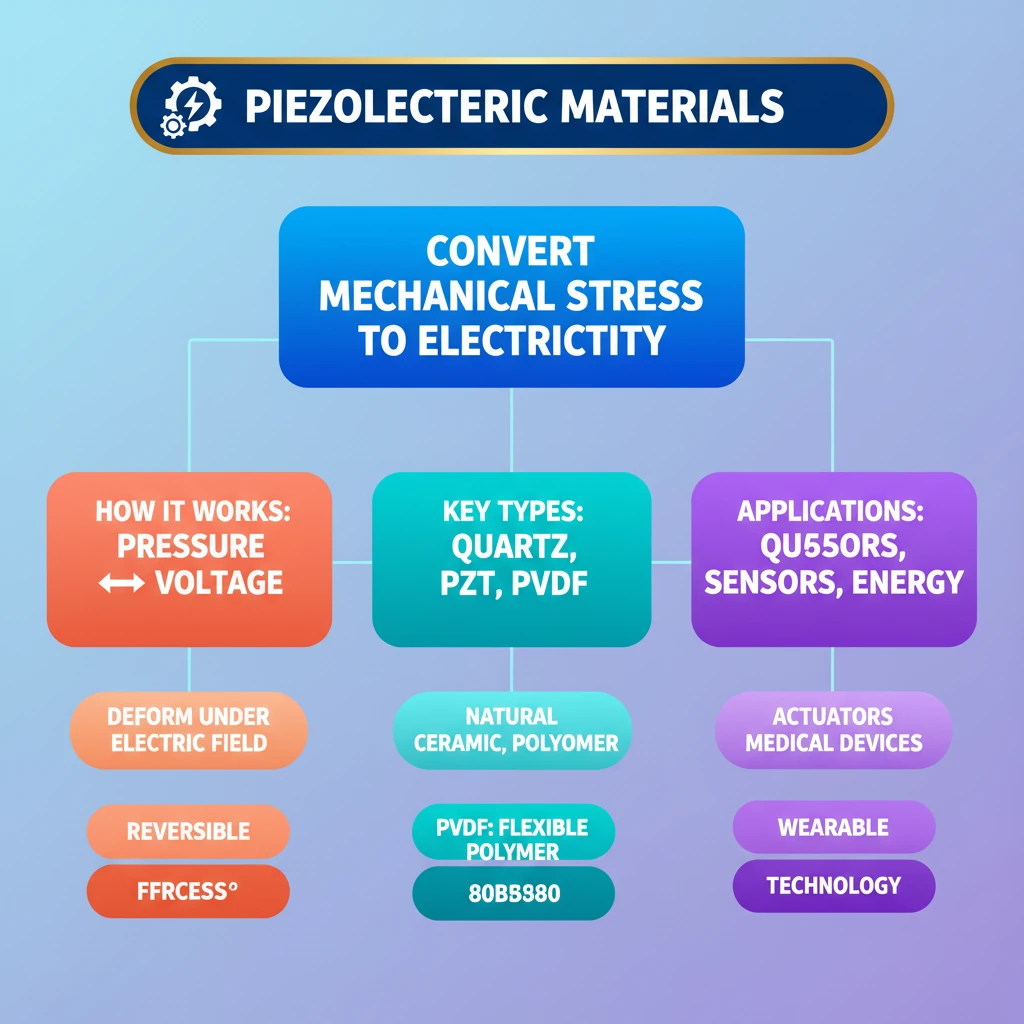
- •Piezoelectric materials generate electricity from mechanical stress and deform under electric fields.
- •Examples include natural (Quartz), ceramic (PZT), and polymer (PVDF) types.
- •Applications span sensors, actuators, energy harvesting, and medical devices.
- •Polymers are large molecules made of repeating monomer units.
- •Piezoelectric polymers like PVDF offer flexibility for wearable tech.
- •Nanomaterials (1-100 nm) and nanocomposites enhance polymer properties (mechanical, thermal, electrical).
🧠 Memory Techniques

95% Verified Content
📚 Reference Sources
•General knowledge of piezoelectric materials, polymers, and nanotechnology concepts