Tardigrades: Adaptations, Cryptobiosis, and Potential Human Applications - Science And Technology | UPSC Learning
Topics
0 topics • 0 completed
🔍
No topics match your search
Tardigrades: Adaptations, Cryptobiosis, and Potential Human Applications
Medium⏱️ 7 min read
science and technology
📖 Introduction
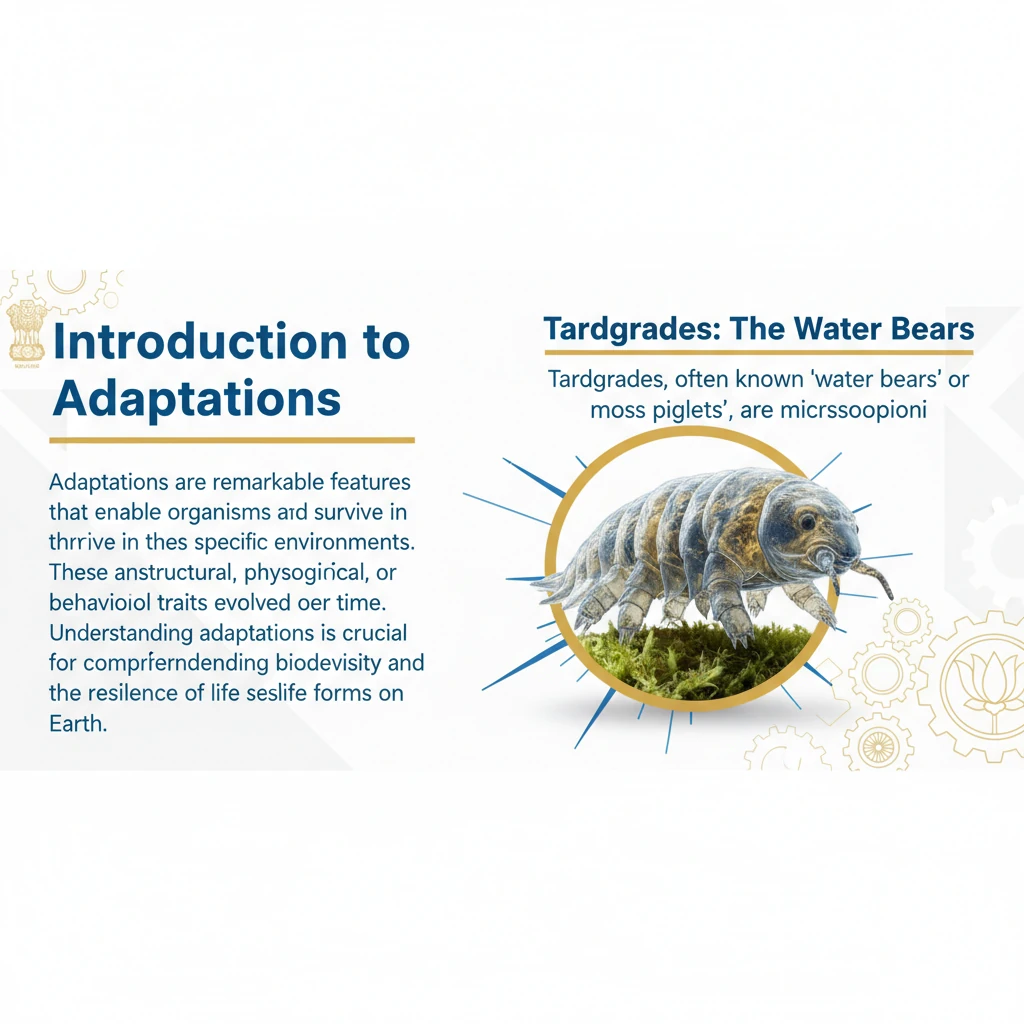
<h4>Introduction to Adaptations</h4><p><strong>Adaptations</strong> are remarkable features that enable organisms to survive and thrive in their specific environments. These can be structural, physiological, or behavioral traits evolved over time.</p><p>Understanding adaptations is crucial for comprehending biodiversity and the resilience of life forms on Earth.</p><h4>Tardigrades: The Water Bears</h4><p><strong>Tardigrades</strong>, often known as 'water bears' or 'moss piglets', are microscopic invertebrates renowned for their extraordinary survival capabilities. Molecular dating suggests their origin dates back at least <strong>600 million years ago</strong>.</p><div class='info-box'><p><strong>Origin:</strong> At least <strong>600 million years ago</strong> (molecular dating)</p><p><strong>Common Name:</strong> Water Bears, Moss Piglets</p></div><p>These creatures are masters of survival, capable of inhabiting some of the most extreme ecosystems on the planet.</p><div class='key-point-box'><p><strong>Extreme Habitats:</strong> <ul><li><strong>Arctic regions</strong></li><li><strong>Deep-sea floors</strong></li><li><strong>Deserts</strong></li><li>Even the <strong>vacuum of space</strong></li></ul></p></div><h4>Unparalleled Resilience</h4><p>Tardigrades exhibit an astonishing ability to withstand conditions that would be lethal to most other life forms. Their resilience makes them a subject of intense scientific study.</p><div class='info-box'><p><strong>Extreme Conditions Withstood:</strong></p><ul><li><strong>Extreme radiation</strong></li><li><strong>Starvation</strong></li><li><strong>Lack of oxygen (anoxia)</strong></li><li><strong>Severe dehydration (lack of water)</strong></li><li><strong>Freezing temperatures</strong></li></ul></div><h4>Cryptobiosis: A Survival Mechanism</h4><p>A key to the tardigrades' survival is a reversible metabolic state called <strong>cryptobiosis</strong>. In this state, they halt nearly all biological activity to endure extreme environmental stress.</p><div class='key-point-box'><p><strong>Cryptobiosis Definition:</strong> A metabolic state of life entered by an organism in response to adverse environmental conditions, characterized by a significant reduction in metabolic activity.</p></div><p>This remarkable process allows them to survive prolonged periods of dehydration, freezing, and even intense radiation damage, resuming normal functions once conditions improve.</p><h4>Genetic Basis of Resilience</h4><p>Recent research has shed light on the genetic mechanisms behind tardigrade resilience. The <strong>DDA1 gene</strong> plays a significant role in their ability to recover from stress.</p><div class='info-box'><p><strong>DDA1 Gene Function:</strong> Helps synthesize <strong>betalains</strong>, a type of <strong>antioxidant</strong>.</p></div><p><strong>Betalains</strong> are pigments with powerful antioxidant properties. They are believed to protect tardigrade cells from damage caused by radiation, enabling them to repair and reactivate after exposure.</p><div class='exam-tip-box'><p><strong>UPSC Insight:</strong> Questions on extremophiles and their adaptations often appear in the Science & Technology section (<strong>GS Paper III</strong>). Understanding concepts like <strong>cryptobiosis</strong> and specific genetic mechanisms (e.g., <strong>DDA1 gene</strong>) can provide an edge.</p></div>
💡 Key Takeaways
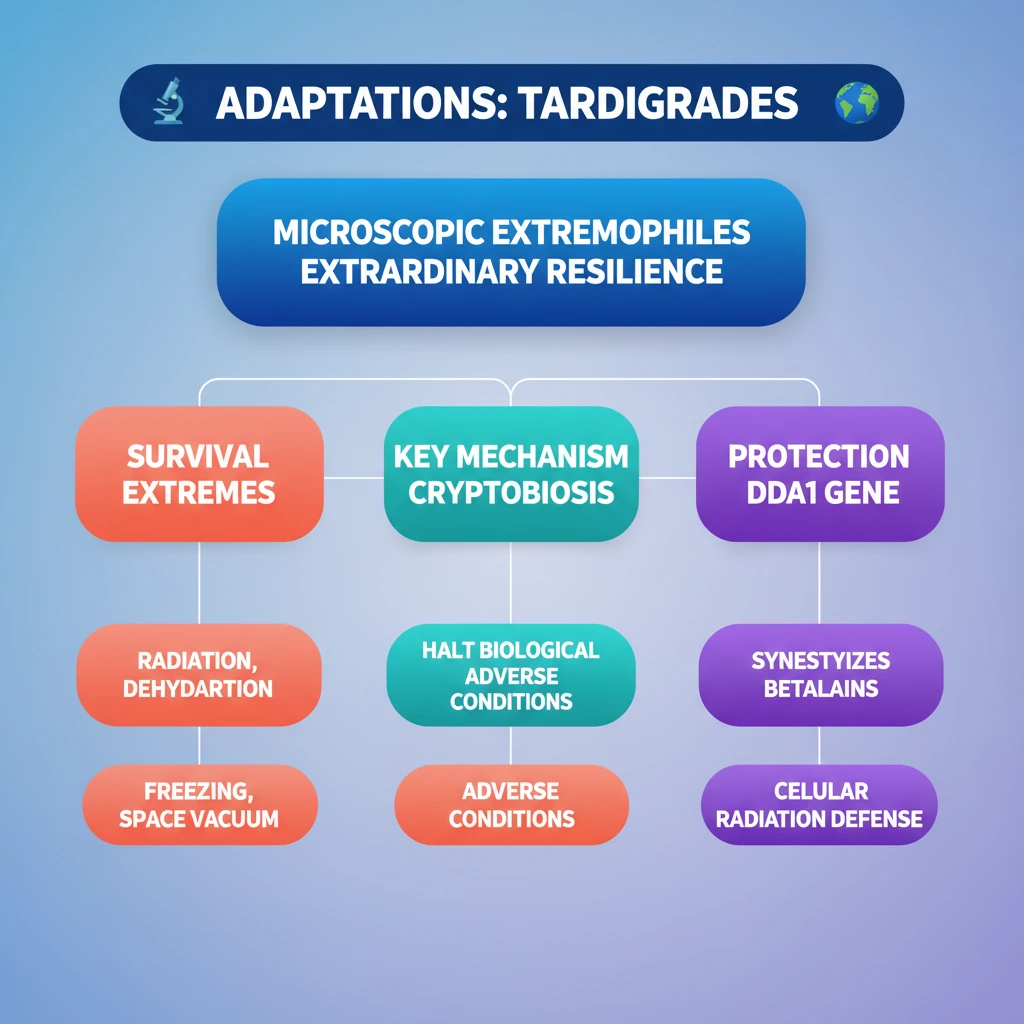
- •Tardigrades ('water bears') are microscopic extremophiles known for extraordinary resilience.
- •They can survive extreme radiation, starvation, lack of oxygen, dehydration, freezing, and even space vacuum.
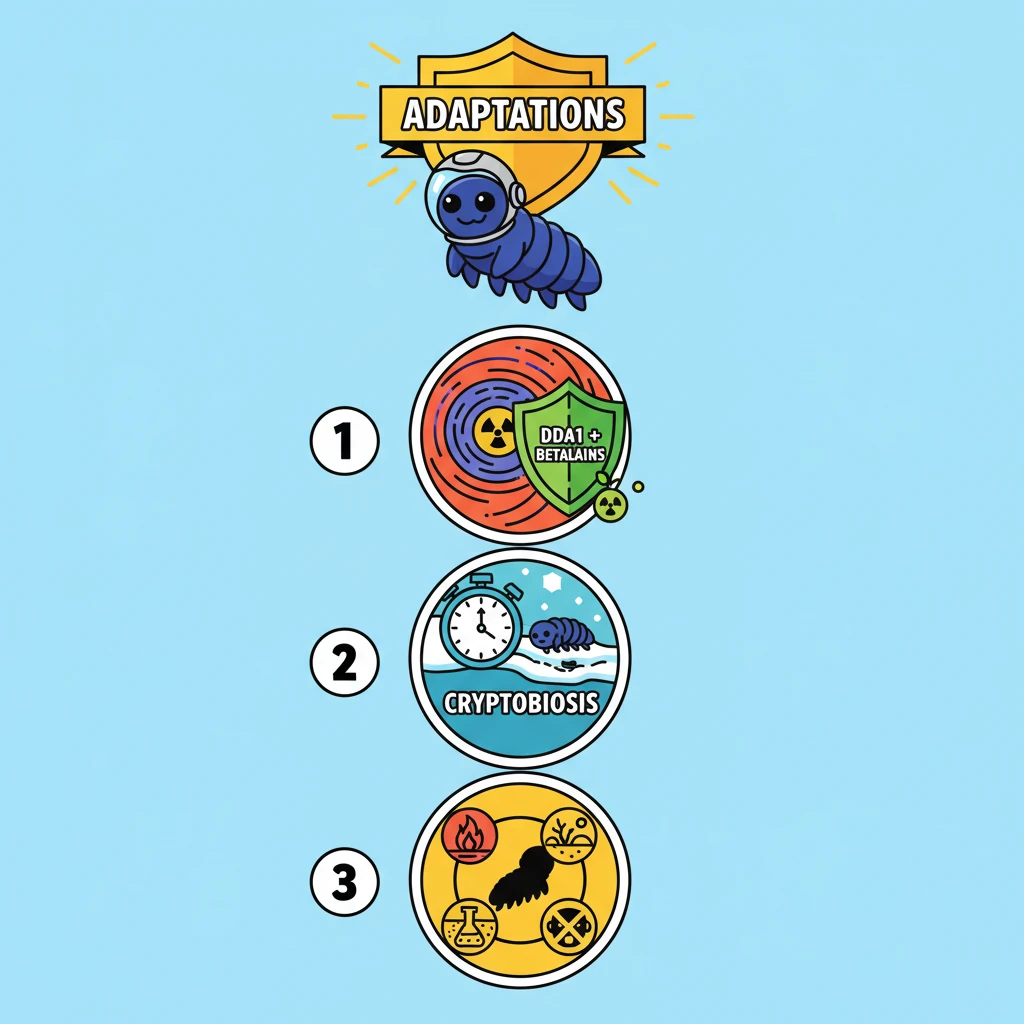
- •Cryptobiosis is a key survival mechanism, allowing them to halt biological activity in adverse conditions.
- •The DDA1 gene helps synthesize betalains (antioxidants) that protect cells from radiation damage.
- •Their properties offer potential applications in medicine (organ preservation), space technology, and radiation protection.
🧠 Memory Techniques
95% Verified Content
📚 Reference Sources
•Scientific literature on Tardigrades and Cryptobiosis (e.g., Nature, PNAS)
•General biology textbooks on adaptations and extremophiles