INDIA’S THREE-STAGE NUCLEAR PROGRAMME - Science And Technology | UPSC Learning
Topics
0 topics • 0 completed
🔍
No topics match your search
INDIA’S THREE-STAGE NUCLEAR PROGRAMME
Medium⏱️ 8 min read
science and technology
📖 Introduction
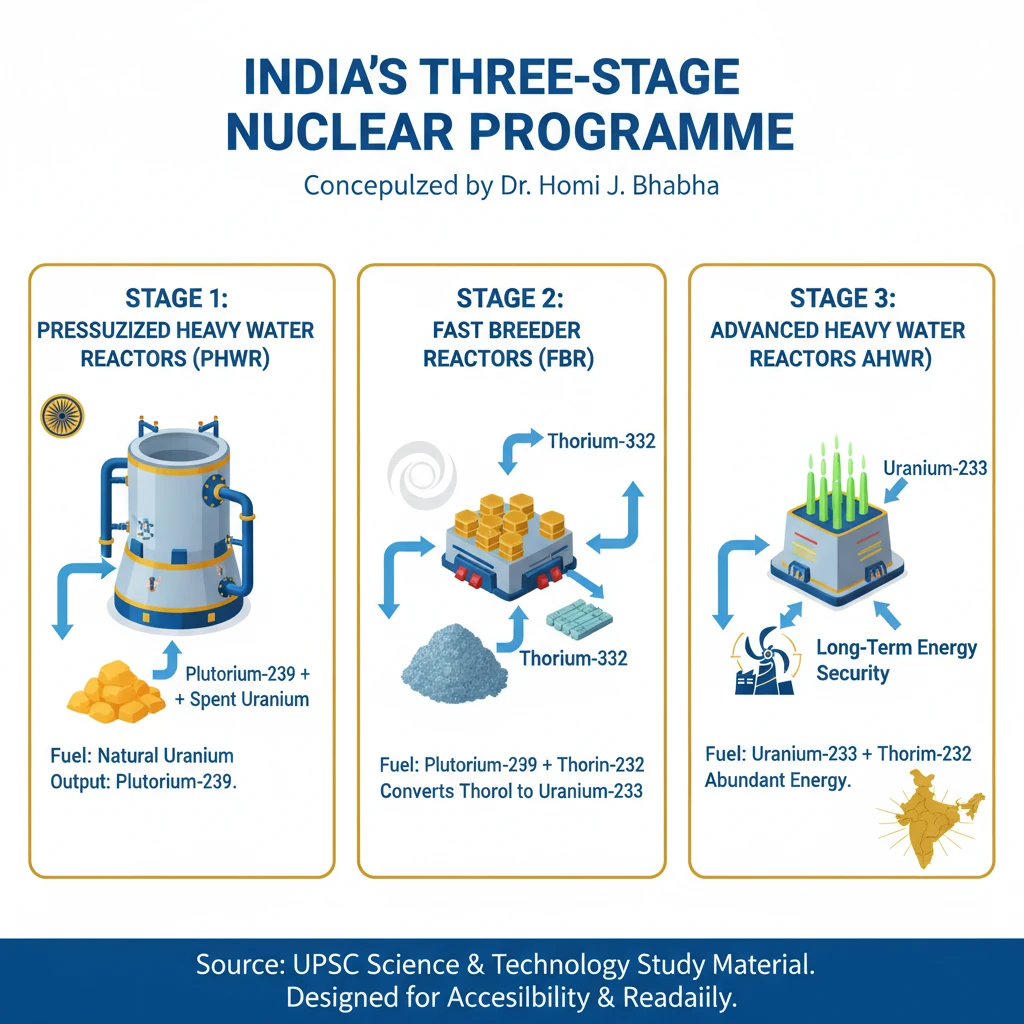
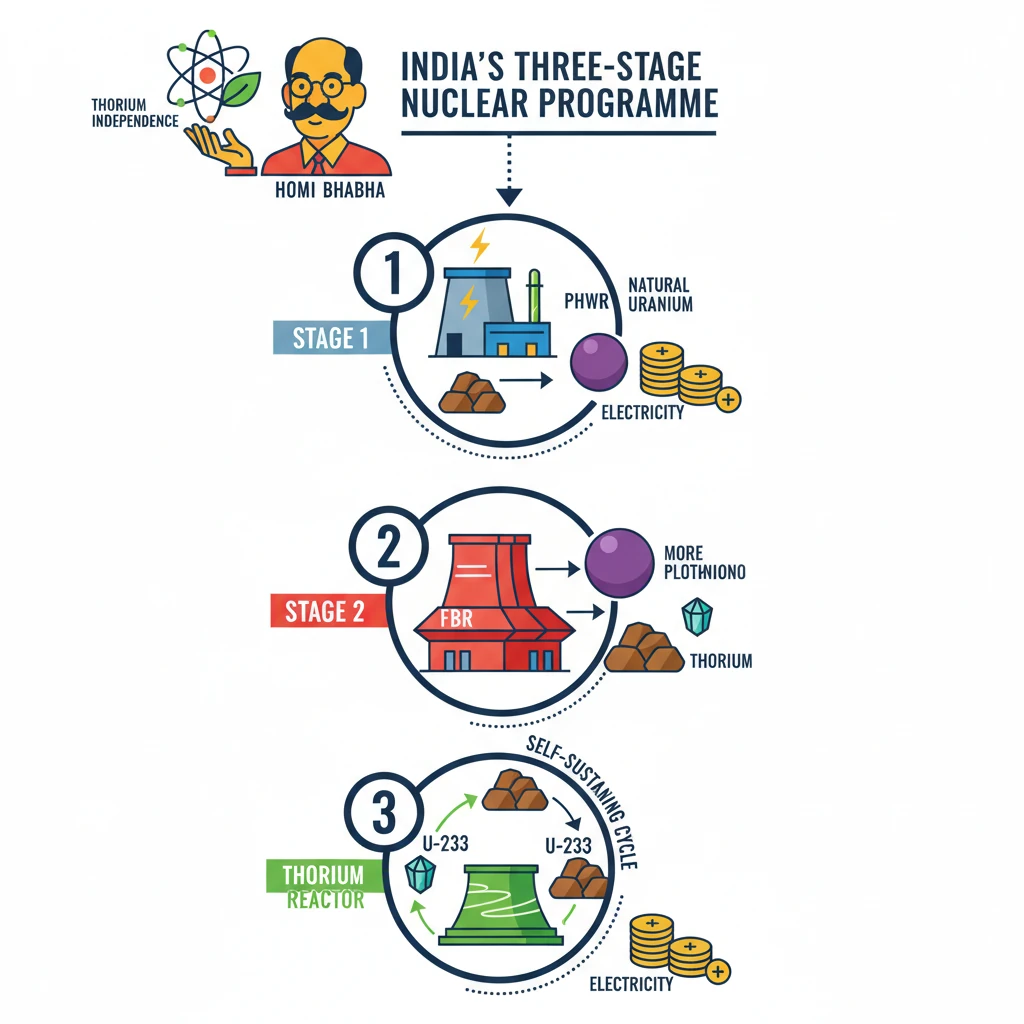
<h4>Introduction to India's Three-Stage Nuclear Programme</h4><p>India's ambitious <strong>Three-Stage Nuclear Power Programme</strong> was conceptualised by Dr. <strong>Homi J. Bhabha</strong>, the architect of India's nuclear energy initiative. This strategic plan was designed to ensure long-term energy security for the nation.</p><p>The programme's design is specifically tailored to India's unique resource profile, which includes limited reserves of <strong>natural uranium</strong> but abundant reserves of <strong>thorium</strong>. The goal is to maximise energy generation from these indigenous resources.</p><div class='key-point-box'><p><strong>Core Objective:</strong> To achieve energy independence and harness India's vast <strong>thorium</strong> reserves through a phased approach, overcoming the scarcity of <strong>uranium</strong>.</p></div><h4>Stage 1: Pressurised Heavy Water Reactors (PHWRs)</h4><p>The first stage of the programme focuses on deploying <strong>Pressurised Heavy Water Reactors (PHWRs)</strong>. These reactors utilise <strong>natural uranium</strong> as fuel and <strong>heavy water</strong> as both moderator and coolant.</p><p>The primary output of these reactors is electricity. A crucial byproduct of this stage is <strong>plutonium-239 (Pu-239)</strong>, which is vital for the subsequent stages of the programme.</p><div class='info-box'><p><strong>Stage 1 Specifications:</strong></p><ul><li><strong>Fuel:</strong> Natural Uranium</li><li><strong>Reactor Type:</strong> Pressurised Heavy Water Reactors (PHWRs)</li><li><strong>Byproduct:</strong> Plutonium-239</li><li><strong>Estimated Capacity:</strong> 10 GWe (Gigawatt-electric) for 40 years</li><li><strong>Capacity Factor:</strong> 0.8 (80%)</li></ul></div><h4>Stage 2: Fast Breeder Reactors (FBRs)</h4><p>The second stage involves the use of <strong>Fast Breeder Reactors (FBRs)</strong>. These reactors are designed to be fuelled by the <strong>plutonium-239</strong> produced in the first stage.</p><p>FBRs have a unique capability: they not only generate electricity but also 'breed' more fissile fuel than they consume. They convert <strong>uranium-238</strong> (depleted uranium from Stage 1) into additional <strong>plutonium-239</strong>.</p><p>During this stage, <strong>thorium</strong> is also introduced into the FBRs. The <strong>thorium</strong> is irradiated and transmuted into <strong>uranium-233 (U-233)</strong>, which is the fissile fuel for the third stage.</p><div class='info-box'><p><strong>Stage 2 Specifications:</strong></p><ul><li><strong>Fuel:</strong> Plutonium-239 (from Stage 1), mixed with natural uranium or depleted uranium</li><li><strong>Reactor Type:</strong> Fast Breeder Reactors (FBRs)</li><li><strong>Key Process:</strong> Breeding of Plutonium-239, conversion of Thorium into U-233</li><li><strong>Estimated Capacity:</strong> 500 GWe for 100 years</li><li><strong>Capacity Factor:</strong> 0.8 (80%)</li></ul></div><h4>Stage 3: Thorium-based Reactors</h4><p>The final and most crucial stage aims to utilise India's vast <strong>thorium</strong> reserves. This stage involves advanced reactors fuelled by <strong>uranium-233 (U-233)</strong>, which is bred from <strong>thorium</strong> in the second stage.</p><p>These reactors will primarily use a mix of <strong>thorium</strong> and <strong>uranium-233</strong> as fuel. The <strong>thorium</strong> in the reactor core will continuously be converted into <strong>uranium-233</strong>, ensuring a sustainable and long-term energy supply.</p><div class='info-box'><p><strong>Stage 3 Specifications:</strong></p><ul><li><strong>Fuel:</strong> Uranium-233 (bred from Thorium)</li><li><strong>Reactor Type:</strong> Advanced Thorium-based Breeder Reactors</li><li><strong>Key Process:</strong> Self-sustaining Thorium-Uranium-233 fuel cycle</li><li><strong>Estimated Capacity:</strong> 500 GWe for 350 years</li><li><strong>Capacity Factor:</strong> 0.8 (80%)</li></ul></div><div class='exam-tip-box'><p><strong>UPSC Insight:</strong> Understanding the interdependencies between the stages is crucial. Each stage provides the fuel for the next, highlighting the long-term vision for energy security and self-reliance. Questions often focus on the rationale and challenges of each stage.</p></div>
💡 Key Takeaways
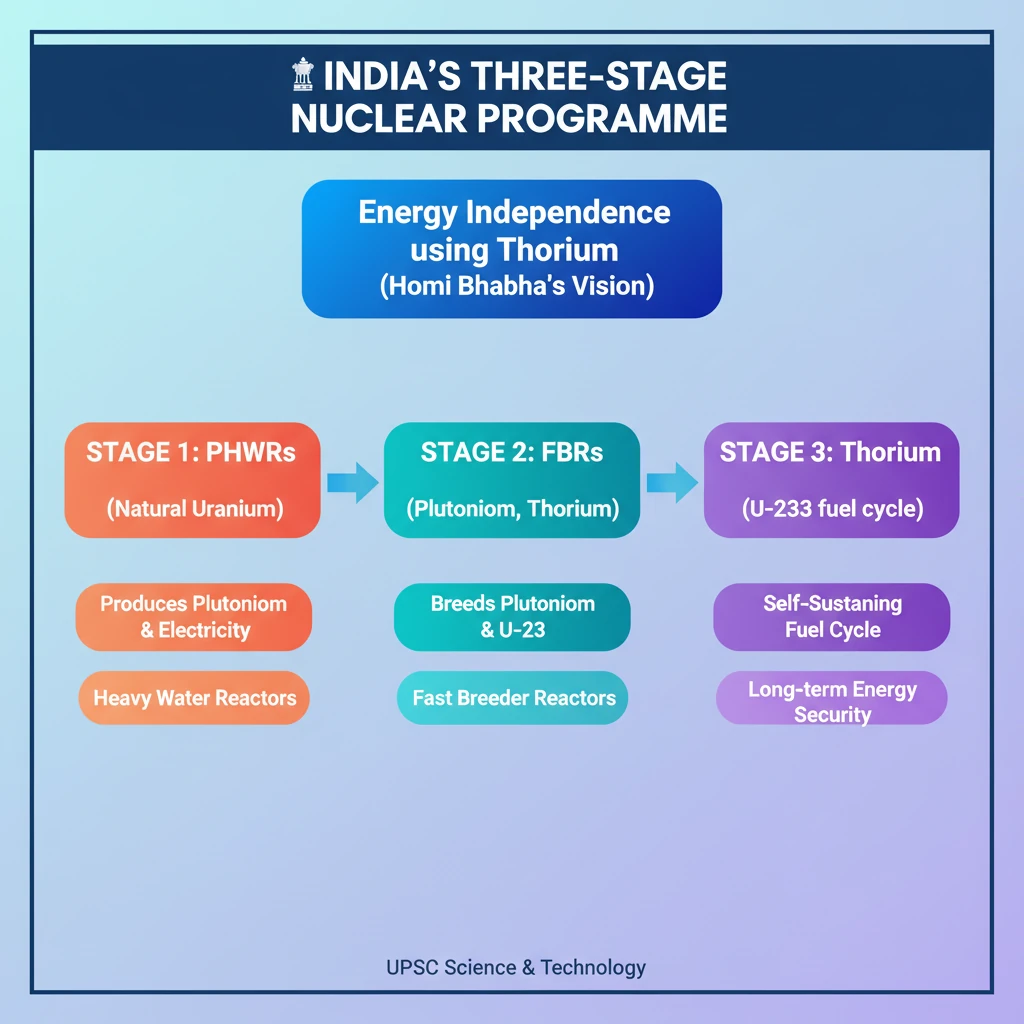
- •India's nuclear program, envisioned by Homi Bhabha, aims for energy independence using indigenous thorium.
- •Stage 1 (PHWRs) uses natural uranium to produce electricity and plutonium.
- •Stage 2 (FBRs) uses plutonium from Stage 1 to breed more plutonium and convert thorium into U-233.
- •Stage 3 (Thorium-based reactors) will use U-233 to achieve a self-sustaining thorium fuel cycle.
- •The program is crucial for India's long-term energy security, climate change goals, and technological self-reliance.
🧠 Memory Techniques
95% Verified Content
📚 Reference Sources
•Department of Atomic Energy (DAE) official reports
•Press Information Bureau (PIB) releases on nuclear energy