What are the Key Features of the Legal Metrology (IST) Rules, 2025? - Science And Technology | UPSC Learning
Topics
0 topics • 0 completed
🔍
No topics match your search
What are the Key Features of the Legal Metrology (IST) Rules, 2025?
Medium⏱️ 8 min read
science and technology
📖 Introduction
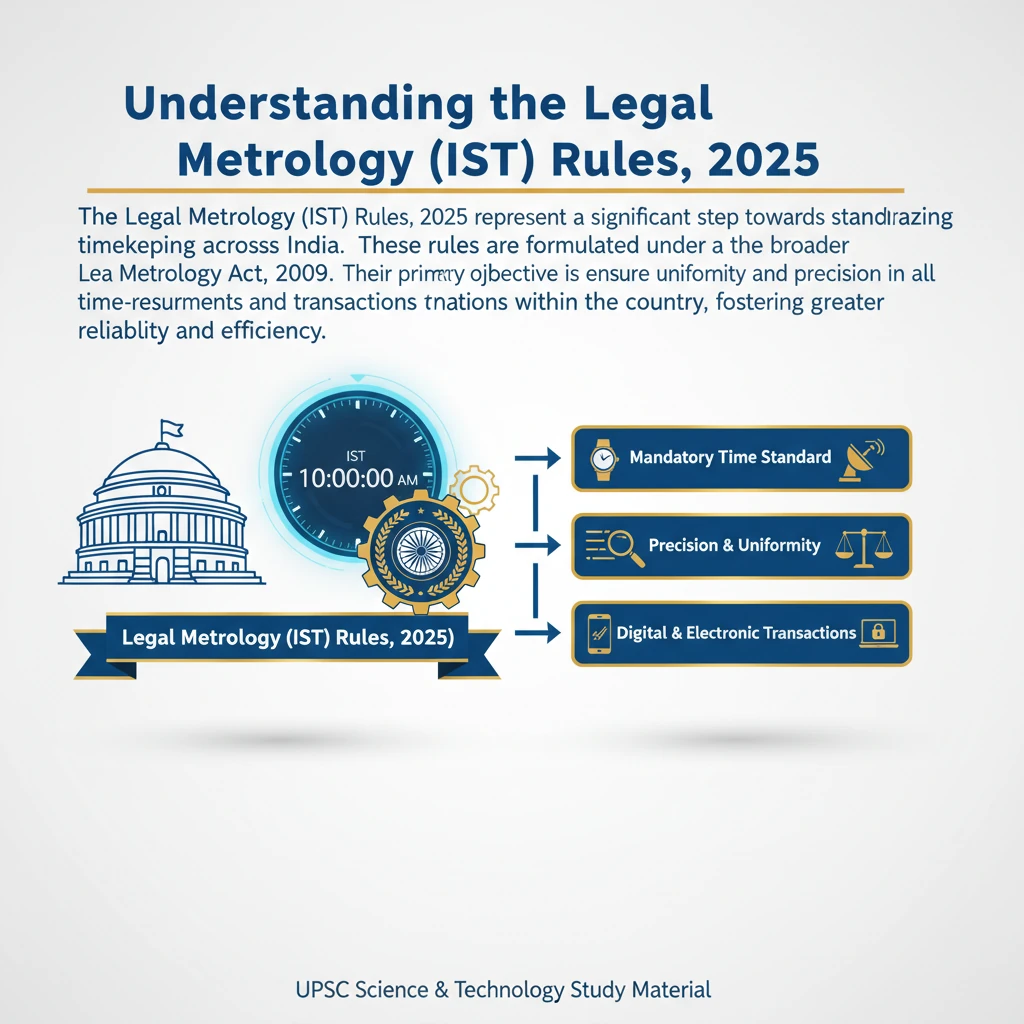
<h4>Understanding the Legal Metrology (IST) Rules, 2025</h4><p>The <strong>Legal Metrology (IST) Rules, 2025</strong> represent a significant step towards standardizing timekeeping across India. These rules are formulated under the broader framework of the <strong>Legal Metrology Act, 2009</strong>.</p><p>Their primary objective is to ensure uniformity and precision in all time-related measurements and transactions within the country, fostering greater reliability and efficiency.</p><h4>Mandatory Adoption of Indian Standard Time (IST)</h4><p>A central feature of the <strong>Legal Metrology (IST) Rules, 2025</strong> is the <strong>mandatory adoption of IST</strong>. This means that <strong>Indian Standard Time</strong> will become the sole legally recognized time standard throughout India for all official, commercial, and scientific purposes.</p><div class='info-box'><p><strong>Indian Standard Time (IST)</strong> is based on a longitude of <strong>82.5° E</strong>, passing near <strong>Mirzapur, Uttar Pradesh</strong>. It is <strong>5 hours and 30 minutes ahead of Coordinated Universal Time (UTC)</strong>.</p></div><h4>Role of CSIR-NPL</h4><p>The rules explicitly state that <strong>IST</strong>, as maintained by the <strong>Council of Scientific and Industrial Research - National Physical Laboratory (CSIR-NPL)</strong>, will be the official benchmark. <strong>CSIR-NPL</strong> is India's national metrology institute, responsible for maintaining and disseminating national standards of measurement.</p><div class='key-point-box'><p><strong>CSIR-NPL's</strong> role is crucial as it ensures the <strong>accuracy, traceability, and reliability</strong> of <strong>IST</strong> through advanced atomic clocks and precise calibration mechanisms.</p></div><h4>Reinforcing "One Nation, One Time"</h4><p>The mandatory adoption of <strong>IST</strong> strongly reinforces the principle of <strong>"One Nation, One Time."</strong> This initiative aims to eliminate any potential ambiguities or discrepancies in timekeeping that could arise from unofficial or localized time standards.</p><div class='exam-tip-box'><p>This concept is vital for national integration and efficient governance. UPSC aspirants should connect it with other 'One Nation' initiatives like <strong>'One Nation, One Ration Card'</strong> or <strong>'One Nation, One Grid'</strong> to demonstrate holistic understanding.</p></div><p>A unified time standard is essential for critical sectors such as transportation, communication, financial markets, and national defense, where synchronized operations are paramount.</p>
💡 Key Takeaways
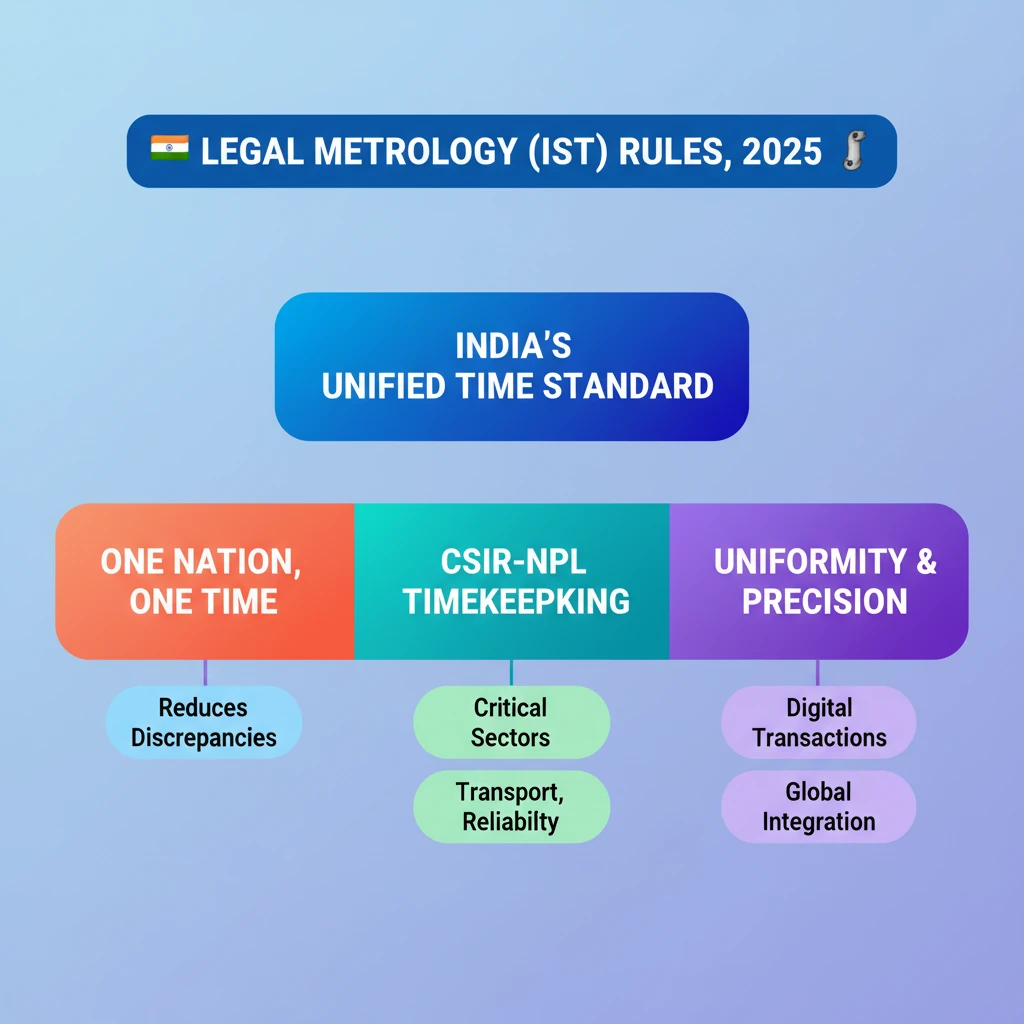
- •The Legal Metrology (IST) Rules, 2025 mandate the adoption of Indian Standard Time (IST) as the sole legal time standard.
- •IST is maintained and disseminated by the CSIR-National Physical Laboratory (CSIR-NPL).
- •The rules reinforce the principle of 'One Nation, One Time', promoting uniformity and precision across India.
- •This standardization is crucial for critical sectors like transportation, finance, digital transactions, and national security.
- •It enhances reliability, reduces discrepancies, and supports India's digital transformation and global integration efforts.
🧠 Memory Techniques

95% Verified Content
📚 Reference Sources
•Legal Metrology Act, 2009 (India)
•CSIR-National Physical Laboratory (NPL) official website
•Ministry of Consumer Affairs, Food & Public Distribution notifications (related to Legal Metrology)