What is the Impact on the Human Body in the ISS ? - Science And Technology | UPSC Learning
Topics
0 topics • 0 completed
🔍
No topics match your search
What is the Impact on the Human Body in the ISS ?
Medium⏱️ 9 min read
science and technology
📖 Introduction
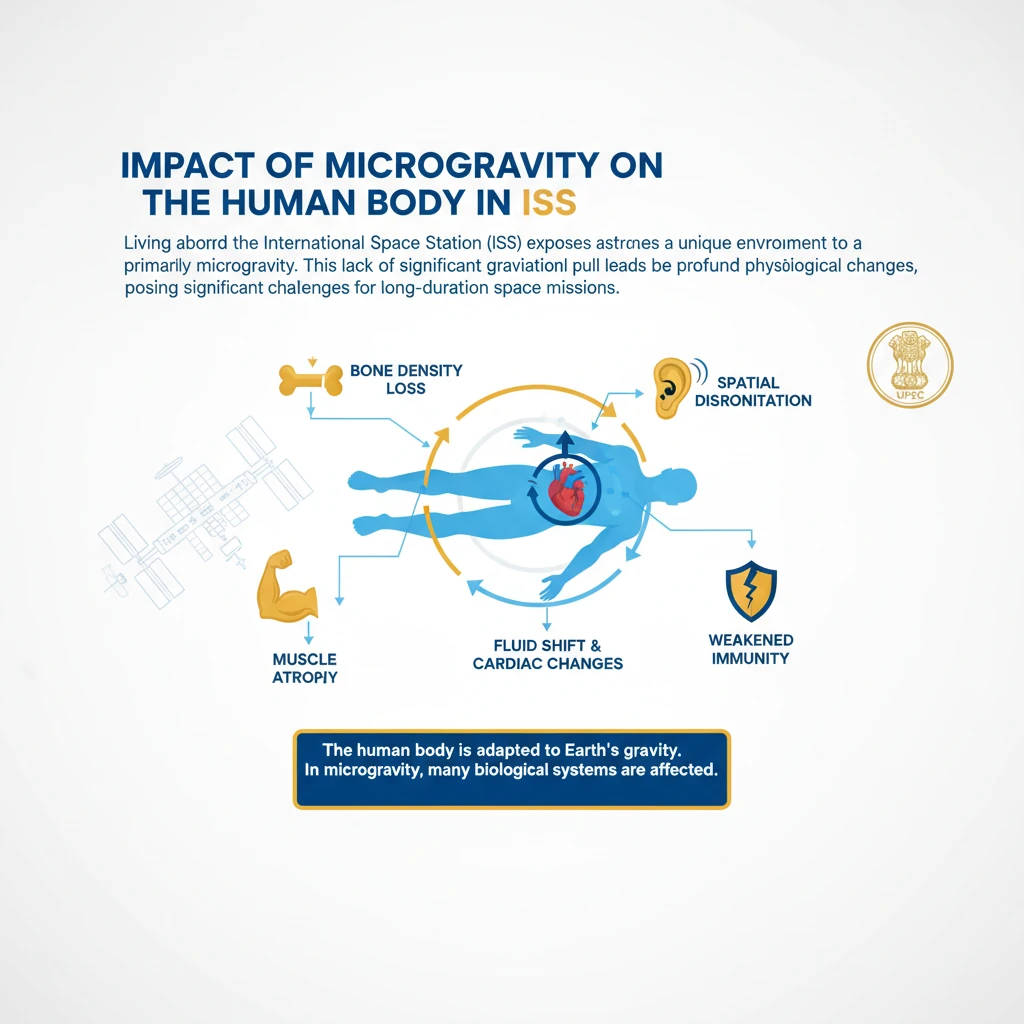
<h4>Impact of Microgravity on the Human Body in ISS</h4><p>Living aboard the <strong>International Space Station (ISS)</strong> exposes astronauts to a unique environment, primarily <strong>microgravity</strong>. This lack of significant gravitational pull leads to profound physiological changes, posing significant challenges for long-duration space missions.</p><div class='key-point-box'><p>The human body is adapted to Earth's gravity. In <strong>microgravity</strong>, many biological systems behave differently, leading to a range of health issues that require continuous monitoring and countermeasures.</p></div><h4>Bone Density Loss</h4><p>One of the most significant impacts is the rapid loss of <strong>bone density</strong>. Without the constant stress of gravity, bones lose minerals, primarily calcium, at an accelerated rate.</p><div class='info-box'><p>Astronauts can lose up to <strong>1% of bone mass per month</strong> while in microgravity. This rate is significantly higher than age-related bone loss on Earth.</p></div><p>This substantial loss increases the risk of developing conditions akin to <strong>osteoporosis</strong> and makes astronauts more susceptible to <strong>fractures</strong>, both during and after their missions.</p><h4>Muscle Atrophy</h4><p>Similar to bones, muscles also suffer in microgravity. The lack of gravitational resistance means muscles are not used as intensely as on Earth, leading to <strong>muscle atrophy</strong>.</p><div class='key-point-box'><p><strong>Muscle mass</strong> and <strong>strength</strong> diminish significantly. This affects not only large skeletal muscles but also muscles vital for posture and movement.</p></div><p>To counteract these effects, astronauts must adhere to rigorous daily <strong>exercise routines</strong>, often involving specialized equipment like treadmills, cycle ergometers, and resistance devices, for several hours each day.</p><h4>Vision Problems: Spaceflight Associated Neuro-ocular Syndrome (SANS)</h4><p>A notable and concerning impact is on vision. In microgravity, fluids in the body tend to shift upwards towards the head, leading to increased <strong>intracranial pressure</strong>.</p><p>This elevated pressure can cause structural changes to the eyes, including flattening of the optic nerve head, choroidal folds, and cotton wool spots, resulting in vision-related issues.</p><div class='info-box'><p>These vision changes are collectively known as <strong>Spaceflight Associated Neuro-ocular Syndrome (SANS)</strong>. It can lead to persistent vision impairment in some astronauts.</p></div><h4>Cardiovascular Changes</h4><p>The cardiovascular system also undergoes significant adaptation. The heart, accustomed to pumping against gravity, changes its workload and structure in space.</p><p>The initial fluid shift to the upper body can make the heart work harder, but over time, the heart can become smaller and less efficient due to reduced demand.</p><div class='key-point-box'><p>The <strong>heart can change shape and size</strong> in microgravity, potentially leading to reduced cardiac output and orthostatic intolerance upon return to Earth's gravity.</p></div><h4>Psychological Effects</h4><p>Beyond physiological changes, the mental well-being of astronauts is also profoundly affected. Extended periods of <strong>isolation</strong> and <strong>confinement</strong> in a small, enclosed environment can take a toll.</p><p>These psychological challenges can manifest as <strong>stress</strong>, <strong>anxiety</strong>, mood disturbances, and even cognitive impairments, impacting mission performance and overall health.</p><div class='exam-tip-box'><p>Understanding these impacts is crucial for UPSC aspirants, especially for <strong>General Studies Paper 3 (Science and Technology)</strong>, as it highlights challenges and solutions in human spaceflight and future exploration missions.</p></div>
💡 Key Takeaways
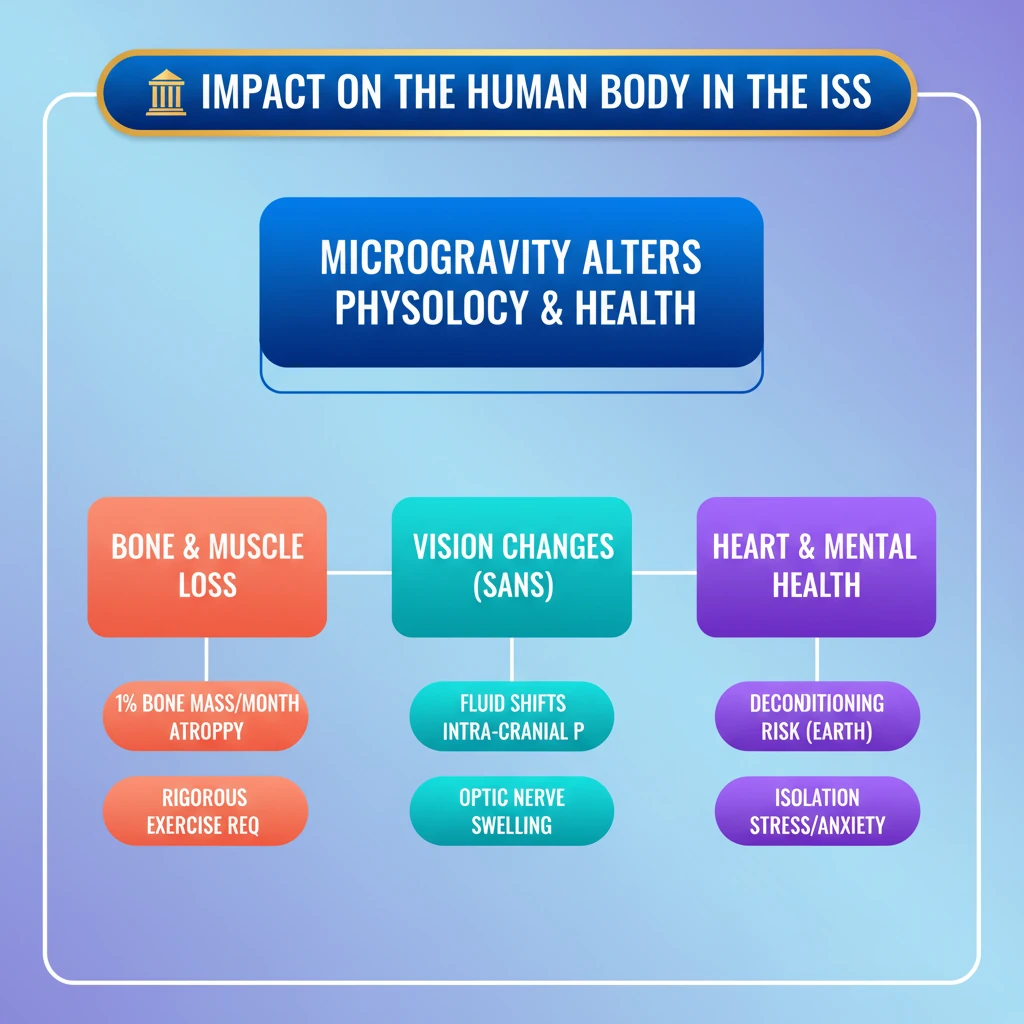
- •Microgravity significantly impacts bone density, muscle mass, vision, cardiovascular health, and psychological well-being.
- •Astronauts can lose up to 1% bone mass/month and experience muscle atrophy, requiring rigorous exercise.
- •Spaceflight Associated Neuro-ocular Syndrome (SANS) causes vision problems due to fluid shifts and increased intracranial pressure.
- •The heart adapts to reduced workload, potentially leading to deconditioning upon return to Earth.
- •Extended isolation and confinement pose significant psychological challenges like stress and anxiety.
- •Effective countermeasures and continuous research are crucial for sustaining long-duration human space missions to the Moon and Mars.
🧠 Memory Techniques

98% Verified Content
📚 Reference Sources
•European Space Agency (ESA) astronaut health and research articles
•Drishti IAS Summary (provided as source content)
•Peer-reviewed scientific literature on space medicine and physiology