Why is the Carbon Footprint of Artificial Intelligence High? - Science And Technology | UPSC Learning
Topics
0 topics • 0 completed
🔍
No topics match your search
Why is the Carbon Footprint of Artificial Intelligence High?
Medium⏱️ 8 min read
science and technology
📖 Introduction
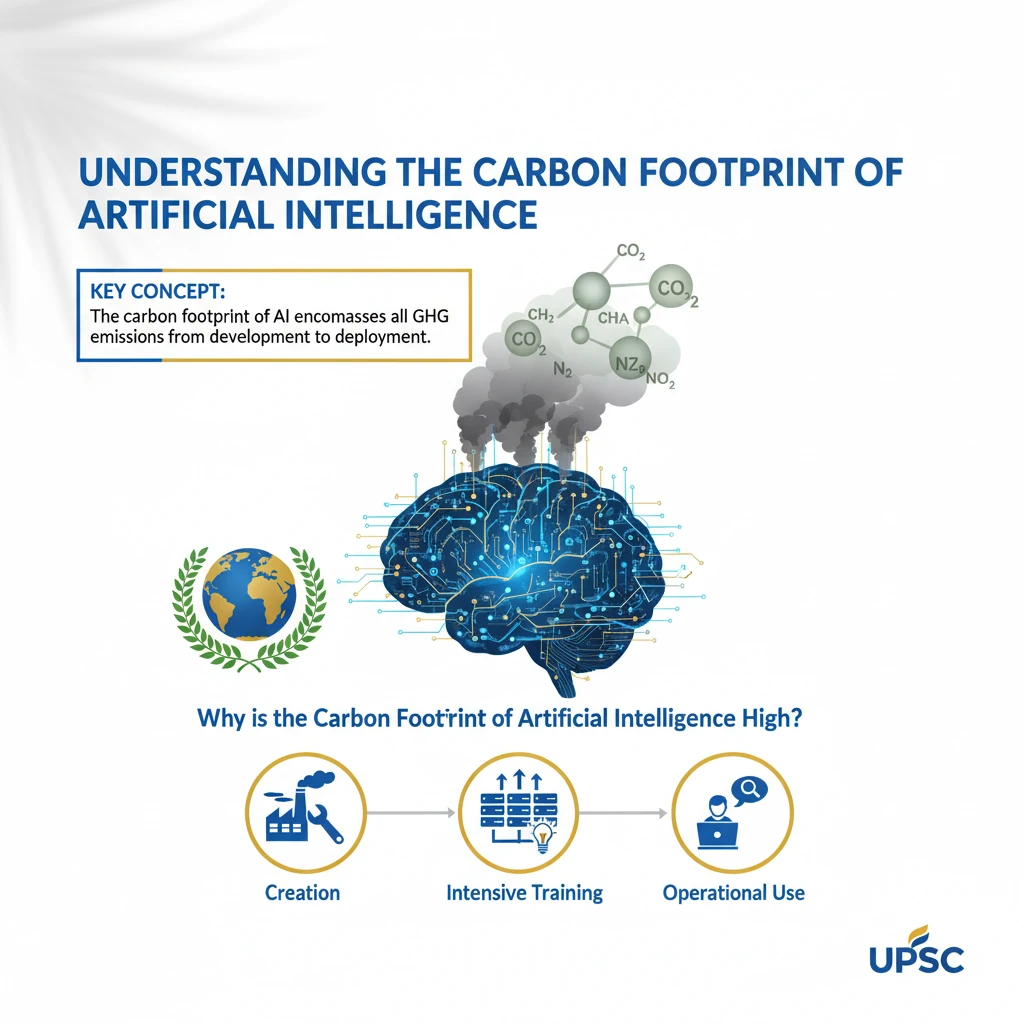
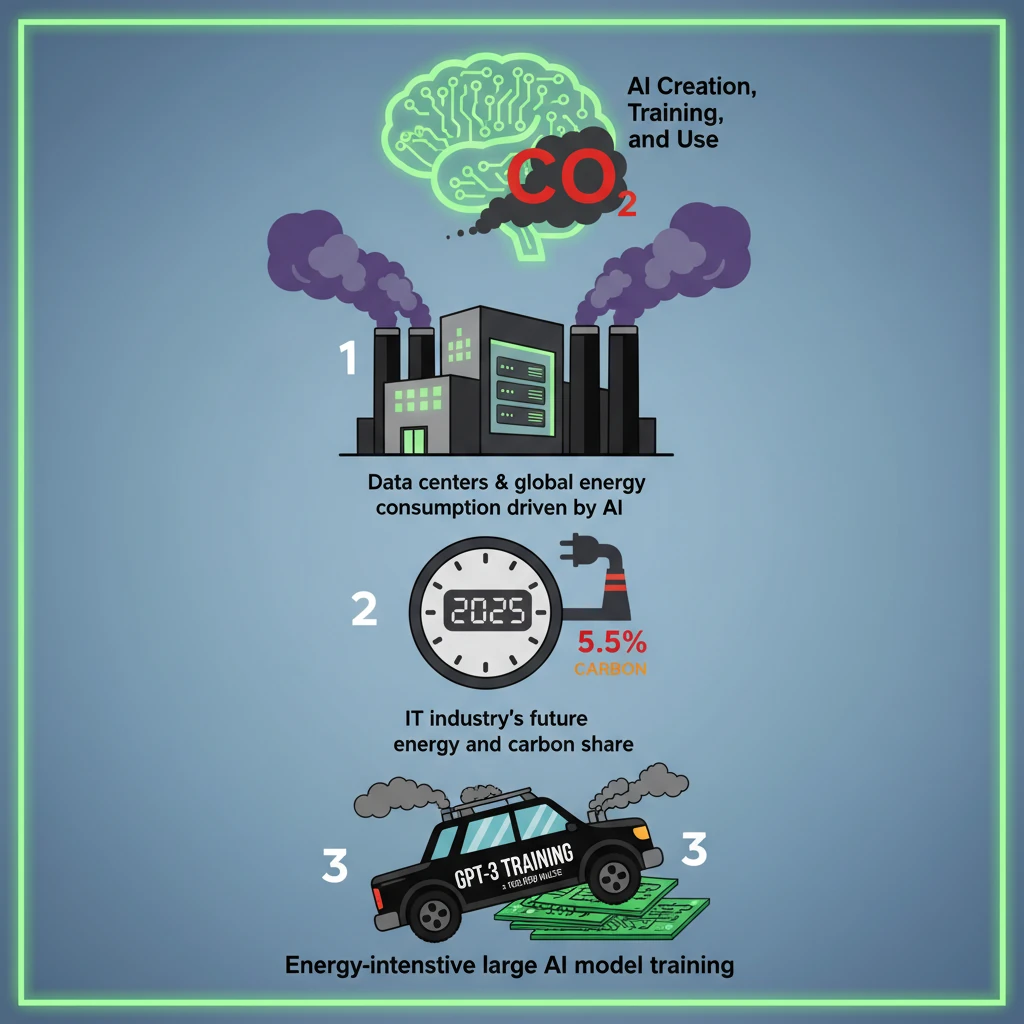
<h4>Understanding the Carbon Footprint of Artificial Intelligence</h4><p>The <strong>carbon footprint of artificial intelligence (AI)</strong> refers to the total amount of <strong>greenhouse gas (GHG) emissions</strong> generated throughout the entire lifecycle of AI systems. This includes their creation, intensive training, and subsequent operational use.</p><div class='key-point-box'><p><strong>Key Concept:</strong> The carbon footprint of AI encompasses all GHG emissions from development to deployment, highlighting its environmental impact.</p></div><h4>Growing Energy Consumption and Data Centres</h4><p>The rapid proliferation of <strong>data centres</strong> is a primary driver behind the increasing energy demands of AI. These facilities are essential for storing, processing, and powering the complex computations required by AI algorithms.</p><p>As the demand for AI technologies continues to surge, so does the energy consumption associated with these data centres globally.</p><div class='info-box'><p><strong>Projected Energy Consumption:</strong> By <strong>2025</strong>, it is estimated that the <strong>Information Technology (IT) industry</strong>, significantly propelled by AI advancements, could consume up to <strong>20% of all electricity produced globally</strong>. This could lead to approximately <strong>5.5% of the world's total carbon emissions</strong>.</p></div><h4>Significant Emissions from AI Model Training</h4><p>Training large and sophisticated <strong>AI models</strong>, such as <strong>Large Language Models (LLMs)</strong> like <strong>GPT-3</strong> and <strong>GPT-4</strong>, is an incredibly energy-intensive process. This training consumes substantial amounts of electricity, leading to considerable <strong>carbon dioxide (CO2) emissions</strong>.</p><p>Research indicates that the energy expended in training a single large AI model can result in CO2 emissions equivalent to those produced by several cars over their entire lifetimes.</p><div class='info-box'><p><strong>Example: GPT-3 Emissions:</strong> The training and operation of <strong>GPT-3</strong> alone are estimated to emit approximately <strong>8.4 tonnes of CO2 annually</strong>.</p></div><p>Since the beginning of the <strong>AI boom in the early 2010s</strong>, the energy requirements for training advanced AI systems, particularly large language models (the technology underpinning platforms like <strong>ChatGPT</strong>), have escalated dramatically.</p><div class='info-box'><p><strong>Energy Requirement Surge:</strong> The energy demand for AI systems has increased by an astonishing <strong>factor of 300,000</strong> since the early 2010s.</p></div><div class='exam-tip-box'><p><strong>UPSC Insight:</strong> Understanding the specific factors contributing to AI's carbon footprint (data centres, training intensity) is crucial for questions on <strong>sustainable technology</strong> and <strong>environmental impact</strong> in GS-III.</p></div>
💡 Key Takeaways
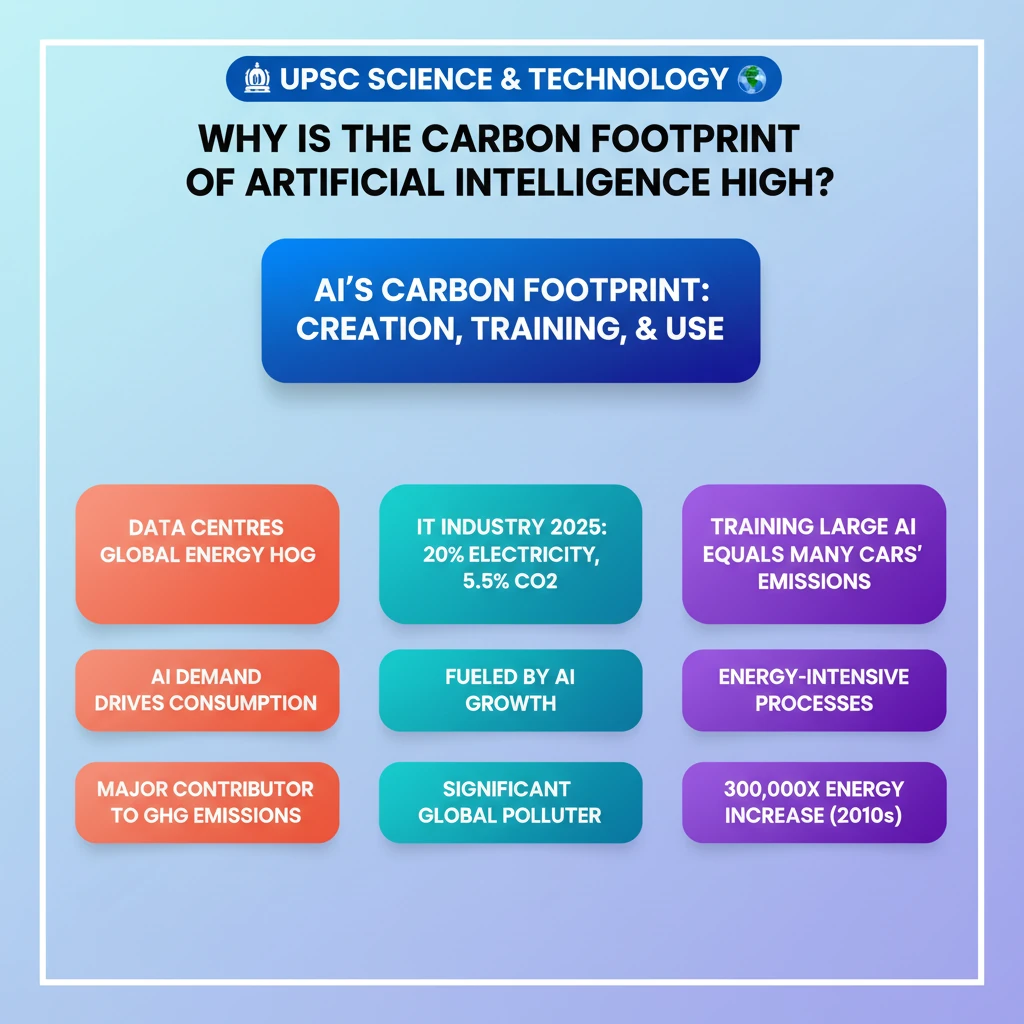
- •AI's carbon footprint includes all GHG emissions from its creation, training, and use.
- •Data centres, driven by AI demand, are major contributors to global energy consumption.
- •By 2025, the IT industry (fueled by AI) could consume 20% of global electricity and emit 5.5% of carbon.
- •Training large AI models (like GPT-3) is extremely energy-intensive, emitting CO2 equivalent to multiple cars' lifetimes.
- •AI energy requirements have increased 300,000-fold since the early 2010s AI boom.
🧠 Memory Techniques
95% Verified Content
📚 Reference Sources
•Academic research papers on AI energy consumption and carbon emissions (e.g., publications by Emma Strubell et al. on NLP's carbon footprint, OpenAI's GPT-3 details)
•Reports from organizations like the International Energy Agency (IEA) on data centre energy use.