West Nile Fever - Science And Technology | UPSC Learning
Topics
0 topics • 0 completed
🔍
No topics match your search
West Nile Fever
Medium⏱️ 12 min read
science and technology
📖 Introduction
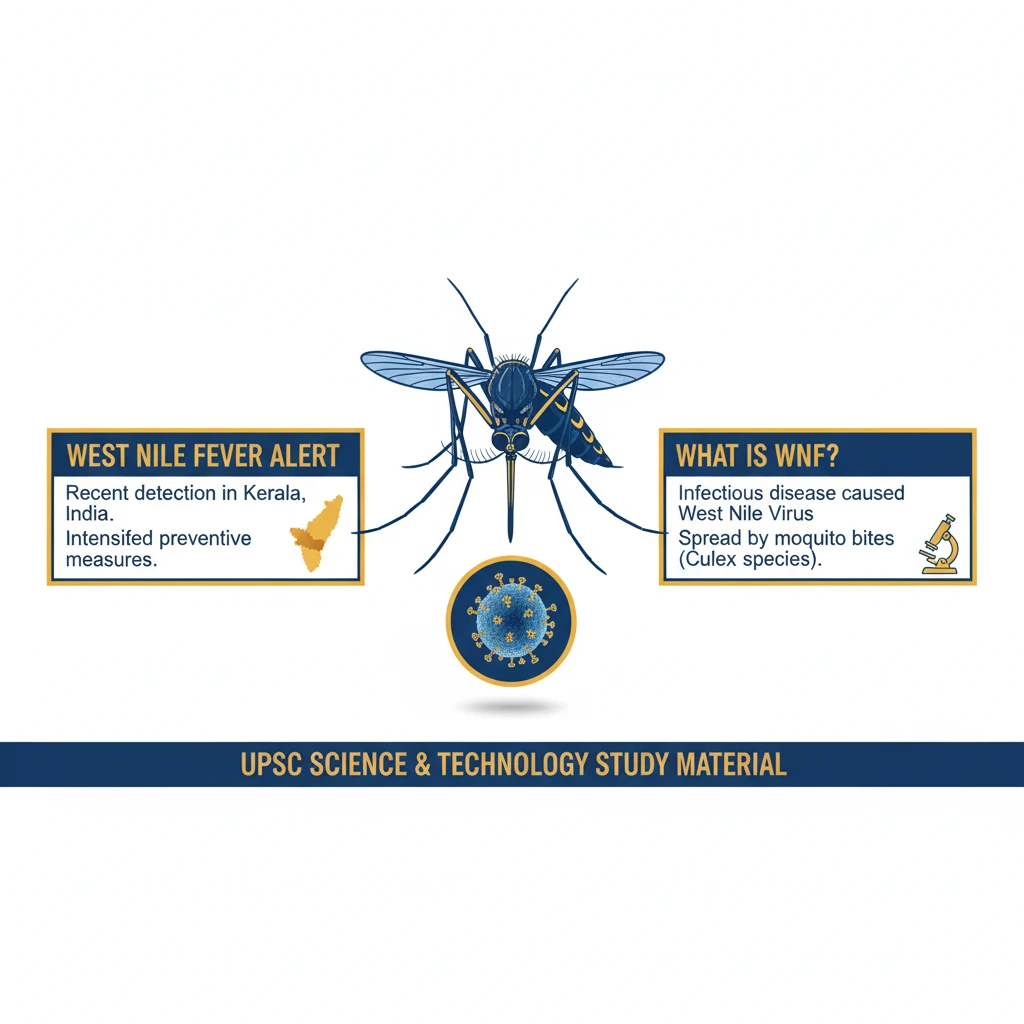
<h4>Introduction: West Nile Fever Alert</h4><p>The recent detection of <strong>West Nile fever</strong> in three districts of <strong>Kerala</strong> has prompted health authorities to issue alerts. This situation necessitates intensified preventive measures to control its spread.</p><p>Such outbreaks highlight the continuous public health challenges posed by vector-borne diseases in India.</p><h4>What is West Nile Fever?</h4><p><strong>West Nile Fever (WNF)</strong> is an infectious disease caused by the <strong>West Nile virus (WNV)</strong>. This virus is a <strong>single-stranded RNA virus</strong>, belonging to the <strong>Flaviviridae family</strong> and the <strong>Flavivirus genus</strong>.</p><div class='info-box'><p><strong>Virus Classification:</strong></p><ul><li><strong>Family:</strong> Flaviviridae</li><li><strong>Genus:</strong> Flavivirus</li><li><strong>Type:</strong> Single-stranded RNA virus</li></ul></div><p>The virus is primarily transmitted to humans through the bite of an infected mosquito. <strong>Mosquitoes</strong> of the genus <strong>Culex</strong> are generally considered the principal vectors of WNV.</p><div class='key-point-box'><p><strong>Key Concept: Reservoir Hosts</strong></p><p><strong>Birds</strong> serve as the primary <strong>reservoir hosts</strong> for the West Nile virus. Mosquitoes become infected when they feed on infected birds.</p></div><p>WNV is commonly found across various continents, including <strong>Africa</strong>, <strong>Europe</strong>, the <strong>Middle East</strong>, <strong>North America</strong>, and <strong>West Asia</strong>.</p><h4>Historical Discovery of WNV</h4><p>The <strong>West Nile virus</strong> was first isolated in a woman in the <strong>West Nile district of Uganda</strong> in <strong>1937</strong>. Its presence in birds was identified later, in the <strong>Nile Delta region</strong> in <strong>1953</strong>, according to the <strong>World Health Organization (WHO)</strong>.</p><h4>Transmission Routes</h4><p>The primary mode of transmission is through infected <strong>mosquitoes</strong>. These insects acquire the virus from infected birds and then transmit it to humans and other animals via their bites.</p><p>Transmission can also occur through contact with other infected animals, their blood, or other tissues. This highlights the zoonotic nature of the disease.</p><div class='info-box'><p><strong>Rare Transmission Routes:</strong></p><ul><li><strong>Organ transplant</strong></li><li><strong>Blood transfusions</strong></li><li><strong>Transplacental transmission</strong> (from mother to child)</li></ul></div><p>It is important to note that <strong>no human-to-human transmission</strong> of WNV through casual contact has been documented. This differentiates it from many other viral diseases.</p><h4>Symptoms of West Nile Fever</h4><p>A significant proportion of infected individuals, about <strong>80% of cases</strong>, remain <strong>asymptomatic</strong>, meaning they show no symptoms. This makes tracking and control challenging.</p><p>For those who develop symptoms, common manifestations of <strong>West Nile fever</strong> include <strong>fever</strong>, <strong>headache</strong>, <strong>tiredness</strong>, <strong>body aches</strong>, <strong>nausea</strong>, <strong>vomiting</strong>, and a characteristic <strong>skin rash</strong>.</p><p>In severe cases, the virus can lead to <strong>neurological symptoms</strong>, indicating a more serious infection affecting the central nervous system. These can include <strong>neck stiffness</strong>, <strong>stupor</strong>, <strong>coma</strong>, <strong>tremors</strong>, <strong>convulsions</strong>, <strong>muscle weakness</strong>, and even <strong>paralysis</strong>.</p><h4>Treatment and Prevention</h4><p>Currently, <strong>no specific vaccine is available for humans</strong> to prevent West Nile fever. Treatment primarily focuses on supportive care.</p><p>For individuals with <strong>neuro-invasive cases</strong>, supportive care involves <strong>hospitalization</strong>, administration of <strong>intravenous fluids</strong>, and necessary <strong>respiratory support</strong> to manage severe symptoms and complications.</p><div class='exam-tip-box'><p><strong>UPSC Insight: Public Health Preparedness</strong></p><p>The lack of a human vaccine for WNV underscores the importance of strong public health infrastructure, vector control programs, and early detection systems for managing outbreaks of such diseases. This is relevant for <strong>GS Paper 2 (Health)</strong>.</p></div>
💡 Key Takeaways
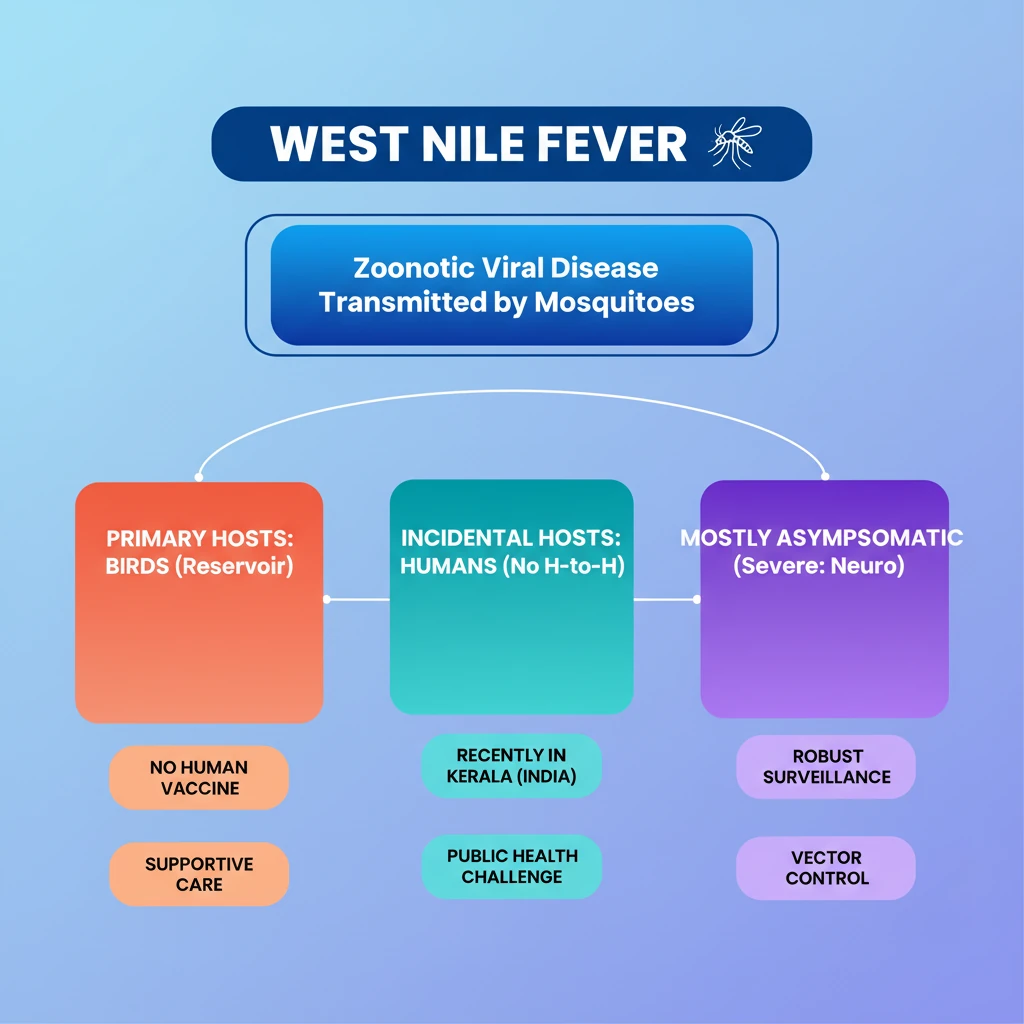
- •West Nile Fever (WNF) is a zoonotic viral disease caused by West Nile virus (WNV), primarily transmitted by Culex mosquitoes.
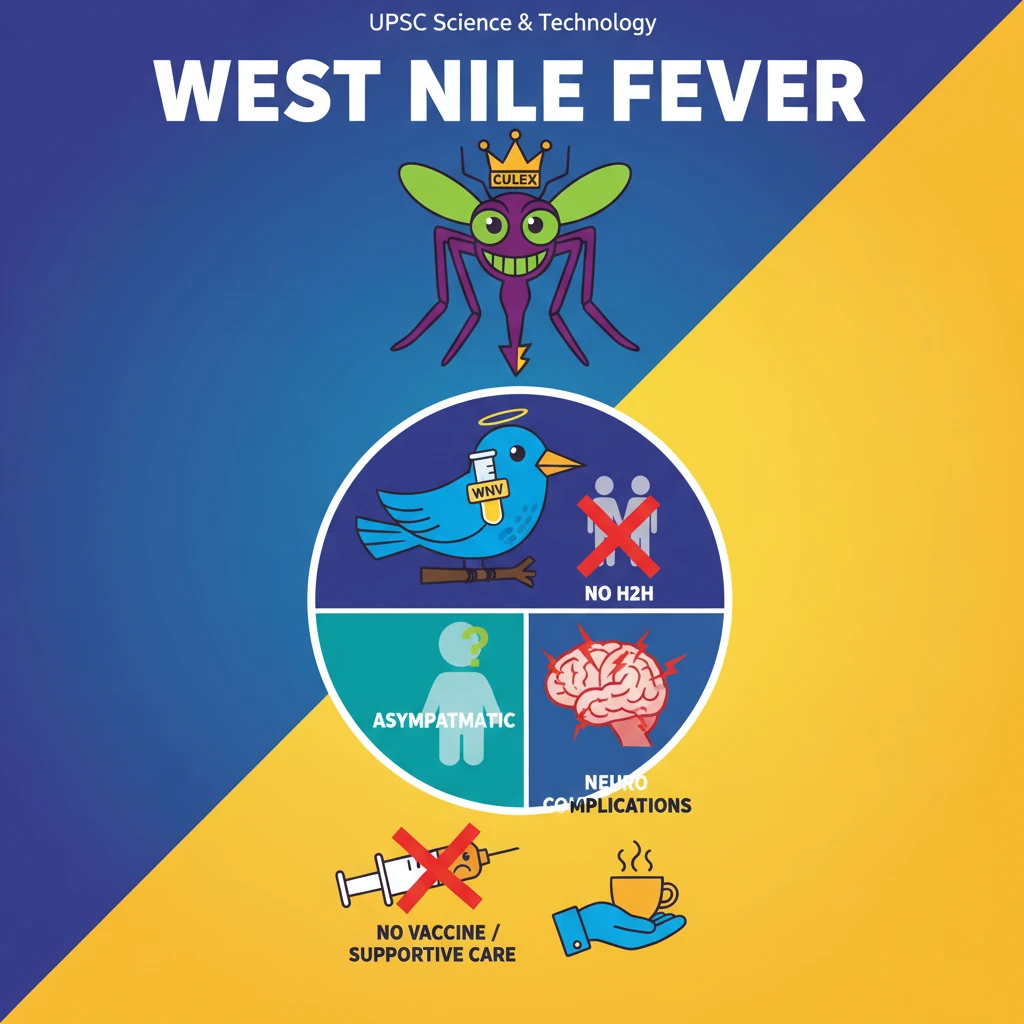
- •Birds are the reservoir hosts; humans are incidental hosts. No human-to-human transmission via casual contact.
- •Most WNF cases are asymptomatic; severe cases can lead to neurological complications.
- •No human vaccine is currently available; treatment is supportive care.
- •Recent detection in Kerala highlights ongoing public health challenges and the need for robust surveillance and vector control.
- •Challenges in vaccine development (e.g., HIV) underscore the complexity of viral mutation and immune evasion.
🧠 Memory Techniques
95% Verified Content
📚 Reference Sources
•World Health Organization (WHO) fact sheets on West Nile Virus
•Centers for Disease Control and Prevention (CDC) information on West Nile Virus
•National Vector Borne Disease Control Programme (NVBDCP), India