Nitrogen Use Efficiency and Biofortification - Science And Technology | UPSC Learning
Topics
0 topics • 0 completed
🔍
No topics match your search
Nitrogen Use Efficiency and Biofortification
Medium⏱️ 8 min read
science and technology
📖 Introduction
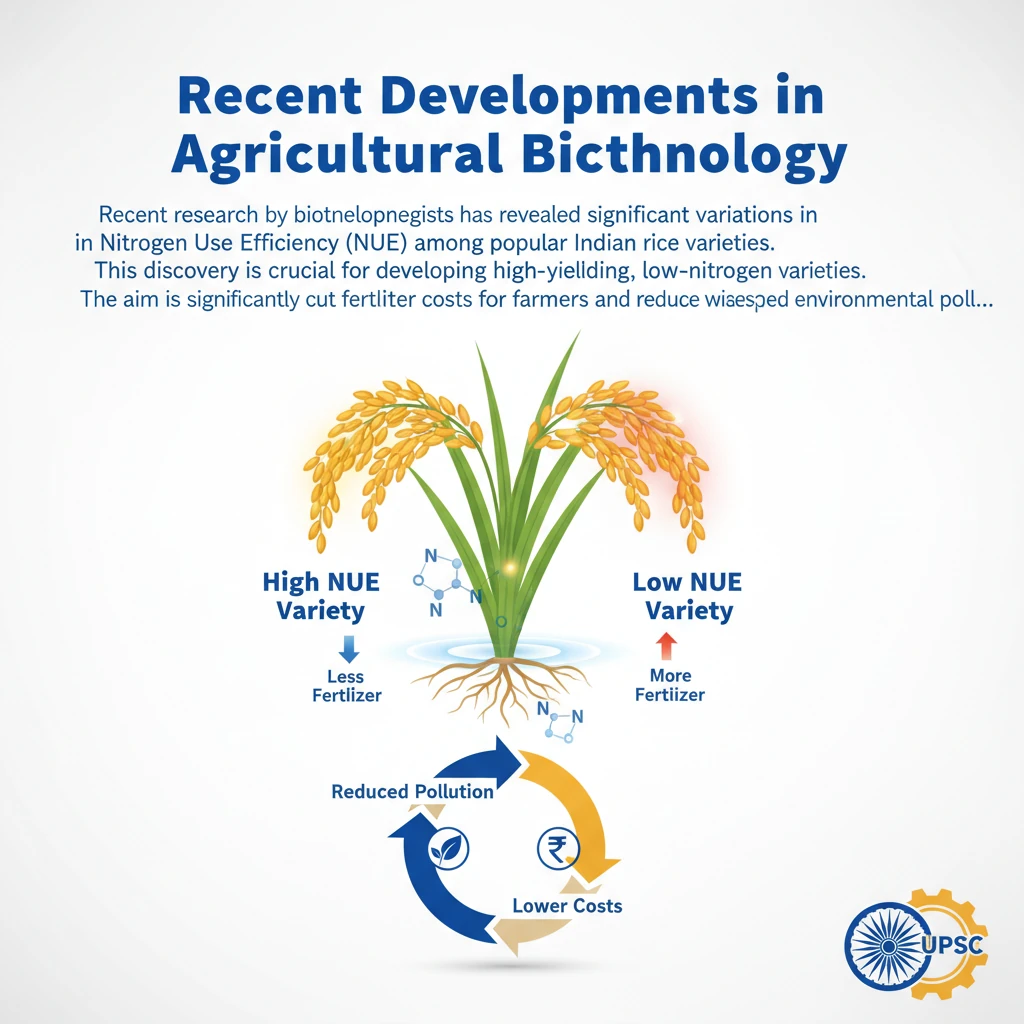
<h4>Recent Developments in Agricultural Biotechnology</h4><p>Recent research by <strong>biotechnologists</strong> has revealed significant variations in <strong>Nitrogen Use Efficiency (NUE)</strong> among popular <strong>Indian rice varieties</strong>. This discovery is crucial for developing <strong>high-yielding</strong>, <strong>low-nitrogen varieties</strong>.</p><p>The aim is to significantly cut <strong>fertiliser costs</strong> for farmers and reduce widespread <strong>environmental pollution</strong> caused by nitrogenous fertilisers. The most efficient rice varieties demonstrated a <strong>NUE</strong> five times higher than the least efficient ones.</p><div class='exam-tip-box'><p>This finding is highly relevant for <strong>UPSC GS-III (Agriculture, Environment)</strong>, particularly concerning sustainable farming practices and reducing agricultural pollution.</p></div><p>In a separate, but related, development, the <strong>Prime Minister of India</strong> launched <strong>109 high-yielding</strong>, <strong>climate-resilient</strong>, <strong>biofortified seed varieties</strong>. These varieties were developed by the <strong>Indian Council of Agricultural Research (ICAR)</strong>.</p><p>The initiative aims to boost overall <strong>farm productivity</strong> and directly enhance <strong>farmers’ incomes</strong>, contributing to agricultural sustainability and food security.</p><h4>Understanding Nitrogen Use Efficiency (NUE)</h4><p><strong>Nitrogen Use Efficiency (NUE)</strong> describes a plant's effectiveness in utilizing applied or fixed nitrogen for its growth and <strong>biomass production</strong>. It is a critical metric in modern agriculture.</p><div class='info-box'><p><strong>Definition:</strong> <strong>NUE</strong> is the ratio between <strong>crop yield</strong> and the amount of <strong>nitrogen absorbed</strong> by the plant. This nitrogen can be absorbed from the <strong>soil</strong> through roots or from the <strong>atmosphere</strong> through biological <strong>fixation by bacteria</strong>.</p></div><p>For sustainable agriculture, <strong>NUE</strong> is a particularly vital factor in <strong>cereals</strong>, especially <strong>rice</strong>. Improving NUE in these staple crops can have a profound impact on global food systems.</p><h4>Concerns Regarding Poor Nitrogen Use Efficiency (NUE)</h4><p>The current low <strong>NUE</strong> in agricultural practices presents several significant challenges, impacting both economic stability and environmental health.</p><ul><li><strong>Economic Waste:</strong> Poor <strong>NUE</strong> leads to the wastage of <strong>Nitrogen fertilisers</strong>. This amounts to approximately <strong>Rs 1 lakh crore</strong> annually in India and over <strong>USD 170 billion</strong> globally.</li><li><strong>Air Pollution:</strong> <strong>Nitrogen fertilisers</strong> are a primary source of <strong>nitrous oxide (N₂O)</strong> and <strong>ammonia pollution</strong> in the air. These gases contribute to respiratory issues and environmental degradation.</li><li><strong>Water Pollution:</strong> The overuse of fertilisers results in <strong>nitrate/ammonium pollution</strong> of water bodies. This impacts aquatic ecosystems and human health.</li><li><strong>Climate Change:</strong> <strong>Nitrous oxide (N₂O)</strong> is a potent <strong>greenhouse gas</strong>, heating the atmosphere far more effectively than <strong>carbon dioxide</strong>. Its emissions significantly contribute to <strong>climate change</strong>.</li></ul><div class='key-point-box'><p><strong>India's Contribution:</strong> <strong>India</strong> is the <strong>world’s second-largest source</strong> of <strong>nitrous oxide (N₂O)</strong> emissions. In <strong>2020</strong>, nearly <strong>11%</strong> of global man-made <strong>N₂O emissions</strong> originated from India, trailing only <strong>China (16%)</strong>. The major source of these emissions is <strong>fertiliser usage</strong>.</p></div>
💡 Key Takeaways
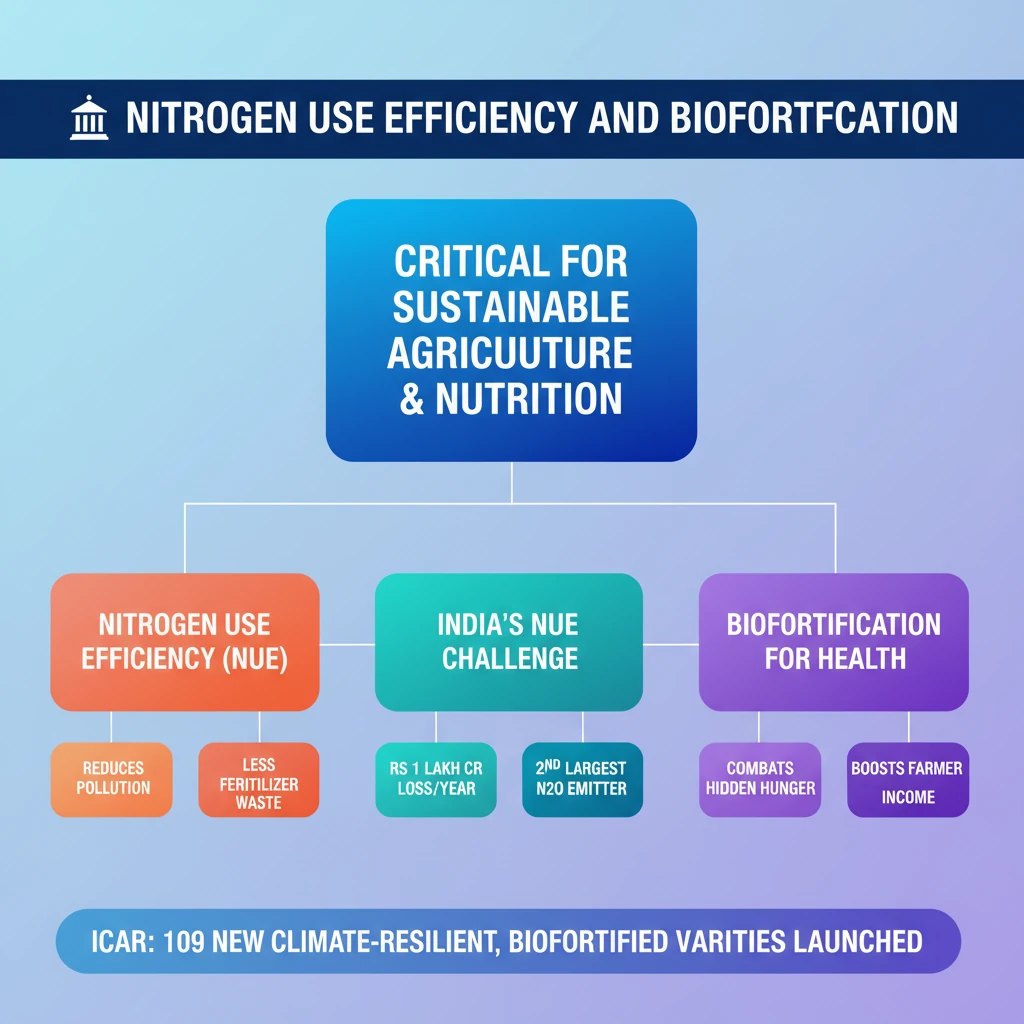
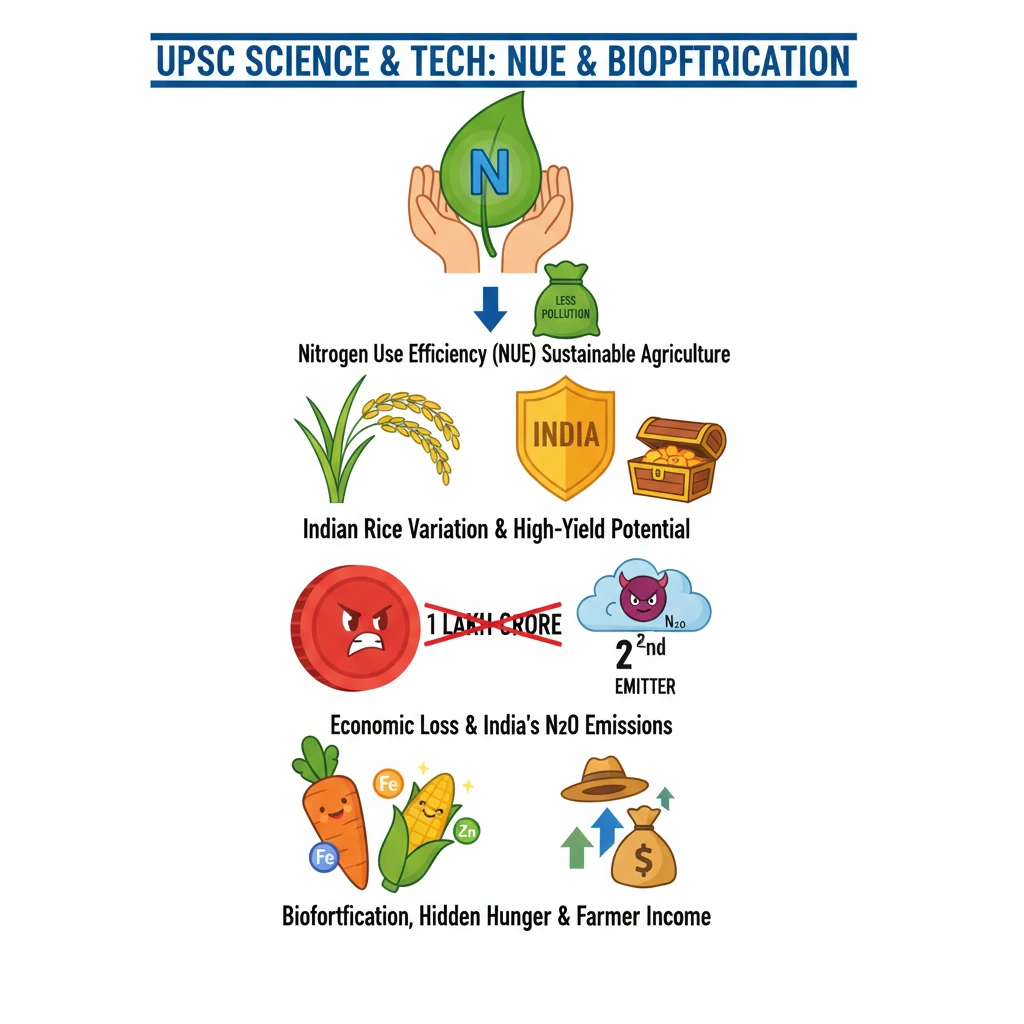
- •Nitrogen Use Efficiency (NUE) is critical for sustainable agriculture, reducing fertilizer waste and pollution.
- •Indian rice varieties show significant NUE variation, offering potential for developing low-nitrogen, high-yielding crops.
- •Poor NUE in India leads to substantial economic loss (Rs 1 lakh crore/year) and makes India the second-largest N2O emitter globally.
- •Biofortification involves enhancing crop nutritional value, addressing hidden hunger and boosting farmer income.
- •ICAR launched 109 high-yielding, climate-resilient, biofortified seed varieties to improve farm productivity and nutrition.
- •Both NUE improvement and biofortification are vital for India's food security, public health, and climate change mitigation goals.
🧠 Memory Techniques
95% Verified Content
📚 Reference Sources
•Indian Council of Agricultural Research (ICAR) official reports (general knowledge)
•Government of India reports on agricultural policy and climate change (general knowledge)