India Eliminates Trachoma as a Public Health Problem - Science And Technology | UPSC Learning
Topics
0 topics • 0 completed
🔍
No topics match your search
India Eliminates Trachoma as a Public Health Problem
Medium⏱️ 7 min read
science and technology
📖 Introduction
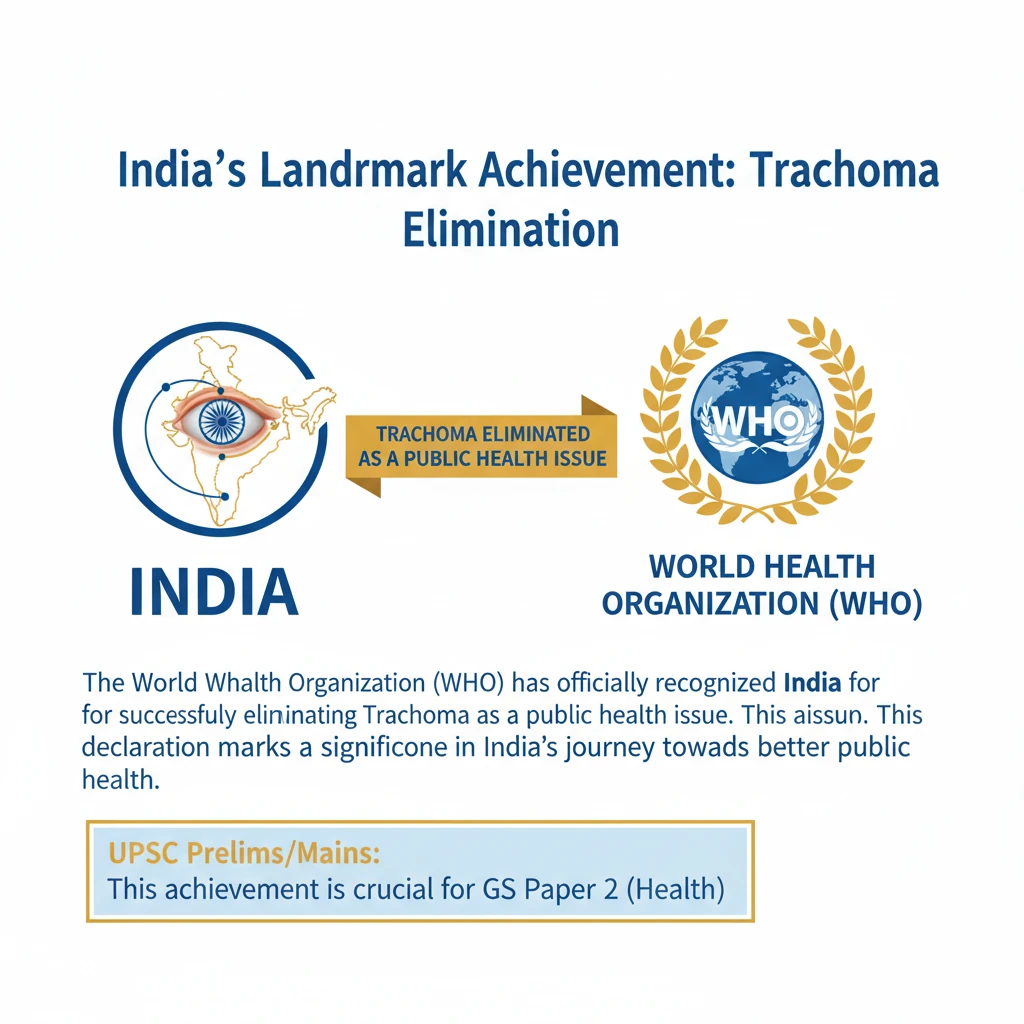
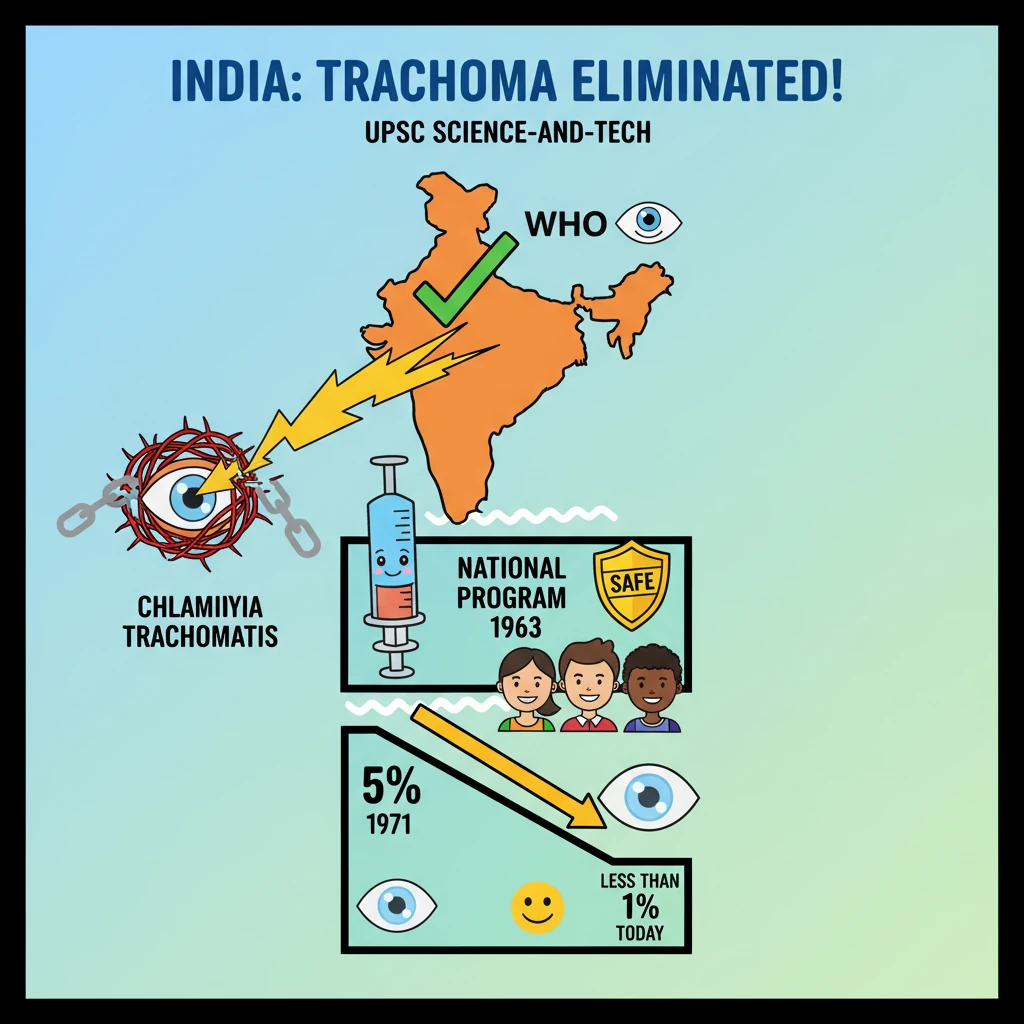
<h4>India's Landmark Achievement: Trachoma Elimination</h4><p>The <strong>World Health Organization (WHO)</strong> has officially recognized <strong>India</strong> for successfully eliminating <strong>Trachoma</strong> as a <strong>public health issue</strong>. This declaration marks a significant milestone in India's journey towards better public health.</p><div class='exam-tip-box'><p><strong>UPSC Prelims/Mains:</strong> This achievement is crucial for <strong>GS Paper 2 (Health)</strong> and <strong>GS Paper 3 (Science & Technology)</strong>. Be prepared to discuss the disease, India's strategy, and its implications.</p></div><h4>Understanding Trachoma</h4><p><strong>Trachoma</strong> is a highly <strong>contagious bacterial eye infection</strong>. It is caused by the bacterium <strong>Chlamydia Trachomatis</strong>.</p><p>If left untreated, this infection can lead to severe complications, including <strong>irreversible blindness</strong>. It primarily affects the conjunctiva, the membrane lining the eyelids and covering the white part of the eye.</p><div class='info-box'><p><strong>Definition:</strong> <strong>Trachoma</strong> is an eye disease caused by infection with the bacterium <strong><em>Chlamydia trachomatis</em></strong>. Repeated infections can lead to scarring of the inner eyelid, turning the eyelashes inwards (trichiasis), which then scrape the cornea, eventually causing irreversible blindness.</p></div><h4>Transmission and Global Impact</h4><p>The infection spreads through direct or indirect contact. This includes contact with the eyes, eyelids, nose, or throat secretions of infected individuals.</p><p>It is also transmitted via contaminated hands, clothing, or flies that have been in contact with discharge from the eyes or nose of an infected person.</p><div class='info-box'><p><strong>Global Burden:</strong> <strong>Trachoma</strong> is categorized as a <strong>neglected tropical disease (NTD)</strong>. Globally, it affects around <strong>150 million people</strong>, with approximately <strong>6 million</strong> at risk of blindness.</p></div><h4>India's Fight Against Trachoma: Historical Context</h4><p>During the <strong>1950s and 1960s</strong>, <strong>Trachoma</strong> was a leading cause of blindness in India, posing a significant public health challenge across many regions.</p><p>Recognizing the severity of the problem, India launched the <strong>National Trachoma Control Program</strong> in <strong>1963</strong>. This program was a crucial step in addressing the widespread prevalence of the disease.</p><p>Later, this dedicated program was integrated into the broader <strong>National Program for Control of Blindness (NPCB)</strong>, demonstrating an integrated approach to eye health.</p><h4>Key Milestones and Strategies for Elimination</h4><p>Significant progress was made over the decades. In <strong>1971</strong>, Trachoma was responsible for <strong>5% of blindness</strong> in India.</p><p>Through sustained efforts, this figure has been dramatically reduced to <strong>less than 1%</strong>. This reduction is a testament to the effectiveness of national health programs.</p><div class='key-point-box'><p><strong>Key Strategy:</strong> The success is largely attributed to the robust implementation of the <strong>National Programme for Control of Blindness & Visual Impairment (NPCBVI)</strong> and the <strong>WHO SAFE strategy</strong>.</p><ul><li><strong>S</strong>urgery for trichiasis</li><li><strong>A</strong>ntibiotics for infection</li><li><strong>F</strong>acial cleanliness</li><li><strong>E</strong>nvironmental improvement</li></ul></div><h4>Current Status and Surveillance</h4><p>India was initially declared free from <strong>Infective Trachoma</strong> in <strong>2017</strong>. This declaration followed extensive surveys and assessments.</p><p>To ensure sustained elimination and meet WHO mandates, ongoing surveillance was conducted from <strong>2019 to 2024</strong>. This continuous monitoring is vital for preventing resurgence.</p><p>As part of this, the <strong>National Trachomatous Trichiasis (TT only) Survey</strong> was carried out in <strong>200 endemic districts</strong> from <strong>2021 to 2024</strong>.</p><p>Reports compiled by the <strong>NPCBVI team</strong> were submitted to <strong>WHO</strong> for final verification. This thorough process led to the official declaration that India has eliminated Trachoma as a public health problem.</p>
💡 Key Takeaways
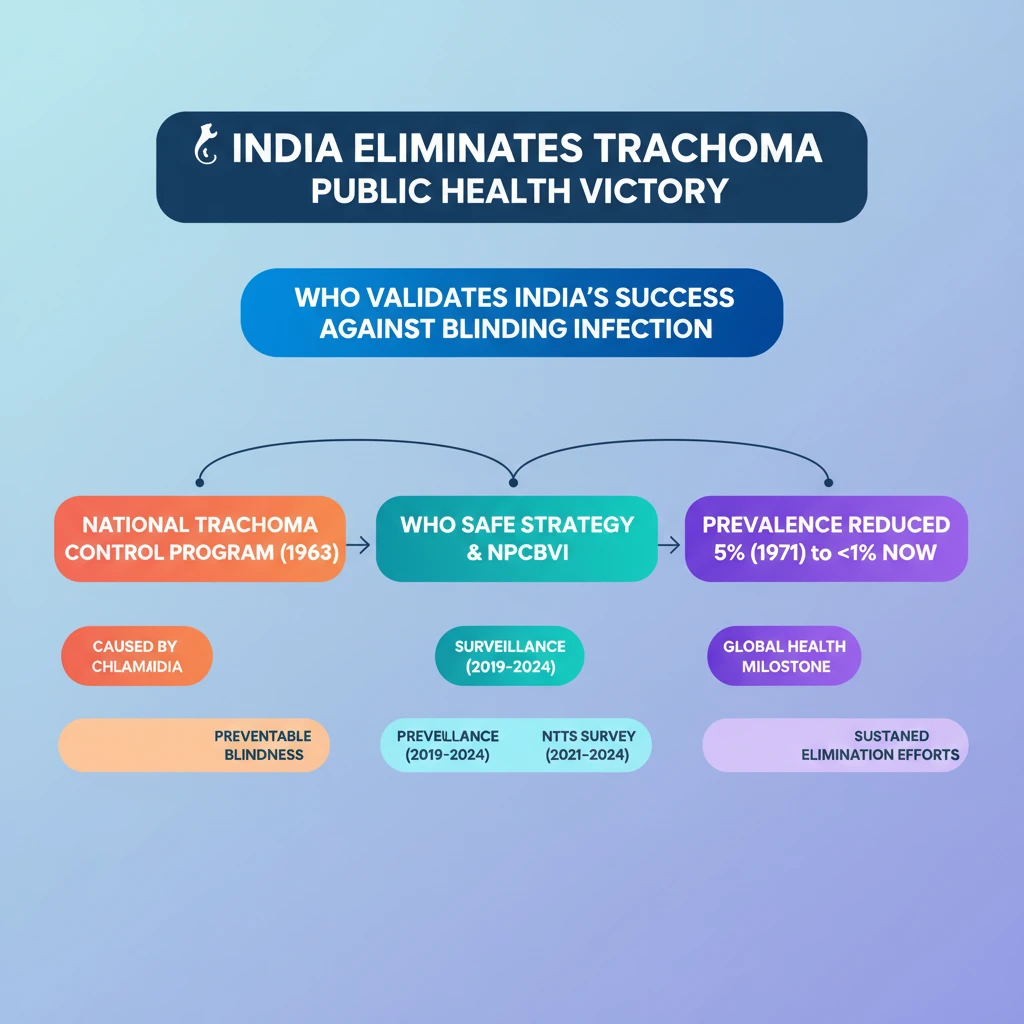
- •India officially eliminated Trachoma as a public health problem, recognized by WHO.
- •Trachoma is a contagious bacterial eye infection caused by Chlamydia Trachomatis, leading to irreversible blindness if untreated.
- •India's success is attributed to the National Trachoma Control Program (1963), NPCBVI, and the WHO SAFE strategy.
- •The prevalence of Trachoma-induced blindness reduced from 5% in 1971 to less than 1% today.
- •Ongoing surveillance (2019-2024) and surveys (National Trachomatous Trichiasis Survey 2021-24) were crucial for final verification and sustained elimination.
🧠 Memory Techniques
98% Verified Content
📚 Reference Sources
•World Health Organization (WHO) official reports and guidelines on Trachoma elimination
•Ministry of Health and Family Welfare (MoHFW), Government of India publications on National Programme for Control of Blindness & Visual Impairment (NPCBVI)