What is One Nation, One Time? - Science And Technology | UPSC Learning
Topics
0 topics • 0 completed
🔍
No topics match your search
What is One Nation, One Time?
Medium⏱️ 7 min read
science and technology
📖 Introduction
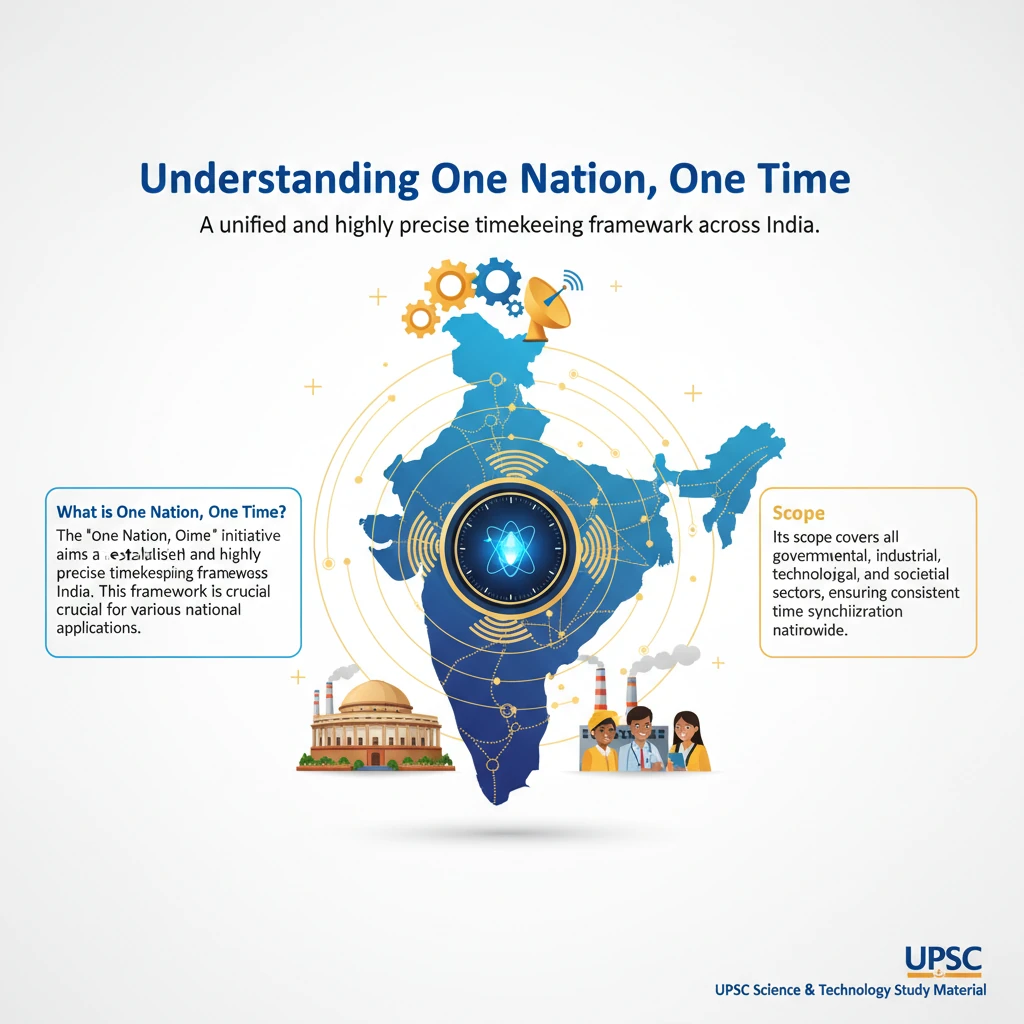
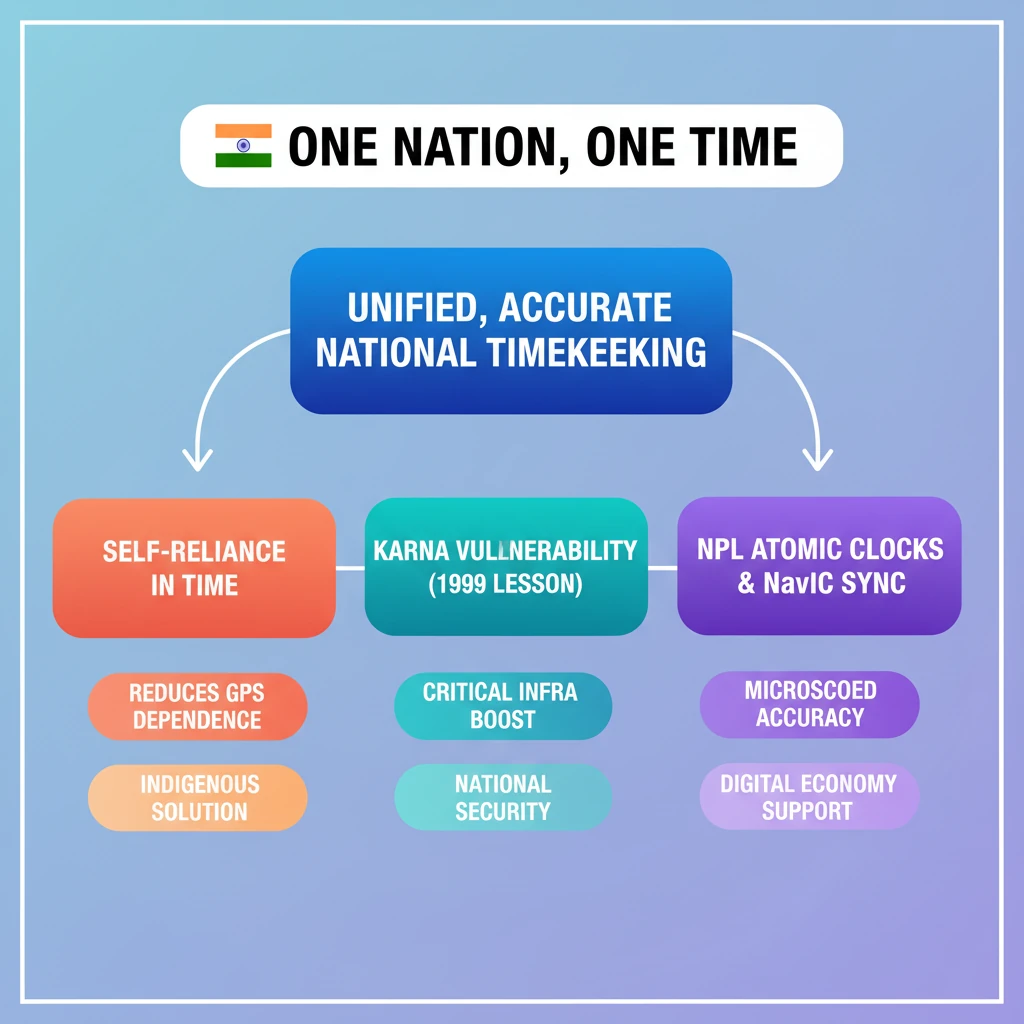
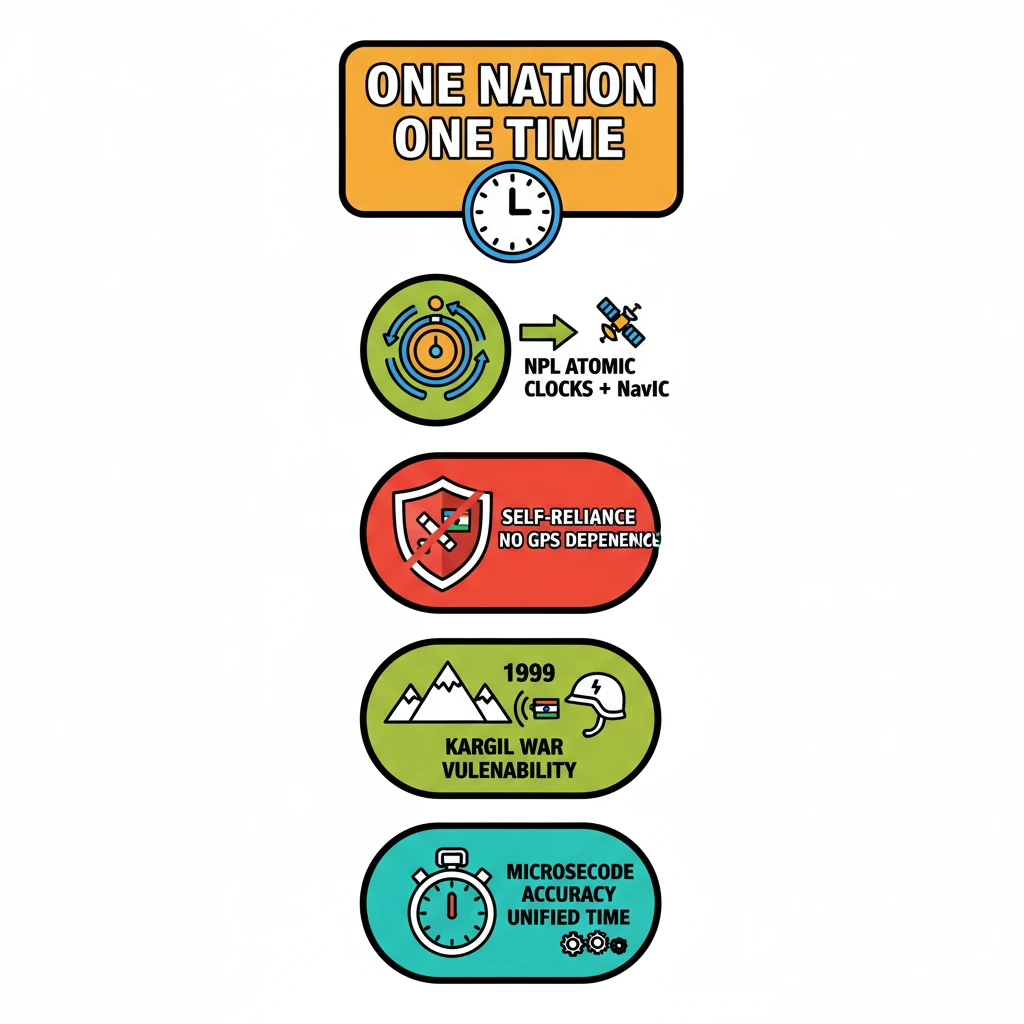
<h4>Understanding One Nation, One Time</h4><p>The <strong>'One Nation, One Time'</strong> initiative aims to establish a <strong>unified</strong> and <strong>highly precise timekeeping framework</strong> across India. This framework is crucial for various national applications.</p><p>Its scope covers all <strong>governmental</strong>, <strong>industrial</strong>, <strong>technological</strong>, and <strong>societal</strong> sectors, ensuring consistent time synchronization nationwide.</p><div class='info-box'><p><strong>Primary Objective:</strong> To achieve a <strong>microsecond-level accuracy</strong> in time dissemination throughout India. This requires advanced infrastructure and precise measurement.</p></div><h4>Government's Implementation Strategy</h4><p>To achieve this high level of accuracy, the Indian government plans to establish <strong>five Legal Metrology laboratories</strong> strategically across the country.</p><p>These laboratories will be equipped with advanced instruments to ensure the precise measurement and dissemination of time, adhering to international standards.</p><h4>The Critical Need for Self-Reliance in Timekeeping</h4><p>A primary driver for the <strong>'One Nation, One Time'</strong> initiative is the urgent need for <strong>national self-reliance</strong> in timekeeping. India currently relies significantly on external systems.</p><p>Reliance on <strong>GPS satellite time</strong>, which is controlled by the <strong>United States</strong>, poses significant <strong>national security</strong> and <strong>cybersecurity risks</strong>. This dependence can be exploited during times of conflict or crisis.</p><div class='key-point-box'><p><strong>Historical Precedent:</strong> During the <strong>Kargil War in 1999</strong>, India's dependence on foreign GPS systems compromised its ability to accurately target enemy positions, highlighting a critical vulnerability.</p></div><p>Establishing a <strong>self-reliant timekeeping system</strong> will significantly reduce this external dependence, thereby protecting India's <strong>critical infrastructure</strong> and strategic capabilities.</p><h4>Functioning Mechanism: NPL and NavIC</h4><p>The <strong>National Physical Laboratory (NPL)</strong> will be at the core of this initiative. It will utilize its highly accurate <strong>atomic clocks</strong> to provide the foundational time reference for India.</p><p>This accurate time will be synchronized and disseminated across the nation via <strong>NavIC (Navigation with Indian Constellation)</strong>, India's indigenous satellite navigation system.</p><div class='info-box'><p><strong>NPL's Atomic Clocks:</strong> These advanced clocks are incredibly precise, losing only <strong>one second over millions of years</strong>. They serve as the ultimate reference for <strong>Indian Standard Time (IST)</strong>.</p></div><div class='exam-tip-box'><p><strong>UPSC Insight:</strong> Understand the synergy between <strong>NPL's atomic clocks</strong> and <strong>NavIC</strong>. This combination forms the backbone of India's self-reliant timekeeping and navigation infrastructure, crucial for <strong>GS Paper 3 (Science & Technology, Internal Security)</strong>.</p></div>
💡 Key Takeaways
- •'One Nation, One Time' aims for unified, microsecond-accurate national timekeeping.
- •Key objective is self-reliance, reducing dependence on foreign systems like US-controlled GPS.
- •Kargil War (1999) highlighted vulnerabilities from GPS dependence, prompting indigenous solutions.
- •NPL's atomic clocks provide the reference time, synchronized via India's NavIC system.
- •Ensures national security, boosts critical infrastructure, and supports the digital economy.
🧠 Memory Techniques
95% Verified Content
📚 Reference Sources
•National Physical Laboratory (NPL) website
•Indian Space Research Organisation (ISRO) - NavIC documentation
•Ministry of Consumer Affairs, Food & Public Distribution - Legal Metrology Division