Difference Between Small Pox, Chicken Pox, Mpox - Science And Technology | UPSC Learning
Topics
0 topics • 0 completed
🔍
No topics match your search
Difference Between Small Pox, Chicken Pox, Mpox
Medium⏱️ 12 min read
science and technology
📖 Introduction
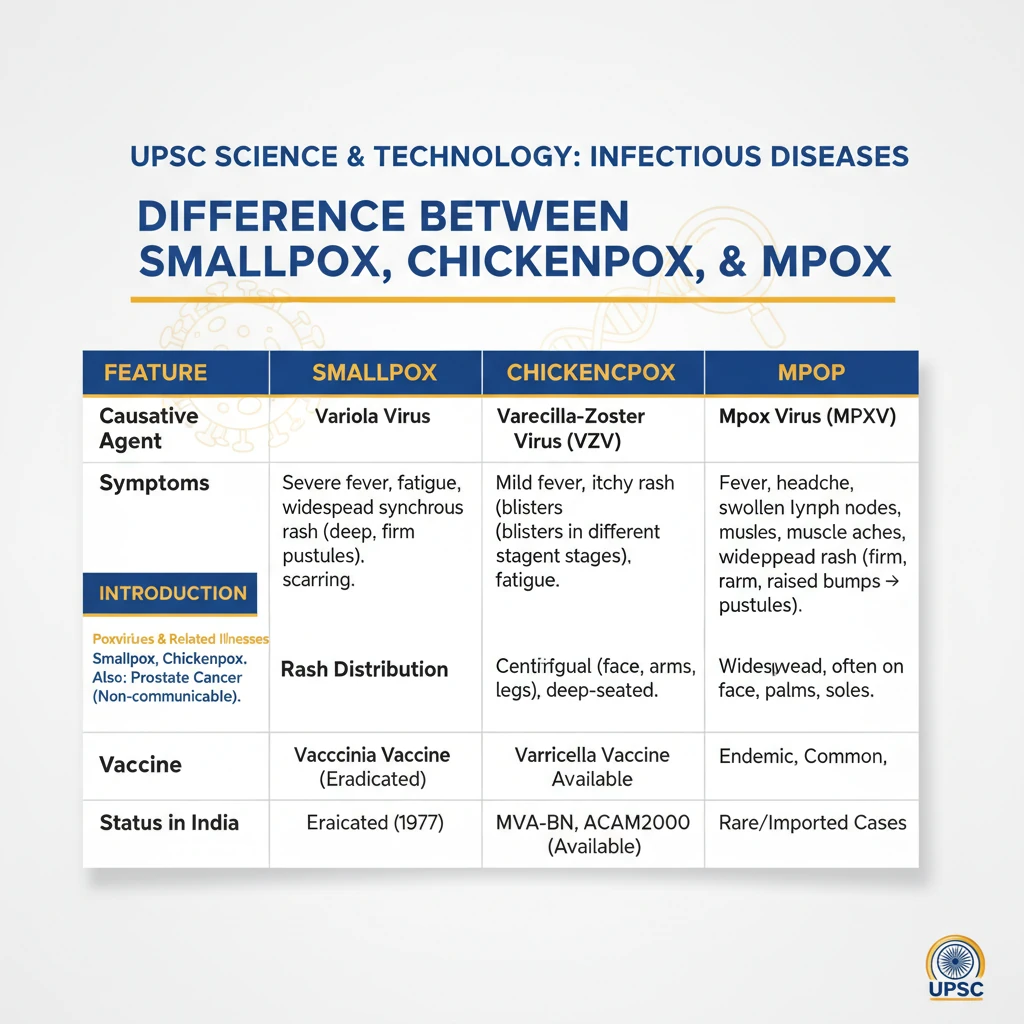
<h4>Introduction to Poxviruses and Related Illnesses</h4><p>This section provides a detailed comparison of three significant viral diseases: <strong>Smallpox</strong>, <strong>Mpox</strong> (formerly Monkeypox), and <strong>Chickenpox</strong>. Understanding their differences is crucial for public health and disease management.</p><p>We will also delve into <strong>Prostate Cancer</strong>, a non-communicable disease with a rising incidence globally, particularly in India.</p><h4>Smallpox: The Eradicated Scourge</h4><p><strong>Smallpox</strong> was a highly contagious and often fatal infectious disease caused by the <strong>Variola virus</strong>. It was characterized by a distinctive, widespread rash.</p><div class='info-box'><p><strong>Virus:</strong> <strong>Variola virus</strong></p><p><strong>Severity:</strong> Highly severe, often fatal</p><p><strong>Status:</strong> Officially <strong>eradicated globally in 1980</strong> following a successful worldwide vaccination campaign.</p></div><p>Its transmission was primarily through <strong>respiratory droplets</strong> and direct contact with infected lesions, making it highly contagious.</p><h4>Chickenpox: A Common Childhood Illness</h4><p><strong>Chickenpox</strong> is a highly contagious disease caused by the <strong>Varicella-zoster virus (VZV)</strong>. It is generally milder than smallpox or mpox.</p><div class='info-box'><p><strong>Virus:</strong> <strong>Varicella-zoster virus (VZV)</strong></p><p><strong>Severity:</strong> Mild</p><p><strong>Status:</strong> A common childhood illness, its prevalence has significantly decreased due to routine vaccination programs.</p></div><p>Transmission occurs through <strong>respiratory droplets</strong> and direct contact with the fluid from infected lesions. Symptoms include fever, fatigue, and an itchy, fluid-filled rash.</p><h4>Mpox (Monkeypox): An Emerging Zoonotic Threat</h4><p><strong>Mpox</strong> is a viral zoonotic disease caused by the <strong>Monkeypox virus</strong>. It presents with symptoms similar to smallpox but is generally milder.</p><div class='info-box'><p><strong>Virus:</strong> <strong>Monkeypox virus</strong></p><p><strong>Severity:</strong> Milder than smallpox, rarely fatal</p><p><strong>Status:</strong> <strong>Endemic in Central and West Africa</strong>, with increasing cases emerging in other parts of the world, highlighting its potential for wider spread.</p></div><p>Transmission involves contact with <strong>infected animals</strong>, lesions, or bodily fluids. Symptoms include fever, headache, swollen lymph nodes, followed by a characteristic rash.</p><h4>Comparative Analysis of Viral Diseases</h4><div class='key-point-box'><p>Understanding the distinctions between these diseases is vital for accurate diagnosis, public health interventions, and vaccination strategies.</p></div><table class='info-table'><tr><th>Feature</th><th>Smallpox</th><th>Mpox</th><th>Chickenpox</th></tr><tr><td><strong>Virus</strong></td><td><strong>Variola virus</strong></td><td><strong>Monkeypox virus</strong></td><td><strong>Varicella-zoster virus (VZV)</strong></td></tr><tr><td><strong>Severity</strong></td><td>Highly severe, often fatal</td><td>Milder than smallpox, rarely fatal</td><td>Mild</td></tr><tr><td><strong>Status</strong></td><td><strong>Eradicated in 1980</strong></td><td>Endemic in <strong>Central and West Africa</strong>, cases emerging elsewhere</td><td>Common childhood illness, less common due to vaccination</td></tr><tr><td><strong>Transmission</strong></td><td>Highly contagious through <strong>respiratory droplets</strong> and contact with infected lesions</td><td>Spread through contact with infected animals, lesions, or bodily fluids</td><td>Highly contagious through <strong>respiratory droplets</strong> and contact with infected lesions</td></tr><tr><td><strong>Symptoms</strong></td><td>Fever, headache, severe fatigue, vomiting, followed by a <strong>deep-seated, pus-filled rash</strong></td><td>Fever, headache, <strong>swollen lymph nodes</strong>, followed by a rash that progresses through stages</td><td>Fever, fatigue, loss of appetite, followed by an <strong>itchy, fluid-filled rash</strong></td></tr><tr><td><strong>Vaccination</strong></td><td>No longer needed</td><td>Not routinely recommended, may be given to <strong>high-risk individuals</strong></td><td><strong>Routine vaccination</strong> for children and adults who haven’t had chickenpox</td></tr></table><h4>Prostate Cancer: An Overview</h4><p><strong>Prostate cancer</strong> is a significant public health concern, particularly in India, where a recent <strong>Lancet Commission paper</strong> highlighted an alarming rise in cases and associated mortality.</p><div class='key-point-box'><p>In India, a large number of patients are diagnosed with <strong>advanced-stage cancer</strong>, leading to a <strong>65% mortality rate</strong>, underscoring the need for early detection and awareness.</p></div><h4>What is Prostate Cancer?</h4><p><strong>Prostate cancer</strong> develops in the <strong>prostate</strong>, a small gland in the male reproductive system. This gland is located below the bladder and plays a crucial role in producing fluid that nourishes and transports sperm.</p><div class='info-box'><p>The <strong>prostate gland</strong> is vital for male reproductive health, and its malfunction can lead to significant health issues.</p></div><h4>Global and Indian Prevalence of Prostate Cancer</h4><p>Globally, <strong>prostate cancer cases</strong> are projected to double by <strong>2040</strong>, with low and middle-income countries facing the most significant increase. India is expected to see new cases reach <strong>71,000 annually</strong>.</p><p>In <strong>2020</strong>, prostate cancer was responsible for approximately <strong>375,000 deaths worldwide</strong>, making it the fifth leading cause of cancer-related deaths in men.</p><div class='info-box'><p>In India, prostate cancer currently accounts for <strong>3% of all cancers</strong>, with an estimated <strong>33,000-42,000 new cases annually</strong>.</p></div><p><strong>Aging populations</strong> and increasing life expectancy contribute to a higher number of older men, which in turn increases the risk of developing prostate cancer.</p><h4>Key Risk Factors for Prostate Cancer</h4><p>Several factors can increase an individual's risk of developing prostate cancer:</p><ul><li><strong>Age:</strong> Especially individuals <strong>over 50 years</strong>.</li><li><strong>Genetics:</strong> A family history of prostate cancer.</li><li><strong>Diet:</strong> Certain dietary patterns may increase risk.</li><li><strong>Obesity:</strong> Higher body mass index is linked to increased risk.</li><li><strong>Smoking:</strong> Tobacco use is a known carcinogen.</li><li><strong>Chemical exposure:</strong> Contact with certain chemicals.</li><li><strong>Prostate inflammation:</strong> Chronic inflammation of the prostate.</li><li><strong>Hormonal factors:</strong> Imbalances or specific hormonal profiles.</li></ul><h4>Symptoms of Prostate Cancer</h4><p>Early-stage <strong>prostate cancer</strong> is typically <strong>asymptomatic</strong>, making early detection challenging. However, as the disease progresses, certain symptoms may appear:</p><ul><li><strong>Difficulty urinating:</strong> Hesitancy or a weak stream.</li><li><strong>Frequent urination:</strong> Especially at night (<strong>nocturia</strong>).</li><li><strong>Blood in the urine:</strong> (<strong>hematuria</strong>) or semen.</li><li><strong>Erectile dysfunction:</strong> Problems achieving or maintaining an erection.</li><li><strong>Lower back or thigh pain:</strong> Indicative of advanced disease or metastasis.</li></ul><div class='exam-tip-box'><p><strong>UPSC Insight:</strong> Awareness of <strong>asymptomatic early stages</strong> and the importance of screening for diseases like prostate cancer is a critical public health concept for <strong>GS-II (Health)</strong>.</p></div>
💡 Key Takeaways
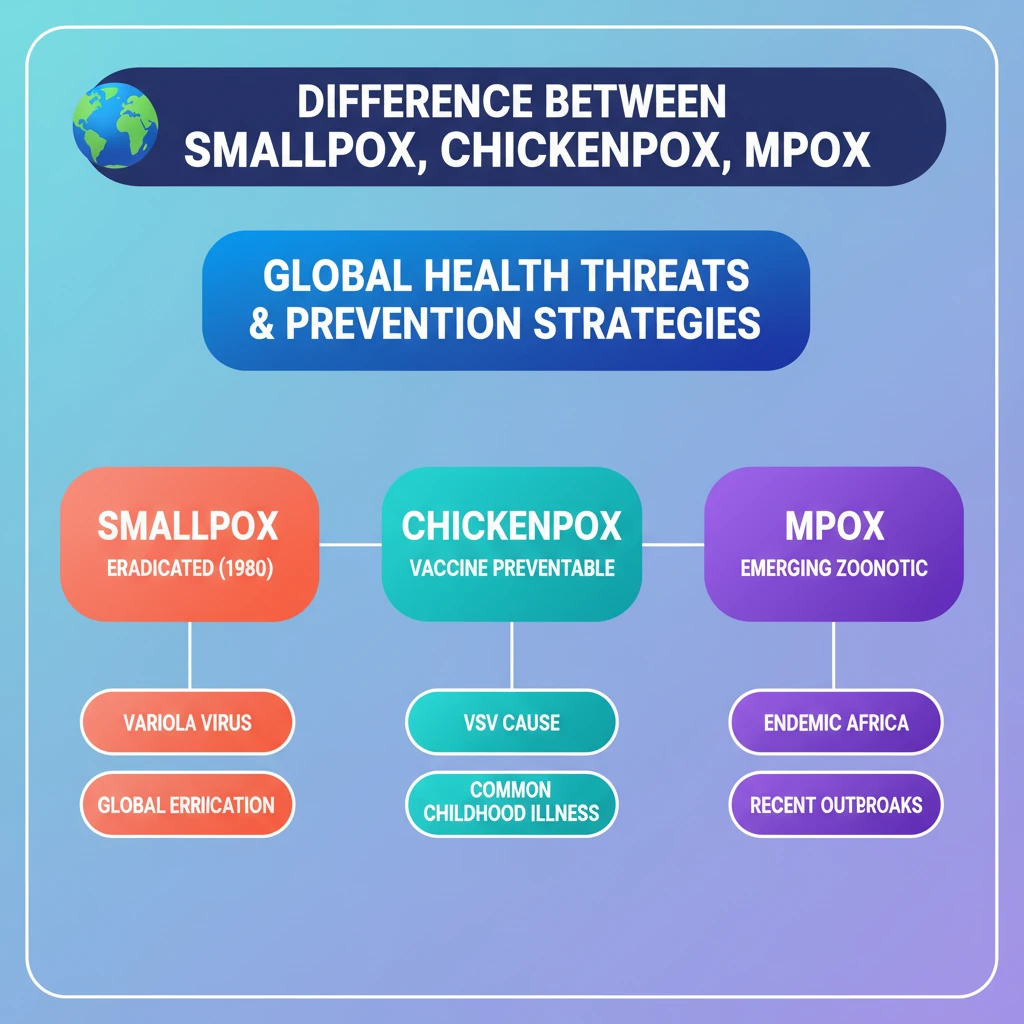
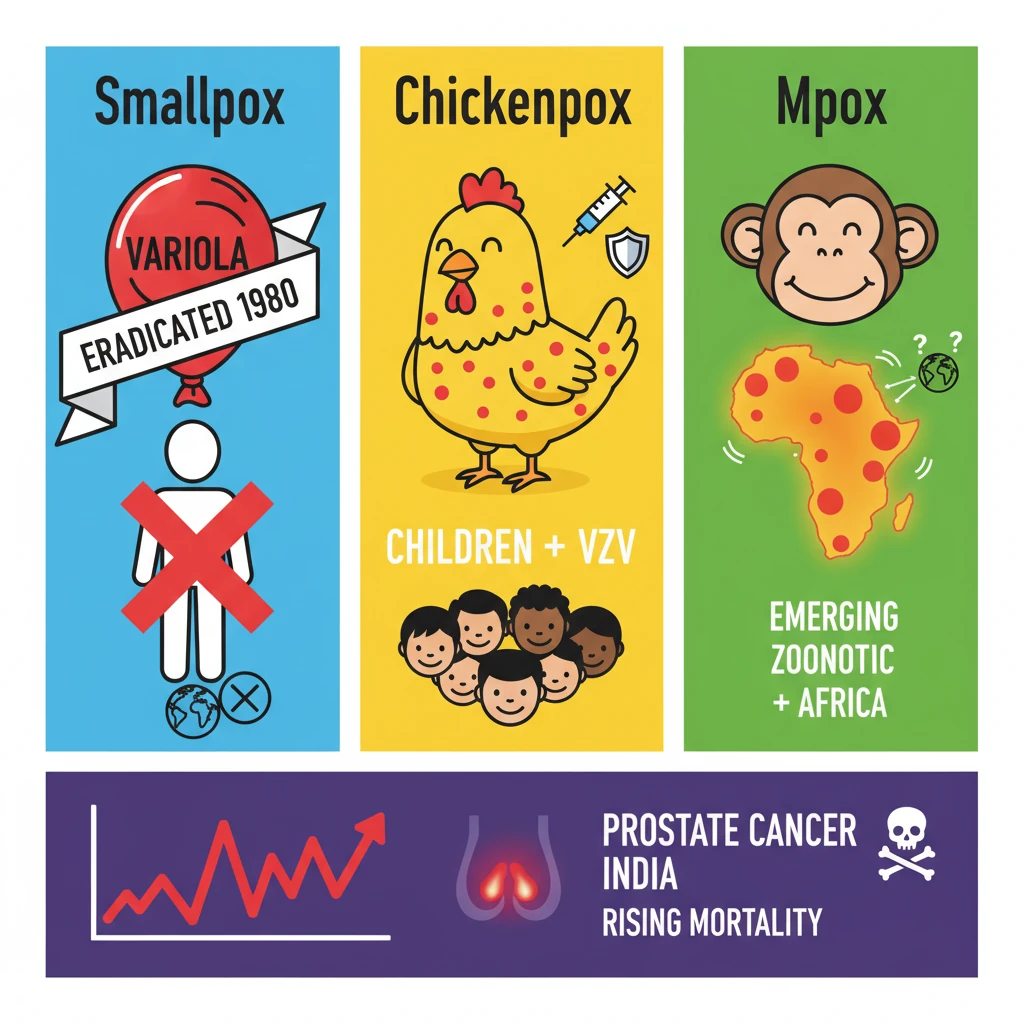
- •Smallpox is the only human disease eradicated globally (1980) by the Variola virus.
- •Mpox (Monkeypox) is an emerging zoonotic disease, endemic in Africa, with recent global outbreaks.
- •Chickenpox, caused by VZV, is a common childhood illness, now largely preventable by routine vaccination.
- •Prostate cancer is a rising NCD globally, particularly in India, with high mortality due to late-stage diagnosis.
- •Key risk factors for prostate cancer include age, genetics, diet, and lifestyle.
- •Early diagnosis and robust public health infrastructure are crucial for managing both infectious diseases and NCDs.
🧠 Memory Techniques
95% Verified Content
📚 Reference Sources
•The Lancet Commission on Prostate Cancer - Recent Reports
•Centers for Disease Control and Prevention (CDC) - Smallpox, Chickenpox, Mpox Information
•Drishti IAS - Original Summary
•Ministry of Health & Family Welfare, Government of India - National Programme for Prevention and Control of Cancer, Diabetes, Cardiovascular Diseases and Stroke (NPCDCS)